Adhyaya 267
Nīrājana-vidhiḥ (Procedure of Nīrājana / Auspicious Lamp-Waving and Royal Propitiation)
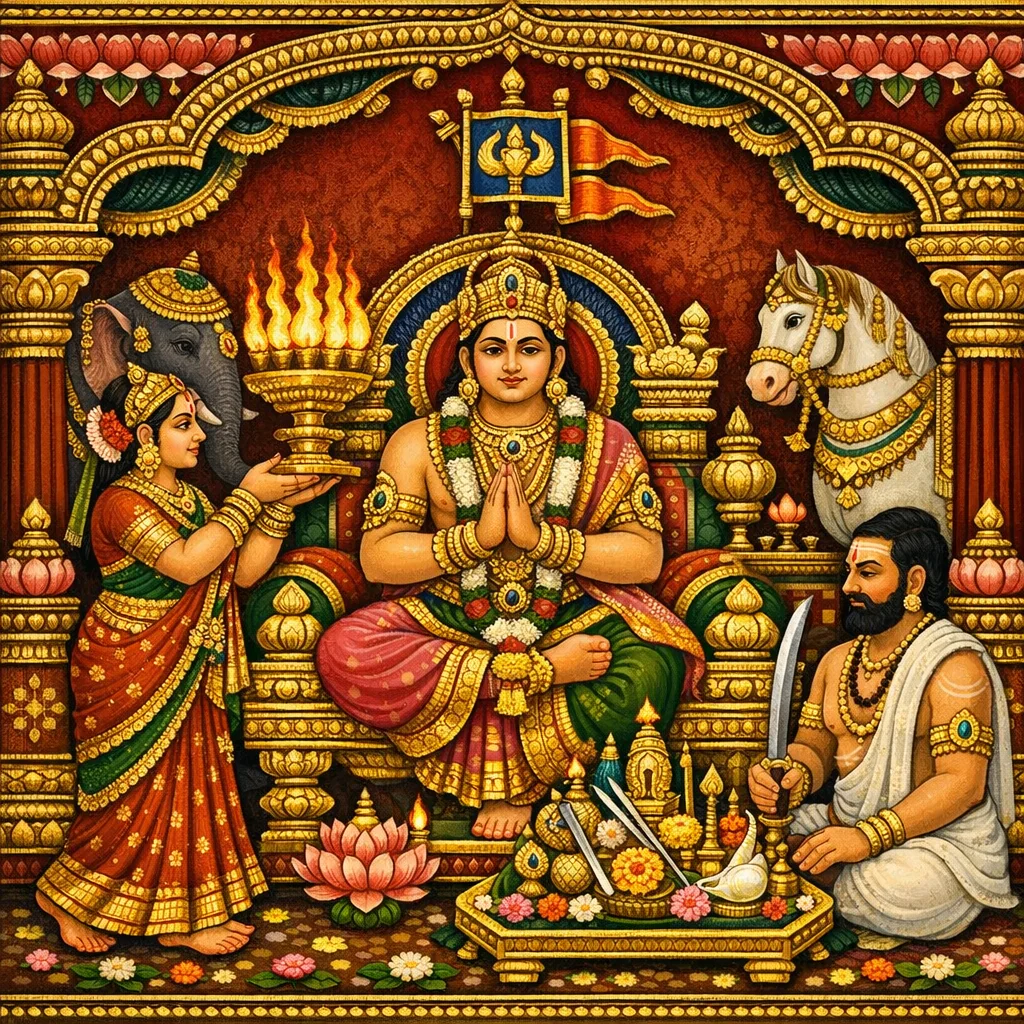
This chapter sets forth a calendrically ordered royal cycle of rites centered on nīrājana (auspicious lamp-waving) as a śānti observance that appeases misfortune and brings victory. Puṣkara prescribes annual and monthly worship—especially on one’s birth-asterism and at each saṅkrānti—and places key seasonal rites: Agastya’s rising with Cāturmāsya worship of Hari, and a five-day festival at Viṣṇu’s awakening. The observance then expands into an Indra-centered public ceremony: raising Indra’s banner, worship of Śacī and Śakra, fasting and tithi-based acts, and recitation of victory-invoking praises that enumerate broad classes of deities. It further weaves in martial and royal symbolism—worship of weapons, royal insignia, and Bhadrakālī for triumph—then details the nīrājana circuit (beginning from the Īśāna quarter), toraṇa installations, and a structured roster of deities including grahas and the eight elephants. Finally it prescribes homa materials for priests, bathing of horses and elephants, procession rules through gateways, distribution of bali, triple circumambulation with the quarters illuminated, and closure as a kingdom-protecting rite that increases prosperity and crushes enemies.
Shlokas
Verse 1
इत्य् आग्नेये महापुराणे महेश्वरस्नानलक्षकोटिहोमादयो नाम षट्षष्ट्यधिकद्विशततमो ऽध्यायः अथ सप्तषष्ट्यधिकद्विशततमो ऽध्यायः नीराजनविधिः पुष्कर उवाच कर्म सांवत्सरं राज्ञां जन्मर्क्षे पूजयेच्च तं मासि मासि च संक्रान्तौ सूर्यसोमादिदेवताः
Thus, in the Agni Mahāpurāṇa, the two-hundred-and-sixty-sixth chapter, entitled “The Bathing of Maheśvara, the lakh-and-crore fire-offerings, and related rites,” comes to an end. Now begins the two-hundred-and-sixty-seventh chapter: “The Procedure of Nīrājana (auspicious lamp-waving).” Puṣkara said: “The annual rite for kings should be performed; and on one’s birth-asterism one should worship that (rite/deity). Also, month after month at each saṅkrānti (solar ingress), the deities beginning with Sūrya and Soma should be worshipped.”
Verse 2
अगस्त्यस्योदये ऽगस्त्यञ्चातुर्मास्यं हरिं यजेत् शयनोत्थापने पञ्चदिनं कुर्यात्समुत्सवम्
At the rising of Agastya, one should worship Hari with the Agastya-related Cāturmāsya observance; and at the awakening from (Viṣṇu’s) sleep, one should hold a grand festival for five days.
Verse 3
प्रोष्ठपादे सिते पक्षे प्रतिपत्प्रभृतिक्रमात् शिविरात् पूर्वदिग्भागे शक्रार्थं भवनञ्चरेत्
In the bright fortnight of Proṣṭhapadā, beginning in due order from the first lunar day (Pratipad), starting from the camp one should establish a dwelling— a ritual pavilion— in the eastern quarter for the sake of Śakra (Indra).
Verse 4
तत्र शक्रध्वजं स्थाप्य शची शक्रञ्च पूजयेत् अष्टम्यां वाद्यघोषेण तान्तु यष्टिं प्रवेशयेत्
There, having established the banner of Śakra (Indra), one should worship Śacī and Śakra. On the eighth lunar day (Aṣṭamī), accompanied by the sound of musical instruments, one should set in place the banner-pole (yaṣṭi) together with its cord/rope attachment (tāntu).
Verse 5
एकादश्यां सोपवासो द्वादश्यां केतुमुत्थितम् यजेद्वस्त्रादिसंवीतं घटस्थं सुरपं शचीं
Observing a fast on the eleventh day (Ekādaśī), and on the twelfth (Dvādaśī) after rising (and breaking the fast), one should worship Ketu; and also Śacī—Indrāṇī, the consort of the lord of the gods—invoked as abiding in a ritual pot (ghaṭa), adorned with garments and other offerings.
Verse 6
वर्धस्वेन्द्र जितामित्र वृत्रहन् पाकशासन देव देव महाभाग त्वं हि भूमिष्ठतां गतः
Prosper, O Indra—conqueror of foes, slayer of Vṛtra, chastiser of Pāka! O god of gods, O greatly fortunate one: indeed, you have attained steadfastness upon the earth.
Verse 7
त्वं प्रभुः शाश्वतश् चैव सर्वभूतहिते रतः अनन्ततेजा वै राजो यशोजयविवर्धनः
You are the sovereign lord, eternal indeed—ever devoted to the welfare of all beings. O King, you are of limitless splendor, a promoter of fame and victory.
Verse 8
तेजस्ते वर्धयन्त्वेते देवाः शक्रः सुवृष्टिकृत् ब्रह्मविष्णुमहेशाश् च कार्त्तिकेयो विनायकः
May these deities increase your splendor—Śakra (Indra), the giver of auspicious rains; and also Brahmā, Viṣṇu, and Maheśa; as well as Kārttikeya and Vināyaka (Gaṇeśa).
Verse 9
आदित्या वसवो रुद्राः साध्याश् च भृगवो दिशः मरुद्गुणा लोकपाला ग्रहा यक्षाद्रिनिम्नगाः
The Ādityas, the Vasus, the Rudras, and the Sādhyas; the Bhṛgus; the Directions; the Maruts and their hosts; the guardians of the worlds; the planets; the Yakṣas; the mountains; and the rivers flowing down from them—all these are to be understood as the divine classes being enumerated.
Verse 10
समुद्रा श्रीर्मही गौरी चण्डिका च सरस्वती प्रवर्तयन्तु ते तेजो जय शक्र शचीपते
May Samudrā, Śrī, Mahī, Gaurī, Caṇḍikā, and Sarasvatī set your splendor in motion and increase your radiant power. Victory to you, O Śakra, lord of Śacī!
Verse 11
तव चापि जयान्नित्यं मम सम्पठ्यतां शुभं प्रसीद राज्ञां विप्राणां प्रजानामपि सर्वशः
May your victory also be ever constant. May this auspicious utterance of mine be recited in full; be gracious—toward kings, toward Brahmin sages, and toward the people as well, in every way.
Verse 12
भवत्प्रसादात् पृथिवी नित्यं शस्यवती भवेत् शिवं भवतु निर्विघ्नं शाम्यन्तामीतयो भृशं
By your gracious favor, may the earth ever be rich in crops. May there be well-being; may everything be free from obstacles; and may calamities and afflictions be thoroughly pacified.
Verse 13
पटस्थमिति क , ग , छ , ज , ट च मन्त्रेणेन्द्रं समभ्यर्च्य जितभूः स्वर्गमाप्नुयात् भद्रकालीं पटे लिख्य पूजयेदाश्विने जये
With the mantra beginning “paṭastham”—employing the syllables ka, ga, cha, ja, and ṭa—one should duly worship Indra; becoming a conqueror of the earth, one attains heaven. Having drawn Bhadrakālī on a cloth (paṭa), one should worship her for victory in the month of Āśvina.
Verse 14
शुक्लपक्षे तथाष्टम्यामायुधं कार्मुकं ध्वजम् छत्रञ्च राजलिङ्गानि शस्त्राद्यं कुसुमादिभिः
Likewise, on the eighth lunar day in the bright fortnight, one should honor the weapons—especially the bow—together with the banner and the parasol, and the royal insignia; and one should worship weapons and related implements with flowers and the like offerings.
Verse 15
जाग्रन्निशि बलिन्दद्याद्द्वितीये ऽह्नि पुनर्यजेत् भद्रकालि महाकालि दुर्गे दुर्गार्तिहारिणि
Keeping vigil at night, one should offer the bali (ritual oblation). On the second day, one should again perform worship, invoking: “O Bhadrakālī, O Mahākālī, O Durgā—remover of the afflictions of those in distress.”
Verse 16
त्रैलोक्यविजये चण्डि मम शान्तौ जये भव नीराजनविधिं वक्ष्ये ऐशान्यान्मन्दिरं चरेत्
O Caṇḍī, conqueror of the three worlds, be for my pacification and for my victory. Now I shall declare the rite of nīrājana (waving of lights); one should circumambulate the sanctuary beginning from the north-east, the Īśāna quarter.
Verse 17
तोरणत्रितयं तत्र गृहे देवान्यजेत् सदा चित्रान्त्यक्त्वा यदा स्वातिं सविता प्रतिपद्यते
There, having set up a triad of ceremonial gateways (toraṇas), one should always worship the deities within the house, when the Sun—having passed beyond the end of Citrā—enters the lunar mansion Svātī.
Verse 18
ततः प्रभृति कर्तव्यं यावत् स्वातौ रविः स्थितः ब्रह्मा विष्णुश् च शम्भुश् च शक्रश् चैवानलानिलौ
From that point onward it should be performed for as long as the Sun remains in Svātī—while remembering/invoking Brahmā, Viṣṇu, Śambhu (Śiva), Śakra (Indra), and also Agni and Vāyu.
Verse 19
विनायकः कुमारश् च वरुणो धनदो यमः विश्वेदेवा वैश्रवसो गजाश्चाष्टौ च तान्यजेत्
One should worship Vināyaka (Gaṇeśa), Kumāra (Skanda), Varuṇa, Dhanada (Kubera), Yama, the Viśvedevās, Vaiśravaṇa (Kubera), and the eight Elephants; these are to be adored.
Verse 20
कुमुदैरावणौ पद्मः पुष्पदन्तश् च वामनः सुप्रतीको ऽञ्जनो नीलः पूजा कार्या गृहादिके
Kumuda, Airāvaṇa, Padma, Puṣpadanta, Vāmana, Supratīka, Añjana, and Nīla—these should be worshipped in rites pertaining to the house and its related spaces and structures.
Verse 21
पुरोधा जुहुयादाज्यं समित्सिद्धार्थकं तिलाः कुम्भा अष्टौ पूजिताश् च तैः स्नाप्याश्वगजोत्तमाः
The royal priest should pour oblations of ghee into the fire, together with sacred fuel-sticks, white mustard, and sesame. Eight water-pots (kumbhas) should be duly worshipped; with their water, excellent horses and elephants are to be ritually bathed.
Verse 22
अश्वाः स्नाप्या ददेत् पिण्डान् ततो हि प्रथमं गजान् निष्क्रामयेत्तोरणैस्तु गोपुरादि न लङ्घयेत्
After bathing the horses, one should offer them food-balls (piṇḍas). Then, first of all, one should lead the elephants out. One should not pass over or cross the gateway-arches (toraṇas) or the gopura and similar structures.
Verse 23
विक्रमेयुस्ततः सर्वे राजलिङ्गं गृहे यजेत् शेखरादीति क वारुणे वरुणं प्रार्च्य रात्रौ भूतबलिं ददेत्
Then all should proceed onward; one should worship the royal Liṅga (rāja-liṅga) in one’s house. In the Vāruṇa rite, having duly worshipped Varuṇa, one should at night offer a bhūta-bali, a food-offering to beings or spirits.
Verse 24
विशाखायां गते सूर्ये आश्रमे निवसेन्नृपः अलङ्कुर्याद्दिने तस्मिन् वाहनन्तु विशेषतः
When the Sun has entered Viśākhā, the king should reside in a hermitage (āśrama); on that day he should especially have his mount or vehicle adorned.
Verse 25
पूजिता राजलिङ्गाश् च कर्तव्या नरहस्तगाः हस्तिनन्तुरगं छत्रं खड्गं चापञ्च दुन्दुभिम्
The royal insignia are to be duly honored and borne by attendants: the elephant and the horse, the royal parasol, the sword, the bow, and the war-drum.
Verse 26
ध्वजं पताकां धर्मज्ञ कालज्ञस्त्वभिमन्त्रयेत् अभिमन्त्र्य ततः सर्वान् कुर्यात् कुञ्जरधूर्गतान्
The knower of dharma, skilled in choosing the proper time, should consecrate the standard and the banner with mantras. Having thus consecrated them, he should then station all (troops or attendants) in the ranks assigned to the elephant corps.
Verse 27
कुञ्जरोपरिगौ स्यातां सांवत्सरपुरोहितौ मन्त्रितांश् च समारुह्य तोरणेन विनिर्गमेत्
Let the annual court priest and the household priest be mounted upon elephants; and, with the consecrated protective rites performed and having ascended in due order, he should proceed out through the ceremonial gateway (torana).
Verse 28
निष्क्रम्य नागमारुह्य तोरणेनाथ निर्गमेत् बलिं विभज्य विधिवद्राजा कुञ्जरधूर्गतः
Having come out from the palace and mounted an elephant, the king should then depart through the ceremonial gateway (torana). Having duly distributed the bali-offerings according to rule, he should proceed seated upon the elephant’s howdah.
Verse 29
उन्मूकानान्तु निचयमादीपितदिगन्तरं राजा प्रदक्षिणं कुर्यात्त्रीन् वारान् सुसमाहितः
But the king—fully composed—should circumambulate (pradakṣiṇā) three times, keeping to his right the collection of (persons or objects) who are dumb and mute, with the quarters illuminated to their farthest limits.
Verse 30
चतुरङ्गबलोपेतः सर्वसैन्येन नादयन् एवं कृत्वा गृहं गच्छेद्विसर्जितजलाञ्जलिः
Equipped with the fourfold army, making the entire host resound, having done thus, he should return home—after releasing (offering and letting fall) the handful of water.
Verse 31
शान्तिर् नीराजनाख्येयं वृद्धये रिपुमर्दनी
This appeasement-rite is to be known as “Nīrājana”; it brings prosperity and growth, and it crushes enemies.
Frequently Asked Questions
It is defined as a śānti rite that increases prosperity and growth while crushing enemies, implemented through lamp-waving, bali distribution, and a protected royal procession.
Key triggers include saṅkrānti (monthly solar ingress), one’s birth-asterism, the rising of Agastya, Viṣṇu’s awakening festival, the bright fortnight of Proṣṭhapadā with tithi-specific actions, and performance during the Sun’s stay in Svātī (and later mention of Viśākhā).
By sacralizing kingship through regulated rites—banner installation, weapon/insignia worship, deity rosters, homa, and procession rules—royal authority is portrayed as stabilized by mantra, timing, and offerings rather than mere force.