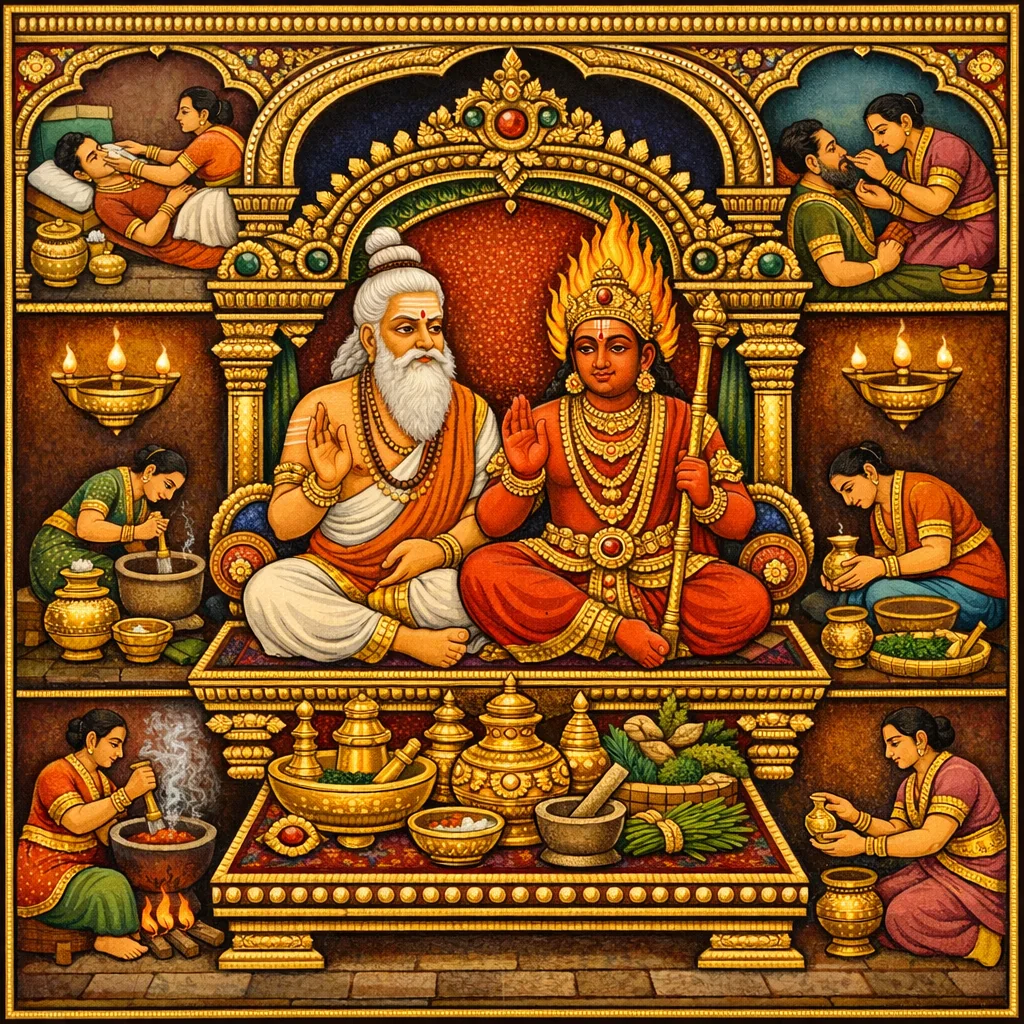
Adhyaya 278
अध्याय २७८: सिद्धौषधानि (Siddha Medicines / Perfected Remedies)
This chapter turns from vaṃśa narration to applied sacred science. Agni announces an exposition of Āyurveda—the life-restoring mṛtasañjīvanī taught by Yama to Suśruta and revealed through the divine Dhanvantari. Suśruta asks for therapies and mantras that can heal humans and animals and even revive life. Dhanvantari delivers a practical medical compendium focused on diet and procedures: fever care through fasting, gruels, bitter decoctions, and staged treatment; a directional rationale for choosing emesis versus purgation; and disease-specific pathya (wholesome foods) for diarrhea, gulma, jaṭhara, kuṣṭha, meha, rājayakṣmā, śvāsa-kāsa, grahaṇī, arśas, dysuria, vomiting, thirst, visarpa, and vāta-śoṇita. It also includes ENT and eye measures (nasya, ear-filling, collyria, lepas), rasāyana/vājīkaraṇa guidance (night honey-ghee, śatāvarī preparations), wound care, postpartum protection, and antidotes for snake, scorpion, and dog poison. The chapter ends with a concise pañcakarma hierarchy—trivṛt for purgation, madana for emesis—and the best vehicles (oil, ghee, honey) according to predominant doṣa.
Shlokas
Verse 1
इत्य् आग्नेये महापुराणे पुरुवंशवर्णनं नाम सप्तसप्तत्यधिकद्विशततमो ऽध्यायः अथाष्टसप्तत्यधिकद्विशततमो ऽध्यायः सिद्धौषधानि अग्निर् उवाच आयुर्वेदं प्रवक्ष्यामि सुश्रुताय यमब्रवीत् देवो धन्वन्तरिः सारं मृतसञ्जीवनीकरं
Thus, in the Agni Mahāpurāṇa ends the two-hundred-and-seventy-seventh chapter entitled “Description of the Puru lineage.” Now begins the two-hundred-and-seventy-eighth chapter: “Siddha Medicines.” Agni said: “I shall expound Ayurveda—the very teaching that Yama spoke to Suśruta—namely, the essential doctrine revealed by the divine Dhanvantari, the ‘life-restoring’ (mṛtasañjīvanī) essence.”
Verse 2
सुश्रुत उवाच आयुर्वेदं मम ब्रूहि नराश्वेभरुगर्दनम् सिद्धयोगान्सिद्धमन्त्रान्मृतसञ्जीवनीकरान्
Suśruta said: “Teach me the Āyurveda—(that knowledge) which cures the afflictions of men, horses, and elephants, (and teach) the perfected therapeutic formulations and the perfected mantras that effect revivification, restoring even the dead to life.”
Verse 3
धन्वन्तरिर् उवाच रक्षन् बलं हि ज्वरितं लङ्घितं भोजयेद्भिषक् सविश्वं लाजमण्डन्तु तृड्ज्वरान्तं शृतं जलम्
Dhanvantari said: Protecting the patient’s strength, the physician should feed the fever-stricken person after fasting (therapeutic lightening). And one should give rice-gruel (lāja-maṇḍa) prepared with viśva (dry ginger); and for the cessation of thirst and fever, administer boiled (medicated) water.
Verse 4
मुस्तपर्पटकोशीरचन्दनोदीच्यनागरैः षडहे च व्यतिक्रान्ते तित्तकं पाययेद्ध्रुवं
With mustā, parpaṭa, uśīra, candana, udīcya, and nāgara—after six days have passed—one should certainly administer the bitter decoction (tiktaka).
Verse 5
स्नेहयेत्तक्तदोषन्तु ततस्तञ्च विरेचयेत् जीर्णाः षष्टिकनीवाररक्तशालिप्रमोदकाः
One should first administer oleation (snehana) to the patient afflicted with disorders arising from buttermilk (takta); thereafter one should also purge him (virecana). As the post-therapy diet, aged preparations of ṣaṣṭika rice, nīvāra rice, red śāli rice, and light cakes (pramodaka) are recommended.
Verse 6
तद्विधास्ते ज्वरेष्विष्टा यवानां विकृतिस् तथा मुद्गा मसूराश् च णकाः कुलत्थाश् च सकुष्ठकाः
Preparations of that kind are recommended in fevers; likewise, processed barley (yava), and also green gram (mudga), lentils (masūra), chickpeas (caṇaka), and horse-gram (kulattha)—prepared together with kuṣṭha—are commended.
Verse 7
पक्वदोषन्त्विति ञ आटक्यो नारकाद्याश् च कर्कोटककतोल्वकम् पटोलं सफलं निम्बं पर्पटं दाडिमं ज्वरे
For fever in which the morbid doṣa are in a “cooked/ripe” (pakva) state, the knowledgeable prescribe the group beginning with āṭakī and nāraka, as well as karkoṭaka and katolva; likewise paṭola, nimba (with its fruit), parpaṭa, and pomegranate are beneficial in fever.
Verse 8
अधोगे वमनं शस्तमूर्ध्वगे च विरेचनम् रक्तपित्ते तथा पानं षडङ्गं शुण्ठिवर्जितम्
When the disorder is moving downward, emesis (vamana) is recommended; and when it is moving upward, purgation (virecana). Likewise, in raktapitta one should administer as a drink the “ṣaḍaṅga” preparation, excluding dry ginger (śuṇṭhī).
Verse 9
शक्तुगोधूमलाजाश् च यवशालिमसूरकाः सकुष्ठचणका मुद्गा भक्ष्या गोधूमका हिताः
Parched flour (saktu), wheat, and puffed rice (lāja), as well as barley, rice, red lentil (masūra), and chickpea (caṇaka) prepared with kuṣṭha, and green gram (mudga)—these are recommended edible items; wheat-based foods are beneficial.
Verse 10
साधिता घृतदुग्धाभ्यां क्षौद्रं वृषरसो मधु अतीसारे पुराणानां शालीनां भक्षणं हितं
In diarrhea, it is beneficial to take a preparation cooked with ghee and milk, together with honey, the juice of vṛṣa (a medicinal plant extract), and madhu (honey); and it is wholesome to eat aged śāli-rice (old rice).
Verse 11
अनभिष्यन्दि यच्चान्नं लोध्रवल्कलसंयुतम् मारुतं वर्जयेद् यत्नः कार्यो गुल्मेषु सर्वथा
One should take food that is non-obstructive (non–channel-clogging) and mixed with lodhra-bark, and one should carefully avoid whatever aggravates vāta (wind). In cases of gulma, such care must be observed in every way.
Verse 12
वाट्यं क्षीरेण चाश्नीयाद्वास्तूकं घृतसाधितं गोधूमशालयस्तिक्ता हिता जठरिणामथ
One should eat vāṭya along with milk, and vāstūka cooked with ghee. Wheat, śāli-rice, barley, and bitter-tasting foods or herbs are beneficial for those suffering from jaṭhara-roga (abdominal/digestive disorder).
Verse 13
गोधूमशालयो मुद्गा ब्रह्मर्क्षखदिरो ऽभया पञ्चकोलञ्जाङ्गलाश् च निम्बधात्र्यः पटोलकाः
Enumerated are: wheat and śāli-rice; mudga (green gram); brahmarkṣa and khadira; as well as abhaya (harītakī); the pañcakola group and the jāṅgala (dry-land) group; neem and dhātrī (āmalakī); and paṭolaka (pointed gourd).
Verse 14
मातुलङ्गरसाजातिशुष्कमूलकसैन्धवाः कुष्ठिनाञ्च तथा शस्तं पानार्थे खदिरोदकं
For those suffering from kuṣṭha (cutaneous disorders), a drink is recommended consisting of citron (mātulaṅga) juice, jāti (jasmine), dried radish, and saindhava (rock-salt); likewise, for drinking, water prepared with khadira (khadira-udaka) is prescribed as beneficial.
Verse 15
मसूरसुद्गौ पेयार्थे भोज्या जिर्णाश् च शालयः निम्बपर्पटकैः शाकैर् जाङ्गलानां तथा रसः
For preparing thin gruel (peya), lentils and green gram (mudga) are suitable, and well-aged śāli rice should also be eaten. Likewise, vegetable dishes with neem and parpaṭaka are recommended, and also the meat-juice/broth of animals from dry, open lands (jāṅgala).
Verse 16
विडङ्गं मरिचं मुस्तं कुष्ठं लोध्रं सुवर्चिका मनःशिला च वालेयः कुष्ठहा मूत्रपेषितः
Vidanga, black pepper, musta (nut-grass), kuṣṭha (costus), lodhra, suvarcikā, and manaḥśilā (realgar)—these, together with vāleya, when triturated in urine, form a preparation that destroys kuṣṭha (chronic skin disease).
Verse 17
अपूपकुष्ठकुल्माषयवाद्या मेहिनां हिताः यवान्नविकृतिर्मुद्गा कुलत्था जीर्णशालयः
For those afflicted with meha (prameha), beneficial foods include apūpa (cakes), kuṣṭha, kulmāṣa (parched pulses), and preparations based on barley (yava) and the like. Wholesome too are barley-rice preparations, mung beans (mudga), horse-gram (kulattha), and aged śāli rice.
Verse 18
तिक्तरुक्षाणि शाकानि तिक्तानि हरितानि च तैलानि तिलशिग्रुकविभीतकेङ्गुदानि च
Bitter and drying (rukṣa) vegetables, as well as bitter green leafy vegetables, should be used; and also oils such as sesame oil, śigrū (moringa) oil, bibhitaka oil, and ingudī oil are to be considered.
Verse 19
मुद्गाः सयवगोधूमा धान्यं वर्षस्थतञ्च यत् जाङ्गलस्य रसः शस्तो भोजने राजयक्ष्मिणां
For those suffering from rājayakṣmā (consumption), mung beans (mudga), grains such as barley (yava) and wheat (godhūma), and any grain stored through the rainy season are recommended. Likewise, the meat-juice/broth of dry-land (jāṅgala) animals is wholesome as food.
Verse 20
कौलत्थमौद्गको रास्नाशुष्कमूलकजाङ्गलैः पूपैर् वा विस्करैः सिद्धैर् दधिदाडिमसाधितैः
A preparation of kulattha (horse-gram) and mudga (green gram), cooked with rāsnā, dried radish, and the meat of animals from the arid wilderness; or else pūpa cakes and light game-birds (viskara), properly cooked and then prepared with curd and pomegranate, is recommended as a therapeutic diet.
Verse 21
मातुलङ्गरसक्षौद्रद्राक्षाव्योषादिसंस्कृतैः यवगोधूमशाल्यन्नैर् भोजयेच्छ्वासकासिनं
A patient suffering from dyspnea and cough should be fed meals of barley, wheat, and rice, prepared with citron-juice (mātulaṅga), honey, raisins, and the tri-kaṭu spices (dry ginger, black pepper, and long pepper), and similar adjuncts.
Verse 22
दषमूलवलारास्नाकुलत्थैर् उपसाधिताः पेयाः पूपरसाः क्वाथाः श्वासहिक्कानिवारणाः
Gruels (peya), soups or essences drawn from cakes (pūpa-rasa), and decoctions (kvātha) cooked with daśamūla, valā, rāsnā, and kulattha are remedies that alleviate dyspnea (śvāsa) and hiccups (hikkā).
Verse 23
शुष्कमूलककौलत्थमूलजाङ्गलजैरसैः यवगोधूमशाल्यन्नं जीर्णम् सोशीरमाचरेत्
One should take well-digested food—barley, wheat, and rice—along with soups or juices prepared from dried radish, kulattha, roots, and the meat-essence of wild animals, and it should be accompanied by uśīra (vetiver).
Verse 24
सोथवान् सगुडां पथ्यां खादेद्वा गुडनागरम् तक्रञ्च चित्रकञ्चोभौ ग्रहणीरोगनाशनौ
One suffering from swelling (edema) should eat harītakī (pathyā) mixed with jaggery (guda); or else take jaggery with dry ginger (nāgara). Buttermilk and citraka—both—destroy grahaṇī-disease, a disorder of digestion and absorption.
Verse 25
पुराणयवगोधूमशालयो जङ्गलो रसः मुद्गामलकखर्जूरमृद्वीकावदराणि च
Old barley, wheat, and śāli-rice; the meat-essence (broth) of dry-land (jaṅgala) animals; and also green gram (mudga), āmalakī, dates, raisins, and jujube fruits—these are commended as wholesome dietary items.
Verse 26
मधु सर्पिः पयः शक्रं निम्बपर्पटकौ वृषम् तक्रारिष्टाश् च शस्यन्ते सततं वातरोगिणाम्
For patients suffering from Vāta disorders, honey, ghee, milk, Śakra (a strengthening nutritive preparation/drink), neem and parpaṭaka, vṛṣa (vāsā), and buttermilk-based ariṣṭa (fermented medicated preparations) are recommended for regular use.
Verse 27
हृद्रोगिणो विरेच्यास्तु पिप्पल्यो हिक्किनां हिताः तक्रावलालसिन्धूनि मुक्तानि शिशिराम्भसा
Patients suffering from heart-disease should be treated with purgation (virecana); long pepper (pippalī) is beneficial for those afflicted with hiccup. Buttermilk, the sour gruel (āvalāla), and rock-salt should be taken after being dissolved or tempered with cool water.
Verse 28
मुक्ताः सौवर्चलाजादि मद्यं शस्तं मदात्यये सक्षौद्रपयसा लाक्षां पिवेच्च क्षतवान्नरः
For overcoming excessive intoxication (madātyaya), liquor prepared with muktā (pearl), sauvarcala (black salt) and the like is recommended. And a wounded man should drink lākṣā (lac) mixed with honey and milk.
Verse 29
भद्राविष्टाश्चेति ख सदामये इति ञ दमात्यये इति ट क्षयं मांसरसाहारो वह्निसंरक्षणाज्जयेत् शालयो भोजने रक्ता नीवारकलमादयः
“(Reading-notes:) ‘bhadrāviṣṭāś ca’—variant kha; ‘sadāmaye’—variant ña; ‘damātyaye’—variant ṭa.” Consumption (kṣaya) is overcome by taking meat-juice/broth as food and by safeguarding the digestive fire (agni); and in meals one should use red śāli rice and grains such as nīvāra and kalama, and the like.
Verse 30
यवान्नविकृतिर्मासं शाकं सौवर्चलं शटी पथ्या तथैवार्शसां यन्मण्डं तक्रञ्च वारिणा
For those afflicted with hemorrhoids (arśas), preparations of barley-food, māṣa (black gram), leafy vegetables, sauvarcala (black salt), śaṭī, and pathyā are wholesome; likewise, thin rice-gruel (maṇḍa) and buttermilk (takra), taken together with water, are beneficial.
Verse 31
मुस्ताभ्यासस् तथा लेपश्चित्रकेण हरिद्रया यवान्नविकृतिः शालिर्वास्तूकं ससुवर्चलम्
Regular application of mustā (nut-grass), and also a topical paste prepared with citraka and turmeric; a preparation made from barley-food; and the use of śāli-rice and vāstūka (greens) together with suvarcalā—these are prescribed as beneficial measures and remedies.
Verse 32
त्रपुषर्वारुगोधूमाः क्षीरेक्षुघृतसंयुताः मूत्रकृच्छ्रे च शस्ताः स्युः पाने मण्डसुरादयः
For dysuria (mūtrakṛcchra), bottle-gourd (trapuṣa), cucumber (vāru), and wheat (godhūma), taken together with milk, sugarcane-juice, and ghee, are considered beneficial. For drinking, thin rice-gruel (maṇḍa), fermented liquor (surā), and similar beverages are prescribed.
Verse 33
लाजाः शक्तुस् तथा क्षौद्रं शून्यं मांसं परूषकम् वार्ताकुलावशिखिनश्छर्दिघ्नाः पानकानि च
Parched rice (lājā), roasted grain-flour (śaktu), and honey (kṣaudra); lean (non-fatty) meat (śūnya-māṃsa), the parūṣaka fruit; and preparations of eggplant, quail, and peacock—these, as well as suitable cooling drinks (pānaka), are remedies that check vomiting.
Verse 34
शाल्यन्नन्तोयपयसी केवलोष्णे शृते ऽपि वा तृष्णाघ्ने मुस्तगुडयोर्गुटिका वा मुखे धृता
Śāli-rice cooked with water and milk—prepared simply by boiling (even in plain hot water)—alleviates excessive thirst. Alternatively, a small pellet made of mustā and jaggery, held in the mouth, is thirst-relieving.
Verse 35
यवान्नविकृतिः पूपं शुष्कमूलकजन्तथा शाकं पटोलवेत्राग्रमुरुस्तम्भविनाशनम्
Preparations made from barley-gruel and a barley cake (pūpa), likewise dried radish, and leafy-vegetable dishes—especially patola (pointed gourd) and the tender tip of cane (vetrāgra)—are said to destroy stiffness or obstruction in the thighs (uru-stambha).
Verse 36
मुद्गाढकमसूराणां सतिलैर् जाङ्गलैरसैः ससैन्धवघृतद्राक्षाशुण्ठ्यामलककोलजैः
Preparations or broths made from mung beans (mudga), horse-gram (āḍhaka), and lentils (masūra), together with sesame and the meat-juices of dry-land animals (jāṅgala-rasa), combined with rock-salt (saindhava), ghee (ghṛta), raisins (drākṣā), dry ginger (śuṇṭhī), āmalakī, and jujube (kola).
Verse 37
यूषैः पुराणगोधूमयवशाल्यन्नमभ्यसेत् विसर्पी ससिताक्षौद्रमृद्वीकादाडिमोदकम्
A patient suffering from visarpa (a spreading erysipelatous skin disorder) should regularly take old wheat, barley, and śāli-rice as food, together with soups (yūṣa). He should also take a drink prepared with sugar and honey, with raisins and pomegranate.
Verse 38
रक्तयष्टिकगोधूमयवमुद्गादिकं लघु काकमारी च वेत्राग्रं वास्तुकञ्च सुवर्चला
Red yaṣṭikā (rakta-yaṣṭikā), wheat, barley, mung beans, and similar items are light and easy to digest. Likewise, kākamārī, the tender tips of cane (vetrāgra), vāstuka, and suvarcalā are also light.
Verse 39
वातशोणितनाशाय तोयं शस्तं सितं मधु पथ्या तथैव काशस्य मण्डं तक्रञ्च वारुणमिति ख , ञ , च यूषमिति ख , ज च नाशारोगेशु च हितं घृतं दुर्वाप्रसाधितम्
To alleviate vāta-śoṇita (a vāta disorder with vitiated blood), water is recommended; likewise sugar, honey, and harītakī (pathyā). Beneficial too are rice-gruel water (maṇḍa), buttermilk (takra), and the fermented liquor vāruṇī. (Some recensions read “yūṣa,” i.e., pulse-soup.) For diseases that also involve nasal afflictions, ghee (ghṛta) processed with durvā grass is beneficial.
Verse 40
भृङ्गराजरसे सिद्धं तैलं धात्रीरसे ऽपि वा नश्यं सर्वामयेष्विष्टं मूर्धजन्तूद्भवेषु च
Oil cooked in the juice of bhṛṅgarāja—or likewise in the juice of dhātrī (āmalakī)—is recommended for nasal administration (nasya). It is beneficial in all diseases, and also in disorders arising from parasitic infestations affecting the head and scalp.
Verse 41
शीततोयान्नपानञ्च तिलानां विप्र भक्षणम् द्विजदार्ढ्यकरं प्रोक्तं तथा तुष्टिकरम्परम्
O brāhmaṇa, taking cool water along with food and drink, and the twice-born one’s consumption of sesame, is declared to bestow strength and robustness upon the dvija, and to be supremely satisfying and merit-yielding.
Verse 42
गण्डूषं तिलतैलेन द्विजदार्ढ्यकरं परं विडङ्गचूर्णं गोमूत्रं सर्वत्र कृमिनाशने
Holding sesame oil in the mouth as a gargle (gandūṣa, oil-pulling) is an excellent means of strengthening the teeth of the dvija. Vidanga powder and cow’s urine are, in all cases, destroyers of worms and parasitic infestations.
Verse 43
धात्रीफलान्यथाज्यञ्च शिरोलेपनमुत्तमम् शिरोरोगविनाशाय स्निग्धमुष्णञ्च भोजनम्
Dhātrī (āmalakā) fruits, and also ghee, are an excellent paste for application to the head. For the destruction of head-diseases, one should take food that is unctuous and warm.
Verse 44
तैलं वा वस्तमूत्रञ्च कर्णपूरणमुत्तमम् कर्णशूलविनाशाय सर्वशुक्तानि वा द्विज
Either oil, or goat’s urine, is excellent for filling the ear by instillation (karṇa-pūraṇa). For the destruction of earache, employ all such measures, O twice-born.
Verse 45
गिरिमृच्चन्दनं लाक्षा मालती कलिका तथा संयोज्या या कृता वर्तिः क्षतशुक्रहरी तु सा
Mountain mineral earth (girimṛt), sandalwood, lac, and jasmine buds (mālatī)—when combined and made into a medicated wick (varti), that preparation is said to remove disorders of kṣata (injury/ulceration) and defects of śukra (semen, the vital reproductive fluid).
Verse 46
व्योषं त्रिफलया युक्तं तुच्छकञ्च तथा जलम् सर्वाक्षिरोगशमनं तथा चैव रसाञ्जनं
Vyoṣa (Trikatu) combined with Triphalā, together with tucchaka and water—this formulation, and likewise rasāñjana (a berberis extract used as collyrium), is said to pacify all diseases of the eyes.
Verse 47
आज्यभृष्टं शिलापिष्टं लोध्रकाञ्जिकसैन्धवैः आश्च्योतनाविनाशाय सर्वनेत्रामये हितम्
Roasted in ghee and then ground on a stone—together with lodhra, kāñjika (fermented sour gruel), and rock-salt—this preparation is beneficial for destroying the disorder that calls for eye-instillation (āścyotana) and is wholesome in all diseases of the eyes.
Verse 48
गिरिमृच्चन्दनैर् लेपो वहिर्नेत्रस्य शस्यते नेत्रामयविघातार्थं त्रिफलां शीलयेत् सदा
For the prevention of eye diseases, an external application (lepa) made of mountain mineral earth (girimṛt) and sandalwood is recommended for the outside of the eye; and one should always make use of Triphalā to ward off eye-ailments.
Verse 49
रात्रौ तु मधुसर्पिर्भ्यां दीर्घमायुर्जिजीविषुः शतावरीरसे सिद्धौ वृष्यौ क्षीरघृतौ स्मृतौ
At night, one who desires to live long should take honey and ghee. Milk and ghee, when processed in the juice of śatāvarī, are traditionally remembered as vṛṣya—aphrodisiac and vitality-promoting.
Verse 50
कलम्बिकानि माषाश् च वृष्यौ क्षीरघृतौ तथा सर्वशुक्लान्नीति ख आयुष्या त्रिफला ज्ञेया पूर्ववन्मधुकान्विता
Kalambikā preparations and black gram (māṣa) are aphrodisiac; likewise milk and ghee (ghṛta). A diet consisting wholly of “white foods” is also commended. Triphalā is to be understood as life-promoting (āyuṣya), prepared as previously described, together with madhuka (licorice).
Verse 51
मधुकादिरसोपेता बलीपलितनाशिनी वचासिद्धघृतं विप्र भूतदोषविनाशनम्
O brāhmaṇa, the medicated ghee (ghṛta) prepared with vacā (sweet flag), endowed with the supporting juices of madhuka and other ingredients, destroys wrinkles and grey hair and eliminates afflictions attributed to bhūtas (spirit-caused disorders).
Verse 52
कव्यं बुद्धिप्रदञ्चैव तथा सर्वार्थसाधनम् वलाकल्ककषायेण सिद्धमभ्यञ्जने हितम्
This preparation is said to enhance intellect and also to accomplish all desired aims. When processed with a decoction (kaṣāya) made from the paste (kalka) of valā, it is beneficial for therapeutic oiling and massage (abhyanga).
Verse 53
रास्नासहचरैर् वापि तैलं वातविकारिणाम् अनभिष्यन्दि यच्चान्नं तद्ब्रणेषु प्रशस्यते
For disorders arising from vāta, oil prepared with rāsnā and sahacara (herbs) is recommended; and whatever food is non-abhishyandī (non–channel-clogging, non–ooze-forming), that is praised as beneficial in cases of wounds.
Verse 54
शक्तुपिण्डी तथैवाम्ला पाचनाय प्रशस्यते पक्वस्य च तथा भेदे निम्बचूर्णञ्च रोपणे
Śaktupiṇḍī and Āmlā are praised for promoting digestion; likewise, for the bursting (opening) of a ripened abscess, neem powder is recommended for healing the wound.
Verse 55
तथा शूच्युपचारश् च बलिकर्म विशेषतः सूतिका च तथा रक्षा प्राणिनान्तु सदा हिता
Likewise, the observances of purity—and especially the rite of bali-offerings—as well as the postpartum regimen (for the woman in childbirth) and protective measures: these are always beneficial for living beings.
Verse 56
भक्षणं निम्बपत्राणां सर्पदष्टस्य भेषजम् तालनिम्बदलङ्केश्यं जीर्णन्तैलं यवाघृतम्
Eating neem leaves is a medicine for one bitten by a snake. One may also administer a preparation from tāla-nimba leaves, aged oil, and barley mixed with ghee.
Verse 57
धूपो वृश्चिकदष्टस्य शिखिपत्रघृतेन वा अर्कक्षीरेण संपिष्टं लोपा वीजं पलाशजं
For one stung by a scorpion, a medicated fumigation (dhūpa) should be given: lopā-seeds born of palāśa, ground either with ghee prepared using śikhī leaves, or with the milky latex of arka.
Verse 58
वृश्चिकार्तस्य कृष्णा वा शिवा च फलसंयुता अर्कक्षीरं तिलं तैलं पललञ्च गुडं समम्
For one afflicted by a scorpion sting, take kṛṣṇā (black/long pepper) or śivā (harītakī) together with its fruit; and prepare an equal mixture of arka-milk (Calotropis latex), sesame, sesame-oil, palala (meat/fish paste), and jaggery.
Verse 59
पानाज्जयति दुर्वारं श्वविषं शीघ्रमेव तु पीत्वा मूलं त्रिवृत्तुल्यं तण्डुलीयस्य सर्पिषा
By drinking this preparation, one quickly overcomes even hard-to-counteract dog-poison. One should drink, with ghee, the root of taṇḍulīya in a quantity equal to trivṛt.
Verse 60
सर्पकीटविषाण्याशु जयत्यतिबलान्यपि चन्दनं पद्मकङ्कुष्ठं लताम्बूशीरपाटलाः
Even very potent poisons arising from snakes and insects are swiftly overcome by sandalwood, padmaka, kāṅkuṣṭha, the creeper (latā), ambu, uśīra (vetiver), and pāṭalā.
Verse 61
कन्ठ्यं वृद्धिप्रदञ्चैवेति ख प्रत्युपचारैश्चेति ख कलसंयुतेति क निर्गुण्डी शारिवा सेलुर्लूताविषहरो गदः शिरोविरेचनं शस्तं गुडनागरकं द्विज
“It is beneficial for the throat and also promotes growth (nourishment),”—thus it is stated. “And it is to be used with appropriate attendant measures (post-therapies),”—thus it is stated. “(Prepared/used) together with a vessel (kalasa),”—thus it is stated. The formulation consisting of nirguṇḍī, śārivā, and selu is a remedy that destroys spider-poison; and for head-cleansing (śirovirecana), a preparation of jaggery with dry ginger is recommended, O twice-born one.
Verse 62
स्नेहपाने तथा वस्तौ तैलं धृतमनुत्तमम् स्वेदनीयः परो वह्निः शीताम्भःस्तम्भनं परम्
For oleation by drinking (snehapāna) and for medicated enema (vasti), oil and ghee are unsurpassed. For inducing sweating (svedana), fire is the supreme agent; for producing stambhana (checking/solidifying, arresting flows), cold water is the best.
Verse 63
त्रिवृद्धि रेचने श्रेष्ठा वमने मदनं तथा वस्तिर्विरेको वमनं तैलं सर्पिस् तथा मधु वातपित्तबलाशानां क्रमेण परमौषधं
Trivṛt is the best drug for purgation; Madana is likewise the best for emesis. For enema, purgation, and emesis, the supreme medicinal adjuncts (anupāna/vehicles) are, in due order for vāta, pitta, and śleṣman (kapha): oil, ghee, and honey.
Frequently Asked Questions
It emphasizes protecting strength while using langhana (therapeutic fasting/lightening), then staged refeeding with lāja-maṇḍa and medicated water, followed by bitter decoctions and doṣa-appropriate procedures.
By framing medicine as Agneya Vidya—disciplined care aligned with dharma—where maintaining health, purity, and social protection supports steadiness in worship, study, and the pursuit of puruṣārthas.