Adhyaya 268
Mantras for the Parasol and Other Royal/Worship Emblems (छत्रादिमन्त्रादयः)
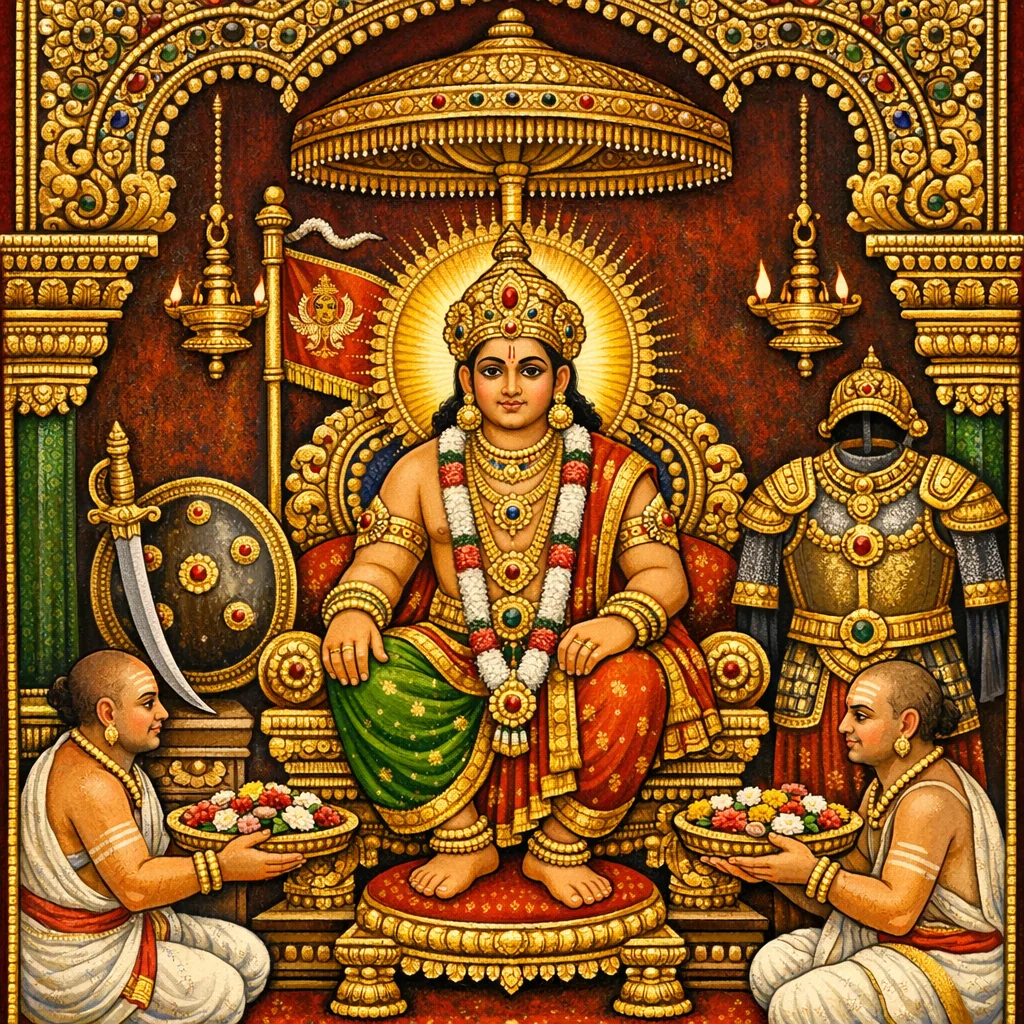
This chapter shifts from the prior topic (nīrājana) to a practical guide for mantra-empowerment of royal and martial emblems—parasol, horse, banner, sword, armor, and war-drum—treating them as ritually enlivened instruments of rājadharma. Puṣkara teaches formulas invoking Brahmā’s truthful power and the deities Soma and Varuṇa, then extends protection and victory through solar radiance, Agni’s potency, Rudra’s discipline, and Vāyu’s speed. Ethical admonition is woven in (the kṣatriya’s duty and the sin of falsehood for land), alongside prayers for battlefield stability and auspiciousness. The chapter further sacralizes war-technology by linking military success to divine agencies: Garuḍa’s epithets, Indra on Airāvata, the guardians of directions, and hosts of beings invoked for comprehensive protection. It concludes with procedural instruction: these emblems are to be regularly worshipped with mantras, used in victory-rites, and integrated into annual consecrations, including the king’s abhiṣeka performed by a learned purohita skilled in daiva-jñāna.
Shlokas
Verse 1
इत्य् आग्नेये महापुराणे नीराजनाविधिर्नाम सप्तषष्ट्यधिकद्विशततमो ऽध्यायः विशाखान्त्विति क , छ च अथाष्टषष्ट्यधिकद्विशततमो ऽध्यायः छत्रादिमन्त्रादयः पुष्कर उवाच छत्रादिमन्त्रान्वक्ष्यामि यैस्तत् पूज्य जयादिकम् ब्रह्मणः सत्यवाक्येन सोमस्य वरुणस्य च
Thus, in the Agni Mahāpurāṇa, the two-hundred and sixty-seventh chapter entitled “The Rite of Nīrājana (ceremonial waving of lights)” concludes. (So reads a variant in some manuscripts: “ending with Viśākhā”.) Now begins the two-hundred and sixty-eighth chapter: “Mantras for the Parasol and other (royal/worship) emblems.” Puṣkara said: “I shall declare the mantras beginning with the parasol, by which that set of emblems—worthy of worship—bestows victory and the like, by the truthful utterance of Brahmā, and by the power of Soma and Varuṇa as well.”
Verse 2
सूर्यस्य च प्रभावेन वर्धस्व त्वं महामते पाण्डराभप्रतीकाश हिमकुन्देन्दुसुप्रभ
By the mighty radiance of the Sun, may you increase and flourish, O great-minded one—O you who appear with a pale-white brilliance, resplendent like snow, jasmine, and the moon.
Verse 3
यथाम्बुदश्छादयते शिवायैनां वसुन्धरां तथाच्छादय राजानं विजयारोग्यवृद्धये
Just as a rain-cloud covers this earth for her welfare, so too cover (protectively) the king, for the increase of victory and health.
Verse 4
गन्धर्वकुलजातस्त्वं माभूयाः कुलदूषकः ब्रह्मणः सत्यवाक्येन सोमस्य वरुणस्य च
Born in the lineage of the Gandharvas, may you never again become a defiler of your family—by the unfailing truth of Brahmā’s word, and by (the truth of) Soma and Varuṇa as well.
Verse 5
प्रभावाच्च हुताशस्य वर्धस्व त्वं तुरङ्गम तेजसा चैव सूर्यस्य मुनीनां तपसा तथा
By the mighty power of Hutāśa (Agni), may you grow and thrive, O horse—also by the radiance of the Sun, and likewise by the ascetic heat (tapas) of the sages.
Verse 6
रुद्रस्य ब्रह्मचर्येण पवनस्य बलेन च स्मर त्वं राजपुत्रो ऽसि कौस्तुभन्तु मणिं स्मर
By Rudra’s celibate discipline (brahmacarya) and by the strength of the Wind-god, remember: you are a prince. And remember the Kaustubha jewel.
Verse 7
यां गतिं ब्रह्महा गच्छेत् पितृहा मातृहा तथा भूम्यर्थे ऽनृतवादी च क्षत्रियश् च पराङ्मुखः
The same fate that a slayer of a brāhmaṇa attains is attained likewise by the slayer of one’s father and the slayer of one’s mother; and also by one who speaks falsehood for the sake of land, and by a kṣatriya who turns away (from battle or duty).
Verse 8
व्रजेस्त्वन्तां गतिं क्षिप्रं मा तत् पापं भवेत्तव विकृतिं मापगच्छेस्त्वं युद्धे ऽध्वनि तुरङ्गम
O horse, go swiftly to the final course (your destined pace); let that not become sin for you. Do not fall into disorder or deformity—remain steady on the road of battle.
Verse 9
रिपून् विनिघ्नन्समरे सह भर्त्रा सुखी भव शक्रकेतो महावीर्यः सुवर्णस्त्वामुपाश्रितः
Crushing the enemies in battle, be happy together with your husband. O Śakraketu—of great prowess—Suvarṇa has taken refuge in you (and stands under your protection).
Verse 10
पतत्रिराड्वैनतेयस् तथा नारायणध्वजः काश्यपेयो ऽमृताहर्ता नागारिर्विष्णुवाहनः
He is the sovereign lord of birds (Patatrirāṭ), Vainateya; also the banner of Nārāyaṇa; the son of Kaśyapa; the bringer of amṛta (nectar of immortality); the enemy of the Nāgas; and the mount (vāhana) of Viṣṇu.
Verse 11
अप्रमेयो दुराधर्षो रणे देवारिसूदनः महाबलो मावेगो महाकायो ऽमृताशनः
He is immeasurable; unassailable; in battle, the slayer of the enemies of the gods; of great strength; unimpetuous (not rash); of vast form; and the eater of amṛta (ambrosia of immortality).
Verse 12
गरुत्मान्मारुतगतिस्त्वयि सन्निहितः स्थितः विष्णुना देवदेवेन शक्रार्थं स्थापितो ह्य् असि
Garutmān (Garuḍa), whose speed is like that of the wind, abides here, present within you; indeed, you have been installed by Viṣṇu—the God of gods—for the sake of Śakra (Indra).
Verse 13
जयाय भव मे नित्यं वृद्धये ऽथ बलस्य च साश्ववर्मायुधान्योधान्रक्षास्माकं रिपून्दह
Be for me ever the cause of victory, and also of increase and strength. Protect our warriors—together with their horses, armor, and weapons—and burn (destroy) our enemies.
Verse 14
कुमुदैरावणौ पद्मः पुष्पदन्तो ऽथ वामनः सुप्रतीको ऽञ्जनो नील एते ऽष्टौ देवयोनयः
Kumuda and Airāvaṇa, Padma, Puṣpadanta, and then Vāmana; Supratīka, Añjana, and Nīla—these eight are devayonis (divine-born celestial beings).
Verse 15
तेषां पुत्राश् च पौत्राश् च बलान्यष्टौ समाश्रिताः भद्रो मन्दो मृगश् चैव गजः संकीर्ण एव च
From them arise, as it were, their “sons” and “grandsons”—eight classes of military formations are derived: the Bhadra, the Manda, the Mṛga, the Gaja, and likewise the Saṅkīrṇa (the mixed formation) as well.
Verse 16
वने वने प्रसूतास्ते स्मरयोनिं महागजाः पान्तु त्वां वसवो रुद्रा आदित्याः समरुद्गणाः
May those great elephants—born in forest after forest, sprung from the source of Kāma—protect you; and may the Vasus, the Rudras, and the Ādityas, together with the hosts of the Maruts, safeguard you.
Verse 17
भर्तारं रक्ष नागेन्द्र समयः परिपाल्यतां ऐरावताधिरूढस्तु वज्रहस्तः शतक्रतुः
“Protect your lord, O Nāgendra, king of serpents; let the pact be duly upheld. For Śatakratu (Indra), the wielder of the vajra, mounted upon Airāvata, stands as witness and enforcer.”
Verse 18
पृष्ठतो ऽनुगतस्त्वेष रक्षतु त्वां स देवराट् अवाप्नुहि जयं युद्धे सुस्थश् चैव सदा व्रज
May that sovereign of the gods—who follows behind you—protect you. Attain victory in battle, and go forth always in well-being.
Verse 19
अवाप्नुहि बलञ्चैव ऐरावतसमं युधि श्रीस्ते सोमाद्बलं विष्णोस्तेजः सूर्याज्जवो ऽनिलात्
May you obtain strength indeed—equal to Airāvata in battle. May fortune (Śrī) come to you from Soma; strength from Viṣṇu; splendor from the Sun; and swiftness from the Wind (Anila).
Verse 20
स्थैर्यं गिरेर्जयं रुद्राद्यशो देवात् पुरन्दरात् युद्धे रक्षन्तु नागास्त्वां दिशश् च सह दैवतैः
May the Mountain grant you steadfastness; may Rudra grant you victory; may the Divine grant you renown; may Purandara (Indra) grant you martial power. In battle, may the Nāgas protect you, and may the Directions, together with their presiding deities, guard you.
Verse 21
अश्विनौ सह गन्धर्वैः पान्तु त्वां सर्वतो दिशः मन्वो वसवो रुद्रा वायुः सोमो महर्षयः
May the Aśvins, together with the Gandharvas, protect you from all directions. May the Manus, the Vasus, the Rudras, Vāyu, Soma, and the great seers also protect you.
Verse 22
नागकिन्नरगन्धर्वयक्षभूतगणा ग्रहाः प्रमथास्तु सहादित्यैर् भूतेशो मातृभिः सह
May the hosts of Nāgas, Kinnaras, Gandharvas, Yakṣas, and Bhūtas; the Grahas; and the Pramathas—together with the Ādityas—and Bhūteśa along with the Mother-goddesses (Mātṛs), all be present for protection and auspiciousness.
Verse 23
शक्रः सेनापतिः स्कन्दो वरुणश्चाश्रितस्त्वयि प्रदहन्तु रिपून् सर्वान् राजा विजयमृच्छतु
May Śakra (Indra), the army-commander Skanda, and Varuṇa—having taken refuge in you—burn up all enemies; may the king attain victory.
Verse 24
यानि प्रयुक्तान्यरिभिर्भूषणानि समन्ततः पतन्तु तव शत्रूणां हतानि तव तेजसा
May whatever hostile ‘ornamental’ implements have been deployed by enemies fall down on all sides—your foes struck down by your radiance (tejas).
Verse 25
कालनेमिबधे यद्वत् युद्धे त्रिपुरघातने हिरण्यकशिपोर्युद्धे बधे सर्वासुरेषु च
Just as it occurred in the slaying of Kālanemi, in the battle for the destruction of Tripura, in the combat with Hiraṇyakaśipu, and likewise in the killing of all other asuras.
Verse 26
शोभितासि तथैवाद्य शोभस्व समयं स्मर नीलस्वेतामिमान्दृष्ट्वा नश्यन्त्वाशु नृपारयः
You are indeed adorned even now; be resplendent—remember the pledged agreement. Seeing this blue-and-white sign, may the enemies of the king swiftly perish.
Verse 27
व्याधिभिर्विविधैर् घोरैः शस्त्रैश् च युधि निर्जिताः पूतना रेवती लेखा कालरात्रीति पठ्यते
For those overcome by dreadful, varied diseases, and also for those defeated by weapons in battle—(for protection and appeasement) these names are to be recited: Pūtanā, Revatī, Lekhā, and Kālarātrī.
Verse 28
दहन्त्वाशु रिपून् सर्वान्पताके त्वामुपाश्रिताः सर्वमेधे महायज्ञे देवदेवेन शूलिना
O Banner (Patākā), may all enemies be swiftly burned up—we who have taken refuge in you—as you were empowered in the Sarvamedha, the great sacrifice, by the God of gods, the trident-bearing Lord.
Verse 29
शर्वेण जगतश् चैव सारेण त्वं विनिर्मितः नन्दकस्यापरां मूर्तिं स्मर शत्रुनिवर्हण
You have been fashioned by Śarva indeed, and by the very essence of the universe. O destroyer of enemies, remember (in contemplation) the further, other form of Nandaka.
Verse 30
नीलोत्पलदलश्याम कृष्ण दुःस्वप्ननाशन असिर्विशसनः खड्गस्तीक्ष्णधारो दुरासदः
Dark as the petal of a blue lotus; the Dark One (Kṛṣṇa); the destroyer of evil dreams; the sword that cuts down; the slayer; the broadsword—sharp-edged and unassailable.
Verse 31
औगर्भो विजयश् चैव धर्मपालस्तथैव च इत्यष्टौ तव नामानि पुरोक्तानि स्वयम्भुवा
“Augarbha, Vijaya, and likewise Dharmapāla—thus these eight names of yours were formerly declared by Svayambhū (Brahmā).”
Verse 32
नक्षत्रं कृत्तिका तुभ्यं गुरुर्देवो महेश्वरः हिरण्यञ्च शरीरन्ते दैवतन्ते जनार्दनः
For you, the nakṣatra is Kṛttikā; your preceptor-deity is Maheśvara. Gold is your bodily substance, and your presiding deity is Janārdana (Viṣṇu).
Verse 33
राजानं रक्ष निस्त्रिंश सबलं सपुरन्तथा पिता पितामहो देवः स त्वं पालय सर्वदा
Protect the king, O sword (nistriṁśa); protect also the army and the city. You, the god who is as father and grandfather—ever safeguard them.
Verse 34
शर्मप्रदस्त्वं समरे वर्मन् सैन्ये यशो ऽद्य मे रक्ष मां रक्षणीयो ऽहन्तवानघ नमो ऽस्तु ते
O armor (kavaca), you bestow safety in battle. In the army, protect my fame today; protect me who am to be protected. O sinless one, slayer of foes—obeisance be to you.
Verse 35
दुन्दुभे त्वं सपत्नानां घोषाद्धृदयकम्पनः भव भूमिसैन्यानां यथा विजयवर्धनः
O war-drum, by your reverberating roar become a shaker of the hearts of our foes; and for the armies upon the earth, be the augmenter of victory.
Verse 36
यथा जीमूतघोषेण हृष्यन्ति वरवारणाः तथास्तु तव शब्देन हर्षो ऽस्माकं मुदावह
Just as excellent elephants rejoice at the rumbling sound of rainclouds, so too may your utterance bring us joy—may it cause delight and exhilaration in us.
Verse 37
यथा जीमूतशब्देन स्त्रीणां त्रासो ऽभिजायते तथा तु तव शब्देन त्रस्यन्त्वस्मद्द्विषो रणे
Just as fear arises in women at the sound of thunderclouds, so too—by your shout—may our enemies be terrified in battle.
Verse 38
मन्त्रैः सदार्चनीयास्ते योजनीया जयादिषु घृतकम्बलविष्णादेस्त्वभिषेकञ्च वत्सरे
They are to be worshipped constantly with mantras, and they are to be employed in rites beginning with the Jaya ceremony. And, in the course of the year, one should also perform the consecratory bathing (abhiṣeka) of (the deity/objects) such as Ghṛtakambala, Viṣṇu, and others.
Verse 39
राज्ञो ऽभिषेकः कर्तव्यो दैवज्ञेन पुरोधसा
The king’s consecration (abhiṣeka) should be performed by the royal chaplain (purohita), who is a daivajña—an expert in divination and astrology.
Frequently Asked Questions
The chapter gives applied mantra-sets (prayoga) for specific royal/martial objects—parasol, horse, banner, sword, armor, drum—linking each to particular deities and desired outcomes (victory, health, stability, enemy-destruction), and concludes with procedural notes on regular worship and abhiṣeka.
It frames political and martial instruments as dharmic sacraments: success in rule and battle is pursued through truth, mantra, and deity-alignment, while ethical cautions (falsehood for land, turning away from duty) ensure that power remains accountable to dharma—integrating bhukti with spiritual discipline.