Adhyaya 264
Chapter 264 — Dikpālādi-snāna (Bathing rites for the Dikpālas and associated deities)
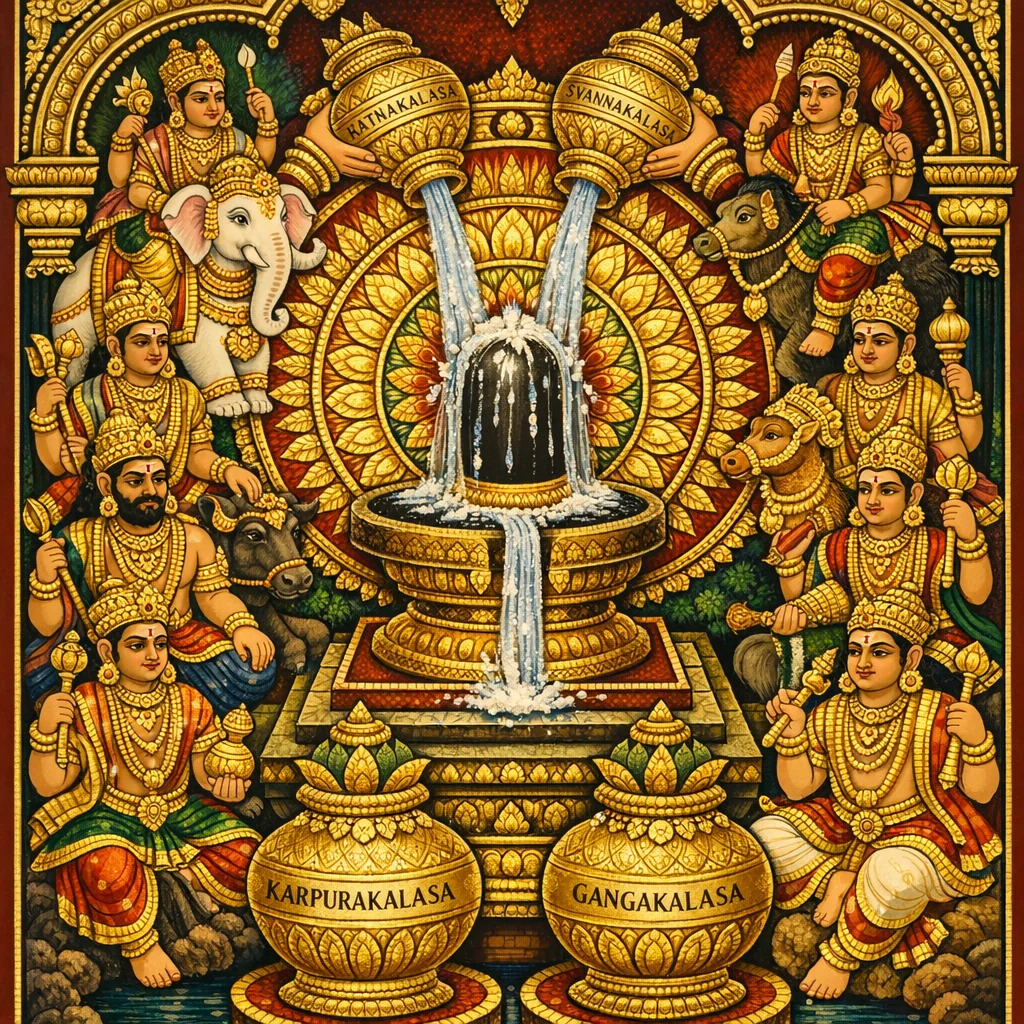
Agni teaches Vasishtha an all-purpose, shanti-producing snana (ritual bath) to be performed at auspicious sites—riverbank, lake, home, temple, or tīrtha—while invoking Vishnu and the Grahas. The chapter links the rite’s efficacy to context-specific aims: relief from fever and graha-afflictions (especially Vinayaka-graha), support for students, success for those seeking victory, and remedies for reproductive misfortune—bathing in a lotus-pond to counter miscarriage, and bathing near an Ashoka tree to end repeated neonatal loss. It prescribes calendrical choice (a Vaishnava day when the Moon is in Revati or Pushya) and a seven-day preparatory cleansing (utsadana). A detailed dravya-vidhi follows: powdered botanicals and aromatics, pañcagavya with barley-flour for udvartana, and herbs infused in a kumbha. The rite culminates in constructing snana-mandalas in the directions and intermediates, inscribing deities (Hara; Indra and the dikpala set with weapons and retinues), worship of Vishnu and a brahmana, and homa with specified offerings, kalasha-names, and invoked deity-groups. The closing exemplum—Indra’s consecration leading to victory over the Daityas—frames the snana as a dharmic technology for auspicious success, especially at the outset of conflict.
Shlokas
Verse 1
इत्य् आग्नेये महापुराणे देवपूजावैश्वदेवबलिर्नाम त्रिषष्ट्यधिकद्विशततमो ऽध्यायः अथ चतुःषष्ठ्यधिअकद्विशततमो ऽध्यायः दिक्पालादिस्नानं अग्निर् उवाच सर्वार्थसाधनं स्नानं वक्ष्ये शान्तिकरं शृणु स्नापयेच्च सरित्तीरे ग्रहान् विष्णुं विचक्षणः
Thus, in the Agni Mahāpurāṇa, the two-hundred-and-sixty-third chapter called “Deva-worship, Vaiśvadeva and Bali (offerings)” concludes. Now begins the two-hundred-and-sixty-fourth chapter: “Bathing rites for the Dikpālas and others.” Agni said: “I shall describe the bath that accomplishes all aims and brings pacification; listen. A discerning person should bathe on a riverbank, invoking Viṣṇu and the Grahas (planetary deities).”
Verse 2
सौरभेया इति क , घ , छ , ञ च पुष्पराशय इति ज , ट च देवालये ज्वरार्त्यादौ विनायकग्रहार्दिते विद्यार्थिनो ह्रदे गेहे जयकामस्य तीर्थके
“Saurabheyā” is the name-group for those beginning with the syllables ka, gha, cha, and ña; and “Puṣparāśaya” is the name-group for those beginning with ja and ṭa. (These are to be applied) in a temple; in conditions such as fever and other afflictions; for one tormented by the Vināyaka-graha; for a student; at a lake; in a house; for one desiring victory; and at a sacred ford (tīrtha).
Verse 3
पद्मिन्यां स्नापयेन्नारीं गर्भो यस्याः स्रवेत्तथा अशोकसन्निधौ स्नायाज्जातो यस्या विनश्यति
A woman whose pregnancy is slipping away (miscarrying) should be bathed in a lotus-pond. Likewise, a woman whose newborn repeatedly dies should bathe in the proximity of an Aśoka tree.
Verse 4
पुष्पार्थिनाञ्च पुष्पाढ्ये पुत्रार्थिनाञ्च सागरे गृहसौभाग्यकामानां सर्वेषां विष्णुसन्निधौ
Those who desire flowers should resort to a place abounding in flowers; those who desire sons, to the sea; and those who seek domestic prosperity—indeed all—find fulfillment in the immediate presence of Viṣṇu.
Verse 5
वैष्णवे रेवतीपुष्ये सर्वेषां स्नानमुत्तमं स्नानकामस्य सप्ताहम्पूर्वमुत्सादनं स्मृतं
On the Vaiṣṇava day—when the Moon is in Revatī or Puṣya—bathing is declared best for everyone. For one who wishes to undertake the ritual bath, preparatory anointing and cleansing (utsādana) for seven days beforehand is prescribed.
Verse 6
पुनर् नवां रोचनाञ्च शताङ्गं गुरुणी त्वचं मधूकं रजनी द्वे च तगरन्नागकेशरम्
Also add punarnavā, rocanā, śatāṅga, the bark of guruṇī, madhūka, both kinds of rajanī (turmeric varieties), tagara, and nāgakeśara.
Verse 7
अम्बरीञ्चैव मञ्जिष्ठां मांसीयासकमर्दनैः प्रियङ्गुसर्षपं कुष्ठम्बलाम्ब्राह्मीञ्च कुङ्कुमं
Also take amberī, mañjiṣṭhā, māṃsī, yāsaka, and mardana; along with priyaṅgu, mustard-seed, kuṣṭha, balā, brāhmī, and saffron (kuṅkuma).
Verse 8
पञ्चगव्यं शक्तुमिश्रं उद्वर्त्य स्नानमाचरेत् मण्डले कर्णिकायाञ्च विष्णुं ब्राह्मणमर्चयेत्
Having rubbed the body with pañcagavya mixed with roasted barley-flour as an unction, one should perform a purificatory bath; and in the maṇḍala—especially in its central karnikā—one should worship Viṣṇu and also honor a brāhmaṇa.
Verse 9
दक्षे वामे हरं पूर्वं पत्रे पूर्वादिके क्रमात् लिखेदिन्द्रादिकान्देवान् सायुधान् सहबान्धवान्
On the right and on the left, one should first inscribe Hara (Śiva). Then, on the lotus-petals, in sequence beginning from the eastern direction, one should write the gods beginning with Indra—depicting them with their weapons and together with their attendant kin and retinues.
Verse 10
स्नानमण्डलकान् दिक्षु कुर्याच्चैव विदिक्षु च विष्णुब्रह्मेशशक्रादींस्तदस्त्राण्यर्च्य होमयेत्
He should construct the bathing-circles (snāna-maṇḍalas) in the cardinal directions and also in the intermediate directions; having worshipped Viṣṇu, Brahmā, Īśa (Śiva), Śakra (Indra) and the others—together with their presiding astra-mantras—he should then offer them into the fire (perform homa).
Verse 11
एकैकस्य त्वष्टशतं समिधस्तु तिलान् धृतं भद्रः सुभद्रः सिद्धार्थः कलसाः पुष्टिवर्धनाः
For each offering/rite, the kindling-sticks (samidh) should be eight hundred; one should offer sesame seeds and ghee. The ritual vessels (kalaśas) are to be arranged/named as Bhadra, Subhadra, and Siddhārtha—thus promoting nourishment and prosperity.
Verse 12
अमोघश्चित्रभानुश् च पर्जन्यो ऽथ सुदर्शनः स्थापयेत्तु वटानेनान् साश्विरुद्रमरुद्गणान्
Amogha, Citrabhānu, Parjanya, and then Sudarśana—these deities he should install according to this vaṭa-arrangement, together with the Aśvin twins, Rudra, and the hosts of the Maruts.
Verse 13
सहवाहनानिति घ , ज च विश्वे देवस् तथा दैत्या वसवो मुनयस् तथा आवेशयन्तु सुप्रीतास् तथान्या अपि देवताः
“(Invoke them) together with their vehicles (vāhana).” Thus is the formula ‘gha’ and ‘ja’ as well. May the Viśvedevas, the Daityas, the Vasus, and the sages—well-pleased—enter this rite/this worshipper/this maṇḍala; and may other deities also enter.
Verse 14
ओषधीर् निक्षिपेत् कुम्भे जयन्तीं विजयां जयां शतावरीं शतपुष्पां विष्णुक्रान्तापराजिताम्
One should place medicinal herbs into a kumbha (ritual pot): jayantī, vijayā, jayā, śatāvarī, śatapuṣpā, and viṣṇukrāntā (also called aparājitā).
Verse 15
ज्योतिष्मतीमतिबलाञ्चन्दनोशीरकेशरं कस्तूरिकाञ्च कर्पूरं बालकं पत्रकं त्वचं
Jyotiṣmatī, Atibalā, sandalwood, uśīra (vetiver), saffron (keśara), musk, camphor, bālaka, patraka (leaf-fragrance), and tvac (bark) are to be taken as the listed ingredients.
Verse 16
जातीफलं लवङ्गञ्च मृत्तिकां पञ्चगव्यकं भद्रपीठे स्थितं साध्यं स्नापयेयुर्द्विजा बलात्
With nutmeg, clove, clay, and pañcagavya, the Brahmins should—by firm resolve—perform the ritual bathing (abhiṣeka) of the sādhya placed upon the auspicious pedestal (bhadrapīṭha).
Verse 17
राजाभिषेकमन्त्रोक्तदेवानां होमकाः पृथक् पूर्णाहुतिन्ततो दत्वा गुरवे दक्षिणां ददेत्
One should separately perform the fire-offerings (homa) to the deities prescribed in the royal consecration (rājābhiṣeka) mantras; then, having offered the final oblation (pūrṇāhuti), one should give the dakṣiṇā (sacrificial honorarium) to the guru, the officiating preceptor.
Verse 18
इन्द्रो ऽभिषिक्तो गुरुणा पुरा दैत्यान् जघान ह दिक्पालस्नानङ्कथितं संग्रामादौ जयादिकं
Indra, once consecrated (anointed) by his preceptor, formerly slew the Daityas. Thus the Dikpāla-bath has been taught, bestowing victory and related auspicious results at the very outset of battle.
Frequently Asked Questions
It is presented as sarvārtha-sādhana and śānti-kara: a bath that accomplishes aims (health, prosperity, victory) while pacifying disturbances, especially those linked to grahas and directional forces.
The chapter states that bathing is best for everyone on a Vaiṣṇava day when the Moon is in Revatī or Puṣya.
It combines Vishnu-centered worship (including honoring a brahmana) with precise mandala construction, directional deity inscription, specified offerings, kalasha arrangements, and homa—showing Agneya Vidya as both bhakti-aligned and shastrically engineered.
For miscarriage: bathing in a lotus-pond; for repeated newborn loss: bathing near an Ashoka tree—each tying place-specific sanctity to desired outcomes.
Indra’s consecration by his guru and subsequent victory over Daityas serves as a precedent (itihasa-style proof) that abhiṣeka/snana rites empower success, especially for victory at the start of battle.