Adhyaya 265
Vināyaka-snāna (The Vinayaka Bath) — Obstacle-Removal and Consecratory Bathing Rite
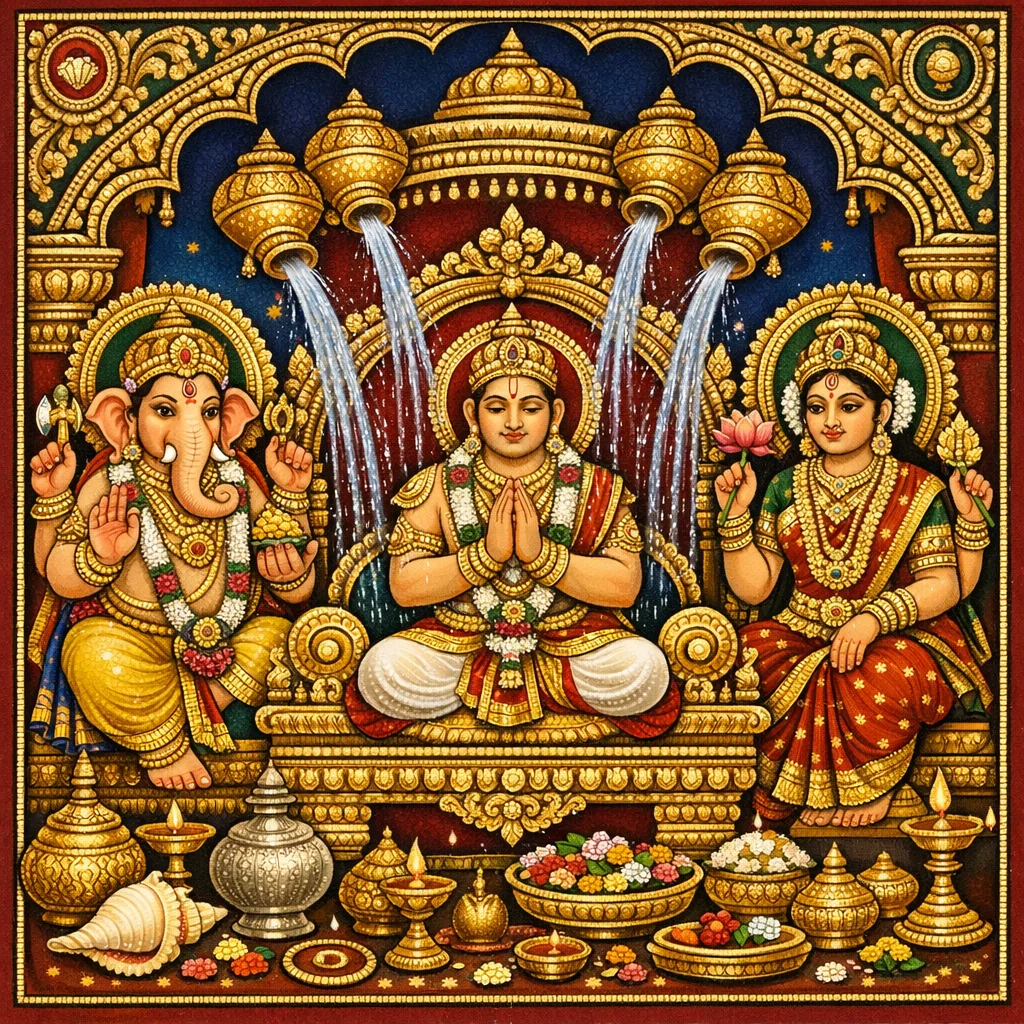
This chapter teaches a specialized snāna/snāpana-vidhi to cure affliction by Vināyaka, a power linked with karmic obstacles and the disruption of successful outcomes. It first lists diagnostic dream-omens and lived symptoms: disturbing visions, irrational fear, repeated failure of undertakings, impediments to marriage and progeny, loss of pedagogical efficacy, and even political instability for rulers. The rite is then set out with strict ritual logistics—auspicious nakṣatras (Hasta, Puṣya, Aśvayuj, Saumya), a Vaiṣṇava occasion, and a bhadrapīṭha seat—showing how cosmic timing supports dharmic action. The procedure includes mustard-and-ghee unction, herbal and fragrant head-anointing, four kalaśa pourings with purifying substances gathered from liminal/powerful locations (stables, anthill, confluence, lake), and mantra-led consecration invoking Varuṇa, Bhaga, Sūrya, Bṛhaspati, Indra, Vāyu, and the Saptarṣis. A bali offering at a crossroads—using named invocations (Mita, Sammita, Śālaka, Kaṇṭaka, Kuṣmāṇḍa, Rājaputra) and diverse food items—completes the appeasement. Worship of Vināyaka’s Mother and Ambikā, followed by brāhmaṇa-feeding and gifts to the guru, seals the rite, promising śrī (prosperity) and karmaphala (verified success).
Shlokas
Verse 1
इत्य् आग्नेये महापुराणे दिक्पालादिस्नानं नाम चतुःषष्ठ्यधिकद्विशततमो ऽध्यायः अथ पञ्चषष्ट्यधिकद्विशततमो ऽध्यायः विनायकस्नानं पुष्कर उवाच विनायकोपसृष्टानां स्नानं सर्वकरं वदे विनायकः कर्मविघ्नसिद्ध्यर्थं विनियोजितः
Thus, in the Agni Mahāpurāṇa, ends the two-hundred-and-sixty-fourth-plus chapter, entitled “Bathing rites connected with the Dikpālas and others.” Now begins the two-hundred-and-sixty-fifth-plus chapter: “The Vināyaka Bath.” Puṣkara said: “I shall describe the all-effective bathing rite for those afflicted by Vināyaka. Vināyaka has been appointed to bring about obstacles to actions (karmas) and their consequent accomplishment/verification.”
Verse 2
गणानामाधिपत्ये च केशवेशपितामहैः स्वप्नेवगाहते ऽत्यर्थं जलं मुण्डांश् च पश्यति
When one attains lordship over groups (or hosts), and when Keśava, Īśa, and Pitāmaha are propitiated, one (in a dream) plunges deeply into water and also sees shaven-headed men.
Verse 3
विनायकोपसृष्टस्तु क्रव्यादानधिरोहति व्रजमानस् तथात्मानं मन्यते ऽनुगतम्परैः
But one afflicted by (the graha called) Vināyaka climbs onto a flesh-eating being; and while moving about, he imagines himself to be followed by others.
Verse 4
विमना विफलारम्भः संसीदत्यनिमित्ततः कन्या वरं न चाप्नोति न चापत्यं वराङ्गना
A dejected (or ill-disposed) person begins undertakings in vain; he collapses without any apparent cause. A maiden does not obtain a bridegroom, and a beautiful woman does not obtain offspring.
Verse 5
आचार्यत्वं श्रोत्रियश् च न शिष्यो ऽध्ययनं लभेत् धनी न लाभमाप्नोति न कृषिञ्च कृषीबलः
Even if one holds the status of an ācārya and is a śrotriya learned in the Veda, a fit disciple does not thereby obtain true learning from him. Likewise, a wealthy man does not necessarily gain profit, and one who has only bodily strength does not for that reason succeed in agriculture.
Verse 6
राजा राज्यं न चाप्नोति स्नपनन्तस्य कारयेत् हस्तपुष्याश्वयुक्सौम्ये वैष्णवे भद्रपीठके
A king does not attain secure sovereignty unless he has the consecratory bath (snāpana) performed. It should be arranged under the nakṣatras Hasta, Puṣya, Aśvayuj, or Saumya, on a Vaiṣṇava (Viṣṇu-favoured) occasion, upon an auspicious seat (bhadrapīṭhaka).
Verse 7
गौरसर्षपकल्केन साज्येनोत्सादितस्य च सर्वौषधैः सर्वगन्धैः प्रलिप्तशिरसस् तथा
And for one who has been rubbed and massaged with a paste of yellow mustard (gaura-sarṣapa) mixed with ghee, and likewise for one whose head has been anointed with all medicinal herbs and with all fragrant substances.
Verse 8
चतुर्भिः कलसैः स्नानन्तेषु सर्वौषाधौ क्षिपेत् अश्वस्थानाद्गजस्थानाद्वल्मीकात् सङ्गमाद्ध्रदात्
At the conclusion of bathing, one should pour an infusion of ‘all medicinal herbs’ using four water-pots (kalasas), taking the sanctifying material from a horse-stable, an elephant-stable, an anthill (valmīka), a river-confluence (saṅgama), and a lake (hrada).
Verse 9
मृत्तिकां रोचनाङ्गन्धङ्गुग्गुलुन्तेषु निक्षिपेत् सहस्राक्षं शतधारमृषिभिः पावनं कृतम्
One should place (mix) clay together with rocanā (yellow pigment), fragrant substances, and guggulu (resin) into those vessels. This is the purifying substance, made sacred by the ṛṣis, called Sahasrākṣa (“thousand-eyed”) and Śatadhāra (“hundred-streamed”).
Verse 10
तेन त्वामभिषिञ्चामि पावमान्यः पुनन्तु ते भगवन्ते वरुणो राजा भगं सूर्यो वृहस्पतिः
With that consecrated water/rite I anoint you in abhiṣeka. May the purifying Pavamāna sacred formulas cleanse you. May Lord Varuṇa the King, and Bhaga, Sūrya, and Bṛhaspati also purify and bless you.
Verse 11
भगमिन्द्रश् च वायुश् च भगं सप्तर्षयो ददुः यत्ते केशेषु दौर्भाग्यं सीमन्ते यच्च मूर्धनि
Indra and Vāyu, and the Seven Ṛṣis, have bestowed bhaga—good fortune. Whatever ill-luck lies in your hair, at the parting (sīmanta), and upon the crown of your head—may it be removed.
Verse 12
ललाटे कर्णयोरक्ष्णोरापस्तद्घ्नन्तु सर्वदा दर्भपिञ्जलिमादाय वामहस्ते ततो गुरुः
Upon the forehead, the ears, and the eyes—may the waters always ward that off, removing impurity and evil. Then the teacher (guru), taking a bundle of darbha-grass in the left hand, proceeds with the rite.
Verse 13
हस्तपुष्याश्वयुक्सौम्यवैष्णवेषु शुभेषु चेति घ , ञ च साज्येनासादितस्य चेति क , छ च इमा आप इति छ , ञ स्नातस्य सार्षपन्तैलं श्रुवेणौडुम्बरेण च जुहुयान्मूर्धनि कुशान् सव्येन परिगृह्य च
On auspicious occasions—such as the days or nakṣatras Hasta, Puṣya, Aśvayuj, Saumya, and Vaiṣṇava—after bathing one should offer mustard oil (sārṣapa) as a homa oblation, using a ladle made of udumbara wood. While doing so, one holds kuśa-grass upon the head with the left hand and recites the prescribed ritual formulas, including the mantra beginning “imā āpaḥ….”
Verse 14
मितश् च सम्मितश् चैव तथा शालककण्टकौ कुष्माण्डो राजपुत्रश् च एतैः स्वाहासमन्वितैः
“(Invoke) Mita and Sammita, and also Śālaka and Kaṇṭaka, as well as Kuṣmāṇḍa and Rājaputra—by these names, each conjoined with the utterance ‘svāhā’.”
Verse 15
नामभिर्बलिमन्त्रैश् च नमस्कारसमन्वितैः दद्याच्चतुष्पथे शूर्पे कुशानास्तीर्य सर्वतः
With the appropriate names and bali-mantras, accompanied by reverential salutations, one should present the offering at a four-way crossroads, placing it upon a winnowing tray after spreading kuśa-grass all around.
Verse 16
कृताकृतांस्तण्डुलांश् च पललौदनमेव च मत्स्यान्पङ्कांस्तथैवामान् पुष्पं चित्रं सुरां त्रिधा
One should also (offer/recite) rice-grains, both cooked and uncooked, and the meat-prepared rice-porridge (palala-odana); likewise fish, items tainted with mud or impurity, and raw items; variegated flowers; and liquor (surā) of three kinds.
Verse 17
मूलकं पूरिकां पूपांस्तथैवैण्डविकास्रजः दध्यन्नं पायसं पिष्टं मोदकं गुडमर्पयेत्
One should offer radish (mūlaka), stuffed cakes (pūrikā), fried cakes (pūpa), and also garlands of round sweet confections (aiṇḍavikā); likewise curd-rice, milk-rice pudding (pāyasa), flour preparations (piṣṭa), sweet dumplings (modaka), and jaggery (guḍa).
Verse 18
विनायकस्य जननीमुपतिष्ठेत्ततो ऽम्बिकां दूर्वासर्षपपुष्पाणां दत्वार्घ्यं पूर्णमञ्जलिं
Then one should reverently attend upon the Mother of Vināyaka; thereafter one should worship Ambikā, offering arghya with both hands cupped full of dūrvā grass, mustard seeds, and flowers.
Verse 19
रूपं देहि यशो देहि सौभाग्यं सुभगे मम पुत्रं देहि धनं देहि सर्वान् कामांश् च देहि मे
Grant me beauty; grant me fame; grant me good fortune. O auspicious one, grant me a son; grant me wealth; and grant me all desired aims.
Verse 20
भोजयेद्ब्राह्मणान्दद्याद्वस्त्रयुग्मं गुरोरपि विनायकं ग्रहान्प्रार्च्य श्रियं कर्मफलं लभेत्
One should feed the Brāhmaṇas and also give a pair of garments to the Guru. Having duly worshipped Vināyaka and the planetary deities, one obtains prosperity (Śrī) and the fruit of the rite (karma).
Frequently Asked Questions
Dream-omens (deep plunging into water, seeing shaven-headed men) and practical disruptions: repeated failure of initiatives, sudden collapse without cause, obstacles to marriage/progeny, loss of teaching efficacy, lack of profit, and insecurity of kingship.
Auspicious timing (Hasta, Puṣya, Aśvayuj, Saumya; Vaiṣṇava occasion), mustard-ghee unction, sarvauṣadhi and fragrance anointing, four kalaśa pourings with mixed clay/rocanā/guggulu, mantra-led abhiṣeka, mustard-oil oblation with an udumbara ladle, and a crossroads bali arranged on a winnowing tray ringed with kuśa.
By framing obstacle-removal as a dharmic, mantra-governed purification that restores right action (karma) and its fruition, it supports artha and kāma without violating dharma, thereby stabilizing the practitioner for higher sādhana oriented toward mokṣa.