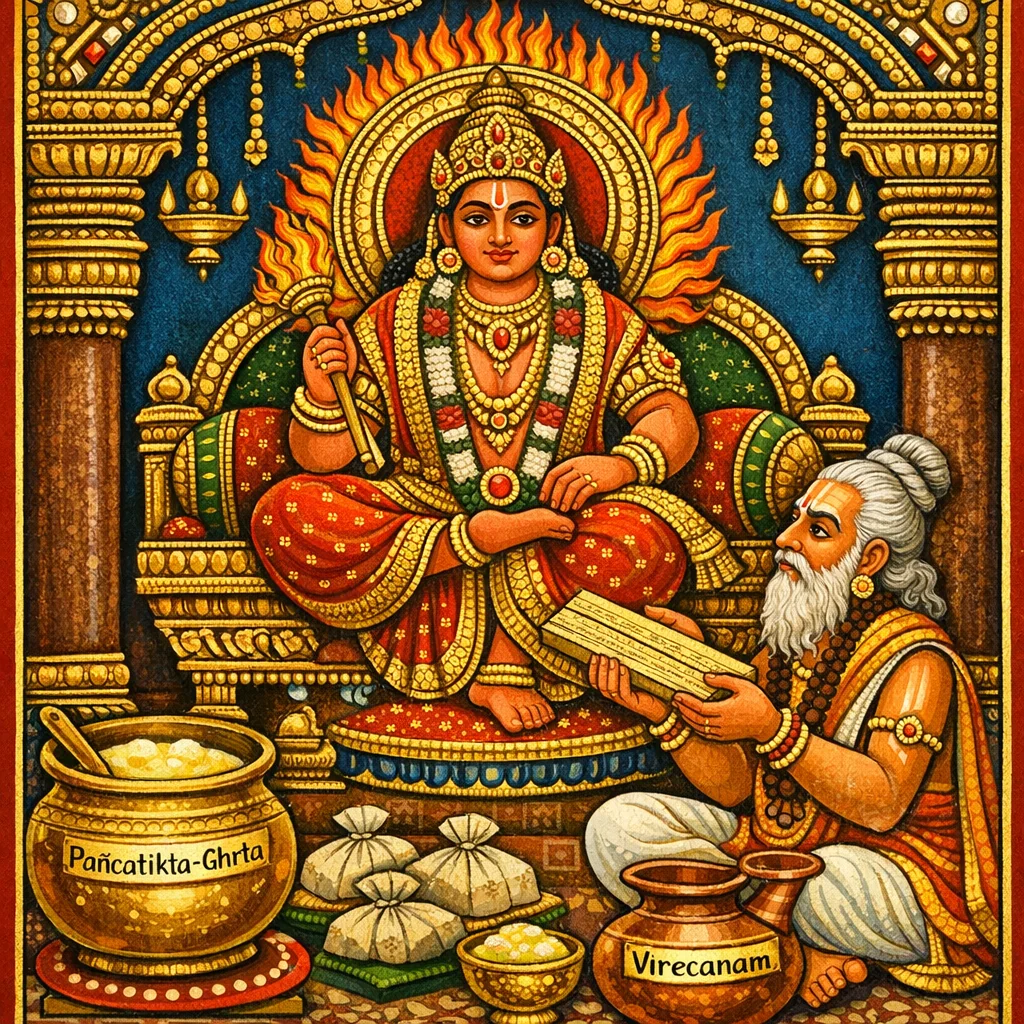
Adhyaya 284
मृतसञ्जीवनीकरसिद्धयोगः (Mṛtasañjīvanī-kara Siddha-yogaḥ) — Perfected Formulations for Revivification and Disease-Conquest
This chapter formally shifts from mantra-formed medicines to an Ayurvedic compendium of siddha-yogas (perfected formulations) attributed to Ātreya and re-taught by Dhanvantari. Encyclopedic and practical in aim, it catalogs treatment protocols for major disease clusters—jvara (fever), kāsa-śvāsa-hikka (cough, dyspnea, hiccup), arocana (loss of appetite), chardi-tṛṣṇā (vomiting and thirst), kuṣṭha and visphoṭa (skin diseases and eruptions), vraṇa and nāḍī/bhagandara (wounds and fistula/ano-rectal abscess), āmavāta and vāta-śoṇita, śotha (edema), arśas (hemorrhoids), atīsāra (diarrhea), kṣaya (consumption), women’s disorders, and eye diseases. Formulas are arranged by dosage forms and procedures: kvātha (decoction), cūrṇa (powder), ghṛta (medicated ghee), taila (medicated oil), lepa (paste), guṭikā (pills), añjana (collyrium), nasya, seka (affusion), and the cleansing therapies of vamana and virecana. The chapter concludes by exalting purgation—especially the ‘Nārāca’ formulation—as foremost, and by affirming (as Suśruta attests) these siddha-yogas as universal destroyers of disease, preserving life in accord with dharma and sustaining one’s capacity for sādhanā.
Shlokas
Verse 1
इत्य् आग्नेये महापुराणे मन्त्ररूपौषधकथनं नाम त्र्यशीत्यधिकद्विशततमो ऽध्यायः अथ चतुरशीत्यधिकद्विशततमो ऽध्यायः मृतसञ्जीवनीकरसिद्धयोगः धन्वन्तरिर् उवाच सिद्धयोगान् पुनर्वक्षे मृतसञ्जीवनीकरान् आत्रेयभाषितान् दिव्यान् सर्वव्याधिविमर्दनान्
Thus, in the Agni Mahāpurāṇa, the two-hundred-and-eighty-third chapter, entitled “Account of medicines in the form of mantras,” is concluded. Now begins the two-hundred-and-eighty-fourth chapter: “The perfected medicinal formulations that bring about the restoration of life.” Dhanvantari said: “I shall again expound the perfected formulations—those that effect the revivification of the dead—declared by Ātreya, divine in nature, and capable of crushing all diseases.”
Verse 2
आत्रेय उवाच विल्वादिपञ्चमूलस्य क्वाथः स्याद्वातिके ज्वरे पावनं पिप्पलीमूलं गुडूची विष्वजो ऽथ वा
Ātreya said: In fever caused by vāta, a decoction of the bilvādi pañca-mūla should be administered. As a purifying remedy, one may also give pippalī-root, or guḍūcī, or the herb called viṣvaja.
Verse 3
वीरकार्ये इति ख एकनामाथ सर्थकमिति ख , ञ च सर्वव्याधिविनाशकानिति ख आमलक्यभया कृष्ण वह्निः सर्वज्वरान्तकः विल्वाग्निमन्थश्योनाककाश्मर्यः पार्ला स्थिरा
“Vīrakārye” (so reads the Kha manuscript); “Ekānāma” and “Sārthaka” (so read the Kha manuscript); and also “Sarvavyādhivināśaka” (so reads the Kha manuscript). (These are) Āmalakī, Abhayā, Kṛṣṇā, Vahni, Sarvajvarāntaka, Vilva, Agnimantha, Śyonāka, Kāśmarya, Pārlā, and Sthirā.
Verse 4
त्रिकण्टकं पृश्नपर्णी वृहती कण्टकारिकाः ज्वराविपाकपार्श्वार्तिकाशनुत् कुशमूलकम्
Trikaṇṭaka, Pṛśniparṇī, Vṛhatī, and Kaṇṭakārikā—together with the root of kuśa-grass—are remedies that alleviate fever, disordered digestion/indigestion, and pain in the flanks.
Verse 5
गुडूची पर्पटी मुस्तं किरातं विश्वभेषजम् वातपित्तज्वरे देयं पञ्चभद्रमिदं स्मृतम्
Guḍūcī, Parpaṭī, Musta, Kirāta, and Viśvabheṣaja—this set of five is prescribed to be administered in fever arising from Vāta and Pitta; it is remembered as the “Pañcabhadra”.
Verse 6
त्रिवृद्विशालकटुकात्रिफलारग्बधैः कृतः स्ंस्कारो भेदनक्वाथः पेयः सर्वज्वरापहः
A purgative decoction to be taken as a drink, prepared by duly processing the drugs with trivṛt, viśālā, kaṭukā, triphalā, and āragvadha, is a “bhedana-kvātha” that removes all types of fever.
Verse 7
देवदारुबलावासात्रिफलाव्योपपद्मकैः सविडङ्गैः सितातुल्यं तच्चुर्णं पञ्चकाशजित्
A powder made from deodara, balā, vāsā, triphalā, vyopapadmaka, and viḍaṅga—mixed with an equal measure of sugar—conquers the five kinds of cough.
Verse 8
दशमूलीशटीरास्नापिप्पलीबिल्वपौष्करैः शृङ्गीतामलकीभार्गीगुडूचीनागवल्लिभिः
With daśamūla (the group of ten roots), śaṭī, rāsnā, pippalī, bilva, and pauṣkara; and with śṛṅgī, tāmalakī, bhārgī, guḍūcī, and nāgavallī.
Verse 9
यवाग्रं विधिना सिद्धं कशायं वा पिवेन्नरः काशहृद्ग्रहणीपार्श्वहिक्वाश्वासप्रशान्तये
A man should drink, prepared according to the proper method, a decoction made from barley-grain (yava), to pacify cough, cardiac distress, disorders of the grahaṇī (duodenum/digestive tract), pain in the flanks, hiccup, and dyspnoea/asthma.
Verse 10
मधुकं मधुना युक्तं विप्पलीं शर्करान्वितां नागरं गुडसंयुक्तं हिक्वाघ्नं लावणत्रयम्
Licorice (madhuka) mixed with honey; long pepper (pippalī) combined with sugar; dry ginger (nāgara) compounded with jaggery (guḍa); and, together with the “three salts”—this formulation destroys hiccup (hikkā).
Verse 11
कारव्यजाजीमरिचं द्राक्षा वृक्षाम्लदाडिमम् सौवर्चलं गुडं क्षौद्रं सर्वारोचननाशनम्
Caraway, cumin, and black pepper; raisins; vṛkṣāmla (Garcinia) and pomegranate; along with sauvarcala salt, jaggery (guḍa), and honey—these remove every kind of loss of appetite (arocanā).
Verse 12
शृङ्गवेररसञ्चैव मधुना सह पाययेत् अरुचिश्वासकाशघ्नं प्रतिश्यायकफान्तकम्
One should administer the juice of śṛṅgavera (fresh ginger) to drink together with honey; it destroys loss of appetite, dyspnea, and cough, and it brings coryza (pratiśyāya) and excess phlegm (kapha) to an end.
Verse 13
वटं शृङ्गी शिलालोध्रदाडिमं मधुकं मधु पिवेत् तण्डुलतोयेन च्छर्दितृष्णानिवारणम्
For the alleviation of vomiting and excessive thirst, one should drink a preparation of vata (banyan), śṛṅgī, śilā-lodhra, pomegranate, and madhuka, together with honey, mixed in rice-water.
Verse 14
देवदारुबलारास्नात्रिफलाव्योषपद्मकैर् इति ख गुडुची वासकं लोध्रं पिप्पलीक्षौद्रसंयुतम् कफान्वितञ्जयेद्रक्तं तृष्णाकासज्वरापहम्
(Another formulation:) with deodar, balā, rāsnā, triphalā, the three pungents (trikaṭu), and padmaka—also a preparation of guḍūcī, vāsaka, and lodhra combined with pippalī and honey—overcomes blood-disorders associated with kapha and relieves thirst, cough, and fever.
Verse 15
वासकस्य रसस्तद्वत् समधुस्ताम्रजो रसः शिरीषपुष्पसुरसभावितं मरिचं हितं
Likewise, the expressed juice of vāsaka is beneficial; similarly, the copper-derived elixir (rasa) taken together with honey is beneficial. Black pepper, processed by impregnation with the fragrance/essence of śirīṣa flowers and holy basil (tulasī/surasā), is wholesome.
Verse 16
सर्वार्तिनुन्मसूरो ऽथ पित्तमुक् तण्ड्लीयकं निर्गुण्डी शारिवा शेलु रङ्गोलश् च विषापहः
Then (it is declared): masūra (lentil) dispels all afflictions; taṇḍulīyaka relieves pitta; and nirguṇḍī, śārivā, śelu, and raṅgola—these are antidotal, poison-destroying substances.
Verse 17
महौषधं मृतां क्षुद्रां पुष्करंग्रन्थिकोद्भवं पिवेत् कणायुतं क्वाथं मूर्छायाञ्च मदेषु च
For fainting and states of intoxication, one should drink a decoction (kvātha) prepared with mahauṣadha, mṛtā, kṣudrā, puṣkara, and granthikodbhava, together with kaṇā (pippalī).
Verse 18
हिङ्गुसौर्चलव्योषैर्द्विप्लांशैर्घृताढकं चतुर्गुणे गवां मूत्रे सिद्धमुन्मादनाशनं
Ghee measuring one āḍhaka, cooked (processed) in cow’s urine taken in a fourfold quantity, with hiṅgu (asafoetida), saurcala (a pungent mineral salt), and vyoṣa (the triad of pungent spices) each added in a double plāṃśa measure—this preparation destroys unmāda (insanity/derangement).
Verse 19
शङ्खपुष्पीवत्ताकुष्ठैः सिद्धं ब्राह्मीरसैर् युतं पुराणं हन्त्यपस्मारं सोन्मादं मेध्यमुत्तमं
A preparation called purāṇa, cooked with śaṅkhapuṣpī, vattā, and kuṣṭha and combined with the juice of brāhmī, destroys apasmāra (epilepsy) and also unmāda (insanity); it is an excellent medhya, a remedy that promotes intellect.
Verse 20
पञ्चगव्यं घृतं तद्वत् कुष्ठनुच्चाभयायुतं पटोलत्रिफलानिम्बगुडुचीधावणीवृषैः
Likewise, ghee (ghṛta) prepared with pañcagavya (the five cow-products) should be used; it is to be combined with kuṣṭha and abhayā (harītakī), along with paṭola, triphalā, nimba, guḍūcī, dhāvaṇī, and vṛṣa, as a formulation that counters kuṣṭha (skin disorders).
Verse 21
सकरञ्जैर् घृतं सिद्धं कुष्ठनुद्वज्रकं स्मृतं निम्बं पटोलं व्याघ्री च गुडूची वासकं तथा
Medicated ghee (ghṛta) cooked with karañja is taught to be “vajraka,” a powerful remedy that dispels kuṣṭha (skin disorders). The formulation also includes nimba (neem), paṭola, vyāghrī, guḍūcī, and vāsaka.
Verse 22
कुर्याद्दशपलान् भागान् एकैकस्य सकुट्टितान् जलद्रोणे विपक्तव्यं यावत्पादावशेषितं
One should take ten-pala portions of each ingredient, coarsely pound each one, and boil them in a droṇa-measure of water until only one quarter remains.
Verse 23
घृतप्रस्थम्पचेत्तेन त्रिफलागर्भसंयुतं पञ्चतिक्तमिति ख्यातं सर्पिः कुष्ठविनाशनं
Then one should cook a prastha-measure of ghee (ghṛta) together with the decoction/ingredients containing Triphalā; that clarified butter is renowned as “Pañcatikta Ghṛta” and it destroys kuṣṭha (obstinate skin diseases).
Verse 24
अशीतिं वातजान्रोगान् चत्वारिंशच्च पैत्तिकान् वङ्कोलश्चेति ख , ञ , च पुष्पकमिति ज ग्रन्थिलोद्भवमिति ख त्रिफलाशर्करायुतमिति ख , ञ च विंशतिं श्लैष्मिकान् कासपीनसार्शोव्रणादिकान्
It cures eighty diseases arising from vāta, forty arising from pitta, and twenty arising from kapha; and it is also beneficial for cough, coryza (rhinitis), hemorrhoids, wounds, and the like. (Some recensions read the ingredient/epithet as “vaṅkola,” others as “puṣpaka,” and some note a reading connected with “granthilodbhava”; another reading specifies: “combined with triphalā and sugar.”)
Verse 25
हन्त्यन्यान् योगरजो ऽयं यथार्कस्तिमिरं खलु त्रिफलायाः कषायेन भृङ्नराजरसेन च
This medicinal powder eliminates other ailments, just as the sun indeed dispels darkness—when administered with a decoction (kaṣāya) of Triphalā and also with the juice of Bhṛṅgarāja.
Verse 26
व्रणप्रक्षालनङ्कुर्यादुपदंशप्रशान्तये पटीलदलचूर्णेन दाडिमत्वग्रजो ऽथ वा
To pacify upadaṁśa (a venereal/ulcerative infection), one should wash the wound—using powder of paṭīla leaves, or alternatively the fine powder of pomegranate bark.
Verse 27
गुण्डयेच्च गजेनापि त्रिफलाचूर्णकेन च त्रिफलायोरजोयष्ठिमार्कवोत्पलमारिचैः
One should triturate the ingredients—even with a stone-grinder—using Triphalā powder; and prepare it with Triphalā, barley pollen/dust, yaṣṭimadhu (licorice), mārkava, utpala (blue lotus), and black pepper.
Verse 28
समैन्धवैः पचेत्तैलमभ्यङ्गाच्छर्दिकापहं सक्षीरान् मार्कवरसान् द्विप्रस्थमधुकोत्पलैः
One should cook a medicinal oil with equal parts of saindhava (rock-salt). Used as an oil-massage (abhyanga), it removes vomiting. Prepare it with mārkava juice together with milk, and with two prasthas of madhuka (licorice) and utpala (blue lotus).
Verse 29
पचेत्तु तैलकुडवं तन्नस्यं पलितापहं निम्बम्पटोलं त्रिफला गुडूची स्वदिरं वृषं
One should cook oil in the measure of one kuḍava; that oil, used as nasya (nasal instillation), removes greying of the hair. It is prepared with neem, paṭola, triphalā, guḍūcī, svadira, and vṛṣa.
Verse 30
भूनिम्बपाठात्रिफलागुडूचीरक्तचन्दनं योगद्वयं ज्वरं हन्ति कुष्ठविस्फोटकादिकं
A twofold formulation consisting of bhūnimba, pāṭhā, triphalā, guḍūcī, and red sandalwood destroys fever and also treats skin-diseases such as kuṣṭha (leprosy) and eruptive blisters and the like.
Verse 31
पटोलामृतभूनिम्बवासारिष्टकपर्पटैः खदिरान्तयुतैः क्वाथो विस्फोटज्वरशान्तिकृत्
A decoction (kvātha) prepared from paṭolā, amṛtā (guḍūcī), bhūnimba, vāsā, ariṣṭaka, and parpaṭa—together with khadira and similar astringent drugs—pacifies eruptive disorders (visphoṭa) and fever (jvara).
Verse 32
दशमूली च्छिन्नरुहा पथ्या दारु पुनर्नवा ज्वरविद्रधिशोथेषु शिग्रुविश्वजिता हिताः
Daśamūlī (the ‘ten-root’ group), Cchinnaruhā (guḍūcī), Pathyā (harītakī), Dāru (devadāru), and Punarnavā—together with Śigru and Viśvajitā—are beneficial in fever, abscess, and swelling.
Verse 33
मधूकं निम्बपत्राणि लेपः स्यद्व्रणशोधनः त्रिफला खदिरो दार्वी न्यग्रोधातिबलाकुशाः
A paste (lepa) made from madhūka and neem leaves should be applied for cleansing wounds. Likewise, applications using triphalā, khadira, dārvī, nyagrodha, atibalā, and kuśa are indicated for wound-purification.
Verse 34
निम्बमूलकपत्राणां कषायाः शोधने हिताः करञ्जारिष्टनिर्गुण्डीरसो हन्याद्व्रणक्रमीन्
For cleansing and purifying wounds, decoctions prepared from the root and leaves of nimba (neem) are beneficial. The expressed juice of karañja, ariṣṭa, and nirguṇḍī destroys worms or infestation arising in wounds.
Verse 35
गुण्डयेन्नगजेनापीति ख , ञ च धातकिचन्दनबलासमङ्गामधुकोत्पलैः दार्वीमेदोन्वितैर् लेपः समर्पिर्व्रणरोपणः
A healing plaster (lepa) for wounds is prepared from dhātakī, sandalwood, balā, samaṅgā, madhuka (licorice), and utpala (blue lotus), combined with dārvī and meda and mixed with ghee; this formulation promotes the closing and healing of ulcers and wounds.
Verse 36
गुग्गुलुत्रिफलाव्योषसमांर्शैर् घृतयोगतः नाडी दुष्टव्रणं शूलम्भगन्दरमुखं हरेत्
A preparation made by combining equal parts of guggulu, triphalā, and tryūṣa (the three pungents), mixed with ghee, removes or treats nāḍī (sinus-tract disease), foul or complicated wounds (duṣṭa-vraṇa), pain (śūla), and the opening of bhagandara (fistula-in-ano).
Verse 37
हरितकीं मूत्रसिद्धां सतैललवणान्वितां प्रातः प्रातश् च सेवेत कफवातामयापहां
Each morning one should take harītakī, boiled and processed in urine and combined with oil and salt; it removes diseases arising from kapha and vāta.
Verse 38
त्रिकटुत्रिफलाक्वाथं सक्षारलवणं पिवेत् कफवातात्मकेष्वेव विरेकः कफवृद्धिनुत्
One should drink a decoction (kvātha) of Trikaṭu and Triphalā together with alkali (kṣāra) and salt. In disorders of a kapha–vāta nature, this purgative therapy (virecana) alleviates aggravated kapha.
Verse 39
पप्पलीपिप्पलीमूलवचाचित्रकनागरैः क्वाथितं वा पिवेत्पेयमामवातविनाशनं
One should drink a thin gruel (peyā) prepared by boiling pappalī, pippalī-root, vacā, citraka, and dry ginger; it destroys āmavāta (a rheumatic disorder arising from āma).
Verse 40
रास्नां गुडुचीमेरण्डदेवदारुमहौषधं पिवेत् सर्वाङ्गिके वाते सामे सन्ध्यस्थिमज्जगे
One should drink a preparation of rāsnā, guḍūcī, eraṇḍa, devadāru, and mahauṣadha in systemic (whole-body) vāta disorder when it is associated with āma and when it affects the joints, bones, and marrow.
Verse 41
दशमूलकशायं वा पिवेद्धा नागराम्भसा शुण्ठीगोक्षुरकक्वाथः प्रातः प्रातिर् निषेवितः
Or one should drink a decoction of Daśamūla, taken with water infused with dry ginger (nāgara). The decoction of dry ginger and gokṣura should be regularly consumed, morning after morning.
Verse 42
सामवातकटीशूलपाचनो रुक्प्रणाशनः समूलपत्रशाखायाः प्रसारण्याश् च तैलकं
Oil prepared from Prasāraṇī—using its root, leaves, and branches—is a digestant of āma-associated vāta and a remedy that alleviates low-back (hip/waist) colic-like pain, destroying bodily aches.
Verse 43
गुडुच्याः सुरसः कल्कः चूर्णं वा क्वाथमेव च प्रभूतकालमासेव्य मुच्यते वातशोणितात्
By taking Gudūcī and Surasa—either as a paste, or as a powder, or as a decoction—for a sustained period, one is freed from vāta-śoṇita (a disorder of vitiated Vāta associated with blood, i.e., a gout-like affliction).
Verse 44
पिप्पली वर्धमानं वा सेव्यं पथ्या गुडेन वा पटोलत्रिफलातीव्रकटुकासृतसाधितं
One should employ pippalī (long pepper) in a «vardhamāna» regimen, increasing the dose gradually; or else take harītakī (pathyā) together with guda (jaggery); or take medicated ghee cooked with paṭola, triphalā, and tīvrakaṭukā (strong pungent drugs).
Verse 45
पक्वं पीत्वा जयत्याशु सदाहं वातशोणितं कफवातविनाशिनीमिति ज त्रिकटुत्रिफलाकुष्ठमिति ञ पटोलत्रिफलाभिरुकटुकामृतसाधितमिति ख , छ , ञ च गुग्गुलं कोष्णशीते तु गुडुची त्रिफलाम्भसा
When this preparation is taken after being properly cooked and matured (pakva), it swiftly conquers chronic burning sensations and vāta-śoṇita (a Vāta-born disorder of the blood, gout-like), and it destroys kapha-vāta disorders—thus is the formula called «ja». The compound «trikaṭu–triphalā–kuṣṭha» is called «ña». The preparation cooked with paṭola, triphalā, abhiru, kaṭukā, and amṛtā (guḍūcī) is called «kha/cha/ña». Guggulu may be administered with a warm or cool vehicle, using water processed with guḍūcī and triphalā.
Verse 46
बलापुनर् नवैर् अण्डवृहतीद्वयगोक्षुरैः सहिङ्गु लवनैः पीतं सद्यो वातरुजापहं
When Balā and Punarnavā are drunk together with fresh aṇḍa, the two Bṛhatīs (bṛhatī-dvaya), and Gokṣura—along with hiṅgu and salts—this draught immediately relieves pain caused by Vāta.
Verse 47
कार्षिकं पिप्पलीमूलं पञ्चैव लवणानि च पिप्पली चित्रकं शुण्ठी त्रिफला त्रिवृता वचा
One kārṣa measure of pippalī-mūla (long-pepper root) is taken together with the five salts; and also pippalī, citraka, śuṇṭhī (dry ginger), triphalā, trivṛt, and vacā—these constitute the stated medicinal compound.
Verse 48
द्वौ क्षारौ शाद्वला दन्ती स्वर्णक्षीरी विषाणिका कोलप्रमाणां गुटिकां पिवेत् सौवीरकायुतां
One should take a guṭikā (pill) of kola-fruit (jujube) size, prepared with the two kṣāra (alkaline substances), śādvalā, dantī, svarṇakṣīrī, and viṣāṇikā, and drink it together with sauvīraka (a fermented sour gruel).
Verse 49
शोथावपाके त्रिवृता प्रवृद्धे चोदरादिके क्षीरं शोथहरं दारु वर्षाभूर्नागरैः शुभम्
When a swelling has suppurated and a strong purgative effect of trivṛt is required—especially in abdominal disorders and the like—milk, which relieves swelling, is beneficial when administered together with dāru, varṣābhū, and dry ginger (nāgara).
Verse 50
सेकस् तथार्कवर्षाभूनिम्बक्वाथेन शोथजित् व्योषगर्भं पलाशस्य त्रिगुणे भस्मवारिणि
Likewise, a medicinal affusion (seka) made from a decoction of arka, varṣābhū, and nimba destroys swelling. Also, palāśa prepared in ash-water (bhasma-vāri) in a threefold measure and compounded with the pungent triad (vyoṣa) alleviates swelling.
Verse 51
साधितं पिवतः सर्पिः पतत्यर्शो न संशयः विश्वक्सेनावनिर्गुण्डीसाधितं चापि लावणं
For one who drinks medicated ghee (sarpis), hemorrhoids subside—there is no doubt. Likewise, salt processed with viśvaksenā and vanirguṇḍī is also a remedy.
Verse 52
विडङ्गानलसिन्धूत्थरास्नाग्रक्षारदारुभिः तैलञ्चतुर्गुणं सिद्धं कटुद्रव्यं जलेन वा
Using viḍaṅga, anala, saindhava (rock-salt), uttha, rāsnā, agrakṣāra (alkali), and dāru, one should prepare medicated oil in a fourfold measure; alternatively, the pungent drugs may be processed with water.
Verse 53
गण्डमालापहं तैलमभ्यङ्गात् गलगण्डनुत् शटीकुनागबलयक्वाथः क्षीररसे युतम्
An oil that removes gandamālā (scrofula, glandular swellings) should be applied by massage; it alleviates galagaṇḍa (goitre). A decoction of śaṭī, kunāga, and bala, combined with milk-essence (milk-juice), is to be used as the preparation or adjunct.
Verse 54
पयस्यापिप्पलीवासाकल्कं सिद्धं क्षये हितम् वचाविडभयाशुण्ठीहिङ्गुकुष्ठाग्निदीप्यकान्
For kṣaya (consumption), a paste (kalka) of Payasyā together with Pippalī and Vāsā, cooked and prepared as a medicated formulation, is beneficial. Vacā, Viḍa-bhayā, Śuṇṭhī, Hiṅgu, Kuṣṭha, and Agni-dīpyaka—herbs that kindle the digestive fire—may likewise be employed as therapeutic ingredients.
Verse 55
द्वित्रिषट्चतुरेकांशसप्तपञ्चाशिकाः क्रमात् चूर्णं पीतं हन्ति गुल्मं उदरं शूलकासनुत्
Taken successively in measures of two, three, six, four, one part, seven, and fifty, this powdered preparation—when drunk—removes gulma (abdominal mass), udara (abdominal disease/ascites), śūla (colic pain), and kāsa (cough).
Verse 56
पाठानिकुम्भत्रिकटुत्रिफलाग्निषु साधितम् क्तोष्टुशीते ऽथेति ख मूत्रेण चूर्णगुटिका गुल्मप्लीहादिमर्दनी
A pill (guṭikā) made from the powder—prepared by processing the drugs with pāṭhā, nikumbha, trikaṭu, triphalā, and agni (citraka)—and then administered with urine as the vehicle (anupāna), alleviates gulma and disorders beginning with splenic disease (plīhā).
Verse 57
वासानिम्बपटीलानि त्रिफला वातपित्तनुत् लिह्यात् क्षौद्रेण विडङ्गं चूर्णं कृमिविनाशनम्
One should take, as a lickable electuary (leha), vāsā, nimba, and paṭīlā together with triphalā; these pacify vāta and pitta. Likewise, viḍaṅga powder, licked with honey, destroys krimi (intestinal worms).
Verse 58
विडङ्गसैन्धवक्षारमूत्रेनापि हरीतकी शल्लकीवदरीजम्बुपियालाम्रार्जुनत्वचः
Harītakī may also be administered together with viḍaṅga, saindhava (rock salt), kṣāra (an alkali), and urine as the vehicle (anupāna). Likewise, medicinal use is indicated for the barks of śallakī, badarī, jambu, piyāla, āmra, and arjuna.
Verse 59
पीताः क्षीरेण मध्वक्ताः पृथक्शीणितवारणाः विल्वाम्रघातकीपाठाशुण्ठीमोचरसाः समाः
Taken orally with milk and honey, these ingredients—prepared separately and then reduced by cooking—namely the expressed juices of bilva, āmra, ghātakī, pāṭhā, śuṇṭhī, and mocarasa, in equal proportions, are prescribed.
Verse 60
पीता रुन्धन्त्यतीसारं गुडतक्रेण दुर्जयम् चाङ्गेरीकोलदध्यम्बुनागरक्षारसंयुतम्
When taken internally, a preparation of buttermilk mixed with jaggery—fortified with cāṅgerī (sorrel), kola (jujube), water mixed with curd, dry ginger (śuṇṭhī), and an alkaline extract—checks even obstinate diarrhoea.
Verse 61
घृतयुक्क्वाथितं पेयं गुदंभ्रसे रुजापहम् विडङ्गातिविषामुस्तं दारुपाथाकलिङ्गकम्
A drinkable decoction (peya) prepared by boiling these drugs together with ghee is pain-relieving in cases of rectal prolapse. The formulation consists of viḍaṅga, ativīṣā, mustā, dāru, pāṭhā, and kaliṅgaka.
Verse 62
मरीचेन समायुक्तं शोथातीसारनाशनम् शर्करासिन्धुशुण्ठीभिः कृष्णामधुगुडेन वा
When combined with black pepper (marīca), it destroys edema (śotha) and diarrhea (atīsāra). It may be administered with sugar, rock-salt, and dry ginger; or alternatively with long pepper (pippalī), honey, and jaggery.
Verse 63
द्वे द्वे खादेद्धरीतक्यौ जीवेद्वर्षशतं सुखी त्रिफला पिप्पलीयुक्ता सम्ध्वाज्या तथैव सा
By eating harītakī two at a time (two pieces or doses), one lives happily for a hundred years. Likewise, Triphalā—combined with pippalī and taken after mixing with ghee—has the same effect.
Verse 64
चूर्नमामलकं तेन सुरसेन तु भवितम् मध्वाज्यशर्करायुक्तं लिढ्वा स्त्रीशः पयः पिवेत्
Having made a powder of āmalaka (Indian gooseberry) and infused it with the juice of surasā (tulasī, holy basil), one should lick it mixed with honey, ghee, and sugar; thereafter, the woman should drink milk.
Verse 65
मासपिप्पलिशालीनां यवगोधूमयोस् तथा चूर्णभागैः समांशैश् च पचेत् पिप्पलीकां शुभां
One should cook an auspicious pippalī preparation by taking equal powdered portions of māṣa (black gram), pippalī, śālī-rice, and also barley and wheat.
Verse 66
तां भक्षयित्वा च पिवेत् शर्करामधुरं पयः नवश् चटकवज्जम्भेद् दशवारान् स्त्रियं ध्रुवम्
After eating that preparation, one should drink milk sweetened with sugar; then, like a sparrow pecking repeatedly, he should copulate with a woman nine—or ten—times, certainly.
Verse 67
समङ्गाधातकीपुष्पलोध्रनीलोत्पलानि च त्रिपला चाम्लपित्तनुदिति ख , ञ च एतत् क्षीरेन दातव्यं स्त्रीणां प्रदरनशनं
Samaṅgā, dhātakī flowers, lodhra, and blue lotus—three palas of this mixture—are said to alleviate āmlapitta (hyperacidity). It should be administered with milk; it destroys pradara (abnormal uterine/vaginal discharge) in women.
Verse 68
वीजङ्कौरण्टकञ्चापि मधुकं श्वेतचन्दनं पद्मोत्पलस्य मूलानि मधुकं शर्करातिलान्
Also take bījaṅkauraṇṭaka, madhūka (licorice), and white sandalwood; take the roots of lotus and blue lotus as well, together with madhūka, sugar, and sesame seeds.
Verse 69
द्रवमाणेषु गर्भेषु गर्भस्यापनमुत्तमं देवदारु नभः कुष्ठं नलदं विश्वभेषजं
When the fetus is “melting away” (i.e., threatened miscarriage with liquefaction/flow), the best means for retaining the pregnancy is a formulation of deva-dāru, nabhaḥ, kuṣṭha, nalada, and viśva-bheṣaja.
Verse 70
लेपः काञ्चिकमम्पष्टस्तैलयुक्तः शिरोर्तिनुत् वस्त्रपूतं क्षिपेत् कोष्णं मिन्धूत्यं कर्णशूलनुत्
A paste of kāñcika, well pounded and mixed with oil, alleviates pain in the head. Mindhūtya, warmed and filtered through cloth, should be instilled into the ear; it removes earache.
Verse 71
लशुनार्द्रकशिग्रूणां कदल्या वा रसःपृथक् बलाशतावरीरास्नामृताः मैरीयकेः पिवेत्
One should drink mairīyaka (a medicinal fermented liquor), prepared with the juices taken separately of garlic, fresh ginger, and śigrū (moringa), or else of banana; along with the drugs balā, śatāvarī, rāsnā, and amṛtā (guḍūcī).
Verse 72
त्रिफलासहितं सर्पिस्तिमिरघ्नमनुत्तमं त्रिफलाव्योषसिन्धूप्त्यैर् घृतं सिद्धं पिवेन्नरः
Ghee prepared together with Triphalā is an unsurpassed remedy that destroys timira (a vision-obscuring eye disorder). A man should drink ghee that has been properly cooked (medicated) with Triphalā, Vyōṣa (the pungent triad), and saindhava (rock-salt).
Verse 73
चाक्षुष्यम्भेदनं हृद्यं दीपनं क्रफरोगनुत् नीलोत्पलस्य किञ्जल्कं गोशकृद्रससंयुतं
The pollen of the blue lotus (nīlotpala), combined with the liquid extract (juice) of cow-dung, is beneficial for the eyes, acts as a stone- or obstruction-breaking remedy, is wholesome for the heart, kindles digestion, and alleviates diseases arising from kapha.
Verse 74
गुटिकाञ्जनमेतत् स्यात् दिनरात्र्यन्धयोर्हितं यष्टीमधुवचाकृष्णावीजानां कुटजस्य च
This should be prepared as a pill-form collyrium (guṭikāñjana); it is beneficial for blindness occurring by day and by night. It is made from yaṣṭīmadhu, vacā, the seeds of kṛṣṇā, and also kuṭaja.
Verse 75
कल्केनालोड्य निम्बस्य कषायो वमनाय सः स्निग्धस्विन्नयवन्तोयं प्रदातव्यं विरेचनम्
A decoction of neem, mixed with its own paste (kalka), is to be administered for therapeutic emesis (vamana). This preparation—containing barley and given after oleation and sudation—should be administered as a purgative (virecana).
Verse 76
अन्यथा योजितं कुर्यात् मन्दाग्निं गौरवारुचिं पथ्यासैन्धवकृष्णानां चूर्णमुष्णाम्बुना पिवेत्
Otherwise, it should be administered with proper adjustment for weak digestive fire, heaviness, and loss of appetite; one should drink the powder of harītakī (pathyā), rock-salt (saindhava), and black pepper (kṛṣṇā) with warm water.
Verse 77
विरेकः सर्वरोगघ्नः श्रेष्ठो नाराचसंज्ञकः कृष्णमिति ख कुष्ठमिति ञ पथ्यासैन्धवकुष्ठानामिति ख सिद्धयोगा मुनिभ्यो ये आत्रेयेण प्रदर्शिताः सर्वरोगहराः सर्वयोगाग्र्याः सुश्रुतेन हि
Purgation (virecana) destroys all diseases; the best is the formulation known as “Nārāca.” (In some recensions, readings occur such as “kṛṣṇa,” “kuṣṭha,” and the compound “pathyā–saindhava–kuṣṭha.”) These perfected therapeutic formulations (siddha-yogas), taught to the sages by Ātreya, are said by Suśruta to remove all diseases and to be foremost among all medicinal preparations.
Frequently Asked Questions
To transmit Ātreya-attributed siddha-yogas via Dhanvantari—practical formulations and procedures across multiple disease classes—presented as universally disease-subduing and therapeutically authoritative.
Decoctions (kvātha), powders (cūrṇa), medicated ghee (ghṛta), oils (taila) for massage and nasya, pastes (lepa), pills (guṭikā), collyrium (añjana), affusion (seka), and the major eliminative therapies of vamana (emesis) and virecana (purgation), culminating in the ‘Nārāca’ virecana as best.
By treating healing and regimen as dhārmic preservation of the body-mind instrument, it supports disciplined living (bhukti aligned to dharma) that sustains ritual duty, ethical conduct, and long-term sādhanā oriented toward mukti.
Fever (jvara) and respiratory-gastrointestinal syndromes (kāsa/śvāsa/hikkā/arocana/chardi), skin diseases (kuṣṭha/visphoṭa), wound management (vraṇa/nāḍī/bhagandara), vāta disorders including āmavāta and vāta-śoṇita, edema (śotha), hemorrhoids (arśas), diarrhea (atīsāra), consumption (kṣaya), women’s disorders (pradara/āmlapitta), and eye disease (timira).