Adhyaya 291
Chapter 291 — Śāntyāyurveda (Ayurveda for Pacificatory Rites): Go-śānti, Penance-Regimens, and Therapeutics (incl. Veterinary Care)
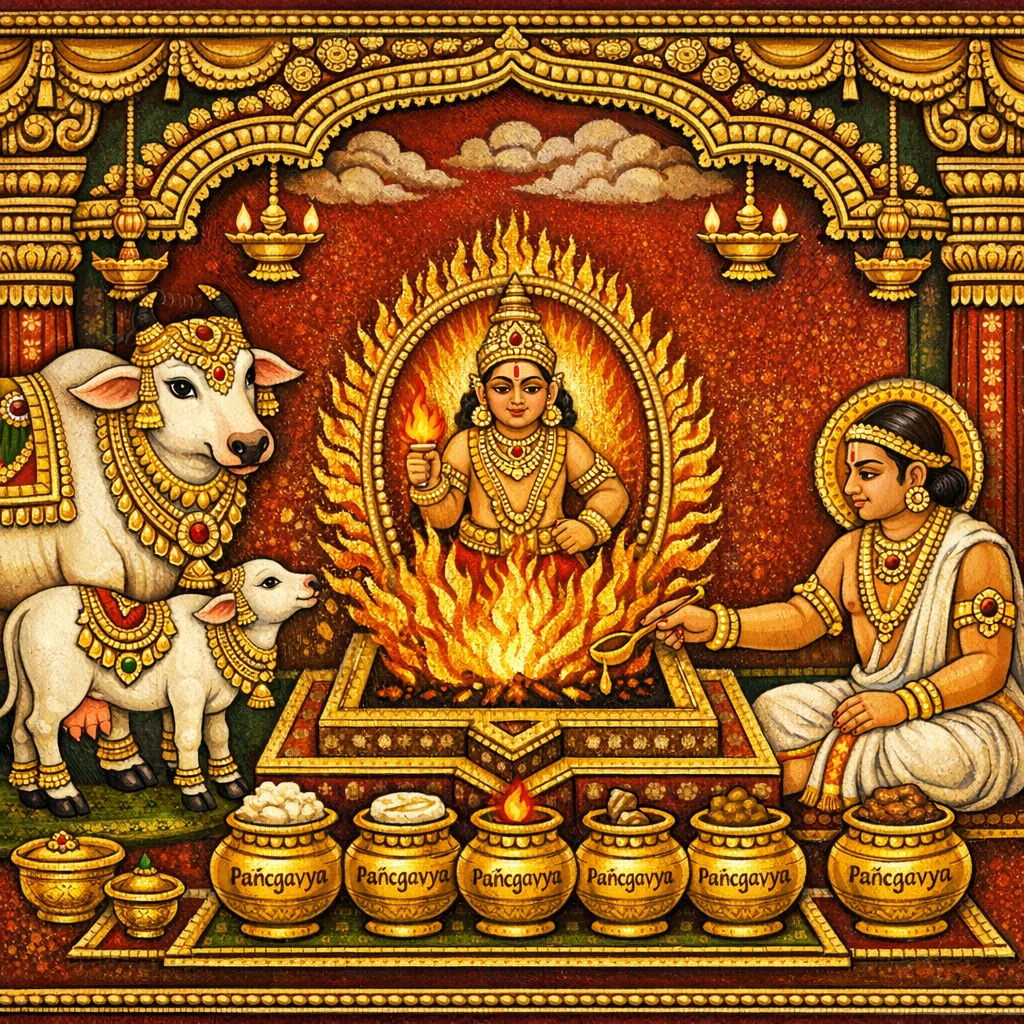
This chapter turns from the close of Gaja-śānti to a cow-centered Śānti-Ayurveda, treating bovine welfare as a king’s moral duty and a cosmological support of the worlds. Dhanvantari affirms the sanctity of cows and the purifying power of pañcagavya-type substances (urine, dung, milk, curd, ghee, and kuśa-water) to remove misfortune, evil dreams, and impurity. It then sets out graded expiations—one-night fasting, Mahā-sāntapana, and kṛcchra variants (taptakṛcchra/śītakṛcchra)—along with the Govrata vow that aligns daily conduct with bovine rhythms, culminating in merit directed toward Goloka. After praising cows as ritual infrastructure (havis, agnihotra, refuge of beings), the text moves into therapeutics (cikitsā): remedies for horn disease, earache, toothache, throat obstruction, vāta disorders, diarrhea, cough/dyspnoea, fractures, kapha conditions, blood disorders, calf nourishment, and anti-graha/anti-poison fumigation. It concludes with calendrical śānti worship of Hari, Rudra, Sūrya, Śrī, and Agni, gifts and release of cows, and a lineage note on specialized veterinary āyurvedas for horses and elephants.
Shlokas
Verse 1
इत्य् आग्नेये महापुराणे गजशान्तिर्नाम नवत्यधिकद्विशततमो ऽध्यायः कृद्वान्यस्मिन्निति ख , ज , ञ च अथैकनवत्यधिकद्विशततमो ऽध्यायः शान्त्यायुर्वेदः धन्वन्तरिर् उवाच गोविप्रपालनं कर्यं रज्ञा गोशान्तिमावदे गावः पवित्रा माङ्गल्या गोषु लोकाः प्रतिष्ठिताः
Thus, in the Agni Mahāpurāṇa, the two-hundred-and-ninetieth chapter, called “Gaja-śānti (Pacification for Elephants),” comes to an end. Now begins the two-hundred-and-ninety-first chapter, “Śāntyāyurveda (Ayurveda for pacificatory rites).” Dhanvantari said: “A king should protect cows and brāhmaṇas; I shall now teach the pacificatory rite concerning cows. Cows are pure and auspicious; the worlds are established in cows.”
Verse 2
शकृन्मूत्रं परं तासामलक्ष्मीनाशनं परं गवां कण्डूयनं वारि शृङ्गस्याघौघमर्दनम्
Cow-dung and cow-urine are supreme for cows, foremost in destroying alakṣmī (misfortune). Water is the best means to relieve cows’ itching, and for the horn it is a crusher of masses of sin and evil.
Verse 3
गोमूत्रं गोमयं क्षीरं दधि सर्पश् च रोचना शडङ्गं परमं पाने दुःस्वप्नाद्यादिवारणं
Cow’s urine, cow-dung, milk, curd (dadhi), sarpa (a serpent-related substance), and rocanā (yellow pigment/bile) make the supreme sixfold mixture for drinking; it wards off evil dreams and similar afflictions.
Verse 4
रोचना विषरक्षोघ्नी ग्रासदः स्वर्गगो गवां यद्गृहे दुःखिता गावः स याति नरकन्नरः
Rocanā (the cow’s yellow pigment) destroys poison and wards off harmful spirits; and one who gives fodder to cows attains heaven. But the man in whose house cows remain distressed goes to hell.
Verse 5
परगोग्रासदः स्वर्गी गोहितो ब्रह्मलोकभाक् गोदानात्कीर्तनाद्रक्षां कृत्वा चोद्धरते कुलम्
One who does not seize another’s cow’s fodder or grazing, who is destined for heaven, and who works for the welfare of cows, becomes a partaker of Brahmā’s world (Brahmaloka). By gifting cows—and by proclaiming their merit—having provided protection, he also uplifts his family line.
Verse 6
गवां श्वासात् पवित्रा भूः स्पर्शनात्किल्विषक्षयः गोमूत्रं गोमयं क्षीरं दधि सर्पिः कुशोदकम्
From the breath of cows the earth is purified; by their touch, sins are destroyed. Likewise purifying are cow’s urine, cow-dung, milk, curd (dadhi), ghee, and water sanctified with kuśa-grass.
Verse 7
एकरात्रोपवासश् च श्वपाकमपि शोधयेत् सर्वाशुभविनाशाय पुराचीरतमीश्वरैः
A fast for a single night can purify even a śvapāka (one deemed most impure by social convention); it was prescribed long ago by the Lords as the means for the destruction of all inauspiciousness.
Verse 8
प्रत्येकञ्च त्र्यहाभ्यम्तं महासान्तपनं स्मृतं सर्वकामप्रदञ्चैतत् सर्वाशुभविमर्दनम्
And each observance, when performed for three days, is known as the Mahā-sāntapana (the ‘great’ Sāntapana penance). This indeed grants the fulfillment of all aims and crushes (removes) every inauspiciousness.
Verse 9
कृच्छ्रातिकृच्छ्रं पयसा दिवसानेकविंशतिं निर्मलाः सर्वकामाप्त्या स्युर्गगाः स्पुर् नतोत्तमाः
Performing the ‘Kṛcchrātikṛcchra’ observance with milk for twenty-one days, they become purified; and by the attainment of all desired aims, they become supremely excellent and radiant, moving in the heavens.
Verse 10
त्र्यहमुष्णं पिवेन्मूत्रं त्र्यहमुष्णं घृतं पिवेत् त्र्यहमुष्णं पयः पीत्वा वायुभक्षः परं त्र्यहम्
For three days one should drink warm urine; for three days one should drink warm ghee. After drinking warm milk for three days, for the next three days one should subsist only on air (i.e., fast completely).
Verse 11
तप्तकृच्छ्रव्रतं सर्वपापघ्नं ब्रह्मलोकदं शीतैस्तु शीतकृच्छ्रं स्याद्ब्रह्मोक्तं ब्रह्मलोकदं
The observance called the Taptakṛcchra-vrata destroys all sins and bestows attainment of Brahmaloka. Likewise, when performed with cold austerities, it becomes the Śītakṛcchra; as declared by Brahmā, it too bestows Brahmaloka.
Verse 12
गोमूत्रेणाचरेत्स्नानं वृत्तिं कुर्याच्च गोरसैः गोभिर्व्रजेच्च भुक्तासु भुञ्जीताथ च गोव्रती
One who observes the Govrata should bathe with cow-urine, sustain himself by the cow’s products, move about with the cows in the cowshed or pasture, and eat only after the cows have eaten.
Verse 13
मासेनैकेन निष्पापो गोलोकी स्वर्गगो भवेत् विद्याञ्च गोमतीं जप्त्वा गोलोकं परमं व्रजेत्
In a single month one becomes free from sin and attains the realm of Goloka, reaching heaven. And having recited the Gomati-vidyā, one goes to the supreme Goloka.
Verse 14
गितैर् नृत्यैर् अप्सरोभिर्विमाने तत्र मोदते गावः सुरभयो नित्यं गावो गुग्गुलगन्धिकाः
There, in a celestial vimāna, he rejoices amid songs and dances performed by Apsarases. The cows there are ever fragrant—cows of sweet scent, cows perfumed with the aroma of guggulu (bdellium).
Verse 15
गावः प्रतिष्ठा भूतानां गावः स्वस्त्ययनं परं अन्नमेव परं गावो देवानां हविरुत्तमम्
Cows are the foundation of all beings; cows are the supreme means of well-being and auspiciousness. Cows are indeed the highest sustenance, and for the gods the cow is the finest oblation (havis).
Verse 16
पावनं सर्वभूतानां क्षरन्ति च वदन्ति च हविषा मन्त्रपूतेन तर्पयन्त्यमरान्दिवि
Purifying all beings, they pour out the oblation and recite the mantras; with the ghee-offering (havis) sanctified by mantra, they satisfy the immortals in heaven.
Verse 17
ऋषीणामग्निहोत्रेषु गावो होमेषु योजिताः सर्वेषामेव भूतानां गावः शरणमुत्तमं
In the agnihotra rites of the sages, cows are employed in the homa-sacrifices; for all beings indeed, cows are the highest refuge.
Verse 18
गावः पवित्रं परमं गावो माङ्गल्यमुत्तमं गावः स्वर्गस्य सोपानं गावो धन्याः सनातनाः
Cows are the supreme purifier; cows are the highest auspiciousness. Cows are the ladder leading to heaven; cows are eternally blessed (and bestowers of blessedness).
Verse 19
नमो गोभ्यः श्रीमतीभ्यः सौरभेयीभ्य एव च नमो ब्रह्मसुताभ्यश् च पवित्राभ्यो नमो नमः
Salutations to the cows—auspicious and blessed; salutations indeed to the Saurabheyī cows; salutations also to the daughters of Brahmā; salutations again and again to the purifying (sacred) ones.
Verse 20
ब्राह्मणाश् चैव गावश् च कुलमेकं द्विधा कृतम् एकत्र मन्त्रास्तिष्ठन्ति हविरेकत्र तिष्ठति
Brahmins and cows are one single ‘family’ divided into two: in one place abide the mantras, and in the other abides the sacrificial oblation.
Verse 21
देवब्राह्मणगोसाधुसाध्वीभिः सकलं जगत् धार्यते वै सदा तस्मात् सर्वे पूज्यतमा मताः
By the gods, Brahmins, cows, holy men, and chaste holy women, the entire world is indeed always sustained; therefore, all of them are regarded as most worthy of worship.
Verse 22
पिवन्ति यत्र तत्तीर्थं गङ्गाद्या गाव एव हि गवां माहात्म्यमुक्तं हि चिकित्साञ्च तथा शृणु
That place where cows drink is indeed a sacred ford (tīrtha), equal to the Gaṅgā and other holy rivers. The greatness of cows has been stated; now listen likewise to their therapeutic applications (cikitsā).
Verse 23
शृङ्गामयेषु धेनूनां तैलं दद्यात् ससैन्धवं शृङ्गवेरबलामांसकल्कसिद्धं समाक्षिकं
In diseases of the horns in cows, one should administer oil mixed with rock-salt (saindhava)—oil prepared by cooking it with a paste of dry ginger (śṛṅgavera), balā, and meat—and then combined with honey.
Verse 24
कर्णशूलेषु सर्वेषु मञ्जिष्ठाहिङ्गुसैन्धवैः सिद्धं तैलं प्रदातव्यं रसोनेनाथ वा पुनः
In all kinds of earache, one should administer as ear-drops oil cooked with mañjiṣṭhā, hiṅgu, and saindhava-salt; or again, oil prepared with garlic.
Verse 25
बिल्वमूलमपामार्गन्धातकी चसपाटला कुटजन्दन्तमूलेषु लेपात्तच्छूलनाशनं
A paste made from bael-root (bilva), apāmārga, dhātakī, and pāṭalā, together with kuṭaja, when applied to the roots of the teeth (the gums), destroys that toothache.
Verse 26
दन्तशूलहरैर् द्रव्यैर् घृतं राम विपाचितं मुखरोगहरं ज्ञेयं जिह्वारोगेषु सैन्धवं
Ghee (ghṛta), O Rāma, medicated by cooking it with substances that alleviate toothache, should be understood as a remedy that removes diseases of the mouth; and in disorders of the tongue, saindhava (rock-salt) is prescribed.
Verse 27
शृङ्गवेरं हरिद्रे द्वे त्रिफला च गलग्रहे हृच्छूले वस्तिशूले च वातरोगे क्षये तथा
Dry ginger (śṛṅgavera), the two haridrās (turmeric and daruharidrā), and Triphalā are prescribed for obstruction or stricture of the throat; likewise for pain in the region of the heart, pain of the bladder or urinary tract, disorders caused by vāta, and also for consumption (kṣaya).
Verse 28
त्रिफला घृतमिश्रा च गवां पाने प्रशस्यते अतीसारे हरिद्रे द्वे पाठाञ्चैव प्रदापयेत्
Triphālā mixed with ghee (ghṛta) is highly commended for administration as a drink in cases of diarrhea. In diarrhea, one should also administer the two haridrās (turmeric and daruharidrā) and pāṭhā.
Verse 29
सर्वेषु कोष्ठरोगेषु तथाशाखागदेषु च शृङ्गवेरञ्च भार्गीञ्च कासे श्वासे प्रदापयेत्
In all diseases of the koṣṭha (trunk and viscera), and likewise in disorders affecting the śākhā (limbs and peripheral tissues), one should administer dry ginger and bhārgī; they are also to be given in cough and in dyspnoea (śvāsa).
Verse 30
दातव्या भग्नसन्धाने प्रियङ्गुर्लबणान्विता तैलं वातहरं पित्ते मधुयष्टीविपाचितं
For the setting and union of fractures, oil prepared with priyaṅgu and salt should be administered; it should be an oil that alleviates vāta, and in pitta-conditions it should be oil cooked (processed) with licorice (madhuyaṣṭī).
Verse 31
कफे व्योषञ्च समधु सपुष्टकरजो ऽस्रजे तैलाज्यं हरितालञ्च भग्नक्षतिशृतन्ददेत्
In disorders of kapha, one should administer vyōṣa (the pungent triad) together with honey and the powder of puṣṭakaraja. In conditions involving blood (asṛj), one should give oil and ghee (taila-ājya), and also haritāla; and one should administer the preparations cooked/processed for fractures and wounds.
Verse 32
मासास्तिलाः सगोधूमाः पशुक्षीरं घृतं तथा एषां पिण्डी सलवणा वत्सानां पुष्टिदात्वियं
Beans (māṣa), sesame seeds, and wheat, together with animal milk and ghee—when formed into a salted bolus (piṇḍī)—this preparation bestows nourishment and strength upon calves.
Verse 33
बलप्रदा विषाणां स्यद्ग्रहनाशाय धूपकः देवदारु वचा मांसी गुग्गुलुर्हिङ्गुसर्षपाः
A medicated fumigant that bestows strength and serves as an antidotal measure against poisons is prescribed for destroying graha-afflictions: deodar (devadāru), sweet-flag (vacā), spikenard (māṁsī), guggulu resin, asafoetida (hiṅgu), and mustard (sarṣapa).
Verse 34
ग्रहादिगदनाशाय एष धूपो गवां हितः घण्ठा चैव गवां कार्या धूपेनानेन भूपिता
For the destruction of afflictions caused by grahas and other diseases, this fumigation is beneficial for cattle. A bell, too, should be made for the cattle, consecrated (purified) with this very fumigation.
Verse 35
अश्वगन्धातिलैः शुक्लं तेन गौः क्षीरिणी भवेत् रसायनञ्च पिन्याकं मत्तो यो धार्यते गृहे
With a white sesame preparation mixed with aśvagandhā and sesame seeds, a cow becomes abundant in milk. Likewise, the oil-cake (pinyāka), kept in the household and given as a rasāyana (rejuvenative feed), produces the desired effect.
Verse 36
भवां पुरीषे पञ्चभ्यां नित्यं शान्त्यै श्रियं यजेत् वासुदेवञ्च गन्धाद्यैर् अपरा शान्तिरुच्यते
For pacification (śānti), one should regularly worship Śrī (Lakṣmī) with the five products of the cow, even including dung and the like. One should also worship Vāsudeva with perfumes and other offerings—this is declared to be another form of pacification rite.
Verse 37
अश्वयुक्शुक्लपक्षस्य पञ्चदश्यां यजेद्धरिं हरिरुद्रमजं सूर्यं श्रियमग्निं घृतेन च
On the fifteenth lunar day (the full-moon day) of the bright fortnight in the month of Aśvayuj, one should worship Hari; and also Hari, Rudra, the Unborn (Brahmā), Sūrya, Śrī (Lakṣmī), and Agni, offering ghee as the oblation.
Verse 38
दधि सम्प्राश्य गाः पूज्य कार्यं वाह्निप्रदक्षिणं वृषाणां योजेयेद् युद्धं गीतवाद्यरवैर् वहिः
Having partaken of curd (dadhi), one should worship the cows and perform pradakṣiṇā, circumambulation of the sacred fire. Outside the ritual space, one should arrange a contest of bulls, accompanied by singing and the sounds of musical instruments.
Verse 39
गवान्तु लवणन्देयं ब्राह्मणानाञ्च दक्षिणा नैमित्तिके माकरादौ यजेद्विष्णुं सह श्रिया
One should gift cows together with salt, and also provide the dakṣiṇā, the priests’ fee, to the Brāhmaṇas. In a naimittika rite performed for a specific occasion—such as at Makara (the Makara-saṅkrānti period) and the like—one should worship Viṣṇu together with Śrī (Lakṣmī).
Verse 40
स्थण्डिलेब्जे मध्यगते दिक्षु केशरगान् सुरान् सुभद्राजो रविः पूज्यो बहुरूपो बलिर्वहिः
In the lotus (diagram) drawn on the ritual ground, with (the deity) placed in the center, one should station the gods upon the filaments in the directions. The Sun (Ravi), named Subhadrāja, is to be worshipped—manifold in form—together with the bali offering that is carried into the rite.
Verse 41
खं विश्वरूपा सिद्धिश् च ऋद्धिः शान्तिश् च रोहिणी दिग्धेनवो हि पूर्वाद्याः कृशरैश् चन्द्र ईश्वरः
“Khaṃ”; Viśvarūpā; Siddhi; Ṛddhi; Śānti; and Rohiṇī. The “directional cows” are indeed the east and the other directions; and Candra, the Lord, is to be remembered/worshipped with kṛśara offerings (rice cooked with legumes).
Verse 42
दिक्पालाः पद्मपत्रेषु कुम्भेष्वग्नौ च होमयेत् क्षीरवृक्षस्य समिधः सर्षपाक्षततण्डुलान्
For the Guardians of the Directions (Dikpālas), one should perform homa using lotus-leaves, placing offerings in ritual pots (kumbhas) and also into the fire—offering kindling-sticks (samidh) of milky trees, together with mustard seeds, akṣata (unbroken rice), and rice grains.
Verse 43
शतं शतं सुवर्णञ्च कांस्यादिकं द्विजे ददेत् गावः पूज्या विमोक्तव्याः शान्त्यै क्षीरादिसंयुताः
One should give, by the hundreds, gold and also bronze and the like to a twice-born (brāhmaṇa). For pacification (śānti), cows—endowed with milk and other produce—are to be honored and then set free.
Verse 44
अग्निर् उवाच शालिहोत्रः सुश्रुताय हयायुर्वेदमुक्तवान् पालकाप्यो ऽङ्गराजाय गजायुर्वेदमब्रवीत्
Agni said: Śālihotra taught Suśruta the Āyurveda of horses; and Pālakāpya expounded the Āyurveda of elephants to the king of Aṅga.
Frequently Asked Questions
It pairs ritual-purity technology (cow-derived purifiers; graded penances like Mahā-sāntapana and Taptakṛcchra) with concrete medical recipes (medicated oils, pastes, ghee preparations, fumigation formulas) and condition-specific indications, including veterinary applications.
By presenting care of cows, disciplined fasting/vows, gifting and protection (dāna/rakṣā), and mantra-ritual observance as purifiers that remove pāpa and inauspiciousness, it frames health and social duty as supports for dharma and higher posthumous attainments (e.g., Goloka/Brahmaloka).