Adhyaya 294
Daṣṭa-cikitsā (Treatment for Bites) — Mantra-Dhyāna-Auṣadha Protocols for Viṣa
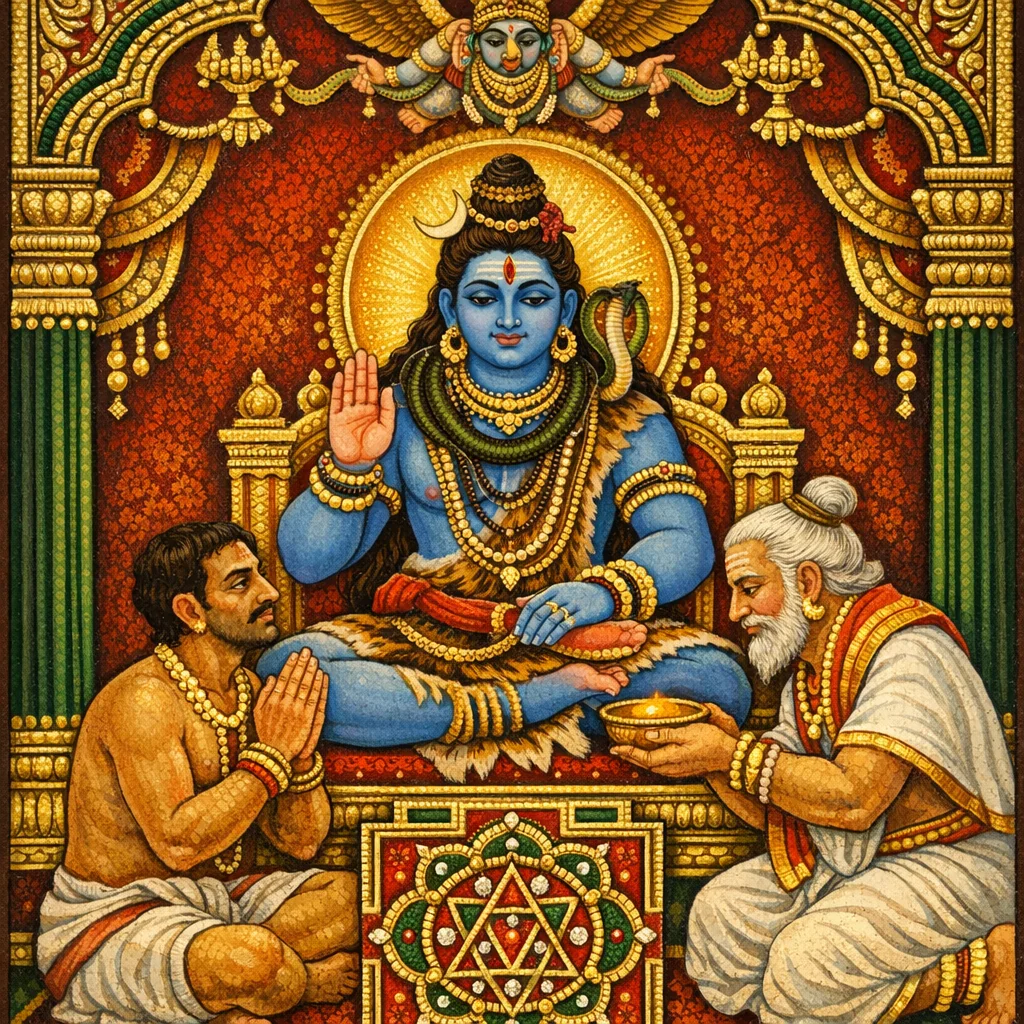
Lord Agni opens a specialized Ayurveda section on daṣṭa-cikitsā (treatment of bites and stings), teaching a threefold therapy of mantra (sacred recitation), dhyāna (meditative visualization), and auṣadha (medicinal administration). He first grounds clinical urgency in devotional power: japa of “Oṃ namo bhagavate Nīlakaṇṭhāya” is said to lessen poison and safeguard life, then viṣa is classified as jaṅgama (mobile, animal-origin—snakes, insects) and sthāvara (immobile, plant/mineral-origin). Agni then details a ritual-therapeutic system centered on the Viyati/Tārkṣya (Garuḍa) mantra, including tonal/phonetic distinctions, kavaca and astra-mantras, yantra/maṇḍala visualization (the mātṛkā-lotus), and precise nyāsa on fingers and bodily joints. Five-element schemata (earth, water, fire, wind, ether) with colors, forms, and presiding deities support a controlled “reversal/interchange” logic to immobilize, transfer, and destroy poison. The chapter concludes with Garuḍa and Rudra/Nīlakaṇṭha mantras, ear-whisper recitation (karṇa-jāpa), protective binding (upānahāva), and Rudra-vidhāna worship, framing anti-venom practice as both medical treatment and dhārmic rite.
Shlokas
Verse 1
इत्य् आग्नेये महापुराणे नागलक्षणदिर्नाम त्रिनवत्यधिकद्विशततमो ऽध्यायः अथ चतुर्नवत्यधिकद्विशततमो ऽध्यायः दष्टचिकित्सा अग्निर् उवाच मन्त्रध्यानौषधैर् दष्टचिकित्सां प्रवदामि ते ॐ नमो भगवते नीलकण्ठायेति जपनाद्विषहानिः स्यदौषधं जीवरक्षणं
Thus, in the Agni Mahāpurāṇa ends the two-hundred-and-ninety-fourth chapter, called “The Characteristics of Serpents (Nāgas).” Now begins the two-hundred-and-ninety-fifth chapter: “Treatment for Bites.” Agni said: “Through mantras, meditative contemplation, and medicines, I shall teach you the treatment for snakebite. By repeating the japa, ‘Oṃ, obeisance to the Blessed Lord Nīlakaṇṭha,’ the force of poison is diminished; this becomes a remedy for the protection of life.”
Verse 2
साज्यं सकृद्रसं पेयं द्विविधं विषमुच्यते जङ्गमं सर्पभूषादि शृङ्ग्यादि स्थावरं विषं
Poison is said to be of two kinds: that which is taken mixed with ghee, and that which is taken as expressed juice in a single dose (as a therapeutic administration). Mobile poison (animal-origin) is that of snakes, insects, and the like; immobile poison (plant/mineral-origin) is that from Śṛṅgī and similar sources.
Verse 3
शान्तस्वरान्वितो ब्रह्मा लोहितं तारकं शिवः वियतेर्नाममन्त्रो ऽयं तार्क्षः शब्दमयः स्मृतः
Brahmā is to be understood as endowed with the śānta (pacific) tonal accent; Śiva is associated with the lohita (ruddy) tāraka (deliverer) tone. This is a mantra named “Viyati”; it is remembered as “Tārkṣya,” constituted of sound.
Verse 4
ख र्दय विमर्दय कवचाय अप्रतिहतशामनं वं हूं फट् अस्त्राय उग्ररूपवारक सर्वभयङ्कर भीषय सर्वं दह दह भस्मीकुरु कुरु स्वाहा नेत्राय सप्तवर्गान्तयुग्माष्टदिग्दलस्वर केशरादिवर्णरुद्धं वह्निराभूतकर्णकं मातृकाम्बुजं कृत्वा हृदिस्थं तन्मन्त्री वामहस्ततले स्मरेत् अङ्गष्ठादौ न्यसेद्वर्णान्वियतेर्भेदिताः कलाः
“Kha—(for the Heart): crush, crush! For the protective armor (kavaca): the pacifier of the unopposed (hostile forces). Vaṁ, hūṁ, phaṭ—(as) the weapon-mantra (astra): the repeller of fierce forms. Make all that is terrifying, with every fear, become afraid; burn, burn everything; reduce it to ashes—do, do—svāhā. For the Eyes (netra): having formed the ‘lotus of letters’ (mātṛkā-ambuja)—whose pericarp is of the nature of fire, whose petals are the eight directions, whose sounds are arranged as paired endings of the seven varga-groups, and whose colors are constrained from saffron and other hues—the adept of that mantra should visualize it as abiding in the heart, upon the palm of the left hand. Beginning with the thumb, he should place (nyāsa) the letters; the kalās are differentiated according to Viyati, the expanse of space.”
Verse 5
पीतं वज्रचतुष्कोणं पार्थिवं शक्रदैवतं वृत्तार्धमाप्यपद्मार्धं शुक्लं वरूणदैवतं
The earth-principle is yellow, shaped as a four-cornered (diamond-like) quadrilateral, and has Śakra (Indra) as its presiding deity. The water-principle is white, formed as a half-circle and as half a lotus, and has Varuṇa as its presiding deity.
Verse 6
त्र्यस्त्रं स्वस्तिकयुक्तञ्च तैजसं वह्निदैवतं वृत्तं विन्दुवृतं वायुदैवतं कृष्णमालिनम्
The Tryastra is to be marked with a svastika. The Taijasa is presided over by Fire, Agni. The circular weapon-diagram is a circle with a central dot; it is presided over by Vāyu and encircled with a black garland (a black ring or border).
Verse 7
अङ्गुष्ठाद्यङ्गुलीमध्ये पर्यस्तेषु स्ववेश्मसु सुवर्णनागवाहेन वेष्ठितेषु न्यसेत् क्रमात्
Then, in due order, one should perform nyāsa upon the respective “abodes” (assigned locations) situated in the middle of the fingers beginning with the thumb, which are encircled by the golden serpent-current (nāga-vāha).
Verse 8
वियतेश् चतुरो वर्णान् सुमण्डलसमत्विषः अरूपे रवतन्मात्रे आकाशेशिवदेवते
In viyat (ether) are the four classes (varṇas), radiant with a lustre equal to a splendid orb. In that which is formless—whose subtle measure is sound (rava) alone—the presiding deity of ākāśa is Śiva.
Verse 9
कनिष्ठामध्यपर्वस्थे न्यसेत्तस्याद्यमक्षरम् नागानामादिवर्णांश् च स्वमण्डलगतान्न्यसेत्
On the middle phalanx of the little finger, one should place (by nyāsa) its first syllable; and one should also place the initial letters of the Nāgas, as arranged within one’s own maṇḍala.
Verse 10
भूतादिवर्णान् विन्यसेदङ्गुष्टाद्यन्तपर्वसु तन्मात्रादिगुणाभ्यर्णानङ्गुलीषु न्यसेद्बुधः
A wise practitioner should assign (by nyāsa) the syllables beginning with the bhūtas upon the joints from the thumb up to the terminal joints; and he should place upon the fingers the syllables corresponding to the qualities (guṇas) beginning with the tanmātras.
Verse 11
स्पर्शनादेवतार्क्षेण हस्ते हन्याद्विषद्वयं मण्डलादिषु तान् वर्णान् वियतेः कवयो जितान्
By mere touch, through Tārkṣya (Garuḍa), one should strike down with the hand the pair of poisons; and in diagrams such as maṇḍalas one should inscribe those syllabic letters—conquered by the sages—belonging to the element of space.
Verse 12
श्रेष्ठद्व्यङ्गुलिभिर्देहनाभिस्थानेषु पर्वसु भेदिकास्तथेति ख वरतन्मत्रे इति ख आजानुतः सुवर्णाभमानाभेस्तुहिनप्रभम्
With the best standard measure of two aṅgulas, the bodily joints—at the places around the navel (the mid-body)—are to be marked as dividing points (bhedikā). From the knees downward, the ideal complexion is golden-hued; at the navel-region it is radiant like snow, bright and clear.
Verse 13
कुङ्कुमारुणमाकण्ठादाकेशान्तात् सितेतरं ब्रह्माण्डव्यापिनं तार्क्षञ्चन्द्राख्यं नागभूषणम्
From the throat up to the crown of the head, visualize it as vermilion-red like saffron; from there downward as of another hue, whitish. That form is all-pervading, filling the Brahmāṇḍa (the cosmic egg, the universe), known as Tārkṣya and “Candrākhya” (“Moon-named”), and adorned with serpents as ornaments.
Verse 14
नीलोग्रनाशमात्मानं महापक्षं स्मरेद्बुधः एवन्तात्क्षात्मनो वाक्यान्मन्त्रः स्यान्मन्त्रिणो विषे
A learned practitioner should visualize within himself the Great-Winged one, the destroyer of the fierce “blue” poison. From such visualization and from the words uttered by oneself, it becomes a mantra effective for the mantra-knower against poison.
Verse 15
सुष्टिस्तार्क्षकरस्यान्तःस्थिताङ्गुष्ठविषापहा तार्क्षं हस्तं समुद्यम्य तत्पञ्चाङ्गुलिचालनात्
Suṣṭi—the mudrā/mantra situated within the “Tārkṣa-hand,” with the thumb placed inside—removes poison. Having raised the Tārkṣa-hand, by moving (shaking) its five fingers, the poison is dispelled.
Verse 16
कुर्याद्विषस्य स्तम्भादींस्तदुक्तमदवीषया आकाशादेष भूवीजः पञ्चार्णाधिपतिर्मनुः
One should carry out the rites beginning with the immobilization (stambhana) of poison, as taught, by means of the mantric formula “ada-vīṣā.” This mantra is the Earth-seed (bhū-bīja) arising from Ākāśa, and it presides over the five-syllabled mantra.
Verse 17
संस्तम्भयेतिविषतो भाषया स्तम्भ्येद्विषम् व्यत्यस्तभूषया वीजो मन्त्रो ऽयं साधुसाधितः
By uttering, in the proper mode of speech, the formula beginning with “saṃstambhaye,” one should arrest the poison. This is a bīja-mantra, rightly accomplished, to be employed with an inverted or altered arrangement (of syllables/ornamentation).
Verse 18
संप्लवः प्लावय यमः शब्दाद्यः संहरेद्विषं दण्डमुत्थापयेदेष सुजप्ताम्भो ऽभिषेकतः
“Saṃplava” brings about inundation; “Plāvaya” makes (the enemy’s forces) drift away; “Yama” restrains them. The “Śabdādya” mantra, beginning with the mystic sound, destroys the foe. This rite “raises the staff”—that is, establishes punitive authority—through an abhiṣeka of sprinkling with water well consecrated by mantra-recitation.
Verse 19
सुजप्तशङ्खभेर्यादिनिस्वनश्रवणेन वा संदहत्येव संयुक्तो भूतेजोव्यत्ययात् स्थितः
Or else, by hearing the resonant sound of a conch (śaṅkha), kettle-drum (bherī), and similar instruments well consecrated by japa, the afflicting entity—being in a state produced by the inversion (mutual opposition) of the elements and fiery energy—seems, as it were, to be burned up when confronted by that rite.
Verse 20
भूवायुव्यत्ययान्मन्त्रो विषं संक्रामयत्यसौ अन्तस्थो निजवेश्मस्थो वीजाग्नीन्दुजलात्मभिः
By the regulated interchange (control and reversal) of earth and wind, that mantra causes the poison to be transferred. Whether the practitioner is within (the patient’s body) or stationed in his own dwelling, it operates through seed-syllables, and through fire, the moon, and water as its effective powers.
Verse 21
एतत् कर्म नयेन्मन्त्री गरुडाकृतिविग्रहः तार्क्षवर्णगेहस्थस्तज्जपान्नाशयेद्विषम्
The mantra-practitioner should perform this rite, assuming a form (or posture) shaped like Garuḍa; established within a space marked by the colour/sign of Tārkṣya (Garuḍa), by the recitation of that (mantra) he should destroy poison.
Verse 22
जामुदण्डीदमुदितं स्वधाश्रीवीजलाञ्छितं स्नानपानात्सर्वविषं ज्वरातोगापमृत्युजित्
This (formula) called Jāmudaṇḍī, proclaimed here and marked with (the powers of) Svadhā, Śrī, and Vījalā—by bathing and drinking (water empowered with it), it conquers all poisons, fever, disease, and untimely death.
Verse 23
पक्षि पक्षि महापक्षि महापक्षि विधि स्वाहा यश इति ञ पक्षि पक्षि महापक्षि महापक्षि क्षि क्षि स्वाहा
“O Bird, O Bird; O Great Bird, O Great Bird—by the rite/ordinance (vidhi), svāhā. ‘Glory/fame’—thus (is said), with the syllable ña. Again: O Bird, O Bird; O Great Bird, O Great Bird—kṣi kṣi, svāhā.”
Verse 24
द्वावेतौ पक्षिराड्मन्त्रौ विषघ्नावभिमन्त्रणात् पक्षिराजाय विध्महे पक्षिदेवाय धीमहि तत्रो गरुड प्रचोदयात् वह्निस्थौ पार्श्वतत्पूर्वौ दन्तश्रीकौ च दण्डिनौ सकालो लाङ्गली चेति नीलकण्ठाद्यमीरितं वक्षःकण्ठशिखाश्वेतं न्यसेत्स्तम्भे सुसंस्कृतौ
These two ‘King-of-birds’ (Garuḍa-related) mantras, when used for consecratory recitation (abhimantraṇa), become destroyers of poison: “We contemplate the King of Birds; we meditate upon the Bird-Deity; may that Garuḍa impel (us).” He should then install (them) on a well-consecrated pillar: (visualizing/placing) the pair ‘Dantaśrīka’ and ‘Daṇḍin’ stationed in fire, together with ‘Sa-kāla’ and ‘Lāṅgalī’, as taught beginning with Nīlakaṇṭha—(with the marks/placement) white upon the chest, throat, and crest (of the figure/yantra).
Verse 25
हर हर हृदयाय नमः कपर्दिने च शिरसे नीलकण्ठाय वै शिखां कालकूटविषभक्षणाय स्वाहा अथ वर्म च कण्ठे नेत्रं कृत्तिवासास्त्रिनेत्रं पूर्वाद्यैर् आननैर् युक्तं श्वेतपीतारुणासितैः अभयं वरदं चापं वासुकिञ्च दधद्भुजैः यस्योपरीतपार्श्वस्थगौरीरुद्रो ऽस्य देवता
“Hara, Hara! Homage to (Rudra) at the heart. Homage to Kapardin at the head. (Homage) to Nīlakaṇṭha at the crown-lock (śikhā). Svāhā to the Devourer of the Kālakūṭa poison. Now (place) the armor (varma) at the throat—the Eye (there): Kṛttivāsas, the Three-Eyed (Lord), endowed with faces beginning with the eastern one, (those faces) being white, yellow, tawny-red, and black; whose arms bear (the gestures of) fearlessness and boon-giving, and also a bow and Vāsuki (the serpent). The deity of this (kavaca/placement) is Rudra together with Gaurī positioned on his upper side/flank.
Verse 26
पादजानुगुहानाभिहृत्कण्ठाननमूर्धसु मन्त्रार्णान्न्यस्य करयोरङ्गुष्ठाद्यङ्गुलीषु च
Having placed (nyāsa) the mantra-syllables upon the feet, knees, groins, navel, heart, throat, face, and head, one should also place them upon the hands—upon the thumb and the other fingers.
Verse 27
तर्जन्यादितदन्तासु सर्वमङ्गुष्ठयोर् न्यसेत् ध्यात्वैवं संहरेत् क्षिप्रं वद्धया शूलमुद्रया
Placing all (the intended nyāsa) upon the fingertips beginning with the index finger, one should then set them upon the two thumbs. Having thus contemplated, one should swiftly withdraw (the placements) by means of the bound Śūla-mudrā.
Verse 28
कनिष्ठा ज्येष्ठया वद्धा तिश्रो ऽन्याः प्रसृतेर्जवाः विषनाशे वामहस्तमन्यस्मिन् दक्षिणं करं
With the little finger bound to the thumb and the other three fingers swiftly extended, for the destruction of poison one should apply the left hand (in this gesture) and, on the other side, the right hand.
Verse 29
ॐ नमो भगवते नीलकण्ठाय चिः अमलकण्ठाय चिः सर्वज्ञकण्ठाय चिः क्षिप ॐ स्वाहा अमलनीलकण्ठाय नैकसर्वविषापहाय नमस्ते रुद्रमन्यव इतिसर्मार्जनाद्विषं विनश्यति न सन्देहः कर्णजाप्या उपानहावा यजेद्रुद्रविधानेन नीलग्रीवं महेश्वरम् विषव्याधिविनाशः स्यात् कृत्वा रुद्रविधानकं
“Om—obeisance to the Blessed Lord Nīlakaṇṭha; (utter) ‘ciḥ’ to Amala-kaṇṭha; (utter) ‘ciḥ’ to Sarvajña-kaṇṭha; ‘kṣipa’; Om, svāhā. Salutations to the stainless Nīlakaṇṭha, the remover of many and of all poisons. By reciting ‘namas te rudra manyava’ and performing sarmārjana (ritual wiping/purification), the poison is destroyed—without doubt. It is to be murmured into the ear (karṇa-jāpa) and employed as an upānahāva (protective binding/amulet rite). One should worship Maheśvara, the blue-necked Nīlagrīva, according to the Rudra-vidhāna; having performed the Rudra-rite, diseases born of poison will be destroyed.”
Frequently Asked Questions
A structured anti-poison protocol combining (1) poison taxonomy (jaṅgama/sthāvara), (2) mantra sets (kavaca/astra/bīja), (3) mātṛkā-ambuja visualization and maṇḍala inscription, and (4) precise nyāsa placements on finger-phalanxes and bodily joints with elemental color-shape-deity correspondences.
It frames healing as dharma-sādhana: devotion to Nīlakaṇṭha/Rudra and disciplined mantra-dhyāna are presented as life-protecting powers, aligning medical action (bhukti) with purity, restraint, and sacred speech that support inner steadiness and spiritual progress (mukti).