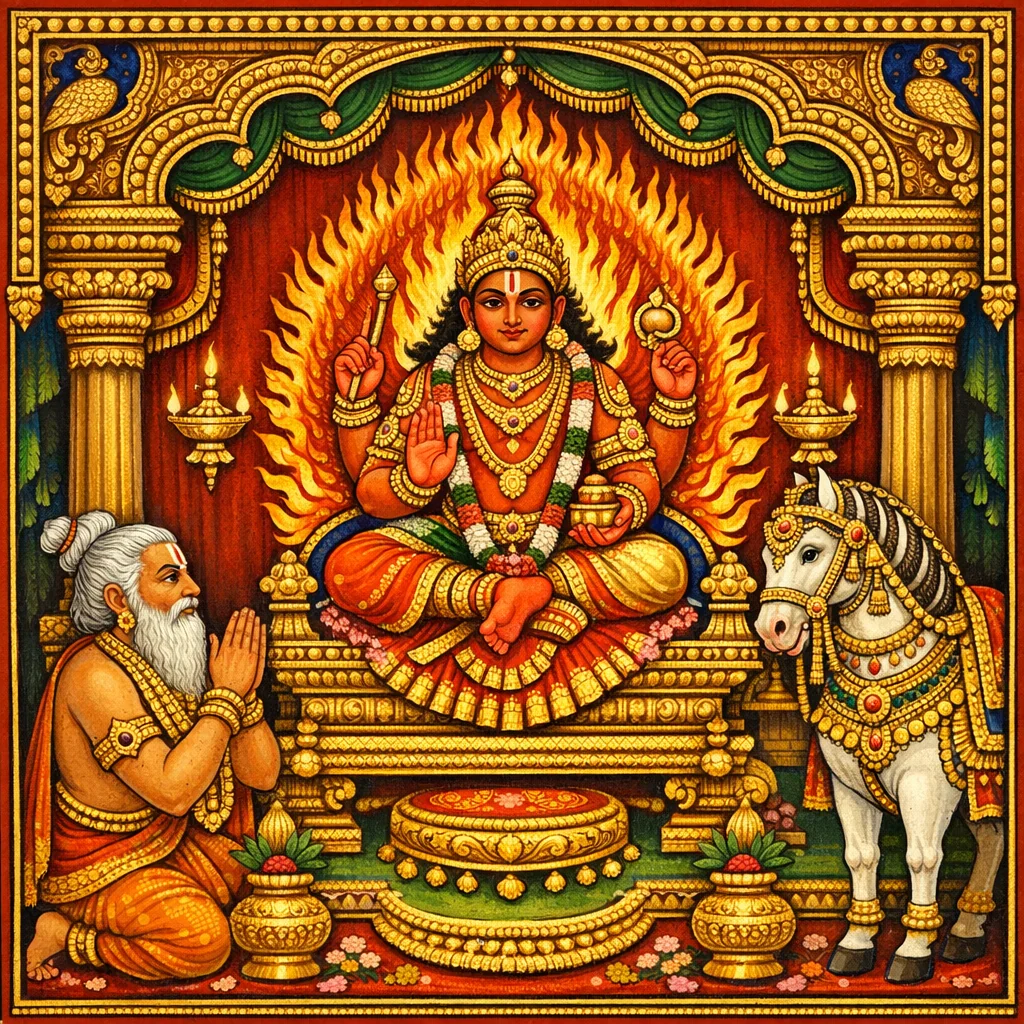
Adhyaya 289
Aśvāyurveda (Medical Science of Horses)
This chapter serves as a heading and bridge into the specialized Ayurvedic field of veterinary medicine, marking the section as Aśvāyurveda within the Agni Purana’s encyclopedic curriculum. In the Agneya Vidyā framework, the care of horses is not merely practical; it is affirmed as a legitimate science that upholds dharma by safeguarding livelihood, mobility, and royal or communal stability. Its placement indicates that Purāṇic medical knowledge extends beyond human therapy to species-specific health management, preparing the reader for subsequent procedural and pacificatory methods. In the Purana’s systematic pedagogy, technical instruction is framed as sacred knowledge—where right practice, right timing, and right intention harmonize bodily welfare with cosmic order.
Shlokas
Verse 1
इत्य् आग्नेये महापुराणे अश्वायुर्वेदो नामाष्टाशीत्यधिकद्विशततमो ऽध्यायः अथोननवत्यधिकद्विशततमो ऽध्यायः अश्वशान्तिः शालिहोत्र उवाच अश्वशान्तिं प्रवक्ष्यामि वजिरोगविमर्दनीं नित्यां नैमित्तकीं कम्यां त्रिविधां शृणु सुश्रुत
Thus, in the Agni Mahāpurāṇa, the two-hundred-and-eighty-ninth chapter is entitled “Aśvāyurveda,” the medical science of horses. Now begins the two-hundred-and-ninetieth chapter, “Aśvaśānti,” the pacificatory rite for horses. Śālihotra said: “I shall teach the Horse-Peace rite, which crushes the diseases of horses—threefold: the daily (regular), the occasional (for a specific cause), and the desire-fulfilling. Listen, O Suśruta.”
Verse 2
शुभे दिने श्रीधरञ्च श्रियमुच्चैःश्रवाश् च तं हयराजं समभ्यर्च्य सावित्रैर् जुजुयाद्घृतं
On an auspicious day, having duly worshipped Śrīdhara (Viṣṇu), Śrī (Lakṣmī), and Uccaiḥśravas—the king of horses—one should offer ghee into the sacred fire while reciting the Sāvitrī (Gāyatrī) mantras.
Verse 3
द्विजेभ्यो दक्षिणान्दद्यादश्ववृद्धिस् तथा भवेत् अश्वयुक् शुक्लपक्षस्य पञ्चदश्याञ्च शान्तिकं
One should give dakṣiṇā, the ritual fee, to the twice-born (Brahmin officiants); thereby there will indeed be an increase of horses. And on the full-moon day of the month Aśvayuj (the fifteenth of the bright fortnight), a śāntika, a pacificatory rite, should also be performed.
Verse 4
वहिः कुर्याद्विशेषेण नासत्यौ वरुणं यजेत् समुल्लिख्य ततो देवीं शाखाभिः परिवारयेत्
One should make the offering outside (the enclosure) with particular care; one should worship the Nāsatyas (the twin Aśvins) and Varuṇa. Then, having clearly marked the ritual ground/mandala, one should surround the Goddess with branches as a protective boundary.
Verse 5
घतान्सर्वरसैः पूर्णान् दिक्षु दद्यात्सवस्त्रकान् यवाज्यं जुहुयात् प्रार्च्य यजेदश्वांश् च साश्विनान्
He should present, in the directions (the eight quarters), pots filled with all kinds of flavorful liquids, together with garments. Having first duly worshipped, he should offer into the fire an oblation of barley mixed with ghee, and he should also perform worship for the horses along with the Aśvin-deities.
Verse 6
विप्रेभ्यो दक्षिणान्दद्यान्नैमित्तिकमतः शृणु मकरादौ हयानाञ्च पद्मैर् विष्णुं श्रियं यजेत्
One should give dakṣiṇā (priestly fees) to the Brahmins; now hear the rule for occasional (naimittika) rites. At the beginning of Makara (Capricorn)—and likewise at the commencement of Aśvinī (the asterism)—one should worship Viṣṇu and Śrī with lotus-flowers.
Verse 7
ब्रह्माणं शङ्करं सोममादित्यञ्च तथाश्विनौ रेवन्तमुच्चैःश्रवसन्दिक्पालांश् च दलेष्वपि
He should also place (invoke/install) Brahmā, Śaṅkara (Śiva), Soma (the Moon), Āditya (the Sun), the two Aśvins, Revanta, Uccaiḥśravas, and the guardians of the directions—even upon the lotus-petals (of the mandala).
Verse 8
प्रत्येकं पूर्णकुम्भैश् च वेद्यान्तत्सौम्यतः स्थले तिलाक्षताज्यसिद्धार्थान् देवतानां शतं शतं उपोषितेन कर्तव्यं कर्म चास्वरुजापहं
At each station, one should place full water-pitchers (pūrṇa-kumbhas) at the edge of the altar, on the auspicious side. With sesame, unbroken rice (akṣata), ghee, and white mustard, one should make offerings to the deities—by hundreds upon hundreds—while observing a fast; and the rite becomes a remover of pain and illness.
Frequently Asked Questions
It marks the beginning of Aśvāyurveda, establishing veterinary Ayurveda—specifically horse medicine—as a recognized Agneya Vidya within the Purana’s encyclopedic system.
By presenting health-care knowledge as dharmic practice: protecting life and social order (bhukti) while cultivating disciplined, ritually aligned action that supports inner refinement (mukti).