Adhyaya 290
Chapter 290 — गजशान्तिः (Gaja-śānti: Elephant-Pacification Rite)
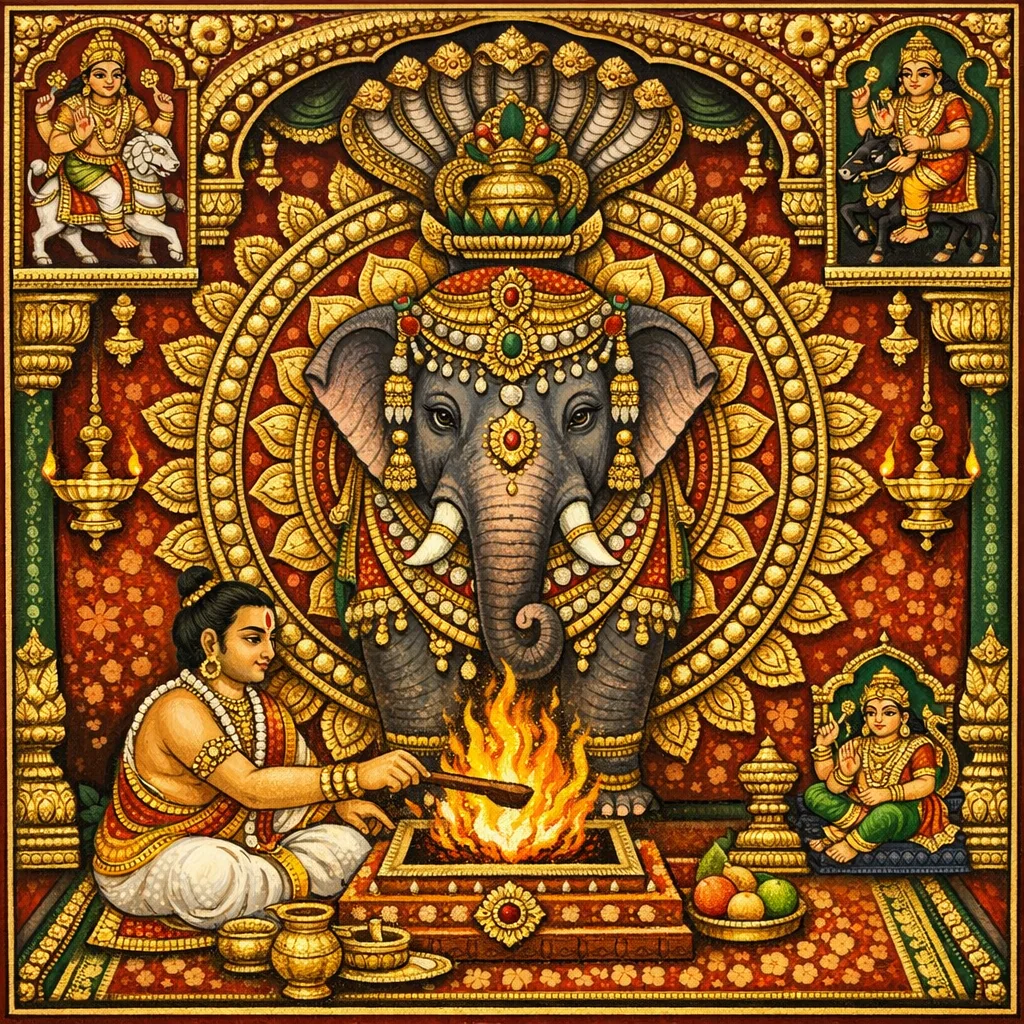
Following the close of Aśva-śānti, this chapter sets out Śālihotra’s gaja-śānti, an applied Ayurvedic-veterinary and royal-protective rite to quell elephant diseases and avert inauspicious results. It begins with choosing the proper time (pañcamī) and a full cycle of invocations—Viṣṇu and Śrī, major deities, cosmic regulators, and Nāga lineages. A lotus mandala is then laid out with exact placements of deities, astras (divine weapons), directional gods, and elements, with outer circles for ṛṣis, sūtra-authors, rivers, and mountains, joining cosmology to therapeutic intent. Ritual implements (kumbhas with four streams, banners, toranas) and offerings (herbs and ghee oblations—hundreds per deity) are prescribed, followed by dismissal and dakṣiṇā, including payment to specialist veterinarians. Mantra-recitation while mounting a female elephant, a royal consecratory sequence, and a protective address to the “Śrīgaja” establish the elephant as the king’s dharmic guardian in battle, travel, and home. The chapter ends with courtly arrangements: honoring elephant officers and attendants, and sounding the ḍiṇḍima (kettledrum) as an auspicious public signal.
Shlokas
Verse 1
इत्य् आग्नेये महापुराणे अश्वशान्तिर्नामोननवत्यधिकद्विशततमो ऽध्यायः अथ नवत्यधिकद्विशततमो ऽध्यायः गजशान्तिः शालिहोत्र उवाच गजशान्तिं प्रवक्ष्यामि गजरोगविमर्दनीम् विष्णुं श्रियञ्च पञ्चम्यां नागम् ऐरावतं यजेत्
Thus, in the Agni Mahāpurāṇa, the two-hundred-and-ninetieth chapter called “Aśva-śānti (Horse-pacification)” concludes. Now begins the two-hundred-and-ninetieth chapter, “Gaja-śānti (Elephant-pacification).” Śālihotra said: “I shall teach the rite of elephant-pacification, which suppresses diseases that afflict elephants. On the fifth lunar day (pañcamī), one should worship Viṣṇu and Śrī (Lakṣmī), and also the Nāga Airāvata.”
Verse 2
ब्रह्माणं शङ्करं विष्णुं शक्रं वैश्नवणंयमं चन्द्रार्कौ वरुणं वायुमग्निं पृथ्वीं तथा च खं
One should invoke (remember) Brahmā, Śaṅkara (Śiva), Viṣṇu, Śakra (Indra), Vaiśravaṇa (Kubera), Yama, the Moon and the Sun, Varuṇa, Vāyu, Agni, the Earth, and also Space (Ākāśa).
Verse 3
शेषं शैलान् कुञ्जरांश् च ये ते ऽष्टौ देवयोनयः विरुपाक्षं महापद्मं भद्रं सुमनसन्तथा
Śeṣa, Śaila, and Kuñjara—these are the eight celestial-born (divine-origin) Nāgas: Virūpākṣa, Mahāpadma, Bhadra, and likewise Sumanas.
Verse 4
कुमुदैरावणः पद्मः पुष्पदन्तो ऽथ वामनः सुप्रतीकोञ्जनो नागा अष्टौ होमो ऽथ दक्षिणां
Kumuda, Airāvaṇa, Padma, Puṣpadanta, and then Vāmana; also Supratīka, Añjana, and Nāga—these are the eight names. Then the text speaks of the homa (fire-offering) and the ritual fee (dakṣiṇā).
Verse 5
गजाः शान्त्युदकासिक्ता वृद्धौ नैमित्तिकं सृणु गजानाम्मकरादौ च ऐशान्यां नगराद्वहिः
When elephants are sprinkled with pacificatory water (śānti-udaka), their condition improves. Now hear the omens and their consequences: for elephants, an inauspicious sign is at the beginning of the Makara (Capricorn) period, and also (when they are found) in the north-east, outside the city.
Verse 6
स्थण्डिले कमले मध्ये विष्णुं लक्ष्मीञ्च केशरे ब्रह्माणं भास्करं पृथ्वीं यजेत् स्कन्दं ह्य् अनन्तकं
On the ritual ground (sthaṇḍila), within a lotus-shaped maṇḍala, one should worship Viṣṇu in the center; Lakṣmī upon the lotus-heart (keśara); and also worship Brahmā, the Sun (Bhāskara), the Earth (Pṛthvī), Skanda, and Anantaka.
Verse 7
खं शिवं सोममिन्द्रादींस्तदस्त्राणि दले क्रमात् वज्रं शक्तिञ्च दण्डञ्च तोमरं पाशकं गदां
Next, in proper sequence, one should set out (or recite) the astras beginning with Kha, Śiva, Soma, and Indra; and also the weapons: the vajra (thunderbolt), the śakti (spear), the daṇḍa (staff), the tomara (javelin), the pāśa (noose), and the gadā (mace).
Verse 8
शूलं पद्मम्बहिर्वृन्ते चक्रे सूर्यन्तथाश्विनौ वसूनष्ठौ तथा साध्यान् याम्ये ऽथ नैरृते दले
On the outer stalk of the lotus one places the trident (śūla). In the cakra are placed the Sun and the two Aśvins; the eight Vasus are placed as well, and likewise the Sādhyas—upon the southern and south‑western petals.
Verse 9
देवानाङ्गिरसश्चाश्विभृगवो मरुतो ऽनिले विश्वेदेवांस् तथा दक्षे रुद्रा शैद्रे ऽथ मण्डले
In the wind-region (Anila) are the Devas, the Aṅgirases, the Aśvins, the Bhṛgus, and the Maruts; in the southern quarter are the Viśvedevas; and in Indra’s quarter are the Rudras—thus arranged within the maṇḍala (directional cosmic scheme).
Verse 10
ततो वृत्तया रेखया तु देवान् वै वाह्यतो यजेत् सूत्रकारानृषीन् वाणीं पूर्वादौ सरितो गिरीन्
Then, by means of a circular line, one should worship the deities on the outer circuit; and also worship the Sūtra-authors (Sūtrakāras), the seers (ṛṣis), Vāṇī (Sacred Speech), and—beginning from the eastern direction—the rivers and the mountains.
Verse 11
महाभूतानि कोणेषु ऐशान्यादिषु संयजेत् पद्मं चक्रं गदां शङ्खं चतुरश्रन्तु मण्डलं
One should duly install (assign in worship) the great elements in the corner-directions beginning with Īśāna (northeast). The maṇḍala is to be a four-sided (square) figure, bearing the lotus, discus, mace, and conch.
Verse 12
चतुर्धारं ततः कुम्भाः अग्न्यादौ च पताकिकाः चत्वारस्तोरणा द्वारि नागान् ऐरवतादिकान्
Then one should arrange pots (kumbhas) furnished with four streams (of water), and at the beginning—in the Agni-quarter, i.e., the east—small banners. At the doorway one should set up four ornamental toraṇas, and depict/place Nāgas such as Airāvata and others.
Verse 13
पूर्वादौ चौषधीभिश् च देवानां भाजनं पृथक् पृथक्शताहुतीश्चाज्यैर् गजानर्च्य प्रदक्षिणं
Beginning from the eastern direction, and also with medicinal herbs, one should set out separate offering-vessels (bhājanas) for the deities individually. Then, with ghee (ājya), one should make a hundred oblations (āhutis) for each, worship the elephants, and perform pradakṣiṇā (clockwise circumambulation).
Verse 14
नागं वह्निं देवतादीन् वाह्यैर् जग्मुः स्वकं गृहम् द्विजेभ्यो दिक्षिणां दद्यात् हयवैद्यादिकस् तथा
Having duly dismissed Nāga, Agni, and the other deities, they departed with their mounts to their own abodes. One should then give the prescribed priestly fee (dakṣiṇā) to the twice-born (brāhmaṇas), and likewise reward specialists such as the physician for horses and others.
Verse 15
करिणीन्तु समारुह्य वदेत् कर्णन्तु कालवित् मरुतो ऽनल इति ज चतुःकुम्भा इति ञ पताकिन इति ज नागराजे ऽमृते शान्तिं कृत्वामुस्मिन् जपेन्मनुम्
Mounting a female elephant, the knower of the proper time should recite the mantra-names: “Marutaḥ, Anala” with the syllable ‘ja’; “Catuḥkumbhā” with the syllable ‘ña’; and “Patākin” with the syllable ‘ja’. Having performed a pacificatory śānti rite for the Nāga-king Amṛta, one should then repeat in japa the prescribed mantra (manu) for that context.
Verse 16
श्रीगजस्त्वं कृतो राज्ञा भवानस्य गजाग्रणीः प्रभूर्माल्याग्रभक्तैस्त्वां पूजयिष्पति पार्थिवः
The king has appointed you as Śrīgaja, the auspicious royal elephant; you are truly the foremost among his elephants. That sovereign will worship you with garlands and with choice offerings of food.
Verse 17
लोकस्तदाज्ञया पूजां करिष्यति तदा तव पालनीयस्त्वया राजा युद्धे ऽध्वनि तथा गृहे
At his command, the people will then perform worship for you. Therefore you must protect the king—whether in battle, on the road, or at home.
Verse 18
तिर्यग्भावं समुत्सृज्य दिव्यं भावमनुस्मर देवासुरे पुरा युद्धे श्रीगजस्त्रिदशैः कृतः
Casting off the animal (base) disposition, recollect the divine state of mind. In the ancient war between the gods and the asuras, Śrīgaja was ordained by the Thirty gods.
Verse 19
ऐरावणसुतः श्रीमानरिष्टो नाम वारणः श्रीगजानान्तु तत् तेजः सर्वमेवोपतिष्ठते
There is the illustrious elephant named Ariṣṭa, the son of Airāvaṇa. Indeed, in the auspicious royal elephants, that entire splendor and potency is fully present.
Verse 20
तत्तेजस्तव नागेन्द्र दिव्यभावसमन्वितं उपतिष्ठतु भद्रन्ते रक्ष राजानमाहवे
O Nāgendra, Lord of the Nāgas, may your splendor—endowed with divine potency—stand forth for your welfare; protect the king in battle.
Verse 21
इत्येवमभिषिक्तैनमारोहेत शुभे नृपः तस्यानुगमनं कुर्युः सशस्त्रनवसद्गजाः
Thus, having been consecrated in this manner, the king should mount the auspicious royal vehicle or seat. After him should proceed nine fine elephants, attended by armed retainers.
Verse 22
शालास्वसौ स्थण्डिले ऽब्जे दिकपालादीन् यजेद्वहिः केशरेषु बलं नागं भुवञ्चैच सरस्वतीं
In the ritual area, upon the lotus maṇḍala, one should worship the Dikpālas (Guardians of the Directions) and the others; and outside, upon the filaments or petals, one should worship Bala, Nāga, Bhuva, and likewise Sarasvatī.
Verse 23
मध्येषु डिण्डिमं प्रार्च्य गन्धमाल्यानुलेपनैः हुत्वा देयस्तु कलसो रसपूर्णो द्विजाय च
In the midst of the ritual arrangement, having first worshipped the ḍiṇḍima with fragrances, garlands, and unguents, and having performed the oblation, one should then present a kalaśa (ritual vessel) filled with rasa, a liquid offering, to a brāhmaṇa as well.
Verse 24
गजाध्यक्षं हस्तिपञ्च गणितज्ञञ्च पूजयेत् गजाध्यक्षाय तन्दद्यात् डिण्डिमं सोपि वादयेत् शुभगम्भीरशब्दैः स्याज्जघनस्थो ऽभिवादयेत्
One should honor the Superintendent of Elephants (gajādhyakṣa), the five principal elephant-attendants, and the expert in computation. One should give the Superintendent a ḍiṇḍima (kettledrum), and he should have it sounded in auspicious, deep tones while standing behind the royal personage and offering salutations.
Frequently Asked Questions
A veterinary-ritual protocol for preventing and suppressing elephant diseases (gajaroga-vimardanī), combining therapeutic sprinkling, herb-based offerings, and structured homa within a mandala-based worship system.
It sacralizes the royal elephant as a protector of kingship: the rite culminates in consecration, protective invocations, and a procession framework (armed attendants and signal drum) that stabilizes public order and royal safety.
Viṣṇu and Śrī anchor the rite; major devas (Brahmā, Śiva, Indra, Kubera, Yama), luminaries (Sun/Moon), elements, Dikpālas, and Nāga lineages (notably Airāvata and the Nāga-king Amṛta) are installed through a directional mandala schema.