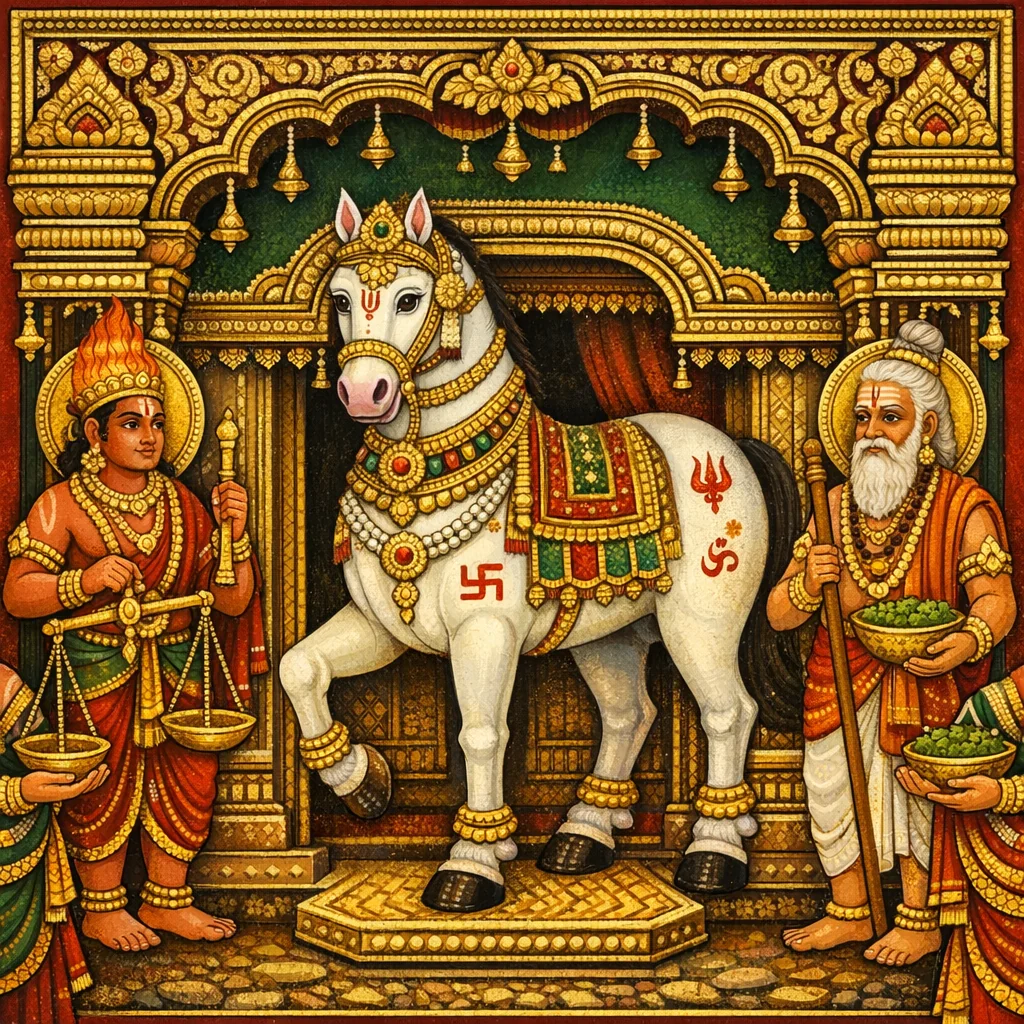
Adhyaya 288
Chapter 288 — अश्वचिकित्सा (Aśva-cikitsā) | Horse-Medicine (Śālihotra to Suśruta)
This chapter records Śālihotra’s teaching to Suśruta on equine science within Ayurveda. It opens with aśva-lakṣaṇa—judging auspicious and inauspicious horses by bodily marks, coat-color types, and the placement of hair-whorls (āvarta), with cautions about malignant influences (graha/rākṣā). It then turns to cikitsā, giving remedies and procedures for common equine disorders: colic, diarrhea/atisāra, fatigue, koṣṭha ailments treated with venesection, cough, fever, swelling, throat constriction (galagraha), tongue stiffness, itching, traumatic wounds, and genito-urinary diseases (including raktameha). Therapies include decoctions, pastes (lepa/kalka), medicated oils, nasya, basti, leeching, sprinkling/irrigation, and dietary regulation. The chapter concludes with seasonal regimen (ṛtu-caryā): post-drinks (pratipāna), seasonal use of ghee/oil/yamaka, restrictions after oleation, watering and bathing schedules, stable management, and feeding—linking animal welfare to dhārmic order and auspicious results.
Shlokas
Verse 1
आयः गोर्जितास्ते ऽतिकीर्तिता इति ख यथाञ्चितमिति ञ मृगञ्जय इति ख , ञ च अथाष्टाशीत्यधिकद्विशततमो ऽध्यायः अश्वचिकित्सा शालिहोत्र उवाच अश्वानां लक्षणं वक्ष्ये चिकित्साञ्चैवसुश्रुतअप्_२८८००१अभीनदन्तो विदन्तश् चकराली कृष्णतालुकः
Now begins the two-hundred-and-eighty-eighth chapter: Horse-medicine. Śālihotra said: “O Suśruta, I shall describe the distinguishing marks of horses, and also their treatment—for example, one whose teeth are unbroken, whose teeth are prominent, whose jaws are formidable, and whose palate is black.”
Verse 2
कृष्णजिह्वश् च यमजोजातमुष्कश् च यस् तथा द्विशफश् च तथा शृङ्गी त्रिवर्णो व्याघ्रवर्णकः
Also enumerated are those called Kṛṣṇajihva (“black-tongued”), likewise Yama-jo-jāta-muṣka, as well as Dviśapha and Śṛṅgī; and also (the varieties) Trivarṇa (“three-coloured”) and Vyāghravarṇaka (“tiger-coloured”).
Verse 3
खरवर्णो भस्मवर्णो जातवर्णश् च काकुदी श्वित्री च काकसादी च खरसारस्तथैव च
‘Kharavarṇa’ (rough/dun discoloration), ‘bhasmavarṇa’ (ash-coloured), ‘jātavarṇa’ (congenital colouring), ‘kākudī’ (the hump-like swelling type), ‘śvitrī’ (white patches/leucoderma), ‘kākasādī’ (crow-dark type), and likewise ‘kharasāra’ (hard, rough, dense type) are also enumerated as named varieties.
Verse 4
वानराक्षः कृष्णशटः कृष्णगुह्यस्तथैव च कृष्णप्रोथश् च शूकश् च यश् च तित्तिरिसन्निभः
(The grahas, afflictive beings, are:) Vānarākṣa, Kṛṣṇaśaṭa, Kṛṣṇaguhya, and also Kṛṣṇaprotha; and (the grahas called) Śūka and Ya—one of them resembling a partridge (tittiri) in appearance.
Verse 5
विषमः श्वेतपादश् च ध्रुवावर्तविवर्जितः अशुभावर्तसंयुक्तो वर्जनीयस्तुरङ्गमः
A horse that is uneven in build, has white feet, lacks the fixed (auspicious) hair‑whorl, and bears inauspicious whorls is to be avoided.
Verse 6
रन्ध्रोपरन्ध्रयोर्द्वौ द्वौ द्वौ द्वौ मस्तकवक्षसोः प्रयाणे च ललाटे च कण्ठावर्ताः शुभा दश
Two whorls each are auspicious at the two apertures (fontanels), two each on the head and on the chest; and whorls at the crown (prayāṇa) and on the forehead—thus the auspicious whorls of the neck are ten.
Verse 7
मृक्कण्याञ्च ललाटे च कर्णमूले निगालके बाहुमूले गले श्रेष्ठा आवर्तास्त्वशुभाः परे
Whorls (spiral marks of hair/skin) located at the side of the waist/hip, on the forehead, at the root of the ear, and at the hollow of the throat are considered excellent; whorls occurring elsewhere are regarded as inauspicious.
Verse 8
शुकेन्द्रगोपचन्द्राभा ये च वायससन्निभाः सुवर्णवर्णाः स्निग्धाश् च प्रशस्यास्तु सदैव हि
Those whose lustre is like that of a parrot, the indragopa insect, or the moon—and also those resembling the hue of a crow—as well as those of golden complexion and with a smooth, glossy appearance are indeed always regarded as auspicious.
Verse 9
दीर्घग्रीवाक्षिकूटाश् च ह्रस्वकर्णाश् च शोभनाः चिकित्सन्तवेति ञ राक्षान्तुरङ्गमा यत्र विजयं वर्जयेत्ततः
Horses with long necks, prominent ridges above the eyes, and short ears are deemed handsome and fit. The knowledgeable one (horse-physician/handler) should treat them according to their condition; but where a horse is afflicted by ‘rākṣā’ (a malignant influence or ailment), one should refrain from expecting victory from that place or from undertaking the venture there.
Verse 10
पालितस्तु हयो दन्ती शुभदो दुःखदो ऽन्यथा श्रियः पुत्रास्तु गन्धर्वा वाजिनो रत्नमुत्तमम्
A well-kept horse and a tusked elephant bestow auspicious results; otherwise they become causes of suffering. Horses are said to be the sons of Śrī (Fortune), of the Gandharvas (celestial musicians), and the finest among treasures.
Verse 11
अश्वमेधे तु तुरगः पवित्रत्वात्तु हूयते वृषो निम्बवृहत्यौ च गुडूची च समाक्षिका
In the Aśvamedha sacrifice, the horse is offered into the fire because of its purifying nature. Likewise the bull is (offered); and also neem, bṛhatī, guḍūcī, and substances accompanied with honey.
Verse 12
सिंहा गन्धकारी पिण्डी स्वेदश् च शिरसस् तथा हिङ्गु पुष्करमूलञ्च नागरं साम्लवेतसं
Siṃhā, Gandhakārī, Piṇḍī, and also a fomentation (sveda) for the head; likewise asafoetida (hiṅgu), the root of puṣkara, dry ginger (nāgara), and sour vetasa (sāmla-vetasa) are (to be used/combined) as medicinal ingredients.
Verse 13
पिप्पलीसैन्धवयुतं शूलघ्नं चीष्णवारिणा नागरातिविषा मुस्ता सानन्ता बिल्वमालिका
Mixed with pippalī (long pepper) and saindhava (rock-salt) and taken with warm water, it destroys colic pain. The remedy employs dry ginger (nāgara), ativīṣā, mustā, anantā, and bilva, arranged in a garland-like series—that is, combined into a single formulation.
Verse 14
क्वाथमेषां पिवेद्वाजी सर्वातीसारनाशनम् प्रियङ्गुसारिवाभ्याञ्च युक्तमाजं शृतं पयः
The patient should drink a decoction of these ingredients; it destroys all forms of diarrhoea and dysentery. One should also take goat’s milk, boiled and prepared with priyāṅgu and sārivā.
Verse 15
पर्याप्तशर्करं पीत्वा श्रमाद्वाजी विमुच्यते द्रोणिकायान्तु दातव्या तैलवस्तिस्तुरङ्गमे
After drinking a sufficient quantity of sugar-water, the horse is freed from fatigue. For the horse, an oil-enema (taila-vasti) should be administered, using a droṇikā measure as the dose.
Verse 16
कोष्ठजा च शिरा वेध्या तेन तस्य सुखं भवेत् दाऋइमं त्रिफला व्योषं गुडञ्च समभाविकम्
In disorders arising from the abdomen (koṣṭha), the vein should be punctured (venesection); by that, relief is obtained. Then pomegranate, Triphalā, Trikaṭu (the three pungents), and jaggery (guda) are to be used in equal proportion.
Verse 17
पिण्डमेतत् प्रदातव्यमश्वानां काशनाशनम् प्रियङ्गुलोध्रमधुभिः पिवेद्वृषरसं हयः
This bolus is to be given to horses as a destroyer of cough. The horse should drink vṛṣa-rasa (a tonic preparation, “bull-juice”), mixed with priyaṅgu, lodhra, and honey.
Verse 18
क्षीरं वा पञ्चकोलाद्यं काशनाद्धि प्रमुच्यते प्रस्कन्धेषु च सर्वेषु श्रेय आदौ विशोधणम्
Or one may take milk (kṣīra), or a preparation beginning with the Pañcakola group; by this one is indeed relieved from cough. And in all disorders of the upper parts of the body, it is better to undertake purification (śodhana) at the outset.
Verse 19
अभ्यङ्गोद्वर्तनैः स्नेहं नस्यवर्तिक्रमः स्मृतः ज्वरितानां तुरङ्गाणां पयसैव क्रियाक्रमः
Oleation (sneha) is to be done by oil-massage and powder-friction; nasal therapy (nasya) and medicinal-wick (vartikā) procedures are also enjoined. For horses afflicted with fever, the proper regimen is to administer remedies using milk alone.
Verse 20
लोध्रकन्धरयोर्मूलं मातुलाङ्गाग्निनागराः राज्ञीतुरङ्गमा यत्रेति ख घृतमिति ख कुष्ठहिङ्गुवचारास्नालेपोयं शोथनाशनः
A topical paste (lepa) made from the roots of lodhra and kandharā, together with mātuluṅga (citron), agni (citraka), and nāgara (dry ginger)—with variant readings adding rājñī and turaṅgamā, and in some recensions ‘yatra’ or ‘ghṛta’—along with kuṣṭha (costus), hiṅgu (asafoetida), vacā (sweet flag), and rāsnā, destroys swelling (śotha).
Verse 21
मञ्जिष्ठा मधुकं द्राक्षावृहत्यौ रक्तचन्दनम् त्रपुषीवीजमूलानि शृङ्गाटककशेरुकम्
Mañjiṣṭhā (Indian madder), madhuka (licorice), drākṣā (grapes/raisins), the two bṛhatīs (bṛhatī and kaṇṭakārī), red sandalwood, the seeds and roots of trapuṣī, along with śṛṅgāṭaka (water-chestnut) and kaśeruka (an aquatic tuber) are to be taken/used as listed.
Verse 22
अजापयःशृतमिदं सुशीतं शर्करान्वितं पीत्वा नीरशनो वाजी रक्तमेहात् प्रमुच्यते
Having drunk this decoction prepared with goat’s milk—well cooled and mixed with sugar—and then fasting (taking no food), a man is freed from raktameha, the disorder marked by bloody urination/bleeding of the urinary tract.
Verse 23
मन्याहनुनिगालस्थशिराशोथो गलग्रहः अभ्यङ्गः कटुतैलेन तत्र तेष्वेव शस्यते
For swelling of the veins in the nape (manyā), jaw (hanu), and throat region (nigāla), and for constriction or stiffness of the throat (gala-graha), oil-massage (abhyaṅga) with pungent medicated oil is specifically recommended for those very conditions.
Verse 24
गलग्रहगदो शोथः प्रायशो गलदेशके प्रत्यक्पुष्पी तथा बह्निः सैन्धवं सौरसो रसः
In cases of galagraha (a throat-gripping disorder) and swelling that usually arise in the throat region, one should prepare a remedy using pratyakpuṣpī, bahni, saindhava (rock salt), and saurasarasa (a sour/acidic juice).
Verse 25
कृष्णाहिङ्गुयुतैर् एभिः कृत्वा नस्यं न सीदति निशे ज्योतिष्मती पाठा कृष्णा कुष्ठं वचा मधु
By preparing a nasya (nasal medication) with these ingredients together with kṛṣṇā (black pepper) and hiṅgu (asafoetida), one does not suffer from the disorder. At night, administer a nasya made of jyotiṣmatī, pāṭhā, kṛṣṇā (black pepper), kuṣṭha, vacā, and honey.
Verse 26
जिह्वास्तम्भे च लेपो ऽयं गुडमूत्रयुतो हितः तिलैर् यष्ट्या रजन्या च निम्बपत्रैश् च योजिता
For stiffness or paralysis of the tongue, this medicinal paste is beneficial: it should be prepared with jaggery and urine, and compounded with sesame, yāṣṭī (licorice), rajanī (turmeric), and neem leaves.
Verse 27
क्षौद्रेण शोधनी पिण्डी सर्पिषा व्रणरोपणी अभिघातेन खञ्जन्ति ये ह्य् अश्चास्तीव्रवेदनाः
A piṇḍī (medicinal bolus) prepared with honey is cleansing for a wound, and one prepared with ghee promotes the healing of wounds. Horses that become lame from a blow and thereby suffer severe pain should be treated with these applications.
Verse 28
परिषेकक्रिया तेषां तैलेनाशु रुजापहा दोषकोपाभिघाताभ्यां पक्वभिन्ने व्रणक्रमः
For them, the therapeutic sprinkling/irrigation procedure (pariṣeka) with oil quickly alleviates pain. The regimen for wounds is applied when a wound has suppurated and ruptured—whether from aggravation of the doṣas or from trauma.
Verse 29
अश्वत्थोडुम्बरप्लक्षमधूकवटकल्कनैः
With medicinal pastes (kalka) prepared from the aśvattha, udumbara, plakṣa, madhūka, and vaṭa trees.
Verse 30
प्रभूतसलिलः क्वाथः सुखोष्णः व्रणशोधनः शताह्वा नागरं रास्ना मञ्जिष्ठाकुष्ठसैन्धवैः
A decoction (kvātha) made with abundant water and kept pleasantly warm cleanses wounds—prepared with śatāhvā (dill), nāgara (dry ginger), rāsnā, mañjiṣṭhā (Indian madder), kuṣṭha, and saindhava (rock salt).
Verse 31
देवदारुवचायुग्मरजनीरक्तचन्दनैः तैलसिद्धं कषायेण गुडूच्याः पयसा सह
Prepare a medicated oil by cooking sesame oil with deodāru, vacā, the pair of rajānī (the two turmerics), and red sandalwood—using a decoction of guḍūcī together with milk.
Verse 32
तिलतैलेनेति ख म्रक्षेण वस्तिनश्ये च योज्यं सर्वत्र लिङ्गिने रक्तस्रावो जलौकाभिर् नेत्रान्ते नेत्ररोगितः
“With sesame oil”—thus it is prescribed: it should be applied by rubbing (unction), and it should also be used in disorders requiring basti (enema) and in states of wasting or decline. In every ailment of the liṅga (male organ), bloodletting should be performed with leeches; and when the disease is at the edge or corner of the eye, the eye-disease should be treated accordingly by such measures.
Verse 33
खादितोडुम्बराश्वत्थकषायेण च साधनम् धात्रीदुरालभातिक्ताप्रियङ्गुकुङ्कुमैः समैः
A medicinal preparation should be made using a decoction of udumbara and aśvattha, compounded with equal parts of dhātrī (āmalakī), durālabhā, tiktā, priyaṅgu, and kuṅkuma (saffron).
Verse 34
गुडूच्या च कृतः कल्को हितो युक्तावलम्बिने उत्पाते च शिले श्राव्ये शुष्कशेफे तथैव च
A paste (kalka) prepared from guḍūcī is beneficial for one afflicted with hernia requiring a supporting bandage, and likewise for prolapse, urinary gravel or stone, painful strangury, and also for dryness of the penis.
Verse 35
क्षिप्रकारिणि दोषे च सद्यो विदलमिष्यते गोशकृन्मञ्जिकाकुष्ठरजनीतिलमर्षपैः
When an acute, swiftly acting disorder of the doṣas arises, an immediate powdered remedy is prescribed, prepared from cow-dung, mañjikā, kuṣṭha, turmeric, sesame, and marṣapa (mustard).
Verse 36
गवां मूत्रेण पिष्टैश् च मर्दनं कण्डुनाशनम् शीतो मधुयुतः क्वाथो नाशिकायां सशर्करः
Rubbing the affected part with a paste ground with cows’ urine destroys itching. A decoction, cooled and mixed with honey and sugar, is to be administered into the nose as a nasal remedy.
Verse 37
रक्तपित्तहरः पानादश्वकर्णैस्तथैव च सप्तमे सप्तमे देयमश्वानां लवणं दिने
Administered as a drink, it alleviates bleeding disorders and pitta; it is likewise to be given along with aśvakarṇa. For horses, salt is to be given on every seventh day.
Verse 38
तथा भुक्तवतान्देया अतिपाने तु वारुणी जीवनीयैः समधुरैर् मृद्वीकाशर्करायुतैः
Likewise it should be given to one who has eaten; but in cases of excessive drinking, vāruṇī (a fermented liquor) is to be administered, prepared with life-restoring (jīvanīya) substances of balanced sweetness, combined with raisins (mṛdvīkā) and sugar (śarkarā).
Verse 39
सपिप्पलीकैः शरदि प्रतिपानं सपद्मकैः विडङ्गापिप्पलीधान्यशताह्वालोध्रसैन्धवैः
In autumn (śarad), one should take a pratipāna (post-drink) prepared with pippalī and padmaka, compounded with viḍaṅga, pippalī, dhānya, śatāhvā, lodhra, and saindhava (rock-salt).
Verse 40
मचित्रकैस्तुरङ्गाणां प्रतिपानं हिमागमे लोध्रप्रियङ्गुकामुस्तापिप्पलीविश्वभेषजैः
In the cold season, horses should be given a restorative pratipāna prepared with chitraka and compounded with lodhra, priyaṅgu, musta, pippalī, and viśvabheṣaja (dry ginger).
Verse 41
सक्षौद्रैः प्रतिपानं स्याद्वसन्ते कफनाशनम् प्रियङ्गुपिप्पलीलोध्रयष्ट्याक्षैः समहौषधैः
In spring, a pratipāna (post-drink) taken together with honey is prescribed to destroy Kapha—prepared with priyaṅgu, pippalī, lodhra, and yaṣṭyāhva (licorice), along with similar medicinal substances.
Verse 42
निदाघे सगुडा देया मदिरा प्रतिपानके वेधनमिस्यत इति ज , ञ च लोध्रकाष्ठं सलवणं पिप्पल्यो विश्वभेषजम्
In the hot season, liquor mixed with jaggery should be given as pratipāna (a corrective counter-drink). For piercing pain (vedhanā), the prescribed remedies are lodhra-wood with salt, pippalī, and viśvabheṣaja (dry ginger).
Verse 43
भवेत्तैलयुतैर् एभिः प्रतिपानं घनागमे निदाघोद्वृतपित्तार्ताः शरत्सु पुष्टशोणिताः
In the rainy season, these formulations should be taken as a pratipāna when mixed with oil; those afflicted by pitta aggravated in summer become nourished in blood and regain vitality in autumn.
Verse 44
प्रावृड्भिन्नपुरीषाश् च पिवेयुर्वाजिनो घृतम् पिवेयुर्वाजिनस्तैलं कफवाय्वधिकास्तु ये
Horses whose feces become loosened in the rainy season should be made to drink ghee; and those in whom kapha and vāyu predominate should be made to drink oil.
Verse 45
स्नेहव्यापद्भवो येषां कार्यं तेषां विरूक्षणम् त्र्यहं यवागूरूक्षा स्याद् भोजनं तक्रसंयुतम्
For those in whom complications arising from oleation (snehapāna) have occurred, drying therapy (rūkṣaṇa) should be undertaken. For three days, their food should be a drying gruel (yavāgu), taken together with buttermilk (takra).
Verse 46
शरन्निदाघयोः सर्पिस्तैलं शीतवसन्तयोः वर्षासु शिशिरे चैव वस्तौ यमकमिष्यते
In autumn and in the hot season, ghee and oil are recommended; in the cool season and in spring, and in the rains and in winter as well, the use of ‘yamaka’—a mixed preparation of ghee and oil—is prescribed.
Verse 47
गुर्वभिष्यन्दिभक्तानि व्यायामं स्नाजमातपम् वायुवर्जञ्च वाहस्य स्नेहपीतस्य वर्जितम्
For one who has drunk medicated fat (snehapāna), heavy and mucus-forming foods are to be avoided; likewise exercise, bathing, exposure to the sun (heat), direct wind, and riding or vehicle-travel are prohibited.
Verse 48
स्नानं पानं शकृत्क्रूष्ठमश्वानां सलिलागमे अत्यर्थं दुर्दिने काले पानमेकं प्रशस्यते
For horses, on reaching water, bathing, drinking, and the passing of dung and urine are normal. But in extremely inclement weather and at an improper time, only giving water to drink is recommended.
Verse 49
युक्तशीतातपे काले द्विःपानं स्नपनं सकृत् ग्रीष्मे त्रिस्नानपानं स्यच्चिरं तस्यायगाहनम्
In the season when cold and sunshine are in balance, one should drink water twice and bathe once. In summer, one should bathe three times and drink water three times; and in that season, prolonged immersion in water is recommended.
Verse 50
निस्तूषाणां प्रदातव्या यवानां चतुराटकी चणकव्रीहिमौद्गानि कलायं वापि दापयेत्
One should give dehusked barley (yava) in the measure of four āṭakas; and one should also have chickpeas, rice, mung-beans, or else peas given in charity.
Verse 51
अहोरात्रेण चार्धस्य यवसस्य तुला दश अष्टौ शुष्कस्य दातव्याश् चतस्रो ऽथ वुषस्य वा
For the offering/gift prescribed for a period of a day-and-night and a half, one should give eighteen tulās of green barley; or else four tulās of dried barley—or, alternatively, an equivalent measure of grain/produce as a substitute.
Verse 52
दूर्वा पित्तं यवः कासं वुषश् च श्लोष्मसञ्चयम् नाशयत्यर्जुनः श्वासं तथा मानो बलक्षयम्
Dūrvā grass alleviates disorders of pitta; barley alleviates cough; and vuṣa, a medicinal plant, removes the accumulation of phlegm/kapha. Arjuna (the arjuna tree) alleviates asthma and dyspnea; and māna, a strengthening remedy, counteracts loss of strength.
Verse 53
वातिकाः पैत्तिकाश् चैव श्लेष्मजाः सान्निपातिकाः न रोगाः पीडयिष्यन्ति दूर्वाहारन्तुरङ्गमम्
Diseases arising from vāta, from pitta, from śleṣman (kapha), and from the combined imbalance of all three (sannipāta) will not afflict the person whose inner body is protected by a sustained regimen of dūrvā as diet.
Verse 54
द्वौ रज्जुबन्धौ दुष्टानां पक्षयोरुभयोरपि पश्चाद्धनुश् च कर्तर्व्यो दूरकीलव्यपाश्रयः
For a defective or warped bow, two cord-bindings should be applied on both limbs; thereafter the bow should be corrected by bracing and bending it against a peg set at a distance, so that its proper curvature is restored.
Verse 55
वासेयुस्त्वास्तृते स्थाने कृतधूपनभूमयः यत्रोपन्यस्तयवसाः सप्रदीपाः सुरक्षिताः कृकवाक्वजकपयो धार्यश्चाश्वगृहे मृगाः
They should be kept in a well-bedded place, with the ground properly fumigated; where fodder (grass or barley) has been set out, lamps are kept burning, and the area is securely protected. In the horse-stable, kṛkavāku birds, goats, and milk-yielding animals should be maintained; and deer too may be kept in the horse-house.
Frequently Asked Questions
A dual technical system is emphasized: (1) selection/diagnosis via aśva-lakṣaṇa and āvarta (hair-whorl) mapping for auspiciousness and suitability, and (2) procedure-led therapeutics (nasya, basti, venesection, leeching, wound irrigation) paired with specific decoctions, pastes, and medicated oils.
By treating animal care, hygiene, and correct regimen as dhārmic stewardship, it frames medical competence as a form of righteous action: protecting life, sustaining order, and aligning practical skill with sacred responsibility—an expression of Agneya Vidya serving both bhukti and the ethical foundation conducive to mukti.