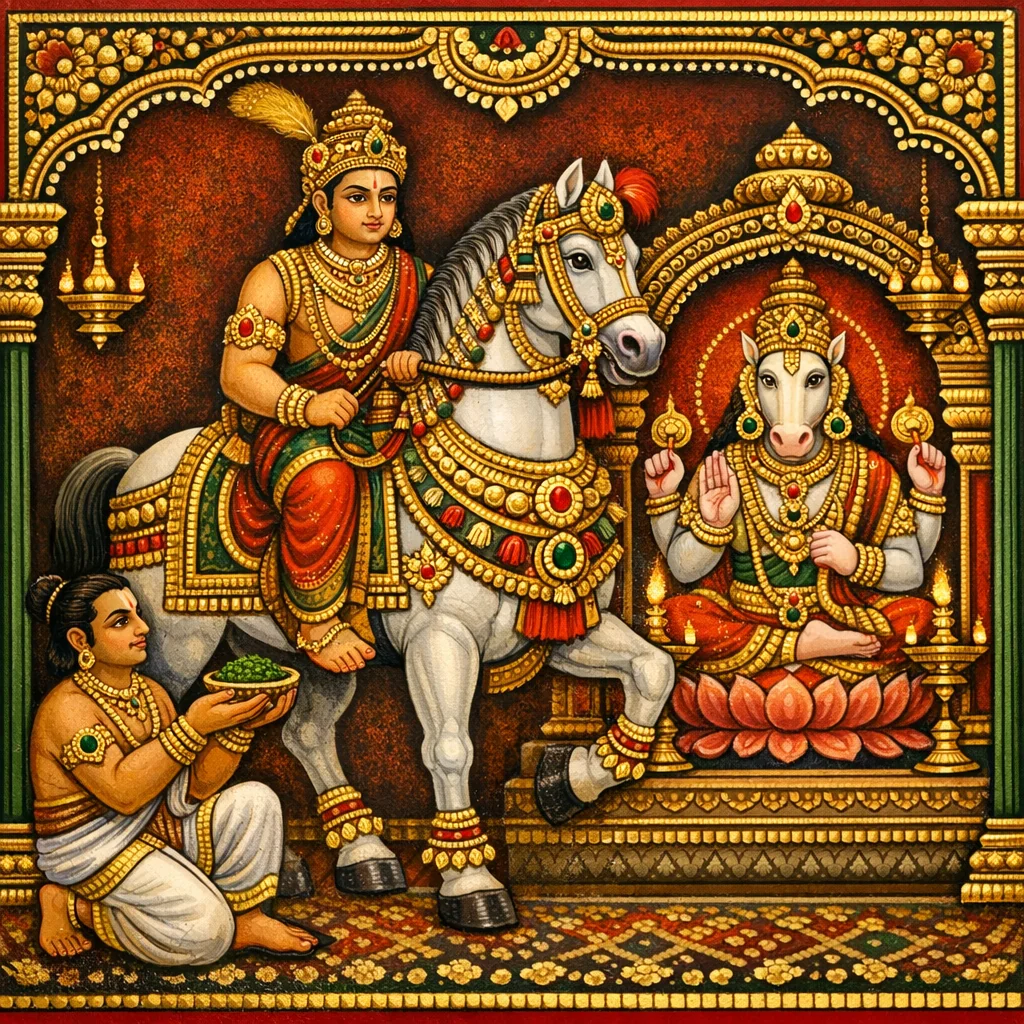
Adhyaya 287
अश्ववाहनसारः (Aśvavāhana-sāra) — Essentials of Horses as Mounts (and Horse-Treatment)
Spoken by Dhanvantari, this chapter treats the horse as a dharmic means of prosperity and protection: acquiring and maintaining horses supports dharma, kāma, and artha. It begins with auspicious timing for initiating and employing horses—nakṣatras Aśvinī, Śravaṇa, Hasta, and the three Uttarās, and the favorable seasons Hemanta, Śiśira, and Vasanta—then turns to ethical, practical handling: avoid cruelty and dangerous terrain, and train gradually through controlled rein-work rather than sudden striking. A substantial middle section blends martial riding with ritual safeguarding, including nyāsa-like deity placements on the body and specific mantra-use for disturbances such as inauspicious neighing and the condition called sādī. The latter portion systematizes training mechanics—seat, rein coordination, turning, restraint methods, and named techniques—along with early veterinary measures (topical paste for fatigue and insect bites; feeding gruel for certain breeds). It concludes with horse typologies (Bhadra, Manda, Mṛgajaṅgha, Saṅkīrṇa), auspicious and inauspicious signs, and a promise to teach equine characteristics in the Śālihotra tradition.
Shlokas
Verse 1
इत्य् आग्नेये महापुराणे गजचिकित्सा नाम षडशीत्यधिकद्विशततमो ऽध्यायः अथ सप्ताशीत्यधिकद्विशततमो ऽध्यायः अश्ववाहनसारः धन्वन्तरिर् उवाच अश्ववाहनसारञ्च वक्ष्ये चाश्वचिकित्सनम् वाजिनां संग्रहः कार्यो धर्मकमार्थसिद्धये
Thus ends, in the Agni Mahāpurāṇa, the two-hundred-and-eighty-sixth chapter called “Treatment of Elephants.” Now begins the two-hundred-and-eighty-seventh chapter, “The Essentials of Horses as Mounts.” Dhanvantari said: “I shall expound the essentials of horses as conveyances, and also the medical treatment of horses. The acquisition and maintenance of horses should be undertaken for the attainment of dharma, kāma, and artha.”
Verse 2
अश्विनी श्रणं हस्तं उत्तरात्रितयन्तथा नक्षत्राणि प्रशस्तानि हयानामादिवाहने
Aśvinī, Śravaṇa, Hasta, and likewise the three Uttarās (Uttaraphalgunī, Uttarāṣāḍhā, and Uttarabhādrapadā)—these lunar mansions are auspicious for the inaugural putting-to-use of horses and other conveyances.
Verse 3
हेमन्तः शिशिरश् चैव वसन्तश्चाश्ववाहने ग्रीष्मेशरदि वर्षासु निषिद्धं वाहनं हये
For riding or employing a horse, the seasons Hemanta, Śiśira, and Vasanta are suitable; but in Grīṣma (summer), Śarad (autumn), and Varṣā (the rainy season), the use of the horse is prohibited.
Verse 4
तीव्रैर् न च परैर् दण्डैर् अदेशे न च ताडयेत् कीलास्थिसंकुले चैव विषमे कण्टकान्विते
One should not strike with excessively harsh or extreme punishments, nor should one beat in an improper place—such as on ground strewn with nails and bones, on uneven terrain, or in a thorny area.
Verse 5
वालुकापङ्गसंच्छन्ने गर्तागर्तप्रदूषिते अचित्तज्ञो विनोपायैर् वाहनं कुरुतेतु हः
When the ground is covered with sand and mire and made treacherous by pits and hollows, a dull-witted man—without employing proper means—still tries to drive his vehicle there.
Verse 6
स वाह्यते हयेनैव पृष्ठस्थः कटिकां विनाअप्_२८७००६अब्छन्दं विज्ञापयेत् कोपि सकृती धीमतां वरः
He is carried only by a horse, seated on its back without a saddle; likewise, a capable person—best among the intelligent—can at once make the metre (chandas) known, rightly identifying and explaining it.
Verse 7
अभ्यासादभियोगाच्च विनाशास्त्रं स्ववाहकः स्नातस्य प्रङ्मुखस्याथ देवान् वपुषि योजयेत्
By repeated practice and focused application, the bearer of his own vehicle (the practitioner who has mastered his means) should, after bathing and while facing east, install the deities upon his body for the deployment of the destructive weapon-spell (vināśāstra).
Verse 8
प्रणवादिनमोन्तेन स्ववीजेन यथाक्रमम् ब्रह्मा चित्ते वले विष्णुर्वैनतेयः पराक्रमे
Beginning with the Pranava (Oṁ) and ending with the salutation formula (namaḥ), and employing one’s own seed-syllable (bīja) in the prescribed order: install Brahmā in the mind; Viṣṇu in strength; and Vainateya (Garuḍa) in valor.
Verse 9
पार्श्वे रुद्रा गुरुर्बुद्धौ विश्वेदेवाथ मर्मसु दृगावर्ते दृशीन्द्वर्कौ कर्णयोरश्विनौ तथा
In the flanks abide the Rudras; in the intellect abides the Guru (Bṛhaspati). In the vital junctions (marmas) are the Viśvedevas. At the turning-corners of the eyes are Dṛśī and Indra; and in the two ears, likewise, are the Aśvins.
Verse 10
जठरे ऽग्निः स्वधा स्वेदे वग्जिह्वायां जवे ऽनिलः पृष्ठतो नाकपृष्ठस्तु खुराग्रे सर्वपर्वताः
Agni is to be contemplated as present in the belly; Svadhā in the sweat; Vāk (speech) upon the tongue; and Anila (the Wind) in swiftness. Behind is the “nāka-pṛṣṭha,” the back of heaven; and at the tips of the hooves are all the mountains.
Verse 11
ताराश् च रोमकूपेषु हृदि चान्द्रमसी कला तेजस्यग्नीरतिः श्रोण्यां ललाटे च जगत्पतिः
The stars are to be contemplated in the pores of the body; the lunar digit in the heart; Agnīrati (fiery power/fiery delight) in the tejas, the vital radiance; and Jagatpati, Lord of the universe, in the hips and also upon the forehead.
Verse 12
ग्रहाश् च हेषिते चैव तथैवोरसि वासुकिः उपोषितो ऽर्चयेत् सादी हयं दक्षश्रुतौ जपेत्
When there is inauspicious neighing (heṣita), it indicates the influence of the Grahas; likewise, pain or affliction in the chest is connected with Vāsuki. Having fasted, one should worship the respective deity; and, for the condition called sādī, one should recite the Hayagrīva-mantra into the right ear.
Verse 13
हय गन्धर्वराजस्त्वं शृणुष्व वचनं गम गन्धर्वकुलजातस्त्वं माभूस्त्वं कुलदूषकः
O Haya, king of the Gandharvas—hear my words and depart. You are born in the Gandharva lineage; do not become a defiler of your family line.
Verse 14
द्विजानां सत्यवाक्येन सोमस्य गरुडस्य च रुद्रस्य वरुणस्यैव पवनस्य बलेन च
By the power of the truth-speaking of the dvijas (the twice-born), and by the might of Soma, of Garuḍa, of Rudra, of Varuṇa, and also by the strength of Pavana (Vāyu).
Verse 15
हुताशनस्य दीप्त्या च स्मर जातिं तुरङ्गम स्मर राजेन्द्रपुत्रस्त्वं सत्यवाक्यमनुस्मर
By the radiance of Hutāśana (Agni), remember your true birth, O horse. Remember—you are the son of the king of kings; recall the truthful words once spoken and keep them firmly in mind.
Verse 16
कणिकां विनेति क , ञ च स्मर त्वं वारुणीं कन्यां स्मर त्वं कौस्तुभं मणिं क्षिरोदसागरे चैव मथ्यमाने सुरासुरैः
Remember the syllables ‘ka’ and ‘ña’ as that which removes impurity; remember the maiden Vāruṇī; remember the Kaustubha jewel—all of which arose when the Ocean of Milk was churned by the gods and the demons.
Verse 17
तत्र देवकुले जातः स्ववाक्यं परिपालय कुले जातस्त्वमश्वानां मित्रं मे भव शास्वतम्
Since you are born there in a noble (divine) lineage, uphold your own pledged word. Born in that lineage of horses, become my enduring friend.
Verse 18
शृणु मित्र त्वमेतच्च सिद्धो मे भव वाहन विजयं रक्ष माञ्चैव समरे सिद्धिमावह
Listen, O friend, to this: become accomplished for me, O my mount (vāhana). Protect my victory, and protect me as well in battle; bring success—siddhi—to me.
Verse 19
तव पृष्ठं समारुह्य हता दैत्याः सुरैः पुरा अधुना त्वां समारुह्य जेष्यामि रिपुवाहिनीं
Mounting upon your back, the gods once slew the Daityas long ago; now, mounting upon you, I shall conquer the enemy host.
Verse 20
कर्णजापन्ततः कृत्वा विमुह्य च तथा प्यरीन् पर्यानयेद्धयं सादी वहयेद्युद्धतो जयः
Then, having performed a close-range stratagem at the enemy’s ear—like a distracting whisper—and thereby bewildered the foes, the mounted rider should wheel the horse about and carry the fight onward; from battle, victory arises.
Verse 21
सञ्जाताः स्वशरीरेण दोषाः प्रायेण वाजिनां हन्यन्ते ऽतिप्रयत्नेन गुणाः सादिवरैः पुनः
Defects arising from a horse’s own body are, for the most part, removed by strenuous and proper corrective effort; and its good qualities, in turn, are restored again by excellent trainers (grooms/riders).
Verse 22
सहजा इव दृश्यन्ते गुणाः सादिवरोद्भवाः नाशयन्ति गुणानन्ये सादिनः सहजानपि
Qualities that arise from causes “with a beginning” (acquired or conditioned factors) appear as though they were innate. Yet those acquired qualities, when set in opposition, can destroy other qualities—even those that are truly inborn.
Verse 23
गुणानेको विजानाति वेत्ति दोषांस् तथापरः धन्यो धीमान् हयं वेत्ति मन्दधीः
One person understands the merits; another likewise recognizes the faults. Blessed is the intelligent one who knows both; the dull-witted knows neither.
Verse 24
अकर्मज्ञो ऽनुपायज्ञो वेगासक्तो ऽतिकोपनः घनदण्डरतिच्छिद्रे यः ममोपि न शस्यते
One who is ignorant of proper action, ignorant of expedient means, addicted to rash impulse, excessively wrathful, fond of severe punishment, and who exploits weaknesses—such a person is not to be recommended, even by me.
Verse 25
उपायज्ञो ऽथ चित्तज्ञो विशुद्धो दोषनाशनः गुणार्जनपरो नित्यं सर्वकर्मविशारदः
He is skilled in the means and procedures of sacrifice; he understands the mind and intention; he is pure and a remover of faults; ever devoted to acquiring virtues, and proficient in every ritual act.
Verse 26
प्रग्रहेण गृहीत्वाथ प्रविष्टो वाहभूतलम् सव्यापसव्यभेदेन वाहनीयः स्वसादिना
Then, having taken hold of the rein and mounted onto the back of the mount, the rider should control and guide the mount by distinguishing left and right movements, according to his own seat and handling.
Verse 27
तथासुरनिति ज , ञ , ट च सह जाताः शरीरेणेति ञ आरुह्य सहसा नैव ताड्नीयो हयोत्तमः ताडनादुभयमाप्नोति भयान्मोहश् च जायते
Thus the rider should note these signals: when the horse’s bodily disposition shows the indicated signs, having mounted, one should not suddenly strike the excellent horse. From striking, a twofold harm results; from fear, confusion (loss of control) also arises.
Verse 28
प्रातः सादी प्लुतेनैव वल्गामुद्धृत्य चालयेत् मन्दं मन्दं विना नालं धृतवल्गो दिनान्तरे
In the morning, the rider should, by a light springing motion, lift up the bridle and set the horse in motion. Gently, gently—without striking with the hoof-iron—holding the bridle, he should exercise it again toward the end of the day.
Verse 29
प्रोक्तमाश्वसनं सामभेदो ऽश्वेन नियोज्यते कषादिताड्नं दण्डो दानं कालसहिष्णुता
Conciliation (sāma) has been stated as the first measure. Persuasion and division (sāma and bheda) are to be employed through an envoy. Flogging with a whip and the infliction of punishment constitute daṇḍa; the granting of gifts is dāna; and patient endurance—waiting for the proper time—is forbearance with respect to time.
Verse 30
पर्वपूर्वविशुद्धौ तु विदध्यादुत्तरोत्तरम् जिह्वातले विनायोगं विदध्याद्वाहने हये
But when purifying (the patient) stage by stage, one should perform the procedures progressively, each step following the one before. The prescribed preparation should be applied beneath the tongue, and likewise administered through a vehicle—namely, using the horse as the carrying medium.
Verse 31
गुणेतरशतां वल्गां सृक्कण्या सह गाहयेत् विस्मार्य वाहनं कुर्याच्छिथिलानां शनैः शनैः
One should bring the horse into training with a bridle of many straps together with the cheek-strap; then, as it gradually ‘forgets’ its resistance or fear, one should train it for riding by loosening the restraints little by little.
Verse 32
हयं जिह्वाङ्गमाहीने जिह्वाग्रन्थिं विमोचयेत् गाटतां मोचयेत्तावद्यावत् स्तोभं न सुञ्चति
For a horse afflicted with a defect of the tongue-organ, one should release (loosen or cut) the tongue-knot, the frenulum. One should keep relieving the tongue’s stiffness and tightness until the animal no longer produces stammering or blocked utterance (stobha).
Verse 33
कुर्याच्छतमुरस्त्राणमविलालञ्च मुञ्चति ऊर्धाननः स्वभाद्यस्तस्योरस्त्राणमश्लथम्
He should prepare a breast-guard of a hundred layers, and release it without any slackness. With face uplifted, sounding his own war-instrument, his breast-guard remains firm and unloosened.
Verse 34
विधाय वाहयेद्दृष्ट्या लीलया सादिसत्तमः तस्य सव्येन पूर्वेण संयुक्तं सव्यवल्गया
Having arranged it thus, the best of horsemen should make the horse move by mere gaze, with effortless ease; and he should keep its left fore side coordinated with the left rein.
Verse 35
यः कुर्यात्पश्चिमं पादं गृहीतस्तेन दक्षिणः क्रमेणानेन यो सेवां कुरुते वामवल्गया
He who places (or draws back) the western foot—being held by that—then moves to the right in this order; and whoever renders service in this sequence does so with a leftward turning, contrary to the auspicious rightward course.
Verse 36
पादौ तेनापि पादः स्याद्गृहीतो वाम एव हि अग्रे चेच्चरणे त्यक्ते जायते सुदृढासनं
With that arrangement, the other foot too is to be grasped—indeed, the left foot first. When the foot is released forward and set in place, a very firm posture (āsana) arises.
Verse 37
यौ हृतौ दुष्करे चैव मोटके नाटकायनं सव्यहीनं खलीकारो हनेन गुणने तथ
‘Yau’ and ‘hṛtau’ are terms used for “difficult tasks.” ‘Moṭaka’ denotes a theatrical passage or section (nāṭakāyana). One who is “without the left (hand/side)” is called a ‘khalīkāra’. Likewise, ‘hanena’ is used in the sense of counting or enumeration (guṇana).
Verse 38
स्वहावं हि तुरङ्गस्य मुखव्यावर्तनं पुरः न चैवेत्थं तुरङ्गाणां पादग्रहणहेतवः
A horse’s turning of the head forward is indeed its natural disposition; and in such a case, this is not a valid cause for seizing or restraining the horse by the feet.
Verse 39
विश्वस्तं हयमालोक्य गाढमापीड्य चासनं रोकयित्वा मुखे पादं ग्राह्यतो लोकनं हितं
After observing that the horse has become trusting, one should press the saddle-seat firmly; having restrained it, one should take hold of the forefoot near the mouth (i.e., lifting the foreleg forward near the head) for inspection—this examination is beneficial for safety and proper handling.
Verse 40
गाढमापीड्य रागाभ्यां वल्गामाकृष्य गृह्यते तद्वन्धनाद् युग्मपादं तद्वद्वक्वनमुच्यते
Pressing firmly with the two reins and drawing the bridle back, the horse is checked and brought under control. When fastened in this way, the pair of forelegs is restrained; likewise, the corresponding restraining call or command is termed “vakvana”.
Verse 41
संयोज्य वल्गया पादान् वल्गामामोच्य वाञ्छितम् वाह्यपार्ष्णिप्रयोगात्तु यत्र तत्ताडनं मतम्
After coordinating the horse’s feet by means of the reins and then releasing the reins as desired, the act in which control is effected through the application of the outer heel is regarded as “tāḍana” (striking), a corrective driving aid.
Verse 42
प्रलयाविप्लवे ज्ञात्वा क्रमेणानेन बुद्धिमान् मोटनेन चतुर्थेन विधिरेष बिधीयते
Knowing that at the time of pralaya (dissolution) there arises viplava, a calamity, the wise should proceed in this very sequence; by the fourth method, called moṭana, this prescribed rite is to be performed.
Verse 43
नाधत्ते ऽधश् च पादं यो ऽश्वो लघुनि मण्डले मोटनोद्वक्कनाभ्यान्तु ग्राहयेत् पादमीशितं
If a horse does not set its hoof down properly in the small circle (exercise-ring), one should make it place the controlled hoof by gripping and guiding it at the moṭana and udvakka points near the navel region.
Verse 44
वटयित्वासने गाटं मन्दमादाय यो ब्रजेत् ग्राह्यते संग्रहाद्यत्र तत्संग्रहणमुच्यते
When a bandage or strap is rolled into a pad and placed upon the seat or base, and one proceeds with a firm yet gentle hold—whereby the part is secured through such gathering and holding—that procedure is called saṃgrahaṇa, therapeutic fixation or binding.
Verse 45
हत्वा पर्श्वे प्रहारेण स्थानस्थो व्यग्रमानसम् वल्गामाकृष्य पादेन ग्राह्यकण्टकपायनम्
Standing firmly in place, one should strike the flank to unsettle (the mount or opponent); then, drawing the bridle with the foot, one should seize and check the one that bolts off in a run beset with spikes or obstacles.
Verse 46
उत्थितो यो ऽङ्घ्रणानेन पार्ष्ण्निपादात्तुरङ्गमः गृह्यते यत् खलीकृत्य खलीकारः स चेष्यते
A horse which, when it rears, is brought under control by pressure of heel and foot, and is then seized after being made to submit (as though accepting the bit), is called a “khalīkāra”; it is a manageable, serviceable horse.
Verse 47
गतित्रये पियः पादमादत्ते नैव वाञ्छितः हत्वा तु यत्र दण्डेन ग्राह्यते गहनं हि तत्
In the three modes of legal disposition, the offender gains only a quarter-share of the consequence, not what he desires. But where, even after killing, one must still be dealt with by punishment, that case is indeed profound—hard to adjudicate.
Verse 48
खलीकृत्य चतुष्केण तुरङ्गो वल्गयान्यया उच्छास्य ग्राह्यते ऽन्यत्र तत्स्यादुच्छासनं पुनः
Having fitted the horse with a khalī (halter) by means of the fourfold tackle, the horse should be restrained by another rein or leading-strap. When it is made to exhale forcefully or snort and is seized elsewhere by an alternate hold, that procedure again is called “ucchāsana”.
Verse 49
भठकालाद्यनुत्पादमिति ज बाह्यपार्श्वे प्रयोगात्त्विति ख वण्टयित्वासने इति ख ग्राहकण्टकपायनमिति ख स्वभावं बहिरस्यन्तं तस्यां दिशि पदायनं नियोज्य ग्राहयेत्तत्तु मुखव्यापर्तनं मतम्
When the opponent (or horse), by its natural movement, throws itself outward away from the line, one should direct a stepping advance (pādāyana) toward that very side and seize it; this is held to be the technique called “turning the face” (mukha-vyāpartana), forcing the head/face to turn and be controlled.
Verse 50
ग्राहयित्वा ततः पादं त्रिविधासु यथाक्रमम् साधयेत् पञ्चधारासु क्रमशो मण्डलादिषु
Then, having caused the “pāda” (quarter/segment) to be fixed in the threefold arrangements in due order, one should carry out the sādhana sequentially through the five dhārās, beginning with the maṇḍala and the subsequent stages.
Verse 51
आजनोर्धाननं वाहं शिथिलं वाहयेत् सुधीः अङ्गेषु लाघवं यावत्तावत्तं वाहयेद्धयं
A wise person should ride gently and in a relaxed manner, keeping an easy seat and posture from the knees upward. He should continue only so long as a sense of lightness arises in the limbs; up to that point he should let the horse and the ride proceed.
Verse 52
मृदुः स्कन्धे लघुर्वक्त्रे शिथिलः सर्वसन्धिषु यदा ससादिनो वश्यः सङ्गृह्णीयात्तदा हयं
When the horse is soft at the shoulders, light in the mouth, and relaxed at all the joints—then, being compliant and responsive to the rider’s aids, one should collect and restrain that horse.
Verse 53
न त्यजेत् पश्चिमं पादं यदा साधुर्भवेत्तदा तदाकृष्टिर्विधातव्या पाणिभ्यामिह बल्गया
When the rear foot is well planted and stable, one should not lift it; at that moment, in this technique called balgayā, the pulling-in (of the opponent) is to be executed with both hands.
Verse 54
तत्रत्रिको यथा तिष्ठेदुद्ग्रीवोश्वः समाननः धरायां पश्चिमौ पादौ अन्तरीक्षे यदाश्रयौ
There, the horse should stand in the “trika” (three-point) stance, with the neck held high and the head kept even. Its two hind feet should be set on the ground, while the fore-feet are held as if supported in mid-air—light and raised for readiness.
Verse 55
तदा सन्धरणं कुर्याद्गाठवाहञ्च मुष्टिना सहसैवं समाकृष्टो यस्तुरङ्गो न तिष्ठति
Then one should apply a firm restraint (saṃdharaṇa); and with the fist also check the horse’s trace or bearing-strap, so that the horse, though suddenly pulled back, does not stop dead.
Verse 56
शरीरं विक्षिपन्तञ्च साधयेन्मण्डलभ्रमैः क्षिपेत् स्कन्धञ्च यो वाहं स च स्थाप्यो हि वल्गया
He should subdue the opponent who is flinging about his body by means of circular turns (maṇḍala-bhrama). And one who hurls (the assailant) onto the shoulder should indeed be countered and brought under control by a sudden springing movement (valgayā).
Verse 57
गोमयं लवणं मूत्रं क्वथितं मृत्समन्वितम् अङ्गलेपो मक्षिकादिदंशश्रमविनाशनः
A body-paste prepared from cow-dung, salt, and urine—boiled and combined with clay—destroys fatigue and alleviates the effects of bites or stings from flies and similar insects.
Verse 58
मध्ये भद्रादिजातीनां मण्डो देयो हि सादिना दर्शनं भोततीक्षस्य निरुत्साहः क्षुधा हयः
For horses of the Bhadrā and related breeds, the rider should administer thin gruel (maṇḍa) at midday. A dull or weakened appearance, loss of spirit, and hunger are signs indicating the horse’s debilitated condition.
Verse 59
यथा वश्यस् तथा शिक्षा विनश्यन्त्यतिवाहिताः अवाहिता न मिध्यन्ति तुङ्गवक्त्रांश् च वाहयेत्
Training should be given in proportion to the horse’s tractability; if carried to excess, the discipline is ruined. When not over-driven, they do not go astray; therefore one should also properly work and handle the high-spirited, strong-mouthed horses.
Verse 60
सम्पीड्य जानुयुग्मेन स्थिरमुष्टिस्तुरङ्गमं गोमूत्राकुटिला वेणी पद्ममण्डलमालिका
Pressing firmly with both knees and keeping a steady fist-grip upon the horse—this is prescribed. The mane-braiding styles are: the “cow-urine curve” (a serpentine bend), the curled/spiral braid, the “lotus-circle” pattern, and the “garland” arrangement.
Verse 61
पञ्चोलूखलिका कार्या गर्वितास्ते ऽतिकीर्तिताः संक्षिप्तञ्चैव विक्षिप्तं कुञ्चितञ्च यथाचितम्
Five (types) called olūkhalikā are to be employed; among them, the garvitā is declared the most celebrated. The movements are: saṃkṣipta (contracted), vikṣipta (expanded), kuñcita (bent/curled), and the yathā-citam mode (as is appropriate).
Verse 62
वल्गितावल्गितौ चैव षोटा चेत्थमुदाहृतम् वीथीधनुःशतं यावदशीतिर् नवतिस् तथा
“Valgita” and “Avalgita” are also so named; and “Ṣoṭā” is declared in this manner. Likewise, the measure called “Vīthī” extends up to a hundred bows, and other measures extend to eighty and to ninety as well.
Verse 63
भद्रः सुसाध्यो वाजी स्यान्मन्दो दण्डैकमानसः मृगजङ्घो मृगो वाजी सङ्कीर्णस्तत्समन्वियात्
A “Bhadra” horse is easy to train. A “Manda” horse has a mind fixed only on the whip (that is, it responds solely to punishment). A “Mṛgajaṅgha” (“deer-shanked”) is a “Mṛga” type horse; and the “Saṅkīrṇa” (mixed) type should be understood as possessing a combination of those traits.
Verse 64
शर्करामधुलाजादः सुगन्धो ऽश्वः शुचिर्द्विजः तेजस्वी क्षत्रियश्चाश्बो विनीतो बुद्धिमांश् च यः
One who is produced from sugar, honey, and parched grain (a sweet preparation), who is fragrant; who is a horse; who is pure; a twice-born (Brāhmaṇa); who is radiant; and a Kṣatriya; who is well-trained and intelligent—these are the auspicious designations and characteristics stated.
Verse 65
शूद्रो ऽशुचिश् चलो मन्दो विरूपो विमतिः खलः वल्गया धार्यमाणो ऽश्वो लालकं यश् च दर्शयेत्
A Śūdra—if impure, fickle, dull, ill-formed, of perverse judgment, and malicious—and likewise a horse that must be restrained by the reins, and any horse that shows slavering at the mouth—are to be understood as inauspicious signs.
Verse 66
धारासु योजनीयो ऽसौ प्रग्रहग्रहमोक्षणैः अश्वादिलक्षणम् वक्ष्ये शालिहोत्रो यथावदत्
He should be properly employed in the lines of training and riding, by taking up and releasing the reins. Now I shall explain the characteristics of horses and the like, just as Śālihotra has correctly taught.
Frequently Asked Questions
It names Aśvinī, Śravaṇa, Hasta, and the three Uttarā nakṣatras as auspicious for first putting horses (and conveyances) into use, and recommends Hemanta, Śiśira, and Vasanta as suitable seasons while discouraging Grīṣma, Śarad, and Varṣā.
It frames horse-keeping and training as a dharma-governed discipline: auspicious timing, restraint from cruelty, ritual protection (deity-installation and mantra), and skilled method (upāya) align technical success with ethical conduct, thereby supporting the puruṣārthas and the larger Agneya synthesis of bhukti with mukti-oriented order.