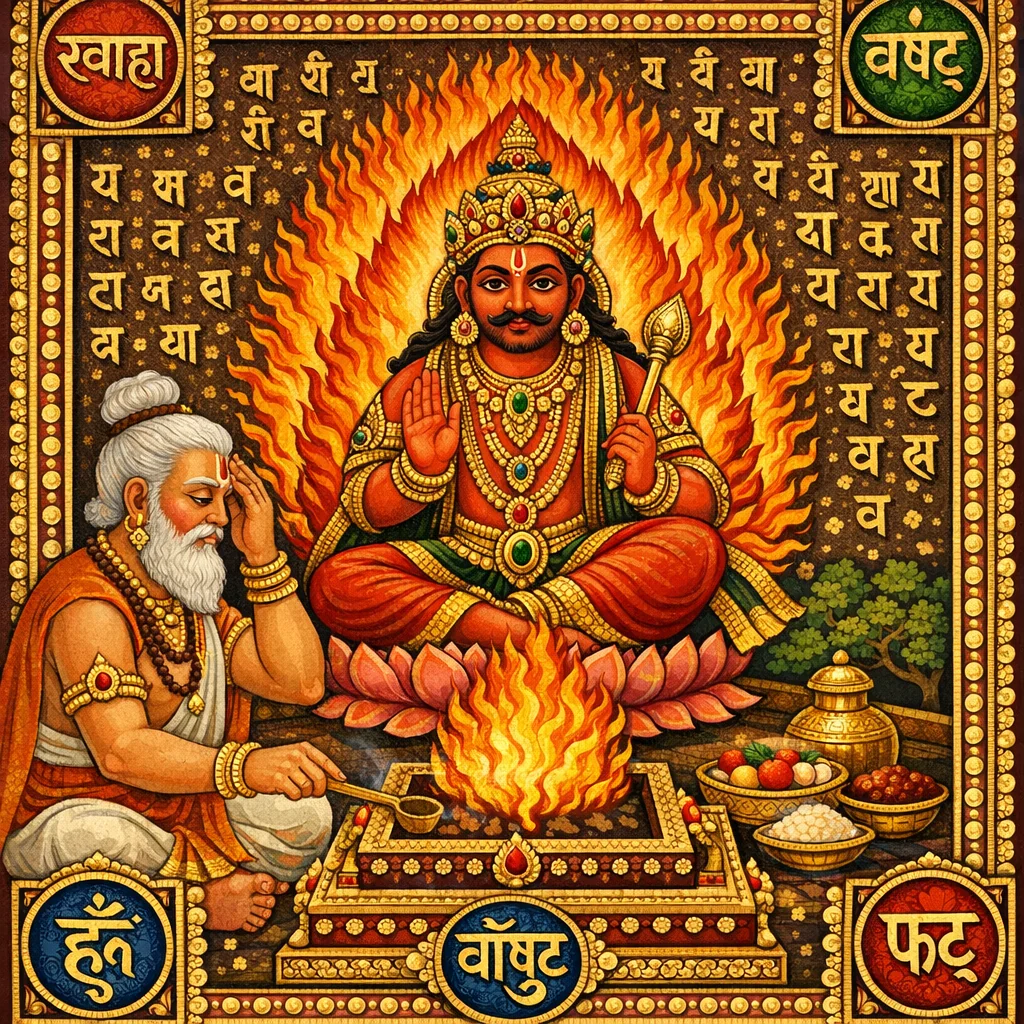
Adhyaya 292
Mantra-paribhāṣā (Technical Definitions and Operational Rules of Mantras)
Agni defines mantra-science as a discipline yielding both bhukti (worldly enjoyment) and mukti (liberation), and opens with a structural taxonomy: bīja-mantras versus longer mālā-mantras, including the syllable-count thresholds that bear siddhi. He then classifies mantras by grammatical gender and by energetic type (Agneya/fiery vs Saumya/gentle), explaining how endings such as “namaḥ” and “phaṭ” can alter a mantra’s operative force for pacificatory or coercive rites (including uccāṭana and binding contexts) under stated restrictions. The chapter turns to praxis—wakeful states, auspicious phonetic beginnings, and omens/arrangements involving script (lipi) and nakṣatra ordering—and stresses that mantra-perfection arises through disciplined sādhanā (japa, pūjā, homa, abhiṣeka) received by proper dīkṣā and guru-transmission, with strict ethical qualifications for both guru and disciple. Finally it codifies applied ritual mechanics: proportional japa counts and homa fractions, modes of recitation from loud to mental, orientation and place-selection, tithi/weekday deities, and detailed nyāsa (lipi-nyāsa, aṅga-nyāsa, mātṛkā-nyāsa), culminating in Vāgīśī/Lipi-devī as the empowering principle by which all mantras become siddhi-giving.
Shlokas
Verse 1
इत्य् आग्नेये महापुराणे शान्त्यायुर्वेदो नामैकनवत्यधिकद्विशततमो ऽध्यायः अथ द्विनवत्यधिकद्विशततमो ऽध्यायः मन्त्रपरिभाषा अग्निर् उवाच मन्त्रविद्याहरिं वक्ष्ये भुक्तिमुक्तिप्रदं शृणु विंशत्यर्णाधिका मन्त्रा मालामन्त्राः स्मृता द्विज
Thus, in the Agni Mahāpurāṇa ends the chapter called “Śānti and Āyurveda,” the 291st chapter. Now begins the 292nd chapter: “Mantra-paribhāṣā” (technical definitions regarding mantras). Agni said: “I shall explain ‘Hari’, the essential doctrine of mantra-science; listen—it bestows worldly enjoyment and liberation. O twice-born one, mantras consisting of more than twenty syllables are remembered as ‘mālā-mantras’ (garland-mantras).”
Verse 2
दशाक्षराधिका मन्त्रास्तदर्वाग्वीजसंज्ञिताः वर्धक्ये सिद्धिदा ह्य् एते मालामन्त्रास्तु यौवेन
Mantras that have more than ten syllables are called “mālā-mantras”; those with fewer than that are termed “bīja (seed)”-mantras. These indeed bestow siddhi in old age, whereas the mālā-mantras are efficacious in youth.
Verse 3
पञ्चाक्षराधिका मन्त्राः सिद्धिदाः सर्वदापरे स्त्रीपुंनपुंसकत्वेन त्रिधाः स्युर्मन्त्रजातयः
Mantras of five syllables or more are always bestowers of accomplishment (siddhi). Moreover, the classes of mantras are threefold according to grammatical gender: feminine, masculine, and neuter.
Verse 4
स्त्रीमन्त्रा वह्निजायन्ता नमोन्ताश् च नपुंसकाः शेषाः पुमांसस्ते शस्ता वक्ष्योच्चाटविषेषु च
Feminine mantras, those beginning with (the seed-syllable or name of) Fire (Vahni/Agni), and those ending with “namaḥ” are regarded as neuter; the rest are masculine. This classification is prescribed, and I shall state their specific applications in rites of uccāṭana (expulsion).
Verse 5
क्षुद्रक्रियामयध्वंसे स्त्रियो ऽन्यत्र नपुंसकाः मन्त्रावाग्नेयसौम्याख्यौ ताराद्यन्तार्द्वयोर्जपेत्
For the destruction of misfortunes produced by petty harmful rites, women—though otherwise employing neuter forms—should perform japa of the two mantras known as Agneya and Saumya, placing them between the initial and final syllables of Tārā.
Verse 6
तारान्त्याग्निवियत्प्रायो मन्त्र आग्नेय इष्यते शिष्टः सौम्यः प्रशस्तौ तौ कर्मणोः क्रूरसौम्ययोः
A mantra predominantly containing the syllabic elements “tārā”, “antya”, “agni”, and “viyat” is regarded as Agneya (fiery) in character. The remaining mantras are Saumya (gentle, lunar). These two are commended respectively for fierce (krūra) and gentle (saumya) rites.
Verse 7
बन्धोच्चाटवशेषु चेति ज स्त्रियो नात्रेति ख आग्नेयमन्त्रः सौम्यः स्यात्प्रायशो ऽन्ते नमो ऽन्वितः सौम्यमन्त्रस् तथाग्नेयः फट्कारेणान्ततो युतः
In rites concerning bondage (bandha) and expulsion (uccāṭana), the letter-codes are taught as “ja” and “kha”, and it is stated that “women are not applicable here.” Generally, an Agneya mantra becomes “saumya” when concluded with “namaḥ”; likewise, a Saumya mantra becomes “agneya” when concluded with the exclamation “phaṭ.”
Verse 8
सुप्तः प्रबुद्धमात्रो वा मन्त्रः सिद्धिं न यच्छति श्वापकालो महावाहो जागरो दक्षिणावहः
A mantra does not bestow siddhi when one is asleep or only half-awake. O mighty-armed one, the time called “śvāpa-kāla” is fit for sleep, while wakefulness is connected with the southern course (dakṣiṇāvaha).
Verse 9
आग्नेयस्य मनोः सौम्यमन्त्रस्यैतद्विपर्ययात् प्रबोधकालं जानीयादुभयोरुभयोरहः
In the case of Manu’s Agneya mantra and the Saumya mantra, by applying the inverse (reversing the stated rule), one should determine the time of awakening (prabodha-kāla); thus, in both cases, the corresponding day is to be ascertained.
Verse 10
दुष्टर्क्षराशिविद्वेषिवर्णादीन् वर्जयेन्मनून् राज्यलाभोपकाराय प्रारभ्यारिः स्वरः कुरून्
For the sake of gaining sovereignty, one should avoid mantras or name-formulas that begin with inauspicious nakṣatras or rāśis, and those that commence with hostile syllables. Instead, one should arrange tone and pronunciation so that, from the very start, the sound bears the “ari-” (enemy-subduing) character.
Verse 11
गोपालककुटीं प्रायात् पूर्णामित्युदिता लिपिः नक्षेत्रेक्षक्रमाद्योज्या स्वरान्त्यौ रेवतीयुजौ
One should proceed to the “Gopālaka-kuṭī” (the cowherd’s hut); this script is declared to be “complete.” It is to be arranged according to the sequence of the nakṣatras (lunar mansions). The first and the last vowels are to be joined with Revatī.
Verse 12
वेला गुरुः स्वराः शोणः कर्मणैवेतिभेदिताः लिप्यर्णा वशिषु ज्ञेया षष्ठेशादींश् च योजयेत्
The time-measure (velā) is termed “heavy” (guru). The vowels are “red” (śoṇa) and are distinguished by the operation (karma) itself. The letters as written (lipi-arṇāḥ) are to be understood among the sibilants (vaśiṣu); and one should also apply the rule beginning with the sixth (ṣaṣṭha) and onward.
Verse 13
लिपौ चतुष्पथस्थायामाख्यवर्णपदान्तराः सिद्धाः साध्या द्वितीयस्थाः सुसिद्धा वैरिणः परे
When an omen is read from writing found at a four-way crossroads, the letters and the spaces between words are interpreted thus: the first position signifies siddha (success); the second signifies sādhya (that which is to be accomplished), and su-siddha (excellent success) as well; while the further positions indicate the vairin (opponents).
Verse 14
सिद्धादीन् कल्पयेदेवं सिद्धात्यन्तगुणैर् अपि सिद्धे सिद्धो जपात् साध्यो जपपूजाहुतादिना
Thus one should ritually establish and employ the Siddha and related classes, even by the supreme excellences born of mantra-perfection. When the mantra is perfected, the practitioner becomes accomplished; and that perfection is attained through japa (repetition), worship, fire-offerings (homa), and allied observances.
Verse 15
सुसिद्धो ध्यानमात्रेण साधकं नाशयेदरिः दुष्टार्णप्रचुरो यः स्यान्मन्त्रः सर्वविनिन्दितः
Even when a mantra is perfectly accomplished, an enemy can destroy the practitioner merely through meditation; and any mantra laden with corrupt, inauspicious, or defective syllables is universally condemned.
Verse 16
प्रविश्य विधिवद्दीक्षामभिषेकावसानिकाम् श्रुत्वा तन्त्रं गुरोर् लब्धं साधयेदीप्सितं मनुम्
Having duly entered initiation (dīkṣā) in the prescribed manner—culminating in the consecratory rite (abhiṣeka)—and having received and heard the Tantra obtained from one’s guru, one should then accomplish in practice the desired mantra (manu).
Verse 17
धीरो दक्षः शुचिर्भक्तो जपध्यानादितत्परः सिद्धद्यन्तदलैर् अपीति ज जपपूर्णाहुतादिनेति ख सिद्धस्तपस्वी कुशलस्तन्त्रज्ञः सत्यभाषणः
He is steady, capable, pure, and devoted—intent on japa, meditation, and related disciplines. He is an accomplished one: an ascetic (tapasvī), competent, a knower of the Tantra (ritual system), and a speaker of truth.
Verse 18
निग्रहानुग्रहे शक्तो गुरुरित्यभिधीयते शान्तो दान्तः पटुश्चीर्णब्रह्मचर्यो हविष्यभुक्
One who is able both to restrain (to discipline) and to show favor (to bestow grace) is called a guru—peaceful, self-controlled, capable, one who has observed brahmacarya, and who lives on sacrificial food (haviṣ).
Verse 19
कुर्वन्नाचार्यशुश्रूषां सिद्धोत्साही स शिष्यकः स तूपदेश्यः पुत्रश् च विनयी वसुदस् तथा
He who renders attentive service to the teacher and is steadfastly energetic in accomplishing what is to be achieved—he is a true disciple. Such a one is fit to be instructed; and likewise a son who is disciplined (humble and well-trained) and a giver of wealth (supportive and generous) is fit to be taught.
Verse 20
मन्त्रन्दद्यात् सुसिद्धौ तु सहस्रं देशिकं जपेत् यदृच्छया श्रुतं मन्त्रं छलेनाथ बलेन वा
When a mantra has become fully accomplished (siddha—proven effective in practice), it may be transmitted; and the disciple should repeat it a thousand times under the teacher’s authority. But a mantra heard only by chance—whether through trickery or by force—is not to be regarded as properly received.
Verse 21
पत्रे स्थितञ्च गाथाञ्च जनयेद्यद्यनर्थकम् मन्त्रं यः साधयेदेकं जपहोमार्चनादिभिः
If one were to produce (compose or write down) verses and songs that are devoid of meaning, that becomes futile; but the person who perfects even a single mantra through japa (repetition), homa (oblations), worship, and related practices truly accomplishes the aim.
Verse 22
क्रियाभिर्भूरिभिस्तस्य सिध्यन्ते स्वल्पसाधनात् सम्यक्सिद्धैकमन्त्रस्य नासाध्यमिह किञ्चन
For one who possesses a single mantra perfected in the proper manner, numerous ritual operations are accomplished with only slight practice; for such a rightly perfected mantra, nothing whatsoever is unattainable here in this world.
Verse 23
बहुमन्त्रवतः पुंसः का कथा शिव एव सः दशलक्षजपादेक वर्णो मन्त्रः प्रसिध्यति
For a man who possesses many mantras, what more is there to be said? He is indeed Śiva himself. By repetition ten million times, even a one-syllabled mantra becomes firmly established, gaining efficacy and renown.
Verse 24
वर्णवृद्ध्या जपह्रासस्तेनान्येषां समूहयेत् वीजाद्द्वित्रिगुणान्मन्त्रान्मालामन्त्रे जपक्रिया
When the number of syllables in a mantra increases, the number of japa repetitions should be reduced; by that same principle, the counts of other associated mantras should also be adjusted proportionally. For a mālā-mantra (rosary-formula), japa is to be performed in a count two or three times that of the bīja (seed-mantra).
Verse 25
सङ्ख्यानुक्तौ शतं साष्टं सहस्रं वा जपादिषु जपाद्दशांशं सर्वत्र साभिशेकं हुतं विदुः
When a specific count is prescribed, in japa and related rites one should perform either 108 repetitions or a thousand. In all cases, the fire-oblation (huta/homa) is understood to be one-tenth of the japa, and it is to be done together with abhiṣeka (ritual sprinkling/anointing).
Verse 26
द्रव्यानुक्तौ घृतं होमे जपो ऽशक्तस्य सर्वतः मूलमन्त्राद्दशांशः स्यादङ्गादीनां जपादिकम्
When no offering-substance is prescribed, ghee (ghṛta) is to be used in the homa. For one who is unable to perform the full rite, japa is recommended in every respect. The repetitions and related acts for the aṅga (auxiliary) mantras should be one-tenth of the count prescribed for the mūla-mantra (root mantra).
Verse 27
जपात्सशक्तिमन्त्रस्य कामदा मन्त्रदेवताः साधकस्य भवेत् तृप्ता ध्यानहोमार्चनादिना
By the japa of a mantra endowed with power, the mantra-deities—bestowers of desired aims—become satisfied with the sādhaka (practitioner) through means such as meditation, fire-offerings, worship (arcana), and the like.
Verse 28
उच्चैर्जपाद्विशिष्टः स्यादुपांशुर्दशभिर्गुणैः जिह्वाजपे शतगुणः सहस्रो मानसः स्मृतः
Compared to loud recitation (uccair-japa), whispered recitation (upāṁśu-japa) is superior by tenfold merit; tongue-recitation (jihvā-japa) is a hundredfold; and mental repetition (mānasa-japa) is remembered to be a thousandfold.
Verse 29
प्राङ्मुखो ऽवाङ्मुखो वापि मन्त्रकर्म समारभेत् प्रणवाद्याः सर्वमन्त्रा वाग्यतो विहिताशनः
Facing east—or, alternatively, facing north—one should begin the performance of a mantra-rite. All mantras are to be prefaced by the syllable Oṃ; and the practitioner, having restrained speech, should observe the prescribed dietary discipline.
Verse 30
आसीनस्तु जपेन्मन्त्रान्देवताचार्यतुल्यदृक् कुटीविविक्ता देशाः स्युर्देवालयनदीह्रदाः
Seated, one should repeat the mantras, regarding the deity and the teacher with equal reverent vision. Suitable places (for japa) are a secluded hermitage or solitary spots—such as temples, riverbanks, and lakes.
Verse 31
सिद्धौ यवागूपूपैर् वा पयो भक्ष्यं हविष्यकम् मन्त्रस्य देवता तावत् तिथिवारेषु वै जपेत्
For attaining mantra-siddhi, one should take as the oblation/offering (havis) either rice-gruel and cakes, or milk as the edible offering. One should then recite (the mantra) on the appropriate lunar dates and weekdays for as long as is prescribed for that mantra’s presiding deity.
Verse 32
कृष्णाष्टमीचतुर्दश्योर्ग्रहणादौ च साधकः दस्रो यमो ऽनलो धाता शशी रुद्रो गुरुर्दितिः
On the dark eighth and the dark fourteenth lunar days—and at the commencement of an eclipse—the relevant Sādhaka-yoga is indicated for the practitioner; its presiding names are Dasra, Yama, Anala, Dhātā, Śaśī, Rudra, Guru, and Diti.
Verse 33
सर्पाः पितरो ऽथ भगो ऽर्यमा शोतेतरद्युतिः त्वष्टा मरुत इन्द्राग्नी मित्रेन्द्रौ निरृतिर्जलम्
The Serpents (Nāgas), the Pitṛs (ancestral fathers), then Bhaga and Aryaman; Śote and Taradyuti; Tvaṣṭṛ; the Maruts; Indra and Agni; Mitra and Indra; Nirṛti; and the Waters.
Verse 34
विश्वेदेवा हृषीकेशो वायवः सलिलाधिपः अजैकपादहिर्व्रध्नः पूषाश्विन्यादिदेवताः
The Viśvedevas, Hṛṣīkeśa, the Vāyus, the Lord of the Waters, Aja-Ekapād, Ahirbudhnya, Pūṣan, and the Aśvins—these and the other deities (are to be invoked and worshipped).
Verse 35
अग्निदस्रावुमा निघ्नो नागश् चन्द्रो दिवाकरः मातृदुर्गा दिशामीशः कृष्णो वैवस्वतः शिवः
Agni; the Nasatyas (the Aśvins); Vāyu; the Slayer (destroyer of obstacles); Nāga; the Moon; the Sun; the Mother-Durgā; the Lord of the Directions; Kṛṣṇa; Vaivasvata (Yama, son of Vivasvān); and Śiva.
Verse 36
पञ्चदश्याः शशाङ्कस्तु पितरस्तिथिदेवताः हरो दुर्गा गुरुर्विष्णुर्ब्रह्मा लक्ष्मीर्धनेश्वरः
For the fifteenth lunar day (Pañcadaśī), the Moon (Śaśāṅka) is the presiding deity; the Pitṛs are the deities of the lunar days (tithis). Also enumerated in this scheme are Hara (Śiva), Durgā, Guru (Bṛhaspati), Viṣṇu, Brahmā, Lakṣmī, and Dhaneśvara (Kubera).
Verse 37
एते सुर्यादिवारेशा लिपिन्यासो ऽथ कथ्यते केशान्तेषु च वृत्तेषु चक्षुषोः श्रवणद्वये
These are the presiding lords of the days beginning with Sunday. Now the lipi-nyāsa (ritual placement of the letters) is described: it is to be performed at the ends of the hair (on the head), on the circular regions (at the temples), on the two eyes, and on the pair of ears.
Verse 38
नासागण्डौष्ठदन्तानां द्वे द्वे मूर्धस्ययोः क्रमात् वर्णान् पञ्चसुवर्गानां बाहुचरणसन्धिषु
Of the five consonant-classes (the five vargas), the sounds are to be articulated in due order, two by two, at the nose, the cheeks, the lips, and the teeth; likewise at the palate and the throat; and their articulation is further indicated at the joints of the arms and legs.
Verse 39
पार्श्वयोः पृष्ठतो नाभौ हृदये च क्रमान्न्यसेत् तरेति ख पञ्चस्वरवर्गाणामिति ख यादींश् च हृदये न्यस्येदेषां स्युः सप्तधातवः
One should place the prescribed syllables in due sequence on the two sides, on the back, on the navel, and on the heart. Thus the five groups of vowels and the ‘ya’-series (ya-ādi) are to be placed upon the heart; from these arise the seven bodily constituents (dhātus).
Verse 40
त्वगसृङ्मांसकस्नायुमेदोमज्जाशुक्राणि धातवः वसाः पयो वासको लिख्यन्ते चैव लिपीश्वराः
Skin, blood, flesh, the tendons/filaments (snāyu), fat, marrow, and semen are called the bodily constituents (dhātus). Fat (vasā), milk (payaḥ), and vāsaka are also recorded in writing—so state the authorities on terminology (lipīśvaras).
Verse 41
श्रीकण्ठो ऽनन्तसूक्ष्मौ च त्रिमूर्तिरमरेश्वरः अग्नीशो भावभूतिश् च तिथीशः स्थानुको हरः
He is Śrīkaṇṭha (the Auspicious-throated One); He is Ananta (the Infinite) and Sūkṣma (the Subtle). He is the Trimūrti (embodying the three cosmic functions) and Amareśvara (Lord of the immortals). He is Agnīśa (Lord of Fire), Bhāva (the Lord as ‘Being’) and Bhūti (sacred ash/holy power). He is Tithīśa (Lord of the lunar days), Sthāṇu (the Immovable One), and Hara (the Remover).
Verse 42
दण्डीशो भौतिकः सद्योजातश्चानुग्रहेश्वरः अक्रूरश् च महासेनः शरण्या देवता अमूः
These are the deities to be remembered: Daṇḍīśa, Bhautika, Sadyojāta, Anugraheśvara, Akrūra, and Mahāsena—benevolent, and granting refuge.
Verse 43
ततः क्रोधीशत्तण्डौ च पञ्चान्तकशिवोत्तमौ तथैव रुद्रकूर्मौ च त्रिनेत्रौ चतुराननः
Then (are invoked) Krodhīśa and Taṇḍu; Pañcāntaka and Śivottama; likewise Rudra and Kūrma; and also the Three-eyed One and the Four-faced One.
Verse 44
अजेशः शर्मसोनेशौ तथा लाङ्गलिदारुकौ अर्धनारीश्वरश्चोमा कान्तश्चाषाढिदण्डिनौ
Ajeśa; Śarmasoneśa; likewise Lāṅgalin and Dāruka; Ardhanārīśvara; Umā; Kānta; and also Āṣāḍhi and Daṇḍin—these are (names of Śiva).
Verse 45
अत्रिर्मोनश् च मेषश् च लोहितश् च शिखी तथा छगलण्डद्विरण्डौ द्वौ समहाकालवालिनौ
Atri, Mona, Meṣa, Lohita, and Śikhī; likewise the two—Chagalaṇḍa and Dviraṇḍa—together with Mahākāla and Vālin: these are the names enumerated here.
Verse 46
भुजङ्गश् च पिनाकी च खड्गीशश् च वकः पुनः श्वेतो भृगुर्लगुडीशाक्षश् च सम्बर्तकः स्मृतः
He is (known as) Bhujaṅga, Pinākī, and Khaḍgīśa; again (he is called) Vaka; (also) Śveta, Bhṛgu, Laguḍīśākṣa; and he is remembered as Sambartaka.
Verse 47
रुद्रात्मशक्तान् लिख्यादीन् नमोन्तान् विन्यसेत् क्रमात् अङ्गानि विन्यसेत्सर्वे मन्त्राः साङ्गास्तु सिद्धिदाः
One should, in due sequence, perform nyāsa of the Rudra-essence Śaktis—beginning with (the group) such as Likhyā—ending with the formula “namo”. Then one should place them upon the limbs (aṅgas). All mantras, when furnished with their aṅgas (i.e., with the ancillary limb-mantras), become bestowers of success (siddhi).
Verse 48
हृल्लेखाव्योमसपूर्वाण्येतान्यङ्गानि विन्यसेत् हृदादीन्यङ्गमन्त्रान्तैर् यो जपेद्धृदये नमः
One should assign (perform nyāsa of) these limbs, beginning with the mantras of hṛt, lekhā, and vyoma. He who recites the heart and the other limb-mantras—ending each with the aṅga-formula—should also repeat within the heart the salutation: “namaḥ.”
Verse 49
स्वाहा शिरस्यथ वषट्शिखायां कवचे च् हूं वौषत् नेत्रे ऽस्त्राय फटस्यात् पञ्चाङ्गं नेत्रवर्जितम्
“Svāhā” is to be placed on the head; “vaṣaṭ” on the topknot (śikhā); “hūṃ” on the protective armour (kavaca); “vauṣaṭ” on the eyes; and “phaṭ” for the weapon-mantra (astrāya). Thus the fivefold set of mantra-aṅgas is established—excluding the eyes.
Verse 50
निरङ्गस्यात्मना चाङ्गं न्यस्येमान्नियुतं जपेत् क्रमाभ्यां देवीं वागीशीं यथोक्तांस्तु तिलान् हुनेत्
Having performed aṅga-nyāsa, taking one’s own self as the mantra’s “body-less” (nir-aṅga) form, one should recite this mantra a niyuta (ten thousand times). Then, in the two prescribed sequences (kramas), one should worship the goddess Vāgīśī and offer sesame seeds into the fire as previously stated.
Verse 51
लिपिदेवी साक्षसूत्रकुम्भपुस्तकपद्मधृक् कवित्वादि प्रयच्छेत कर्मादौ सिद्धये न्यसेत् निष्कविर्निर्मलः सर्वे मन्त्राःसिध्यन्ति मातृभिः
Lipi-devī, the Goddess of Script, bearing the rosary, sacred thread, water-pot, book, and lotus, bestows poetic mastery and related attainments. For success in any rite, one should perform (mātṛkā-)nyāsa at the beginning of the procedure. Even one who is not a poet becomes purified; by the Mothers (Mātṛkā), all mantras attain accomplishment.
Frequently Asked Questions
Operational mantra-taxonomy and procedure: syllable-based categories (bīja/mālā), gendered mantra classes, Agneya–Saumya functional polarity (including how “namaḥ/phaṭ” changes force), and quantified sādhanā rules (japa counts, homa as one-tenth, aṅga-mantras as one-tenth of the root).
It disciplines sacred speech through ethics (guru–śiṣya standards), purity, correct timing, and inward refinement (mental japa ranked highest), presenting mantra-siddhi as a dhārmic technology that stabilizes life (bhukti) while training attention and devotion toward liberation (mukti).