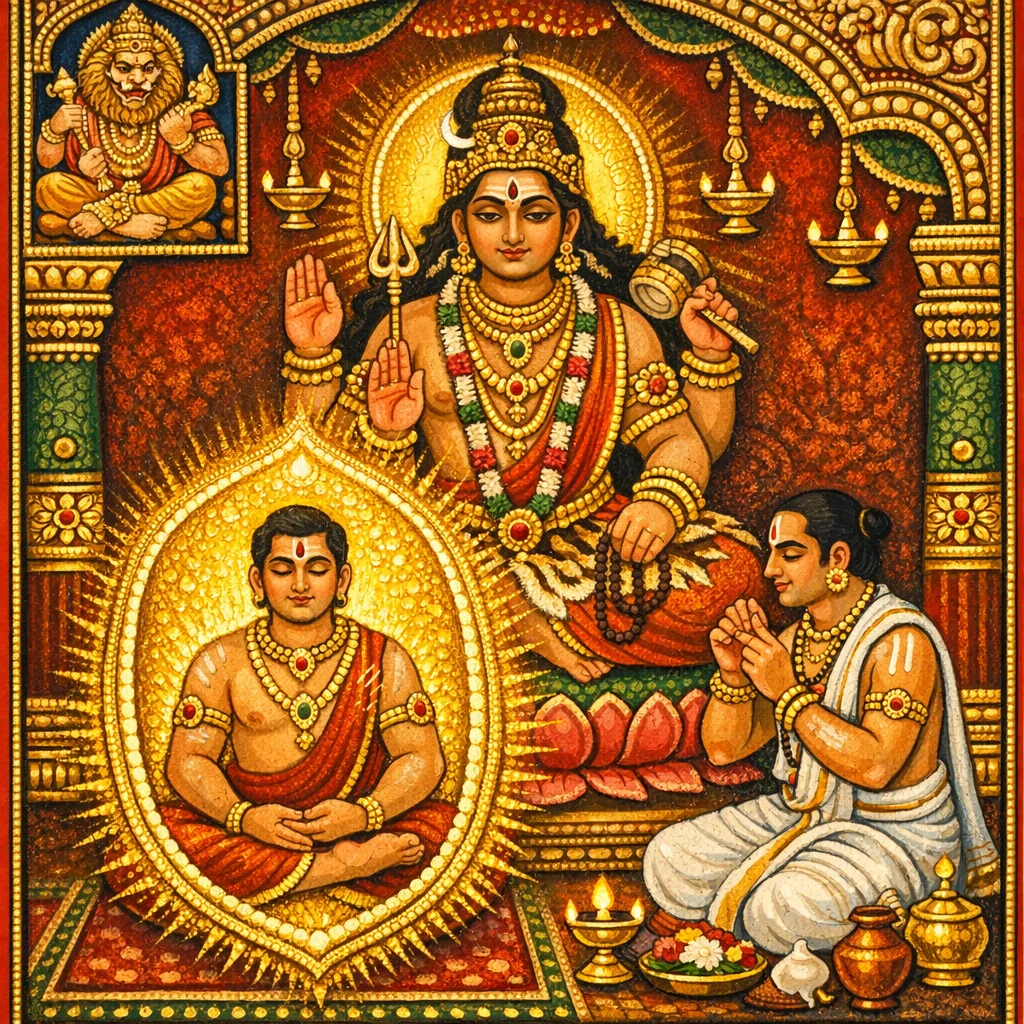
Adhyaya 295
Pañcāṅga-Rudra-vidhāna (The Fivefold Rudra Rite)
After the prior medical discussion on treating bites and stings, Lord Agni teaches the Pañcāṅga-Rudra-vidhāna, a fivefold Rudra rite said to bestow results universally yet aimed specifically at protection from poison and disease. It defines Rudra’s “five limbs” in ritual-technical terms—hṛdaya (heart/hymn), śiva-saṅkalpa, śiva-mantra, sūkta, and pauruṣa—and grounds the practice in nyāsa and sequential japa. The chapter then maps mantra components scholastically: naming the ṛṣi, the chandas (Triṣṭubh, Anuṣṭubh, Gāyatrī, Jagatī, Paṅkti, Vṛhatī), and devatā assignments, including liṅga-based devatā selection and anuvāka-wise Rudra typologies (Eka-Rudra, Rudra/Rudras). It culminates in therapeutic uses: trailokya-mohana as suppression of enemy/poison/disease, followed by 12- and 8-syllabled Viṣṇu–Narasiṃha mantras proclaimed destroyers of visha-vyādhi. Further named mantras (Kubjikā, Tripurā, Gaurī, Candrikā, Viṣahāriṇī) and a “Prasāda-mantra” are given to enhance longevity and health, extending the Ayurveda layer through mantra-based prophylaxis.
Shlokas
Verse 1
इत्य् आग्नेये महापुराणे दष्टचिकित्सा नाम चतुर्णवत्यधिकद्विशततमो ऽध्यायः अथ पञ्चनवत्यधिकद्विशततमो ऽध्यायः पञ्चाङ्गरुद्रविधानं अग्निर् उवाच वक्ष्ये रुद्रविधानन्तु पञ्चाङ्गं सर्वदं परं हृदयं शिवसङ्कल्पः शिवः सूक्तन्तु पौरुषम्
Thus, in the Agni Mahāpurāṇa, ends the two-hundred-and-ninety-fourth chapter called “Treatment for Bites/Stings.” Now begins the two-hundred-and-ninety-fifth chapter: “The Pañcāṅga (Fivefold) Rudra Rite.” Agni said: “I shall teach the Rudra-vidhāna, the supreme fivefold practice that bestows all results: the Hṛdaya, the Śiva-saṅkalpa, the Śiva (mantra), the Sūkta, and the Pauruṣa.”
Verse 2
शिखाभ्यः सम्भृतं सूक्तमाशुः कवचमेव च शतरुद्रियमस्त्रञ्च रुद्रस्याङ्गानि पञ्च हि
From the śikhās (topknots) is gathered the hymn called Āśu; likewise there are the Kavaca and the Śatarudrīya as the Astra—these indeed are the five limbs (aṅgas) of Rudra.
Verse 3
पञ्चाङ्गान्न्यस्य तं ध्यात्वा जपेद्रुद्रांस्तः क्रमात् यज्जाग्रत इति सूक्तं यदृचं मानसं विदुः
Having performed the five-limbed nyāsa and meditated upon Him, one should then recite the Rudra-mantras in sequence. The hymn beginning with “yaj jāgrata …” and that particular ṛc are understood to be recited mentally (mānasa-japa).
Verse 4
ऋषिः स्याच्छिवमङ्कल्पश्छन्दस्त्रिष्टुवुदाहृतं शिवः सहस्रशीर्षेति तस्य नारायणो ऽप्यृषिः
The seer (ṛṣi) is said to be Śivamaṅkalpa; the meter is declared to be Triṣṭubh. The deity is Śiva, praised as “the Thousand-Headed”; and for that hymn, Nārāyaṇa also is recognized as the seer.
Verse 5
देवता पुरुषो ऽनुष्टुप्छन्दो ज्ञेयञ्च त्रैष्टुभम् अभ्यश्रसम्भृतं सूक्तमृषिरुत्तरगोनरः
The presiding deity (devatā) is to be known as Puruṣa; the metre is Anuṣṭubh, and it should also be understood as (having) Triṣṭubh. The seer (ṛṣi) of the hymn called Abhyaśra-sambhṛta is Uttarago-nara.
Verse 6
आद्यानान्तिमृणां त्रिष्टुप्छन्दो ऽनुष्ठुव्द्वयोरपि उत्तरगोनस इति ज , ट च छन्दस्त्रिष्टुभमन्त्यायाः पुरुषो ऽस्यापि देषता
For the (syllabic groups/gaṇas) beginning with ā and ending in mṛ, the metre is Triṣṭubh; for the two patterns in Anuṣṭubh as well, it is said to be the “uttara-gaṇa”. The gaṇas are denoted by the letters ja and ṭa; the metre of the final case is Triṣṭubh, and its presiding deity is Puruṣa too.
Verse 7
आशुरिन्त्रो द्वादशानां छन्दस्त्रिष्टुवुदाहृतं ऋषिः प्रोक्तः प्रतिरथः सूक्ते सप्तदशार्चके
For the twelve verses, the presiding deity is stated to be Indra; the metre (chandas) is declared to be Triṣṭubh; and the seer (ṛṣi) is said to be Pratiratha—this is in the hymn consisting of seventeen verses.
Verse 8
पृथक् पृथक् देवताः स्युः पुरुविदङ्गदेवता अवशिष्टदैवतेषु छन्दो ऽनुष्टुवुदाहृतं
The presiding deities for the respective parts are to be assigned separately, one by one. In the ‘Puruvid-aṅga’ section the deity is specified; and for the remaining deity-assignments, the metre declared is Anuṣṭubh.
Verse 9
असौ यमो भवित्रीन्द्रः पुरुलिङ्गोक्तदेवताः पङ्क्तिच्छन्दो ऽथ मर्माणि त्वपलिङ्गोक्तदेवताः
For the mantra beginning with “asau”, the presiding deity is Yama; for “bhavitrī”, it is Indra. Where the deity is stated in the masculine gender (puru-liṅga), the metre is Paṅkti. Next, for the vital points (marmāṇi) and the skin (tvac), the presiding deities are those stated in the neuter gender (napuṃsaka-liṅga).
Verse 10
रौद्राध्याये च सर्वस्मिन्नार्षं स्यात् परमेष्वपि प्रजापतिर्वा देवानां कुत्सस्य तिसृणाम् पुनः
And throughout the entire Raudra chapter, the (mantra/teaching) is to be regarded as ‘Ārṣa’ (revealed by a seer), even in the case of the supreme deity. The seer is Prajāpati; and for the gods, again, the seer is Kutsa—in the case of the three formulae/verses.
Verse 11
मनोद्वयोरुमैका स्याद्रुद्रो रुद्राश् च देवताः आद्योनुवाको ऽथ पूर्व एकरुद्राख्यदैवतः
For the mantra-group called “the two Manas”, Umā alone is to be taken as the presiding deity; (for the next portion) Rudra and the Rudras are the deities. The first Anuvāka, however, has as its presiding deity the one called “Eka-Rudra” (the single Rudra).
Verse 12
छन्दो गायत्र्यमाद्याया अनुष्टुप् तिसृणामृचाम् तिसृणाञ्च तथा पङ्क्तिरनुष्टुवथ संस्मृतम्
The metre (chandas) of the first set is Gāyatrī; for three ṛc-verses it is Anuṣṭubh. For three more likewise it is Paṅkti; and then again Anuṣṭubh—so it is remembered in tradition.
Verse 13
द्वयोश् च जगतीछन्दो रुद्राणामप्यशीतयः हिरण्यवाहवस्तिस्रो नमो वः किरिकाय च
For the pair of verses the metre is Jagatī; and for the Rudras there are also eighty (forms/recensions). The Hiraṇyavāhas are three—obeisance to you, and also to Kirikā.
Verse 14
पञ्चर्चो रुद्रदेवाः स्युर्मन्त्रे रुद्रानुवाककः विंशके रुद्रदेवास्ताः प्रथमा वृहती स्मृता
In the Rudrānuvāka mantra, the Rudra-deities are arranged in groups of five ṛc-verses. Within the set of twenty verses, those Rudra-deities are enumerated in that manner, and the first metre is remembered as Vṛhatī.
Verse 15
ऋग्द्वितीया त्रिजगती त्रिष्टुवेव च अनुष्टुभो यजुस्तिस्र आर्यादिज्ञः सुसिद्धिभाक्
The second metre is Ṛk; the third is Jagatī; likewise (the next are) Triṣṭubh and Anuṣṭubh. These three metres are of the Yajus. One who knows the Āryā and the rest becomes a recipient of complete accomplishment.
Verse 16
त्रैलोक्यमोहनेनापि विषव्याध्यरिमर्दनं भवित्रीति त्रिष्टुब् लिङ्गोक्तदेवतेति ख रुद्रात्मवाचक इति ज , ट च विषव्याधिविमर्दनमिति ज इं श्रीं ह्रीं ह्रौं हूं त्रैलोक्यमोहनाय विष्णवे नमः अगुष्टुभं नृसिंहेन विषव्याधिविनाशनं
Even by the (mantra) of “trailokya-mohana” (the Bewilderer of the Three Worlds), there will be the crushing of enemies and the suppression of poison and disease—this is in the Triṣṭubh metre. The deity is to be understood according to the indicated liṅga (grammatical gender), and (in some recensions) this mantra is said to express Rudra’s inner nature. (Another reading states:) “the suppression of poison and disease.” Then follows the mantra: “iṃ śrīṃ hrīṃ hrauṃ hūṃ—obeisance to Viṣṇu, the Bewilderer of the Three Worlds.” It is in the Anuṣṭubh metre; and with the form of Narasiṃha it brings about the destruction of poison and disease.
Verse 17
ॐ इं इं उग्रवीरं मंहाविष्णुं ज्वलन्तंसर्वतोमुखं नृसिंहं भीषणं मृत्युमृत्युम्नमाम्यहं
Oṃ. Iṃ, Iṃ. I bow to Narasiṃha—the fierce hero, Mahāviṣṇu—blazing, facing in all directions, terrifying, the Death of Death itself.
Verse 18
अयमेव तु पञ्चाङ्गो मन्त्रः सर्वार्थसाधकः द्वादशाष्टाक्षरौ मन्त्रौ विषव्याधिविमर्दनौ
This indeed is the five-limbed mantra, able to accomplish all aims. The twelve-syllabled and the eight-syllabled mantras likewise destroy poison and disease.
Verse 19
कुब्जिका त्रिपुरा गौरी चन्द्रिका विषहारिणी प्रसादमन्त्रो विषहृदायुरारोग्यवर्धनः सौरो विनायकस्तद्वद्रुद्रमन्त्राः सदाखिलाः
‘Kubjikā’, ‘Tripurā’, ‘Gaurī’, ‘Candrikā’, and ‘Viṣahāriṇī’—these are mantra-names. The “Prasāda-mantra” removes poison and increases the heart’s strength, lifespan, and health. Likewise, the Saura (Sun) and Vināyaka (Gaṇeśa) mantras—and similarly the Rudra mantras—are always effective in all cases.
Frequently Asked Questions
Precise mantra-ritual architecture: pañcāṅga nyāsa, sequential japa, and viniyoga metadata (ṛṣi, chandas, devatā), including meter-sets (Gāyatrī/Anuṣṭubh/Paṅkti/Jagatī/Triṣṭubh/Vṛhatī) and section-wise deity assignment (including liṅga-based indications).
It frames healing and protection (bhukti) as dharmic sādhana: disciplined mantra, nyāsa, and devotion to Rudra/Viṣṇu–Narasiṃha cultivate inner alignment (śiva-saṅkalpa) while addressing concrete afflictions like poison and disease, thus integrating practical welfare with spiritual refinement.
The chapter highlights Viṣṇu–Narasiṃha formulae (including the “iṃ śrīṃ hrīṃ hrauṃ hūṃ… trailokya-mohana… viṣṇave namaḥ” line and the Narasiṃha salutation “oṃ iṃ iṃ ugravīraṃ…”) and states that 12-syllabled and 8-syllabled mantras function as visha-vyādhi destroyers.