Adhyaya 280
Chapter 280 — रसादिलक्षणम् / सर्वरोगहराण्यौषधानि (Characteristics of Taste and Related Factors; Medicines that Remove All Diseases)
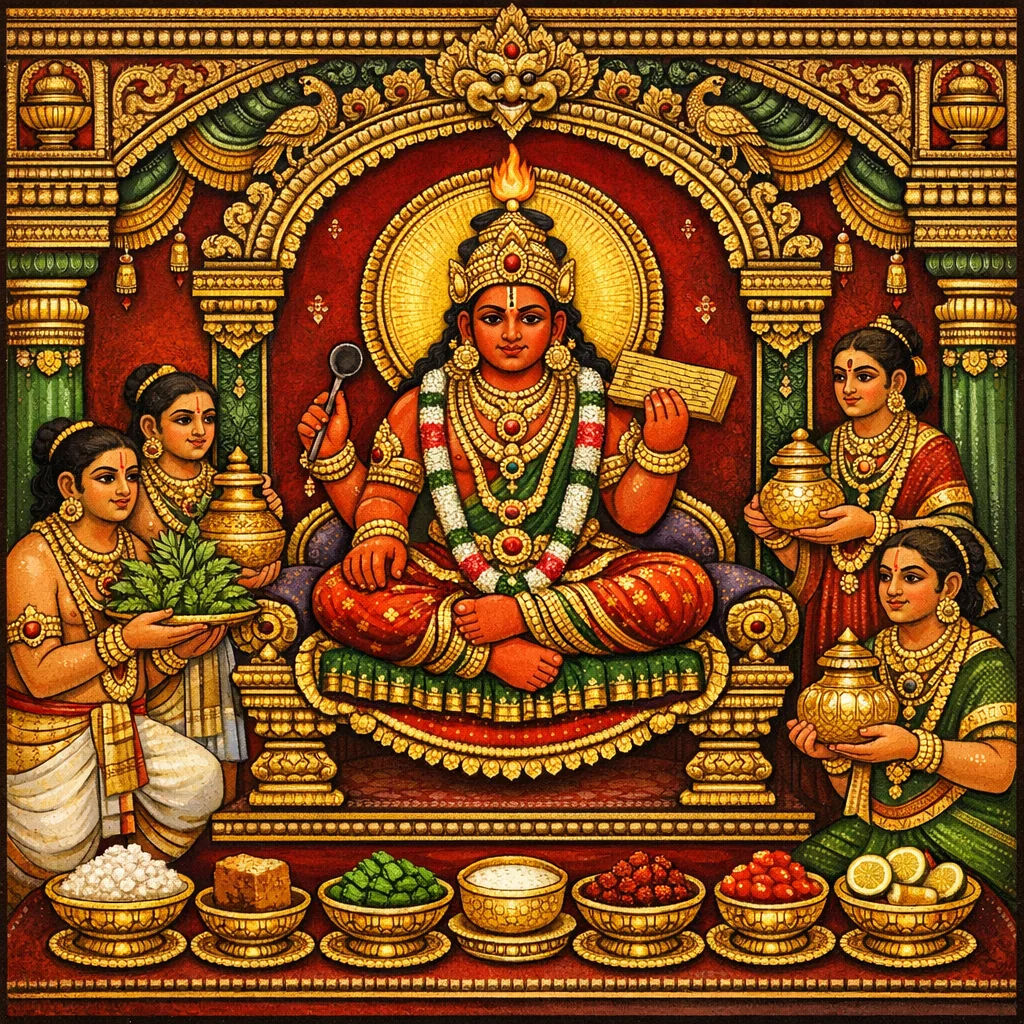
This chapter presents Ayurveda as a protective royal science: Dhanvantari teaches that mastery of rasa (taste), vīrya (potency), and vipāka (post-digestive effect), along with discernment of prabhāva (a specific, sometimes indescribable action), enables a physician to safeguard kings and society. It classifies the six tastes by Soma- and Agni-origins, defines vipāka as threefold and vīrya as hot/cold, and explains exceptions—such as honey being sweet in rasa yet pungent in vipāka—through prabhāva. The text then turns to pharmacy: standard reduction ratios for kaṣāya/kvātha decoctions, principles for snehapāka (medicated fats) and lehya (electuaries), and individualized dosing by age, season, strength, digestive fire (agni), region, substance, and disease. Finally it expands into regimen and prevention: the upastambha triad (food, sleep, sexual conduct), nourishing versus depleting therapies, seasonal rules for massage and exercise, and dietary purity as the root support of agni and human strength—uniting medical technique with disciplined dharmic living.
Shlokas
Verse 1
इत्य् आग्नेये महापुराणे सर्वरोगहराण्यौषधानि नामोनाशीत्यधिकद्विशततमो ऽध्यायः तथोल्कानामुष्मणामध्वसेविनामिति ख अथाशीत्यधिकद्विशततमो ऽध्यायः रसादिलक्षणं धन्वन्तरिर् उवाच रसादिलक्षणं वक्ष्ये भेषजानां गुणं शृणु रसवीर्यविपाकज्ञो नृपादीन्रक्षयेन्नरः
Thus, in the Agni Mahāpurāṇa, the two-hundred-and-eightieth chapter is titled “Medicines that remove all diseases” (in another recension: “Of meteors, heat, and those who travel on roads”). Now begins the two-hundred-and-eightieth chapter, “The characteristics of taste and related factors.” Dhanvantari said: “I shall explain the characteristics of taste and the qualities of medicines—listen. One who knows taste (rasa), potency (vīrya), and post-digestive transformation (vipāka) can protect kings and others.”
Verse 2
रसाः स्वाद्वम्ललवणाः सोमजाः परिकीर्तिताः कटुतिक्तकषायानि तथाग्नेया महाभुज
The tastes—sweet, sour, and salty—are declared to be Soma-born; while pungent, bitter, and astringent are likewise said to be Agni-born, O mighty-armed one.
Verse 3
त्रिधा विपाको द्रव्यस्य कट्वम्ललवणात्मकः द्विधा वीय्य समुद्दिष्टमुष्णं शीतं तथैव च
The post-digestive transformation (vipāka) of a substance is threefold—pungent, sour, and saline in nature. Potency (vīrya) is taught as twofold—hot and likewise cold.
Verse 4
अनिर्देश्यप्रभावश् च ओषधीनां द्विजोत्तम मधुरश् च कषायश् च तिक्तश् चैव तथा रसः
O best of the twice-born, the specific potency (prabhāva) of medicinal herbs is indeed indescribable; and their tastes (rasa) are sweet, astringent, and bitter as well.
Verse 5
शीतवीर्याः समुद्दिष्टाः शेषास्तूष्णाःप्रकीर्तिताः गुडुची तत्र तिक्तपि भवत्युष्णातिवीर्यतः
Those are stated to possess cooling potency (śīta-vīrya); the rest are declared to be heating (uṣṇa). In this regard, guḍūcī—though bitter in taste—acts as strongly heating because its potency is exceedingly intense.
Verse 6
उष्णा कषायापि तथा पथ्या भवति मानद मधुरोपि तथा मांस उष्ण एव प्रकीर्तितः
O bestower of honor, even astringent substances, when taken warm, become wholesome (pathya); likewise even sweet foods—and meat as well—are declared to be of a heating (uṣṇa) nature.
Verse 7
लवणो मध्रश् चैव विपाकमधुरौ स्मृतौ अम्लोष्णश् च तथा प्रोक्तः शेषाः कटुविपाकिनः
Saltiness and sweetness are traditionally remembered as having a sweet post-digestive effect (vipāka). Sourness and pungency are likewise taught to have a sour vipāka; the remaining tastes are said to yield a pungent vipāka.
Verse 8
वीर्यपाके विपर्यस्ते प्रभावात्तत्र निश् चयः मधुरो ऽपि कटुः पाके यच्च क्षौद्रं प्रकीर्तितं
When the relation between potency (vīrya) and post-digestive effect (vipāka) is found reversed, the decisive factor there is specific action (prabhāva). Thus honey (kṣaudra), though sweet in taste, is taught to become pungent in vipāka.
Verse 9
क्वाथयेत् षोडशगुणं विवेद्द्रव्याच्चतुर्गुणम् यवक्षौद्रमिति ख कल्पनैषा कषायस्य यत्र नोक्तो विधिर्भवेत्
One should boil the drug with sixteen times its measure of water and reduce it until one-fourth of the original liquid remains. Barley (yava) and honey (kṣaudra) may be added—this is the standard method for preparing a kaṣāya (decoction) wherever no specific procedure is stated.
Verse 10
कषायन्तु भवेत्तोयं स्नेहपाके चतुर्गुणं द्रव्यतुल्यं समुद्धृत्य द्रव्यं स्नेहं क्षिपेद्बुधः
In cooking a medicated fat (sneha—oil or ghee), the decoction-water should be four times the measure. Having taken kalka (the drug paste) in a quantity equal to the drug measure, the knowledgeable person should add the kalka and the sneha accordingly.
Verse 11
तावत्प्रमाणं द्रव्यस्य स्नेहपादं ततः क्षिपेत् तोयवर्जन्तु यद्द्रव्यं स्नेहद्रव्यं तथा भवेत्
Then one should add sneha (oil/ghee) in a quarter-measure relative to that quantity of ingredients. Any ingredient devoid of water is accordingly to be treated as a “sneha-substance,” counted on the fat/oil side rather than as an aqueous component.
Verse 12
संवर्तितौषधः पाकः स्नेहानां परिकीर्तितः तत्तुल्यता तु लेह्यस्य तथा भवति सुश्रुत
A cooking of sneha in which the medicinal drugs are reduced and concentrated is declared to be the proper pāka for medicated fats. The same equivalence of preparation applies to a lickable electuary, lehya/avaleha, as well, O Suśruta.
Verse 13
स्वच्छमल्पौषधं क्वाथं कषायञ्चोक्तवद्भवेत् अक्षं चूर्णस्य निर्दिष्टं कषायस्य चतुष्पलं
A clear, well-filtered decoction made with a small quantity of medicinal substances is called kvātha; and kaṣāya is to be prepared in the same manner as previously stated. The prescribed measure is one akṣa of powdered drug and four palas of the decoction.
Verse 14
मध्यमैषा स्मृता मात्रा नास्ति मात्राविकल्पना वयः कालं बलं वह्निं देशं द्रव्यं रुजं तथा
This is taught as the “medium” dose; there is no single fixed dosage for all. The dosage must be adjusted with regard to age, season/time, strength, digestive fire (agni), region, the medicinal substance, and the disease or affliction as well.
Verse 15
समवेक्ष्य महाभाग मात्रायाः कल्पना भवेत् सौम्यास्तत्र रसाः प्रायो विज्ञेया धातुवर्धनाः
Having carefully assessed all factors, O noble one, the dosage should be formulated. In that context, the juices/extracts (rasa) are generally understood to be gentle (saumya) and to promote the increase of the bodily tissues (dhātu-vardhana).
Verse 16
मधुरास्तु विशेषेण विज्ञेया धातुवर्धनाः दोषाणाञ्चैव धातूनां द्रव्यं समगुणन्तु यत्
Sweet-tasting substances are to be known, in particular, as promoters of the bodily tissues (dhātu). And that substance whose qualities are balanced with respect to both the doṣas and the dhātus is to be regarded as harmonizing in nature.
Verse 17
तदेव वृद्धये ज्ञेयं विपरीतं क्षमावहम् उपस्तम्भत्रयं प्रोक्तं देहे ऽस्मिन्मनुजोत्तम
That very regimen is to be understood as promoting growth and well-being; its opposite brings deterioration. In this body, O best of men, the triad of subsidiary supports (upastambhas) has been taught.
Verse 18
आहारो मैथुनं निद्रा तेषु यत्नः सदा भवेत् असेवनात् सेवनाच्च अत्यन्तं नाशमाप्नुयात्
Food, sexual intercourse, and sleep—one should always exercise disciplined care regarding these. For, by complete abstention as well as by indulgence, one may come to utter ruin.
Verse 19
क्षयस्य बृंहणं कार्यं स्थुलदेहस्य कर्षणम् रक्षणं मध्यकायस्य देहभेदास्त्रयो मताः
For one who is wasted (emaciated), nourishing and building therapy should be undertaken; for one with a bulky body, reducing (slimming) therapy; and for one of medium build, maintenance and protection. Thus, three bodily types are recognized.
Verse 20
स्नेहपाके च तद्गुणमिति ख तत्तुल्यताप्यस्य तथा यथा भवति सुश्रुत इति ख उपक्रमद्वयं प्रोक्तं तर्पणं वाप्यतर्पणं हिताशी च मिताशी च जीर्णाशी च तथा भवेत्
In the proper cooking and processing of fats (snehapāka), one should recognize the characteristic qualities that indicate correct preparation. Likewise, the applied heating should be of a comparable degree, exactly as stated by Suśruta. Two therapeutic approaches are taught: nourishing therapy (tarpaṇa) and depleting/lightening therapy (atarpaṇa). One should eat what is wholesome (hitāśī), eat in measured quantity (mitāśī), and eat only after the previous meal is digested (jīrṇāśī).
Verse 21
ओषधीनां पञ्चविधा तथा भवति कल्पना रसः कल्कः शृतः शीतः फाण्डश् च मनुजोत्तम
Thus, O best of men, the preparation (kalpanā) of medicinal herbs is of five kinds: expressed juice (rasa), paste (kalka), decoction (śṛta/kvātha), cold infusion (śīta/hima), and phāṇḍa (a sweetened medicinal drink/preparation).
Verse 22
रसश् च पीडको ज्ञेयः कल्क आलोडिताद् भवेत् क्वथितश् च शृतो ज्ञेयः शीतः पर्युषितो निशां
‘Rasa’ is to be understood as a pressed (expressed) juice; ‘kalka’ is produced by agitating and mixing a paste. That which is decocted is to be known as ‘śṛta’ (a boiled preparation). ‘Śīta’ is that which has cooled, and ‘paryuṣita’ is what has been kept overnight.
Verse 23
सद्योभिशृतपूतं यत् तत् फाण्टमभिधीयते करणानां शतञ्चैव षष्टिश् चैवाधिका स्मृता
That which is purified by being quickly boiled and then filtered is called a phāṇṭa (hot infusion). The karaṇas are remembered to be one hundred and sixty in number.
Verse 24
यो वेत्ति स ह्य् अजेयः स्थात्सम्बन्धे वाहुशौण्डिकः आहारशुद्धिरग्न्यर्थमग्निमूलं बलं नृणां
He who understands this indeed becomes unconquerable; in dealings he becomes a strong-armed champion. Purity of diet is for the sake of maintaining Agni (the digestive fire), for the strength of men has Agni as its very root.
Verse 25
ससिन्धुत्रिफलाञ्चाद्यात्सुराज्ञि अभिवर्णदां जाङ्गलञ्च रसं सिन्धुयुक्तं दधि पयः कणां
O noble lady, one should administer a preparation containing rock-salt and Triphalā, which bestows an excellent complexion; and also the juice/extract of lean game-meat (jāṅgala-rasa) combined with rock-salt, along with curd, milk, and grains.
Verse 26
रसाधिकं समं कुर्यान्नरो वाताधिको ऽपि वा निदाघे मर्दनं प्रोक्तं शिशिरे च समं बहु
A person should adopt a regimen that is either more rasa-dominant (nourishing/unctuous) or balanced—even if he is Vāta-predominant. In the hot season (summer), body-massage (mardana/abhyanga) is prescribed; and in the cold season (winter), one should employ it in a balanced manner and in greater measure.
Verse 27
वसन्ते मध्यमं ज्ञेयन्निदाघे मर्दनोल्वणं त्वचन्तु प्रथमं मर्द्यमङ्गञ्च तदनन्तरं
In spring, the massage should be understood to be of moderate intensity; in the hot season (summer), it should be vigorous. One should first massage the skin, and thereafter the limbs (the body parts).
Verse 28
स्नायुरुधिरदेहेषु अस्थि भातीव मांसलं स्कन्धौ बाहू तथैवेह तथा जङ्घे सजानुनी
In bodies where sinews (snāyu) and blood (rudhira) predominate, the bone appears as though covered with flesh; likewise the shoulders and arms, and likewise the shanks together with the knees, appear fleshy.
Verse 29
अरिवन्मर्दयेत् प्रज्ञो जत्रु वक्षश् च पूर्ववत् अङ्गसन्धिषु सर्वेषु निष्पीड्य बहुलं तथा
The skilled practitioner should massage the patient vigorously, as though subduing an enemy; and, as taught earlier, he should likewise treat the collar-and-neck region (jatru) and the chest. In all the joints of the limbs too, he should apply firm, repeated pressure in the same manner.
Verse 30
प्रसारयेदङ्गसन्धीन्न च क्षेपेण चाक्रमात् नीजीर्णे तु श्रमं कुर्यान्न भुक्त्वा पीतवान्नरः
One should gently extend and mobilize the joints of the limbs, not with jerking motions or in haste. Exertion should be undertaken only after the previous meal has been digested—not immediately after eating or drinking.
Verse 31
दिनस्य तु चतुर्भाग ऊर्ध्वन्तु प्रहरार्धके व्यायामं नैव कर्तव्यं स्नायाच्छीताम्बुना सकृत्
In the latter part of the day—when the day has passed beyond its fourth portion (toward the afternoon, in the later half of a watch)—one should not perform physical exercise; one should bathe once with cool water.
Verse 32
वार्युष्णञ्च श्रमं जह्याद्धृदा श्वासन्न धारयेत् व्यायामश् च कफं हन्याद्वातं हन्याच्च मर्दनं
Warm water removes fatigue. One should not forcibly restrain the breath in the heart-region. Exercise destroys kapha, and massage destroys vāta.
Verse 33
स्नानं पित्ताधिकं हन्यात्तस्यान्ते चातपाः प्रियाः आतपक्लेशकर्मादौ क्षेमव्यायामिनो नराः
Bathing alleviates an excess of pitta; and after it, exposure to sunlight is beneficial. At the beginning of sun-exposure, strenuous exertion, or laborious work, a man should undertake safe and measured exercise.
Frequently Asked Questions
It centers on interpreting medicines through rasa (taste), vīrya (hot/cold potency), vipāka (post-digestive effect), and prabhāva (specific action that can override expected correlations).
The chapter gives a default decoction method: boil the drug with sixteen times water and reduce to one-fourth, used where no special procedure is specified.
It rejects a fixed universal dose and requires adjustment by age, season/time, strength, digestive fire (agni), region, the specific substance, and the disease condition.
By treating health science as disciplined dharmic practice: purity and moderation in food, sleep, and sexual conduct sustain agni and balance doṣas, supporting both worldly competence (bhukti) and the steadiness needed for higher aims (mukti).