Adhyaya 286
अध्यायः २८६ — गजचिकित्सा (Elephant Medicine)
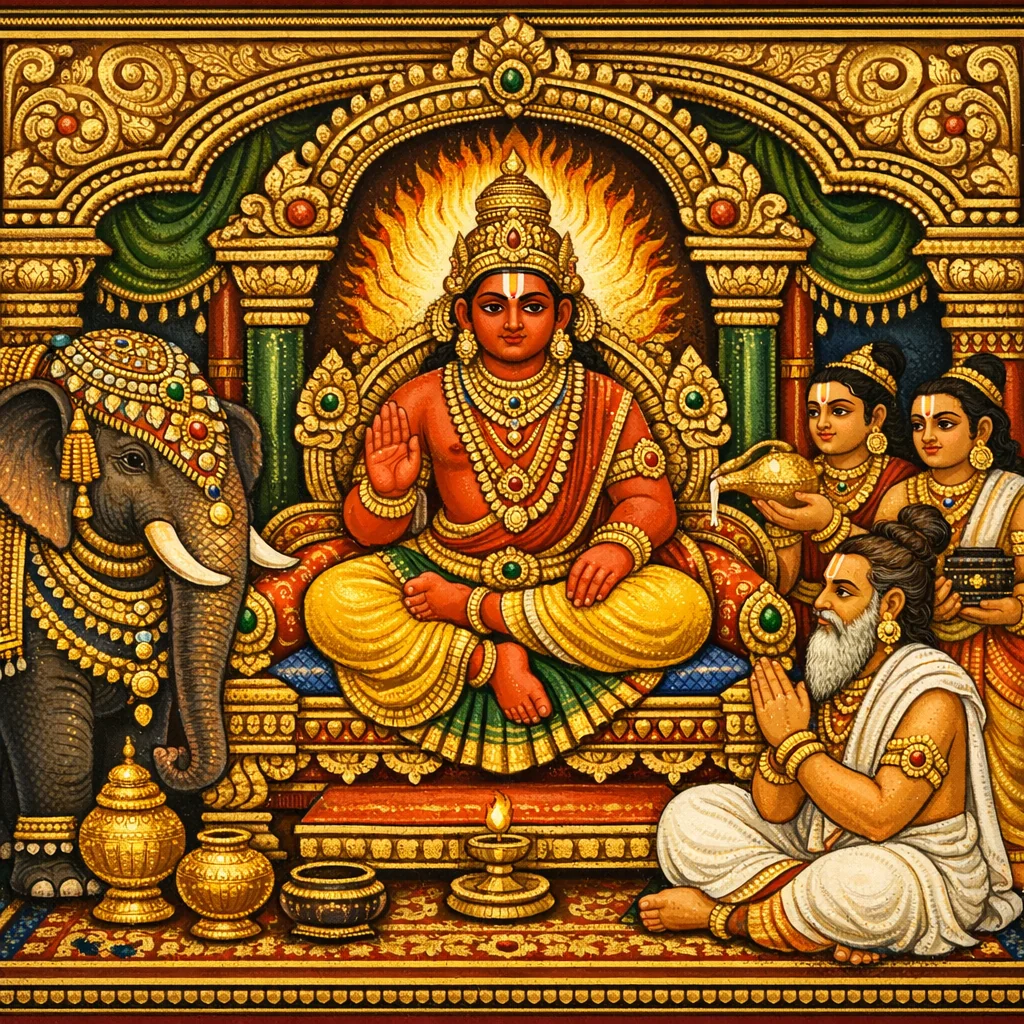
This chapter formally transitions from the previous adhyāya and introduces gaja-cikitsā (elephant medicine) as a specialized Ayurvedic science vital to royal stables and battlefield success. Speaking as Pālakāpya to Lomapāda, it defines auspicious, service-worthy elephant marks (lakṣaṇa)—nail count, musth seasonality, tusk asymmetry, voice quality, ear breadth, and skin speckling—while rejecting dwarfish or malformed types. It then ties elephant management to rājadharma and military victory, stressing that conquest depends on disciplined war-elephants and orderly camp regulation. Treatment is presented in practical order: preparing a draft-free, oleation-ready space; topical procedures (shoulder therapies, massage); internal medicines (ghee/oil preparations, decoctions, milk, meat-broth); and targeted remedies for specific disorders—pāṇḍu-like pallor, ānāha distension, fainting, headache (including nasya), foot ailments, tremors, diarrhea, ear swelling, throat obstruction, urinary retention, skin disease, worm disorders, consumption-like states, colic, and abscess care (incision through oleation/enema). Diet and regimen conclude the medical teaching (grain hierarchy, strength-promoting feeds, seasonal sprinkling), alongside a martial-ritual layer: victory fumigation, eye-washes and collyrium, and mantra-linked empowerment of the eyes—showing the Agni Purāṇa’s characteristic fusion of medicine, warfare science, and sacred efficacy.
Shlokas
Verse 1
इत्य् आग्नेये महापुराणे कल्पसागरो नाम पञ्चाशीत्यधिकद्विशततमो ऽध्यायः अथ षडशीत्यधिकद्विशततमो ऽध्यायः गजचिकित्सा पालकाप्य उवाच गजलक्ष्म चिकित्साञ्च लोमपाद यदामि ते दीर्घहस्ता महोच्छ्वासाः प्रसस्तास्ते महिष्णवः
Thus, in the Agni Mahāpurāṇa ends the two-hundred-and-eighty-fifth chapter called “Kalpa-sāgara”. Now begins the two-hundred-and-eighty-sixth chapter: “Elephant Medicine”. Pālakāpya said: “O Lomapāda, I shall teach you the treatment for the diseases and pathological marks of elephants. Those elephants are praised as excellent—long-trunked and deep-breathing—fit for the royal stables.”
Verse 2
विंशत्यष्टादशनखाः शीतकालमदाश् च ये दक्षिणञ्चोन्नतन्दन्तं वृंहितं जलदोपमं
Elephants that have twenty-eight toe-nails, that come into musth in the cold season, whose right tusk is raised, and whose trumpet is deep like a rain-cloud, are described as auspicious and excellent types.
Verse 3
कर्णौर् च विपूलौ येषां सूक्ष्मविन्द्वन्वितत्वचौ ते धार्या न तथा धार्या वामना ये च सङ्कुशाः
Those whose ears are broad and whose skin bears fine speckled marks (tiny dot-like signs) are to be accepted as suitable; but those that are dwarfish, or whose ears are curved and hooked like an elephant-goad (sankuśa), are not to be accepted in the same manner.
Verse 4
हस्तिन्यः पार्श्वगर्भिण्यो च मूढा मतङ्गजाः वर्णं सत्वं बलं रूपं कान्तिः संहननञ्जवः
In the case of female elephants, those that conceive from the flank (i.e., become pregnant without proper mating), and dull-witted tuskers, one should assess their complexion, temperament, strength, form, luster, compactness of build, and speed.
Verse 5
सप्तस्थितो गजश्चेदृक् सङ्ग्रामेरीञ्जयेत्स च कुञ्जराः परमा शोभा शिविरस्य बलस्य च
If an elephant is stationed in this manner in the sevenfold (standard) positions, he brings victory in battle; and war-elephants are the supreme splendor of both the military camp and the army.
Verse 6
आयत्तं कुञ्जरैश् चैव विजयं पृथिवीक्षितां पाकलेषु च सर्वेषु कर्तव्यमनुवासनं
The conquest of the earth’s rulers depends indeed upon war-elephants; and in all military camps and garrisons, discipline and orderly regulation must be enforced.
Verse 7
घृततैलपरीपाकं स्थानं वातविवर्जितं स्कन्धेषु च क्रिया कर्या तथा पालकवन्नृपाः
A place should be arranged, prepared with warmed ghee (ghṛta) and oil and free from drafts (vāta); and likewise the therapeutic procedure for the shoulders should be carried out—O kings—carefully, as one would tend a child.
Verse 8
गोमूत्रं पाण्डुरोगेषु रजनीभ्यां घृतन्द्विज आनाहे तैलसिक्तस्य निषेकस्तस्य शस्यते
For pāṇḍu-roga (pallor/anemia-like disorders), cow’s urine is prescribed; and ghee prepared with the two rajanīs (two turmeric varieties) is also used. O twice-born one, in ānāha (abdominal distension from obstructed wind), pouring therapy (niṣeka) with oil is recommended for him.
Verse 9
लवणैः पञ्चभिर्मश्रा प्रतिपानाय वारुणी धन्वन्तरिरुवाचेति ञ मर्दना इति ञ विडङ्गत्रिफलाव्योषसैन्धवैः कवलान् कृतान्
Vāruṇī (a medicinal fermented liquor) mixed with the five salts is to be taken as an after-drink (post-dose vehicle). Thus spoke Dhanvantari. A preparation called “Mardanā” (the triturating/rubbing compound) is made by forming oral boluses (kavala) from viḍaṅga, triphalā, vyoṣa, and saindhava (rock salt).
Verse 10
मूर्छासु भोजयेन्नागं क्षौद्रन्तोयञ्च पाययेत् अग्यङ्गः शिरसः शूले नस्यञ्चैव प्रशस्यते
In cases of fainting (mūrcchā), one should administer nāga (lead) as food and also give honey-water to drink. For headache, oil-massage of the head and nasal therapy (nasya) are indeed recommended.
Verse 11
नागानां स्नेहपुटकः पादरोगानुपक्रमेत् पश्चात् कल्ककषायेण शोधनञ्च विधीयते
For ailments of the feet, one should begin the treatment with an oleaginous poultice (snehapuṭaka) prepared from nāga (lead); afterward, purification/cleansing therapy (śodhana) is to be carried out using a paste (kalka) and a decoction (kaṣāya).
Verse 12
शिखितित्तिरिलावानां पिप्पलीमरिचान्वितैः रसैः सम्भोजयेन्नगं वेपथुर्यस्य जायते
For a person in whom tremors (vepathu) arise, one should administer nāga (lead) by making it ingestible together with the expressed juices (rasa) of peacock and partridge, combined with long pepper (pippalī) and black pepper (marica).
Verse 13
बालबिल्वं तथा लोध्रं धातकी सितया सह अतीसारविनाशाय पिण्डीं भुञ्जीत कुञ्जरः
For the destruction of diarrhea (atisāra), an elephant should eat a bolus (piṇḍī) made of tender bilva, lodhra, and dhātakī together with sugar.
Verse 14
नस्यं करग्रहे देयं घृतं लयणसंयुतम् मागधीनागराजाजीयवागूर्मुस्तसाधिता
For nasal therapy (nasya), ghee should be administered by holding it in the palm; it should be combined with rock-salt and prepared (medicated) with māgadhī (pippalī), nāgara (dry ginger), ajājī (cumin), yavāgū (rice gruel), and mustā (Cyperus rotundus).
Verse 15
उत्कर्णके तु दातव्या वाराहञ्च तथा रसम् दशमूलकुलत्थाम्लकाकमाचीविपाचितम्
In the condition of protrusion or swelling of the ear (utkarṇaka), one should administer boar-fat or boar-derived essence as well; and likewise a medicinal juice prepared by decocting daśamūla, kulattha, souring agents, and kākamācī.
Verse 16
तैलमूषणसंयुक्तं गलग्रहगदापहम् अष्टभिर्लवणैः पिष्ठैः प्रसन्नाः पाययेद्घृतम्
Ghee prepared with oil and a heating (pungent) adjunct removes the disorders of throat-obstruction (galagraha) and throat-disease. When it has been well clarified and blended with a paste made from the eight salts, one should administer that ghee as a drink.
Verse 17
मूत्रभङ्गे ऽथ वा वीजं क्वथितं त्रपूषस्य च त्वग्दोषेषु पिवेन्निम्बं वृषं वा क्वथितं द्विपः
In cases of obstruction or retention of urine (mūtrabhanga), one should drink a decoction of the seeds of trapūṣa (cucumber). For disorders of the skin, one should drink a decoction of neem, or else a decoction of vṛṣa (vāsā).
Verse 18
गवां मूत्रं विडङ्गानि कृमिकोष्ठेषु शस्यते शृङ्गवेरकणाद्राक्षाशर्कराभिः शृतं पयः
In abdominal disorders caused by worms, cow’s urine and viḍaṅga (false black pepper) are recommended; likewise, milk boiled with dry ginger, long pepper, raisins, and sugar is advised.
Verse 19
क्षतक्षयकरं पानं तथा मांसरसः शुभः मुद्गोदनं व्योषयुतमरुचौ तु प्रशस्यते
For chest-injury and consumption (kṣata and kṣaya), a restorative drink is recommended; likewise, wholesome meat-broth is beneficial. In loss of appetite (aruci), cooked rice with mung (mudga-odana) mixed with the pungent triad (vyoṣa) is especially praised.
Verse 20
त्रिवृद्व्योषाग्निदन्त्यर्कश्यामाक्षीरेभपिप्पली एतैर् गुल्महरः स्नेहः कृतश् चैव तथापरः
With trivṛt, the three pungents (vyoṣa), citraka, dantī, arka, śyāmā, milk, and pippalī—using these, a medicated oleaginous preparation (sneha) that alleviates gulma is prepared; and another (variant) is likewise made.
Verse 21
भेदनद्रावणाभ्यङ्गस्नेहपानानुवासनैः सर्वानेव समुत्पन्नन् विद्रवान् समुपाहरेत्
By incision (opening), liquefaction/suppuration-promoting measures, oil-massage, internal intake of fats (oleation), and oil-enema (anuvāsana), one should treat all abscesses (vidradhi) that have arisen.
Verse 22
यष्टिकं मुद्गसूपेन शारदेन तथा पिवेत् बालबिल्वैस् तथा लेपः फटुरोगेषु शस्यते
One should drink yaṣṭikā together with a soup of green gram (mudga-sūpa), and likewise follow the autumnal regimen (śārada). Also, a paste prepared with tender bilva fruits is recommended in cases of phaṭu-roga (a fissuring/splitting-type disorder).
Verse 23
विडङ्गेन्द्रयवौ हिङ्गु सरलं रजनीद्वयम् पूर्वाह्णे पाययेत् पिण्डान् सर्वशूलोपशान्तये
In the forenoon, one should administer piṇḍas (medicinal boluses) prepared from viḍaṅga, indrayava, hiṅgu, sarala, and the two rajanīs (two turmeric varieties), for the complete pacification of all colic and pain.
Verse 24
प्रधानभोजने तेषां यष्टिकव्रीहिशालयः मध्यमौ यवगोधूमौ शेषा दन्तिनि चाधमाः
Among those grains, for principal meals the finest rices—yaṣṭika, vrīhi, and śāli—are best. Barley (yava) and wheat (godhūma) are of middling grade; the remaining kinds, such as dantini, are regarded as inferior.
Verse 25
यवश् चैव तथैवेक्षुर्नागानां बलवर्धनः नागानां यवसं शुष्कं तथा धातुप्रकोपणं
Barley (yava), and likewise sugarcane (ikṣu), promote strength in nāgas. Yet for nāgas, dried fodder—dry grass (yavasa)—also aggravates the dhātus (bodily constituents) and provokes disorder.
Verse 26
मदक्षिणस्य नागस्य पयःपानं प्रशस्यते दीपनीयैस् तथा द्रव्यैः शृतो मांसरसः शुभः
For a nāga afflicted with the condition called mada-kṣiṇa (depletion after intoxication), the drinking of milk is commended; likewise, a meat-broth cooked with dīpanīya substances (digestive stimulants) is wholesome and beneficial.
Verse 27
वायसः कुक्कुरश्चोभौ काकोलूककुलो हरिः भवेत् क्षौद्रेण संयुक्तः पिण्डो युद्धे महापदि
In the great crisis of battle, a piṇḍa (bait-pellet) mixed with honey becomes effective for drawing a crow and a dog, and also flocks of crows and owls; it likewise serves as a means to divert or ward off the enemy.
Verse 28
कटुमत्स्यविडङ्गानि क्षारः कोषातकी पयः हरिद्रा चेति धूपोयं कुञ्जरस्य जयावहः
Pungent fish-substance, viḍaṅga, alkali (kṣāra), the milky latex of koṣātakī, and turmeric—this is the fumigatory incense (dhūpa); it brings victory to an elephant.
Verse 29
पिप्पलीतण्डुलास्तैलं माध्वीकं माक्षिकम् तथा नेत्रयोः परिषेकोयं दीपनीयः प्रशस्यते
An eye irrigation (pariṣeka) prepared with pippalī, rice-grains, oil, mādhvīka (a honey-based ferment/mead), and honey is praised as dīpanīya—one that kindles and clears ocular function.
Verse 30
पूरीषञ्चटकायाश् च तथा पारावतस्य च क्षीरवृक्षकरीषाश् च प्रसन्नयेष्टमञ्जनं
To produce clarity and satisfaction of the eyes, the preferred collyrium (añjana) is prepared from the droppings of the sparrow, likewise of the pigeon, and also from the “dung” of milk-yielding trees (kṣīra-vṛkṣas), i.e., their latex/exudate.
Verse 31
मुद्ग्यूषेणेति ज , ञ च मदाय हीति ञ क्षीरवृक्षकरीराश्चेति ञ अनेनाञ्जितनेत्रस्तु करोति कदनं रणे उत्पलानि च नीलानि सुस्तन्तगरमेव च
“(Recite) ‘mudgyūṣeṇa’ with the syllables ja and ña; (and) ‘madāya hi’ with ña; (and) ‘kṣīra-vṛkṣa-karīrāḥ’ with ña.” By this mantra-application, with eyes anointed, one brings about slaughter in battle; and also produces/commands blue lotuses and the poison called sustantagara.
Verse 32
तण्डुलोदकपिष्टानि नेत्रनिर्वापनं परम् नखवृद्धौ नखच्छेदस्तैलसेकश् च मास्यपि
Pastes made with rice-water are an excellent remedy for cooling and soothing the eyes. When the nails overgrow, trimming the nails is prescribed; and even monthly, an oil-pouring (oleation) treatment is recommended.
Verse 33
शय्यास्थानं भवेच्चास्य करीषैः पांशुभिस् तथा शरन्निदाघयोः सेकः सर्पिषा च तथेष्यते
Its resting-place (bedding area) should be prepared with dried dung and fine earth-dust. In the autumn and summer seasons, sprinkling or anointing with ghee is likewise prescribed.
Frequently Asked Questions
It prioritizes gaja-lakṣaṇa (selection markers) and a protocol-driven therapeutic system—environment control, oleation/purification procedures, dietetics, and disease-specific formulations—explicitly tied to stable discipline and battlefield readiness.
By framing veterinary medicine as rājadharma and a form of protective service, it treats technical competence (bhukti) as dharmically sanctified action that sustains order, reduces suffering, and supports the conditions for disciplined spiritual life (mukti-oriented practice).
Yes. The text links elephant health to victory logistics, includes victory-oriented fumigation, ocular preparations, and a mantra layer—showing the Agni Purāṇa’s characteristic integration of medical and martial sciences.