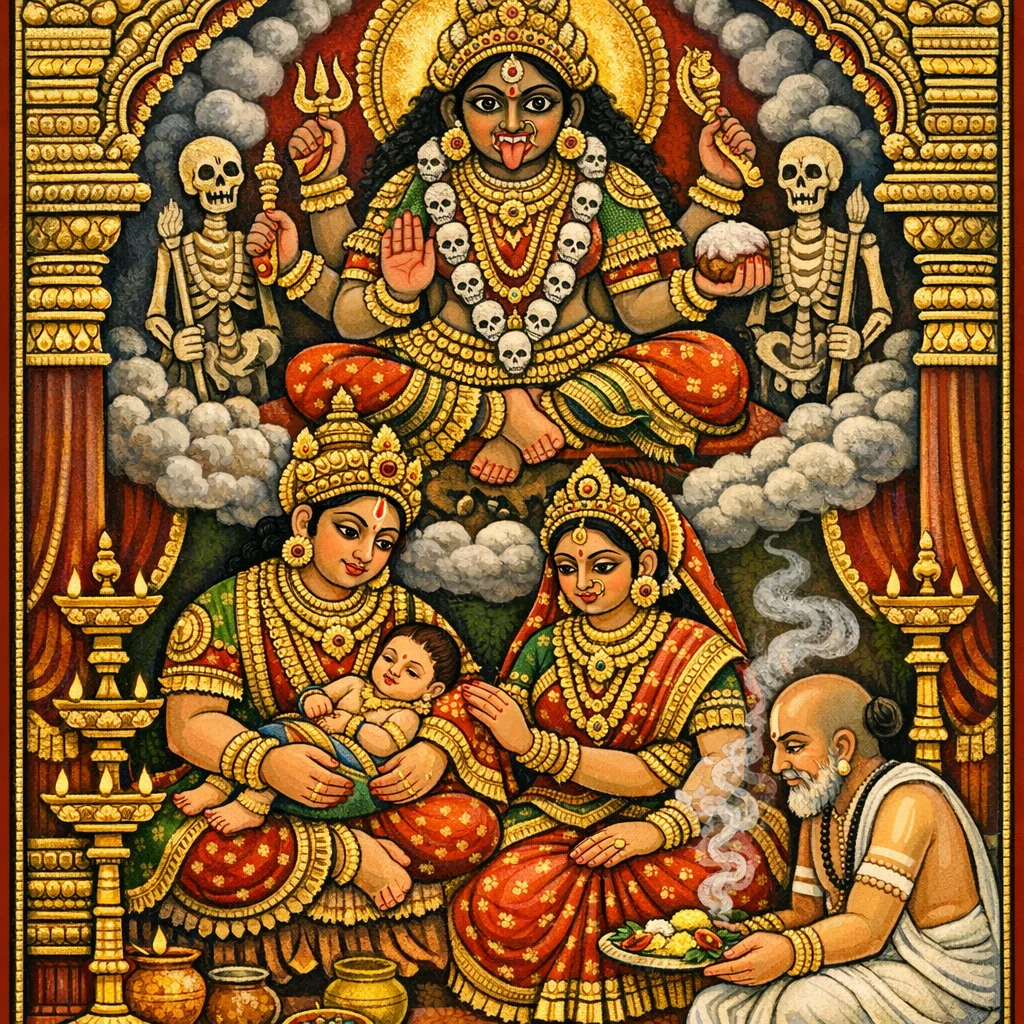
Adhyaya 298
Bala-graha-hara Bāla-tantram (बालग्रहहर बालतन्त्रम्) — Pediatric protection and graha-affliction management
Lord Agni opens a pediatric bāla-tantra on bala-grahas—harmful “seizing” forces believed to afflict infants from birth. The chapter sets out a diagnostic and procedural order: (1) note signs such as restless limbs, anorexia, neck-twisting, abnormal cries, breathing distress, discoloration, foul odor, spasms, vomiting, fear, delirium, and blood-tinged urine; (2) determine the specific graha or time-marker (tithi/day-count, monthly and annual stages) linked to symptom clusters; and (3) apply integrated measures—ointments/pastes (lepa), fumigations (dhūpa), bathing (snāna), lamps and incense, direction- or site-based rites (e.g., under a karañja tree in Yama’s direction), and bali offerings with prescribed foods/substances (fish, meat, liquor, pulses, sesame preparations, sweets) or, for certain classes, “foodless” foul offerings. It culminates in protective mantras to Cāmuṇḍā as universal (sarva-kāmika) safeguards during bali-dāna, showing Agni’s methodical transmission of applied Ayurveda interwoven with ritual prophylaxis to restore child health and household security within dharma.
Shlokas
Verse 1
इत्य् आग्नेये महापुराणे गोनसादिचिकित्सा नाम सप्तनवत्यधिकद्विशततमो ऽध्यायः षष्टिव्योषगुडक्षीरयोग इति क , ज , ञ , ट च अथाष्टनवत्यधिकद्विशततमो ऽध्यायः बलग्रहहरबालतन्त्रम् अग्निर् उवाच बालतन्त्रं प्रवक्ष्यामि बालादिग्रहमर्दनं अथ जातदिने वत्सं ग्रही गृह्णाति पापिनी
Thus, in the Agni Mahāpurāṇa ends the two-hundred-and-ninety-seventh chapter called “Therapy for gonasa and related disorders,” including the formulation titled “Mixture of sixty (drugs) with the pungent-trio, jaggery, and milk,” (classified under the groups) ka, ja, ña, and ṭa. Now begins the two-hundred-and-ninety-eighth chapter: “The Bāla-tantra for removing child-seizing spirits (bala-grahas).” Agni said: “I shall teach the pediatric tantra—methods for crushing and warding off the grahas that afflict infants and children. On the very day of birth, the sinful female grahī seizes the calf/infant.”
Verse 2
गात्रोद्वेगो निराहारो नानाग्रीवाविवर्तनं तच्चेष्टितमिदं तस्यान्मातॄणाञ्च बलं हरेत्
Agitation or trembling of the limbs, refusal of food, and repeated twisting/turning of the neck in various directions—such behavior is indicative of that graha-affliction, and it is said to sap the strength of the Mātṛkās (the Mother-spirits) as well.
Verse 3
सत्स्यमांससुराभक्ष्यगन्धस्रग्धूपदीपकैः लिम्पेच्च धातकीलोध्रमञ्जिष्ठातालचन्दनैः
One should anoint with a fine fragrance prepared from fish, meat, liquor, and edible aromatics, together with garlands, incense (dhūpa), and lamps; and one should also apply a paste made from dhātakī, lodhra, mañjiṣṭhā, tāla, and sandalwood.
Verse 4
महिषाक्षेण धूपश् च द्विरात्रे भौषणी ग्रही तच्चेष्टा कासनिश्वासौ गात्रसङ्कोचनं मुहुः
When fumigation is performed with the substance called Mahiṣākṣa for two nights, the patient is seized by the Bhauṣaṇī-graha. Its signs are abnormal movements, coughing and laboured breathing, and repeated contraction or spasm of the limbs.
Verse 5
आजमूत्रैर् लिपेत् कृष्णासेव्यापामार्गचन्दनैः गोशृङ्गदन्तकेशैश् च धूपयेत् पूर्ववद्बलिः
One should smear (the place or object) with goat’s urine mixed with kṛṣṇā, asevya, apāmārga, and sandalwood; and one should fumigate it with cow-horn, tooth, and hair. Then the bali-offering is to be performed as previously prescribed.
Verse 6
ग्रही त्रिरात्रे घण्ठाली तच्चेष्टा क्रन्दनं मुहुः जृम्भणं स्वनितन्त्रासो गात्रोद्वेगमरोचनं
When a person is seized by a graha-affliction, within three nights there arise: a bell-like ringing (in the head/ears), abnormal movements, frequent crying, repeated yawning, fright at one’s own sounds, agitation of the limbs, and loss of appetite or relish.
Verse 7
केशराञ्जनगोहस्तिदन्तं साजपयो लिपेत् नखराजीबिल्वदलैर् धूपयेच्च बलिं हरेत्
One should apply a coating made of saffron, collyrium (añjana), cow’s products, and elephant-ivory, mixed with goat’s milk. Then one should fumigate with nail-parings and bilva leaves, and thereafter offer a bali (ritual oblation).
Verse 8
ग्रही चतुर्थी काकोली गात्रोद्वेगप्ररोचनं फेनोद्गारो दिशो दृष्टिः कुल्माषैः सासवैर् बलिः
For one afflicted by a graha, on the fourth lunar day the cry of the kākolī-bird is an omen; there is agitation of the limbs and loss of appetite; frothy eructation occurs; and the gaze turns toward the directions. The pacificatory bali-offering should be made with kulmāṣa (boiled pulses) together with fermented liquor.
Verse 9
गजदन्ताहिनिर्मोकवाजिमूत्रप्रलेपनं सराजीनिम्बपत्रेण धूतकेशेन छूपयेत्
One should apply externally a plaster made from elephant-ivory, snake-slough, and horse-urine; and, using streaked (variegated) neem leaves and hair that has been washed and purified, one should perform the prescribed fumigation/ritual application (chūpayet).
Verse 10
हंसाधिका पञ्चमी स्याज्जृम्भाश्वासोर्धधारिणी मुष्टिबन्धश् च तच्चेष्टा बलिं मत्स्यादिना हरेत्
The fifth mudrā is called Haṃsādhikā. It is performed with a yawn-like inhalation, holding the gesture raised upward and with the fists bound (closed); with that very gesture one should present the bali-offering, beginning with fish and the like.
Verse 11
मेषशृङ्गबलालोध्रशिलातालैः शिशुं लिपेत् फट्कारी तु ग्रही षष्ठी भयमोहप्ररोदनं
One should anoint the infant with a preparation made from ram’s horn, balā, lodhra, mineral stone (śilā), and tāla (orpiment). This is a remedy against the graha called Ṣaṣṭhī, which causes fear, delusion, and excessive crying.
Verse 12
निराहारो ऽङ्गविक्षेपो हरेन्मत्स्यादिना बलिं राजीगुग्गुलुकुष्ठेभदन्ताद्यैर् धूपलेपनैः
Fasting and the shaking/twitching of the limbs should be countered by offering bali with fish and the like; and by means of fumigations and unguent-applications prepared from mustard (rajī), guggulu, kuṣṭha, elephant-ivory (ebhadanta), and similar substances.
Verse 13
सप्तमे मुक्तकेश्यार्तः पूतिगन्धो विजृम्भणं सादः प्ररोदनङ्कासो धूपो व्याघ्रनखैर् लिपेत्
In the seventh affliction, the patient—distressed and with hair left loose—has a foul odor, frequent yawning, languor, crying, and a harsh, hacking cough. One should apply the protective measure by fumigation, using tiger-claws as the ritual substance/implement.
Verse 14
वचागोमयगोमूत्रैः श्रीदण्डी चाष्टमे ग्रही दिशो निरीक्षणं जिह्वाचालनङ्कासरोदनं
With vacā (sweet-flag), cow-dung, and cow-urine—these are employed as remedies/agents; and in the eighth case the graha called Śrīdaṇḍin seizes the child. Its signs are: repeatedly looking toward the directions, trembling/jerking of the tongue, and crying with a choking or strangled sound.
Verse 15
बलिः पूर्वैव मत्स्याद्यैर् धूपलेपे च हिङ्गुला वचासिद्धर्थलशुनैश्चोर्ध्वग्राही महाग्रही
First an offering (bali) should be made with fish and the like; and for fumigation and protective smearing, hīṅgulā (cinnabar) is prescribed, together with vacā (sweet-flag), siddhārtha (white mustard), and garlic—for one afflicted by the ‘upward-seizing’ and the ‘great-seizing’ grahas.
Verse 16
उद्वेजनोर्ध्वनिःश्वासः स्वमुष्टिद्वयखादनं रक्तचन्दनकुष्ठाद्यैर् धूपयेल्लेपयेच्छिशुं
When an infant shows startle-fear, laboured upward breathing, and the habit of biting (or chewing) both of its own fists, one should fumigate and apply an unguent to the child using red sandalwood, kuṣṭha, and similar medicinal substances.
Verse 17
कपिरोमनखैर् धूपो दशमी रोदनी ग्रही तच्चेष्टा रोदनं शश्वत् सुगन्धो नीलवर्णता
A smoke (or fumigation-odor) resembling the hair and nails of a monkey; the tenth (daśamī) tithi; a weeping disposition; seizure by a graha; its activity being continual crying; a pleasant fragrance; and a bluish coloration—these are the characteristics described here.
Verse 18
धूपो निम्बेन भूतोग्रराजीसर्जरसैर् लिपेत् बलिं वहिर्हरेल्लाजकुल्माषकवकोदनम्
For fumigation, one should smear (the place or implement) with neem and with the resins/juices of bhūtogrā, rājī, and sarja; and one should carry the bali-offering outside—consisting of parched rice (lāja), kulmāṣa (boiled pulses), kavaka, and cooked rice (odana).
Verse 19
यावत्त्रयोदशाहं स्यादेवं धूपादिका क्रिया गृह्नाति मासिकं वत्सं पूतनासङ्कुली ग्रही
So long as the child’s affliction persists, up to thirteen days, the rite—fumigation (dhūpa) and the like—should be performed in this manner; for the Grahī, namely Pūtanā with her attendant host, seizes a one‑month‑old infant.
Verse 20
काकवद्रोदनं श्वासो मूत्रगन्धो ऽक्षिमीलनं गोमूत्रस्नपनं तस्य गोदन्तेन च धूपनम्
Crying like a crow, laboured breathing, the smell of urine, and closing of the eyes—when these signs appear, he should be bathed with cow’s urine, and he should also be fumigated using a cow’s tooth.
Verse 21
धूपदीपे चेति ट करकोदनमिति ख पीतवस्त्रं ददेद्रक्तस्रग्गन्धौ तैलदीपकः त्रिविधं पायसम्मद्यं तिलमासञ्चतुर्विधम्
For incense (dhūpa) and lamps—this is the ṭa-class; and “karakodana” is said to be the kha-class. One should give a yellow garment; offer a red garland and fragrance; and a lamp fueled with oil. The milk-pudding and the intoxicating drink are of three kinds; sesame and black-gram are of four kinds.
Verse 22
करञ्जाधो यमदिशि सप्ताहं तैर् बलिं हरेत् द्विमासिकञ्च मुकुटा वपुः शीतञ्च शीतलं
Beneath a karañja tree, in the direction of Yama, for seven days one should carry and present the bali-offering with those items. For the two-month observance, (the preta) is described as wearing a crown (mukuṭā); its body is cold, and it abides in coldness.
Verse 23
छर्धिः स्यान्मुखशोषादिपुष्पगन्धांशुकानि च अपूपमोदनं दीपः कृष्णं नीरादि धूपकम्
There may be vomiting, along with dryness of the mouth and related symptoms. For this, fragrant cloths scented with flowers may be used; apūpa-cakes and modaka-sweets may be offered. A lamp (dīpa) should be employed, and a black fumigant (kṛṣṇa dhūpaka) prepared from nīra and other substances is recommended.
Verse 24
तृतीये गोमुखी निद्रा सविन्मूत्रप्ररोदनम् यवाः प्रियङ्गुः पलनं कुल्माषं शाकमोदनम्
In the third stage, one should sleep with the face turned downward (gomukhī-nidrā); urine should be passed at the rising of the morning sun (at daybreak); and one should take barley (yavā), priyaṅgu grain, palana, kulmāṣa (boiled pulses), and rice with vegetables (śāka-odana).
Verse 25
क्षीरं पूर्वे ददेन्मध्ये ऽहनि धूपश् च सर्पिषा पञ्चभङ्गेन तत् स्नानं चतुर्थे पिङ्गलार्तिहृत्
At first, one should administer milk; at midday there should be fumigation (dhūpa) with ghee. Then bathing with the fivefold mixture (pañca-bhaṅga) is prescribed; on the fourth application (or day), it removes the distress of piṅgalā.
Verse 26
तनुः शीता पूतिगन्धः शोषः स म्रियते ध्रुवम् पञ्चमी ललना गात्रसादः स्यान्मुखशोषणं
If the body becomes cold and emaciated, emits a foul odor, and there is wasting (consumption), that person certainly dies. On the fifth (application or day), in a woman there occurs bodily prostration and dryness of the mouth.
Verse 27
अपानः पीतवर्णश् च मत्स्याद्यैर् दक्षिणे बलिः षण्मासे पङ्कजा चेष्टा रोदनं विकृतः स्वरः
Apāna (the downward-moving vital wind) is indicated; there is a yellowish complexion; and a bali offering should be made on the right side with fish and related items. In the sixth month, there is “lotus-like” (unsteady, splayed) movement; the child cries, and the voice becomes distorted.
Verse 28
मत्स्यमांससुराभक्तपुष्पगन्धादिभिर्बलिः सप्रमे तु निराहारा पूतिगन्धादिदन्तरुक्
A bali (ritual offering) may be made with fish, meat, liquor (surā), cooked food, flowers, fragrances, and the like. But the offering intended for the saprame class is to be without food, consisting instead of foul-smelling substances and the like, with ‘dantaruk’ (a pungent, biting additive) included.
Verse 29
पिष्टमांससुरामांसैर् बलिः स्याद्यमुनाष्टमे विस्फोटशोषणाद्यं स्यात् तच्चिकित्सान्न कारयेत्
On the eighth lunar day (aṣṭamī) at the Yamunā, a bali-offering should be made with pounded meat, surā (liquor), and meat. If visphoṭa (eruptive sores), śoṣaṇa (wasting), and the like arise, one should not undertake medical treatment for it, but should follow the prescribed propitiatory rite.
Verse 30
नवमे कुम्भकर्ण्यार्तो ज्वरी च्छर्दति पालकम् रोदनं मांसकुल्माषमद्याद्यैर् वैश्वके बलिः
On the ninth day, when afflicted by Kumbhakarṇī, the child’s guardian becomes feverish and vomits, and there is also crying. In the Vaiśvadeva rite, a bali-offering should be made with meat, kulmāṣa (boiled pulses), surā (liquor), and similar items.
Verse 31
दशमे तापसी चेष्टा निराहारोक्षिमीलनम् घण्टा पताका पिष्टोक्ता सुरामांसबलिः समे
In the tenth observance, the conduct is ascetic (tāpasī): fasting and the closing of the eyes. The rite employs a bell and a banner; a bali of piṣṭa (flour) is prescribed; and in that same rite an offering consisting of surā (liquor) and meat is also to be made.
Verse 32
राक्षस्येकादशी पीडा नेत्राद्यं न चिकित्सनम् चञ्चला द्वादशे श्वासः त्रासादिकविचेष्टितम्
In rākṣasī-affliction, on the eleventh day there is pain; disorders of the eyes and the like are not amenable to treatment. On the twelfth day there is restlessness and labored breathing, along with fearful, agitated movements and similar symptoms.
Verse 33
बलिः पूर्वे ऽथ मध्याह्ने कुल्मापाद्यैस्तिलादिभिः यातना तु द्वितीये ऽब्दे यातनं रोदनादिकम्
First the bali-offering should be made; then, at midday, one should offer kulmāṣa and other foods, together with tilā (sesame) and the like. The period of suffering, however, is in the second year; that suffering consists of weeping and similar afflictions.
Verse 34
तिलमांसमद्यमांसैर् बलिः स्नानादि पूर्ववत् तृतीये रोदनी कम्पो रोदनं रक्तमूत्रकं
The bali (ritual offering) is to be made with sesame, meat, liquor, and meat; bathing and the other preliminaries are as stated earlier. In the third instance there is wailing and trembling; there occurs wailing and the passing of urine mixed with blood.
Verse 35
गुडौदनं तिलापूपः प्रतिमा तिलपिष्टजा तिलस्नानं पञ्चपत्रैर् धूपो राजफलत्वचा
Sweetened rice cooked with jaggery, a sesame cake, and an image fashioned from sesame paste are prescribed. Bathing is to be done with sesame water, incense is to be offered with five leaves, and fumigation is to be made from the bark of rājaphala.
Verse 36
चतुर्थे चटकाशोफो ज्वरः सर्वाङ्गसादनम् मत्स्यमांसतिलाद्यैश् च बलिः स्नानञ्च धूपनम्
In the fourth instance there is sudden swelling (caṭakā-śopha), fever, and prostration of the whole body. A bali is to be offered with fish, meat, sesame and the like, and bathing and fumigation are to be performed.
Verse 37
चञ्चला पञ्चमे ऽब्दे तु ज्वरस्त्रासो ऽङ्गसादनम् मांसौदनाद्यैश् च बलिर्मेषशृङ्गेण धूपनम्
In the fifth year, the graha (afflicting force) called Cañcalā causes fever, terror, and weakness of the limbs. It is pacified by offering a bali of meat, rice-porridge and the like, and by fumigation using a ram’s horn.
Verse 38
पलाशोदुम्बराश्वत्थवटबिल्वदलाम्बुधृक् षष्ठे ऽब्दे धावनीशोषो वैरस्यं गात्रसादनम्
One who subsists on water infused with the leaves of palāśa, udumbara, aśvattha, vaṭa, and bilva—in the sixth year—experiences bodily drying (emaciation), an astringent or bitter tastelessness in the mouth, and debility of the limbs.
Verse 39
सप्ताहोभिर्बलिः पूर्वैर् धुपस्नानञ्च भङ्गकैः सप्तमे यमुनाच्छर्दिरवचोहासरोदनम्
In the preceding weeks there is loss of strength, together with fumigation/incensing and ritual bathing, and a collapse of the body; on the seventh (day/week) there is vomiting like the Yamunā, incoherent speech, laughter, and weeping.
Verse 40
मांसपाद्यसमद्याद्यैर् बलिः स्नानञ्च धूपनम् अष्टमे वा जातवेदा निराहारं प्ररोदनम्
A bali-offering should be made with meat, cooked food and the like, together with liquor and similar items; and one should also perform ritual bathing and fumigation/incensing (dhūpa). Or, on the eighth day, for Jātavedas (Agni), one should observe fasting and perform ritual lamentation.
Verse 41
कृशरापूपदध्याद्यैर् बलिः स्नानञ्च धूपनम् कालाब्दे नवमे वाह्वोरास्फोटो गर्जनं भयम्
With a bali consisting of kṛśarā (khicrī), sweet cakes (pūpa), curd (dadhi) and the like, together with ritual bathing and fumigation/incensing (dhūpa), one should perform the propitiatory rites. In the ninth year of the time-cycle, cracking sounds or twitching in the arms and a rumbling roar are portents of fear.
Verse 42
बलिः स्यात् कृशरापूपशक्तुकुल्मासपायसैः दशमे ऽब्दे कलहंसी दाहो ऽङ्गकृशता ज्वरः
The prescribed bali-offering should be made with kṛśarā (khicrī), cakes (pūpa), parched flour (śaktu/sattu), kulmāṣa (boiled pulses), and pāyasa (milk-rice). In the tenth year there is quarrelsomeness; burning sensations, emaciation of the limbs, and fever are indicated.
Verse 43
वैवर्ण्यमिति ठ भागकैर् इति ख पौलिकापूपदध्यन्नैः पञ्चरात्रं बलिं हरेत् निम्बधूपकुष्ठलेप एकादशमके ग्रही
For the condition called “vaivarṇya” (discoloration), as indicated in the ṭha- and kha-classes, one should offer a bali for five nights using rice-cakes (pūpa), curd (dadhi), and cooked rice. For the eleventh type, the afflicting graha should be treated with neem-incense (nimbadhūpa) and an application (lepa) of kuṣṭha (costus).
Verse 44
देवदूती निष्ठुरवाक् बलिर्लेपादि पूर्ववत् बलिका द्वादशे बलिर्लेपादि पूर्ववत्
For Devadūtī and Niṣṭhuravāk, the bali-offering and the application of ritual paste (lepa), together with the remaining procedures, are to be performed as previously prescribed. For Balikā likewise—on the twelfth (day/observance)—the bali, the lepa-application, and all other rites are to be done exactly as before.
Verse 45
त्रयोदशे वायवी च मुखवाह्याङ्गसादनम् रक्तान्नगन्धमाल्याद्यैर् बलिः पञ्चदलैः स्नपेत्
On the thirteenth (day/observance), one should perform the Vāyavī rite: the sādhana, or consecratory purification, of the mouth and the external limbs. With red food, fragrances, garlands, and similar offerings, one should present the bali, and then bathe (the deity/ritual object) using five petals or leaves.
Verse 46
राजीनिस्वदलैर् धूपो यक्षिणी च चतुर्दशे चेष्टा शूलं ज्वरो दाहो मांसभक्षादिकैर् बलिः
Fumigation (dhūpa) is to be performed with the leaves of rājīnī; and the rite of Yakṣiṇī is prescribed for the fourteenth (day/observance). For conditions such as abnormal movements, colic pain (śūla), fever (jvara), and burning sensation (dāha), a bali-offering should be made with meat, edible portions, and similar items.
Verse 47
स्नानादि पूर्ववच्छान्त्यै मुण्डिकार्तिस्त्रिपञ्चके तच्चेष्टासृक्श्रवः शश्वत्कुर्याम्मातृचिकित्सनम्
For pacification (śānti), one should proceed with bathing and the other preliminaries exactly as previously prescribed. In the triad-and-fivefold set of afflictions—such as the pain called ‘Muṇḍikā’—together with abnormal movements and continual bleeding, one should invariably carry out the Mothers’ therapeutic ritual treatment (Mātṛ-cikitsā).
Verse 48
वानरी षोडशी भूमौ पतेन्निद्रा सदा ज्वरः पायसाद्यैस्त्रिरात्रञ्च वलिः स्नानादि पूर्ववत्
If the affliction called Vānarī arises on the sixteenth (lunar day), one should lie down upon the ground; sleepiness and a persistent fever will occur. For three nights, a bali-offering should be made with payasa (rice cooked in milk) and similar foods; bathing and the other observances are to be performed as previously stated.
Verse 49
गन्धवती सप्तदशे गात्रोद्वेगः प्ररोदनम् कुल्माषाद्यैर् बलिः स्नानधूपलेपादि पूर्ववत्
In the seventeenth kind of odour, called “gandhavatī,” there arise bodily agitation and crying. The propitiatory offering (bali) should be made with kulmāṣa and similar items; bathing, incense-fumigation, anointing, and the rest are to be performed as previously prescribed.
Verse 50
दिनेशाः पूतना नाम वर्षेशाः सुकुमारिकाः आकट्टय एवं सिद्धरूपो ज्ञापयति हरे हरे निर्दोषं कुरु कुरु बालिकां बालं स्त्रियम् पुरुषं वा सर्वग्रहाणामुपक्रमात् चामुण्डे नमो देव्यै ह्रूं ह्रूं ह्रीं अपसर अपसर दुष्टग्रहान् ह्रूं तद्यथा गच्छन्तु गृह्यकाः अन्यत्र पन्थानं रुद्रो ज्ञापयति सर्वबालग्रहेषु स्यान्मन्त्रो ऽयं सर्वकामिकः
“The Dineśas, the one called Pūtanā, the Varṣeśas, and the Sukumārikās”—thus the Siddha-form (an empowered presence) makes it known: “Hare, hare—make blameless, make blameless the girl, the boy, the woman, or the man from the onset/attack of all grahas (seizing spirits). O Cāmuṇḍā, obeisance to the Goddess: hrūṃ hrūṃ hrīṃ—depart, depart, O wicked grahas—hrūṃ. Thus may the gṛhyakāḥ (house-haunting seizers) go away by another path; Rudra proclaims the path.” This mantra is to be used in all cases of child-grahas and is “sarva-kāmika”—effective for all desired aims in this protective context.
Verse 51
ॐ नमो भगवति चामुण्डे मुञ्च मुञ्च बलिं बालिकां वा बलिं गृह्ण गृह्ण जय जय वस वस सर्वत्र बलिदाने ऽयं रक्षाकृत् पठ्यते मनुः रक्षन्तु च ज्वराभ्यान्तं मुञ्चन्तु च कुमारकम्
Om. Homage to the Blessed Goddess Cāmuṇḍā. Release, release—(and accept) the offering (bali), whether for a young girl or otherwise. Accept, accept the offering. Victory, victory; abide, abide (here). In every act of bali-offering this mantra is recited as a maker of protection: “May they protect one afflicted by fever, and may they release the child (from that affliction).”
Frequently Asked Questions
It correlates observable pediatric signs (cry patterns, appetite loss, spasms, breath distress, discoloration, odor, vomiting, blood-urine) with named grahas and time-markers (tithi/day-count and age stages), then assigns matching dhūpa-lepa-snāna-bali protocols.
It treats fumigation, anointment, bathing, lamps/incense, directional rites, and bali offerings as therapeutic instruments alongside plant/mineral/animal materia medica, culminating in protective mantras to Cāmuṇḍā for comprehensive graha-removal.
The Cāmuṇḍā-focused mantra set (hrūṃ hrūṃ hrīṃ… apasara apasara duṣṭa-grahān…) is described as applicable to all child-graha cases and recited during bali-dāna as a raksā-kṛt (protector).