Adhyaya 300
Chapter 300 — सूर्यार्चनम् (Worship of Sūrya)
Lord Agni teaches a concentrated upāsanā of Sūrya (Sūrya-arcana) as a siddhi-yielding discipline that pacifies graha influences, giving a condensed bīja-formula (piṇḍa) said to accomplish comprehensive aims. He explains bīja-construction (limb-components and completion by bindu) and incorporates Gaṇeśa’s five bīja-sets as universal preliminaries: directional worship, mūrti placements, mudrā sealing, iconographic marks (red form, implements, hand-configuration), and observances such as Caturthī. The rite expands into a solar–graha matrix—bathing, arghya offerings, worship of the nine grahas with nine mantra-consecrated water-pots, and specific offerings (a lamp for Caṇḍā; gorocanā, saffron, red perfume, sprouts; grains and hibiscus-linked gifts). Stated results include graha-śānti, victory in conflict, correction of lineage/seed defects, and influence-rites through mantra-installed touch and charged substances (e.g., vetiver). Nyāsa from head to feet and self-identification with Ravi complete the practice, while color-coded visualizations align intentions such as stambhana/māraṇa, puṣṭi, enemy-striking, and mohana. Thus Sūrya worship is presented as a bridge between devotion and applied efficacy within Agneya Vidyā.
Shlokas
Verse 1
इत्य् आग्नेये महापुराणे ग्रहहृन्मन्त्रादिकं नाम नवनवत्यधिकद्विशततमो ऽध्यायः अथ त्रिशततमो ऽध्यायः सूर्यार्चनम् अग्निर् उवाच शय्या तु दण्डिसाजेशपावकश् चतुराननः सर्वार्थसाधकमिदं वीजं पिण्डार्थमुच्यते
Thus, in the Agni Mahāpurāṇa ends the two-hundred-and-ninety-ninth chapter entitled “Grahahṛn-mantras and related rites.” Now begins the three-hundredth chapter: “Worship of Sūrya.” Agni said: “For this worship, the seed-mantra—‘śayyā, daṇḍi, sājeśa, pāvaka, caturānana’—is taught as a piṇḍa (a condensed formula) and is able to accomplish all aims.”
Verse 2
स्वयं दीर्घस्वराद्यञ्च वीजेष्वङ्गानि सर्वशः खातं साधु विषञ्चैव सविन्दुं सकलं तथा
In the seed-syllables (bīja-mantras), one should in every way apply the component “limbs” (aṅga), beginning with the long vowels. The bīja is to be properly formed in the “pierced/marked” mode, together with the “poison” (the sharp, penetrating element), and likewise with the bindu (nasal dot), as a complete whole.
Verse 3
गणस्य पञ्च वीजानि पृथग्दृष्टफलं महत् गणं जयाय नमः एकदंष्ट्राय अचलकर्णिने गजवक्त्राय महोहरहस्ताय पञ्चाङ्गं सर्वसामान्यं सिद्धिः स्याल्लक्षजाप्यतेः
The five seed(-formulae) of Gaṇeśa yield great results, each observed to bestow its own distinct fruit. They are: “Gaṇaṃ—obeisance for victory”; “obeisance to the One-tusked”; “to the Unmoving-eared”; “to the Elephant-faced”; and “to him whose hand removes great obstacles.” This fivefold set is universally applicable; siddhi arises from a hundred-thousand repetitions (japa).
Verse 4
गणाधिपतये गणेश्वराय गणनायकाय गणक्रीडाय दिग्दले पूजयेन्मूर्तीः पुरावच्चाङ्गपञ्चकम् वक्रतुण्डाय एकदंष्ट्राय महोदराय गजवक्त्राय विकटाय विघ्नराजाय धूम्रवर्णाय दिग्विदिक्षु यजेदेताल्लोकांशांश् चैव मुद्रया
In the petals (divisions) of the directions, one should worship the forms (mūrti) as Gaṇādhipati, Gaṇeśvara, Gaṇanāyaka, and Gaṇakrīḍā; and, as previously prescribed, perform the fivefold limb-worship (aṅga-pañcaka). In the eight directions and intermediate directions, one should offer worship to these forms as Vakratuṇḍa, Ekadaṃṣṭra, Mahodara, Gajavaktra, Vikaṭa, Vighnarāja, and Dhūmravarṇa, and also seal the respective worlds/quarters by means of mudrā.
Verse 5
मध्यमातर्जनीमध्यगताङ्गुष्ठौ समुष्टिकौ चतुर्भुजो मोदकाढ्यो दण्डपाशाङ्कुशान्वितः
His thumbs are set between the middle and index fingers, and both hands are formed into fists; he is four-armed, bearing sweet modakas, and furnished with a staff, a noose (pāśa), and an elephant-goad (aṅkuśa).
Verse 6
दन्तभक्षधरं रक्तं साब्जं पाशाड्कुशैर् वृतम् पूजयेत्तं चतुर्थ्याञ्च विशेषेनाथ नित्यशः
One should worship that red form, bearing a tusk and holding a (broken) tooth, together with a lotus, and attended by the noose (pāśa) and the elephant-goad (aṅkuśa)—especially on the fourth lunar day (Caturthī), and also daily.
Verse 7
श्वेतार्कमूलेन कृतं सर्वाप्तिः स्यात्तिलैर् घृतैः तण्डुलैर् दधिमध्वाज्यैः सौभाग्यं वश्यता भवेत्
When performed with the root of the white arka plant, it is said to bring complete attainment of the desired fruits. When the rite is done with sesame, ghee, rice-grains, curd, honey, and clarified butter, good fortune and the power of attraction/subjugation are obtained.
Verse 8
घोषासृक्प्राणधात्वर्दी दण्डी गार्तण्डभैरवः धर्मार्थकाममोक्षाणां कर्ता विम्बपुटावृतः
He is the increaser of sound (mantric resonance), blood, life-breath (prāṇa), and the bodily constituents; the staff-bearing Lord of chastisement; the terrifying Gārtaṇḍa Bhairava, sun-like; the bestower of the four human aims—dharma, artha (prosperity), kāma (pleasure), and mokṣa (liberation)—and the One enclosed within an orb-like enclosure.
Verse 9
ह्रस्वाः स्युर्मूर्तर्यः पञ्च दीर्घा अङ्गानि तस्य च सिन्दूरारुणमीशाने वामार्धदयितं रविं
In that icon, five features are to be short, while its limbs are to be long. In the Īśāna (northeast) aspect, he is to be vermilion-red in hue, and the Sun (Ravi) is to be depicted as beloved upon his left half/side.
Verse 10
आग्नेयादिषु कोणेषु कुजमन्दाहिकेतवः स्नात्वा विधिवदादित्यमाराध्यार्घ्यपुरःसरं
In the corner-directions beginning with the southeast, the worshippers of Mars, Saturn, Rāhu, and Ketu should bathe; then, in the duly prescribed manner, they should worship the Sun (Āditya), preceded by an offering of arghya (water oblation).
Verse 11
कृतान्तमैशे निर्माल्यं तेजश् चण्डाय दीपितं रोचना कुङ्कुमं वारि रक्तगन्धाक्षताङ्कुराः
For Kṛtānta and Maheśa, the offering of nirmālya (consecrated remnants) is prescribed; for Caṇḍā, a blazing lamp is offered. Also to be offered are gorocanā, saffron, water, red perfume, unbroken rice grains (akṣata), and sprouts.
Verse 12
वेणुवीजयवाःशालिश्यामाकतिलराजिकाः जवापुष्पान्वितां दत्वा पात्रैः शिरसि धार्य तत्
Having offered (or donated) bamboo fans, barley, rice, śyāmāka millet, sesame, and mustard—together with hibiscus (javā) flowers—one should place these in vessels and then bear them upon the head as a ritual act.
Verse 13
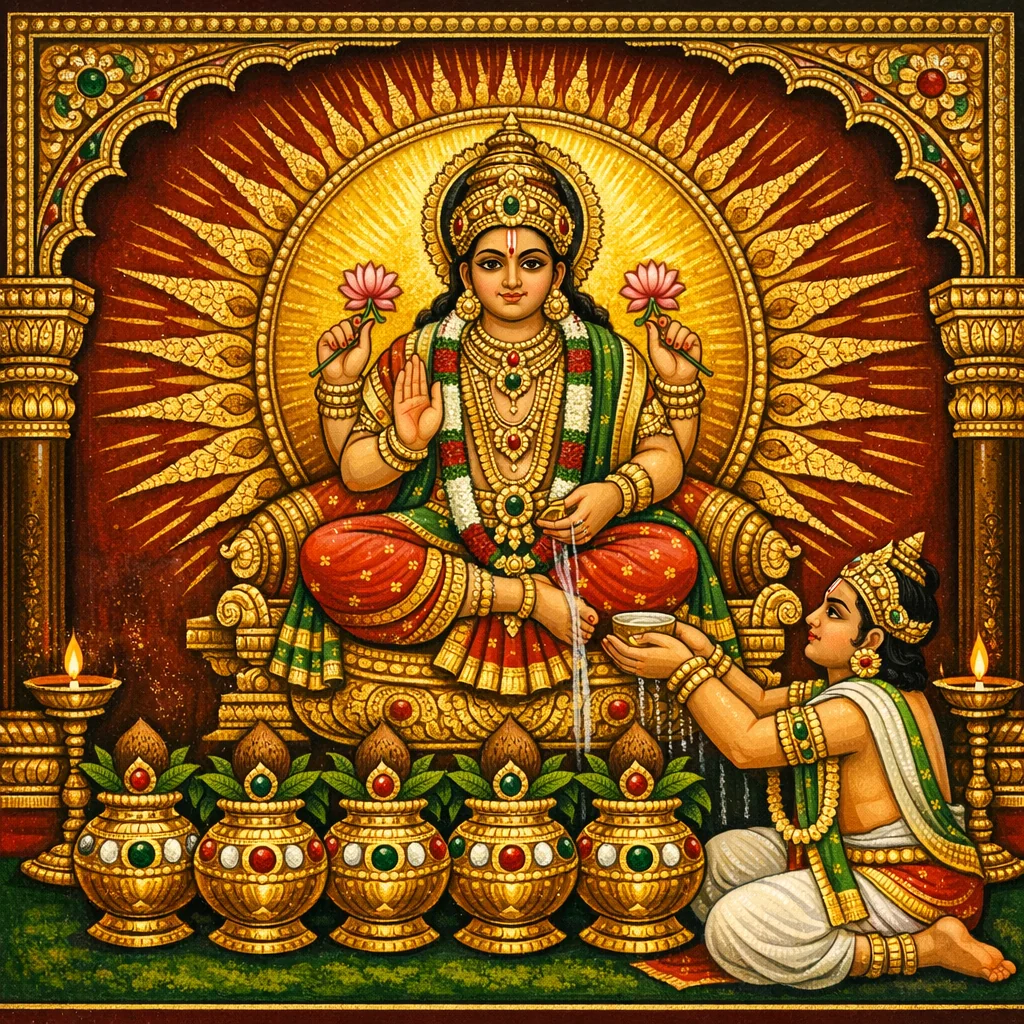
जानुभ्यामवनीङ्गत्वा सूर्यायार्घ्यं निवेदयेत् स्वविद्यामन्त्रितैः कुम्भैर् नवभिः प्रार्च्य वै ग्रहान्
Moving forward on the ground on both knees, one should offer arghya (a reverential libation of water) to the Sun. Then, having duly worshipped the nine Grahas with nine water-pots consecrated by one’s own appropriate mantras, the rite is performed.
Verse 14
ग्रहादिशान्तये स्नानं जप्त्वार्कं सर्वमाप्नुयात् संग्रामविजयं साग्निं वीजदोषं सविन्दुकं
For the pacification of planets and other afflictions, one should bathe and then perform japa of the mantra of Arka (the Sun); thereby one attains all aims—victory in battle together with the power of Agni, and the removal of defects connected with seed/lineage (vīja-doṣa), along with the remedy for ‘bindu’ (seminal drop) disorders.
Verse 15
न्यस्य मूर्धादिपादान्तं मूलं पूज्य तु मुद्रया स्वाङ्गानि च यथान्यासमात्मानं भावयेद्रविं
Having performed nyāsa from the head down to the feet, one should worship the root-mantra (mūla-mantra) with the prescribed mudrā; and, installing (the mantra) upon one’s own limbs according to the nyāsa, one should contemplate oneself as Ravi, the Sun.
Verse 16
ध्यानञ्च मारणस्तम्भे पीतगाप्यायने सितम् रिपुघातविधौ कृष्णं मोहयेच्छक्रचापवत्
In meditations for death-dealing and immobilizing rites (stambha) one should visualize (the form) as yellow; for rites of nourishment and increase, as white; in procedures for striking down an enemy, as black; and for deluding (an opponent), as a rainbow (Indra’s bow).
Verse 17
यो ऽभिषेकजपध्यानपूजाहोमपरः सदा तेजस्वी हृजयः श्रीमान् समुद्रादौ जयं लभेत्
Whoever is always devoted to consecration rites (abhiṣeka), mantra-recitation (japa), meditation, worship, and fire-offerings (homa) becomes radiant, victorious in heart, and prosperous; he attains victory even in great undertakings such as confronting or crossing the ocean and the like.
Verse 18
ताम्बूलादाविदं न्यस्य जप्त्वा दद्यादुशीरकं न्यस्तुवीजेन हस्तेन स्पर्शनं तद्वशे स्मृतं
Placing this (mantra) first upon betel-leaf and the like, and having recited it, one should give uśīraka (vetiver). Touching with the hand in which the seed-mantra (bīja) has been installed is said to bring that person under one’s influence.
Frequently Asked Questions
It emphasizes mantra-ritual architecture: constructing and applying bīja-mantras (with bindu and limb-components), performing directional mūrti-worship with mudrā-sealing, executing arghya and nine-kumbha graha worship, and completing the rite through full-body nyāsa and deity-identification (Ravi-bhāvanā).
Sūrya-arcana is taught as disciplined upāsanā that stabilizes vitality and clarity; by integrating nyāsa, japa, and offerings with ethical observance, it channels desired worldly outcomes into a dharmic framework that supports inner steadiness and higher aims.