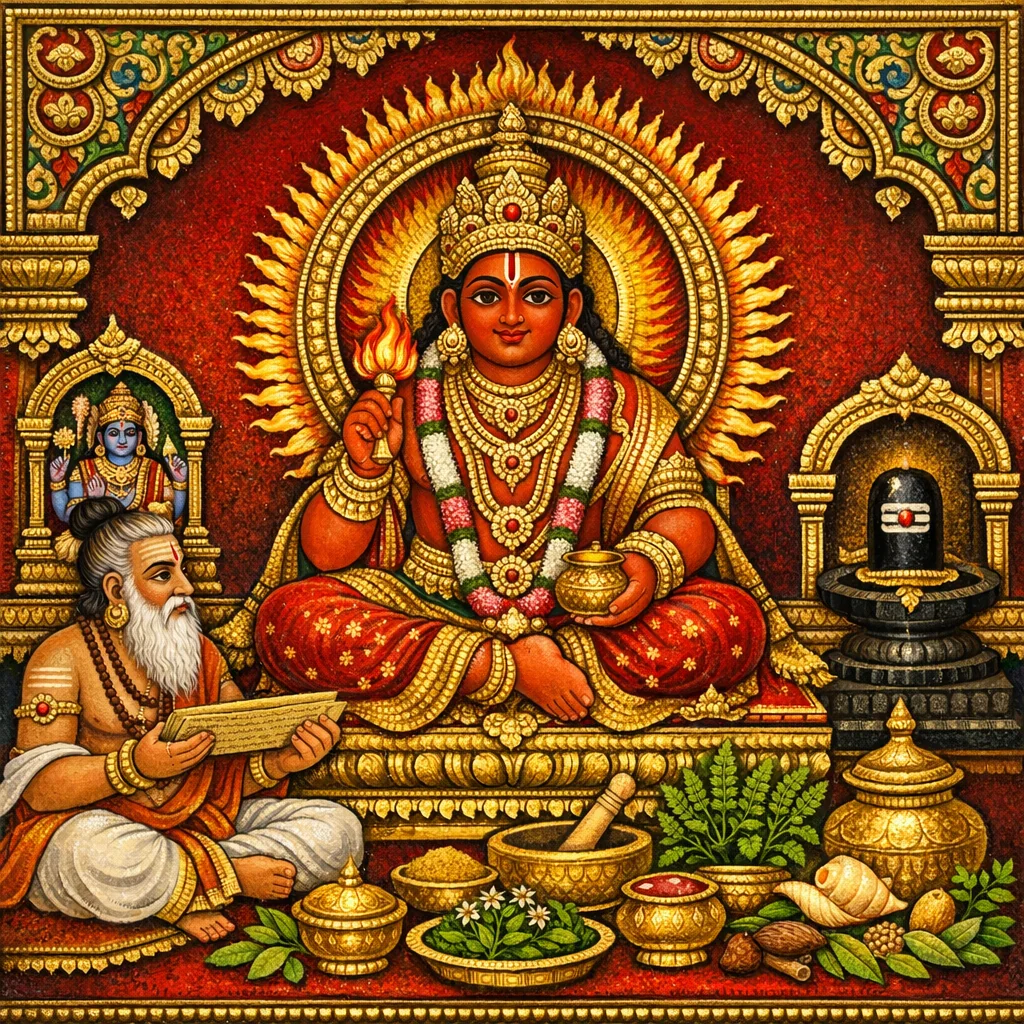
Adhyaya 279
Chapter 279 — सिद्धौषधानि (Siddhauṣadhāni, “Perfected Medicines”) — Colophon/Closure
This chapter serves as the formal closure (colophon) of the preceding medical section titled Siddhauṣadhāni (“Perfected Medicines”). In purāṇic composition, this ending marker is not merely editorial: it signals the completed transmission of a distinct Ayurvedic vidyā within the wider Agneya encyclopedic curriculum. By naming the chapter and sealing its end, the text frames medicine as a teachable, preservable śāstra to be carried forward as authoritative knowledge. It then immediately prepares the transition to the next module on “Medicines that Remove All Diseases,” shifting from specialized perfected remedies toward more universal, preventive, and harmonizing measures. In the Agni Purāṇa’s samanvaya approach, medical knowledge is presented as both practical and sacred—supporting bodily stability so the mind may be steadied for dharma and devotion.
Shlokas
Verse 1
इत्य् आग्नेये महापुराणे सिद्धौषधानि नामाष्ट्सप्तत्यधिकद्विशततमो ऽध्यायः अथैकोनाशीत्यधिकद्विशततमो ऽध्यायः सर्वरोगहराण्यौषधानि धन्वन्तरिर् उवाच शारीरमानमागन्तुसहजा व्याधयो मताः शारीरा ज्वरकुष्ठाद्या क्रोधाद्या मानसा मताः
Thus, in the Agni Mahāpurāṇa ends the two-hundred-and-seventy-ninth chapter called “Siddhauṣadhāni” (Perfected Medicines). Now begins the two-hundred-and-eightieth chapter: “Medicines that Remove All Diseases.” Dhanvantari said: “Diseases are considered to pertain to the body and to be of two kinds—those that are external (āgantuka, adventitious) and those that are congenital (sahaja). Bodily diseases include fever, kuṣṭha (leprosy/skin disorders), and the like; mental diseases are held to arise from anger and similar afflictive states.”
Verse 2
आगन्तवो विघातोत्था सहजाः क्षुज्जरादयः शारीरागन्तुनाशाय सूर्यवारे घृतं गुडम्
Ailments are of several kinds: those coming from outside (āgantava), those arising from injury or assault (vighāta-uttha), and those congenital (sahaja), such as hunger, fever, and the like. For the destruction of bodily disorders caused from without, on Sunday one should administer ghee and jaggery.
Verse 3
लवणं सहिरण्यञ्च विप्रायापूपमर्पयेत् चन्द्रे चाभ्यङ्गदो विप्रे सर्वरोगैः प्रमुच्यते
One should offer salt together with gold, and an apūpa (sweet cake), to a brāhmaṇa. And by giving an unguent or anointing-oil gift (abhyanga) to a brāhmaṇa in connection with the Moon (Candra), one is freed from all diseases.
Verse 4
तैलं शनैश् चरे दद्यादाश्विने गोरसान्नदः घृतेन पयसा लिङ्गं संस्नाप्य स्याद्रुगुज्झितः
In the month of Āśvina, one should donate oil on Saturdays and offer food prepared from cow-products (milk, curd, ghee, and the like). Having bathed the Śiva-liṅga with ghee and milk, one becomes free from disease.
Verse 5
गायत्र्या हावयेद्वह्नौ दूर्वान्त्रिमधुराप्लुताम् यस्मिन् भे व्याधिमाप्नोति तस्मिन् स्नानं बलिः शुभे
Reciting the Gāyatrī, one should offer into the sacred fire dūrvā grass moistened with the three sweet substances. In whichever lunar mansion (nakṣatra) disease has befallen a person, at that nakṣatra’s time one should perform a purificatory bath and an auspicious bali-offering.
Verse 6
मानसानां रुजादीनां विष्णोः स्तोत्रं हरं भवेत् वातपित्तकफा दोषा धातवश् च तथा शृणु
For mental afflictions—such as pain and related disorders—the hymn to Viṣṇu becomes a remover of suffering. Now hear, likewise, about the doṣas—vāta, pitta, and kapha—and also about the bodily tissues (dhātus).
Verse 7
भुक्तं पक्वाशयादन्नं द्विधा याति च सुश्रुत अंशेनैकेन किट्टद्वं रसताञ्चापरेण च
O Suśruta, the food that has been eaten, upon reaching the pakvāśaya (the digestive receptacle/region of the large intestine), becomes divided into two: by one portion it turns into waste (kiṭṭa), and by the other portion it becomes nutritive essence (rasa).
Verse 8
किट्टभागो मलस्तत्र विन्मूत्रस्वेददूषिकाः नासामलङ्कर्णमलं तथा देहमलञ्च यत्
Among these, the waste portion (kiṭṭa) is called “mala” (impurity): namely feces, urine, sweat, and other defilements; likewise the impurities of the nose, ear-wax, and whatever bodily grime there is.
Verse 9
रसभागाद्रसस्तत्र समाच्छोणिततां व्रजेत् मांसं रक्तत्तितो मेदो मेदसो ऽस्थ्नश् च सम्भवः
From a portion of the nutritive fluid (rasa), that rasa becomes blood; from blood, flesh is produced; from flesh, fat arises; and from fat, bone comes into being.
Verse 10
अस्थ्नो मज्जा ततः शुक्रं शुकाद्रागस्तथौजसः देशमार्तिं बलं शक्तिं कालं प्रकृतिमेव च
From bone arises marrow; from that, semen. From semen arise rāga (attachment/passion) and likewise ojas (vital essence). One should also examine locality, affliction/disease, strength, capacity, time (season/age), and one’s constitution (prakṛti) as well.
Verse 11
ज्ञात्वा चिकित्सतं कुर्याद्भेषजस्य तथा बलम् तिथिं रिक्तान्त्यजेद् भौमं मन्दभन्दारुणोग्रकम्
After ascertaining the patient’s condition, the physician should undertake treatment and first determine the potency of the medicine. He should avoid the “empty” lunar dates (riktā tithi) and also Tuesday (Bhauma), which is regarded as dull, obstructive, harsh, and fierce for commencing therapy.
Verse 12
हरिगोद्विजचन्द्रार्कसुरादीन् प्रतिपूज्य च शृणु मन्त्रमिमं विद्वन् भेषजारम्भमाचरेत्
Having duly worshipped Hari, the cow, the twice-born (brāhmaṇas), the Moon, the Sun, and the gods and the rest, listen, O learned one, to this mantra; then one should undertake the commencement of medicinal treatment.
Verse 13
ब्रह्मदक्षाश्विरुद्रेन्द्रभूचन्द्रार्कानिलानलाः ऋषयश् चौषधिग्रामा भूतसङ्घाश् च पान्तु ते
May Brahmā, Dakṣa, the Aśvins, Rudra, Indra, the Earth, the Moon, the Sun, Wind, and Fire—along with the sages, the hosts of medicinal plants, and the multitudes of beings—protect you.
Verse 14
रसायनमिवर्षीणां देवानाममृतं यथा सुधेवोत्तमनागानां भैषज्यमिदमस्तु ते
May this remedy be for you what a rejuvenative rasāyana is for the sages—what nectar (amṛta) is for the gods, and what divine ambrosia (sudhā) is for the foremost serpents: a true medicine for you.
Verse 15
वातश्लेष्मातको देशो बहुवृक्षो बहूदकः अनूपड्तिबिख्यातो जाङ्गलस्तद्विवर्जितः
A region dominated by vāta and śleṣman (kapha) is one that has many trees and abundant water; it is well known as an anūpa (marshy, wet) tract. The jāṅgala (dry, arid) region is the opposite of that.
Verse 16
किञ्चिद्वृक्षोदको देशस् तथा साधारणः स्मृतः जाङ्गलः पित्तबहुलो मध्यः साधारणः स्मृतः
A region having only a small amount of trees and water is likewise regarded as ‘sādhāraṇa’ (moderate). A dry, arid (jāṅgala) region is predominantly pitta-producing; the ‘middle’ (madhya) region is considered moderate (sādhāraṇa).
Verse 17
रूक्ष्मः शीतश् चलो वायुः पित्तमुष्णं कटुत्रयम् स्थिराम्लस्निग्धमधुरं बलाशञ्च प्रचक्षते
They describe Vāyu (Vāta) as dry, cold, and mobile; Pitta as hot and marked by the triad of pungent tastes; and Bala/Śleṣman (Kapha) as stable, sour, unctuous, and sweet.
Verse 18
वृद्धिः समानैर् एतेषां विपरीतैर् विपर्ययः रसाः स्वाद्वम्ललवणाः श्लेष्मला वायुनाशनाः
These doṣas increase through factors of the same kind, and are reversed (alleviated) by opposites. The tastes sweet, sour, and salty promote kapha and pacify vāta.
Verse 19
कटुतिक्तकषायाश् च वातलाः श्लेष्मनाशनाः कट्वम्ललवणा ज्ञेयास् तथा पित्तविवर्धनाः
Pungent, bitter, and astringent substances are to be understood as aggravating vāta and as destroyers of śleṣman (kapha). Likewise, pungent, sour, and salty substances are to be known as those that increase pitta.
Verse 20
तिक्तस्वादुकषायाश् च तथा पित्तविनाशनाः रसस्यैतद्गुणं नास्ति विपाकस्यैतदिष्यते
Bitter, sweet, and astringent effects likewise destroy pitta. This is not regarded as a property of taste (rasa) itself; rather, it is held to be a property of the post-digestive transformation (vipāka).
Verse 21
वीर्योष्णाः कफवातघ्नाः शीताः पित्तविनाशनाः प्रभावतस् तथा कर्म ते कुर्वन्ति च सुश्रुत
Substances that are hot in potency (uṣṇa-vīrya) alleviate kapha and vāta; those that are cold in potency (śīta-vīrya) destroy pitta. And by their specific potency (prabhāva) they also perform their particular actions, O Suśruta.
Verse 22
शिशिरे च वसन्ते च निदाघे च तथा क्रमात् चयप्रकोपप्रशमाः कफस्य तु प्रकीर्तिताः
In winter, in spring, and in summer—respectively in that order—are taught the stages of accumulation, aggravation, and pacification of Kapha.
Verse 23
निदाघवर्षारात्रौ च तथा शरदि सुश्रुत चयप्रकोपप्रशमाः पवनस्य प्रकीर्तिताः
In the hot season (nidāgha), the rainy season (varṣā), at night (rātri), and likewise in autumn (śarad), Suśruta has described the accumulation, aggravation, and pacification phases of Vāta (Pavana).
Verse 24
मेघकाले च शरदि हेमन्ते च यथाक्रमात् चयप्रकोपप्रशमास् तथा पित्तस्य कीर्तिताः
For Pitta as well, its sequential states—accumulation, aggravation, and pacification—are taught to occur respectively in the cloudy season, in autumn, and in winter.
Verse 25
वर्षाद्यो विसर्गस्तु हेमन्ताद्यास् तथा त्रयः शिशिराद्यास् तथादानं ग्रीष्मान्ता ऋतवस्त्रयः
The triad of seasons beginning with the rains is called “Visarga”; likewise, the three beginning with Hemanta are so designated; the three beginning with Śiśira are called “Ādāna”. Thus the triads of seasons are reckoned up to (ending with) Grīṣma.
Verse 26
सौम्यो विसर्गस्त्वादानमाग्नेयं परिकीर्तितम् वर्षादींस्त्रीनृतून् सोमश् चरन् पर्यायशो रसान्
“Visarga” (release/bestowal) is declared to be Saumya (lunar in character), while “Ādāna” (taking up/withdrawing) is proclaimed to be Āgneya (fiery in character). Soma, moving in succession, traverses the three seasons beginning with the rains and thereby the rasas (seasonal essences) in due order.
Verse 27
जनयत्यम्ललवणमधुरांस्त्रीन् यथाक्रमम् शिशिरादीनृतूनर्कश् चरन् पर्ययशो रसान्
As the sun moves through the seasons beginning with Śiśira (late winter), it generates in due succession the three tastes—sour, salty, and sweet.
Verse 28
विवर्धयेत्तथा तिक्तकषायकटुकान् क्रमात् यथा रजन्यो वर्धन्ते वलमेकं हि वर्धते
Likewise, one should gradually increase, in order, the bitter (tikta), astringent (kaṣāya), and pungent (kaṭuka) tastes, so that the doṣas (bodily humors) rise in a regulated way; for indeed only one thing—bodily strength and tonicity—should be made to increase.
Verse 29
क्रमशो ऽथ मनुष्याणां हीयमानासु हीयते रात्रिभुक्तदिनानाञ्च वयसश् च तथैव च
Thus, for human beings, as the nights and days that have been consumed (i.e., have passed) gradually diminish, so too does one’s lifespan correspondingly diminish.
Verse 30
आदिमध्यावसानेषु कफपित्तसमीरणाः प्रकोपं यान्ति कोपादौ काले तेषाञ्चयः स्मृतः
At the beginning, the middle, and the end (of the relevant time-cycle), kapha, pitta, and vāta (samīraṇa) become aggravated; and at the initial phase of that aggravating period, their accumulation is said to occur.
Verse 31
प्रकोपोत्तरके काले शमस्तेषां प्रकीर्तितः अदिभोजनतो विप्र तथा चाभोजनेन च
O brāhmaṇa, the pacification of those doṣas is declared to occur in the period following their aggravation—through overeating, and likewise through abstaining from food.
Verse 32
रोगा हि सर्वे जायन्ते वेगोदीरणधारणैः अन्नेन कुक्षेर्द्वावंशावेकं पानेन पूरयेत्
Indeed, all diseases arise from forcibly stimulating or suppressing the body’s natural urges. One should fill the stomach so that two parts are with food and one part with drink.
Verse 33
आश्रयं पवनादीनां तथैकमवशेषयेत् व्याधेर् निदानस्य तथा विपरीतमथौषधम्
One should determine the locus (āśraya) of vāta and the other doṣas and, after assessment, single out what remains as the decisive factor; and for a disease, one should likewise identify its causative etiology (nidāna) and then apply a remedy (auṣadha) that is contrary (viparīta) to it.
Verse 34
कर्तव्यमेतदेवात्र मया सारं प्रकीर्तितम् नाभेरूर्ध्वमधश् चैव गुदश्रोण्योस्तथैव च
This alone is to be done here; I have stated the essential gist. (Apply it) above and below the navel, and likewise in the region of the anus and the hips/pelvis.
Verse 35
बलाशपित्तवातानां देहे स्थानं प्रकीर्तितं तथापि सर्वगाश् चैते देहे वायुर्विशेषतः
The bodily seats of Bala (Śleṣman/kapha), Pitta, and Vāta have been described; yet all of these pervade the entire body—Vāta in particular (is especially pervasive).
Verse 36
देहस्य मध्ये हृदयं स्थानं तन्मनसः स्मृतम् कृशो ऽल्पकेशश् चपलो बहुवाग्विषमानलः
In the middle of the body, the heart is said to be the seat of that mind. (Such a person) is lean, has scanty hair, is restless, very talkative, and has irregular digestive fire (appetite/metabolism).
Verse 37
व्योमगश् च तथा स्वप्ने वातप्रकृतिरुच्यते अकालपलितः क्रोधी प्रस्वेदी मधुरप्रियः
One who, in dreams, moves through the sky is said to be of Vāta constitution; such a person turns grey prematurely, is prone to anger, sweats readily, and delights in sweet tastes.
Verse 38
स्वप्ने च दीप्तिमत्प्रेक्षी पित्तप्रकृतिरुच्यते दृढाङ्गः स्थिरचित्तश् च सुप्रभः स्निग्धसूर्धजः
One who, even in dreams, beholds brilliant, fiery sights is said to be of Pitta constitution. He has firm limbs, a steady mind, a radiant complexion, and unctuous hair and beard.
Verse 39
शुद्धाम्बुदर्शी स्वप्ने च कफप्रकृतिको नरः तामसा राजसाश् चैव सात्विकाश् च तथा स्मृताः
A man who, in a dream, sees pure water is of Kapha constitution; and such dream-signs are likewise understood in terms of the three guṇas—tāmasa, rājasika, and sāttvika.
Verse 40
मनुष्या मुनिर्शादूल वातपित्तकफात्मकाः रक्तपित्तं व्यवायाच्च गुरुकर्मप्रवर्तनैः
O tiger among sages, human beings are constituted by vāta, pitta, and kapha. The disorder called raktapitta (bleeding from vitiated blood) arises due to sexual indulgence and from undertaking strenuous, heavy exertions.
Verse 41
कदन्नभोजनाद्वायुर्देहे शोकाच्च कुप्यति विदाहिनां तथोल्कानामुष्णान्नाध्वनिसेविनां
In the body, Vāyu (Vāta) becomes aggravated by eating inferior or unsuitable food and also by grief; likewise in those who consume burning or pungent items, those exposed to heat or fire, those who take hot food, and those given to excessive travel.
Verse 42
पित्तं प्रकोपमायाति भयेन च तथा द्विज अत्यम्बुपानगुर्वन्नभोजिनां भुक्तशायिनाम्
O twice-born one (dvija), pitta becomes aggravated through fear; likewise in those who drink excessive water, eat heavy foods, and lie down immediately after eating.
Verse 43
श्लेकेष्माप्रकोपमायाति तथा ये चालसा जनाः वाताद्युत्थानि रोगाणि ज्ञात्वा शाम्यानि लक्षणैः
Likewise, an aggravation of śleṣman/kapha (phlegm) arises in people who are indolent; and, having recognized diseases originating from vāta and the other doṣas, one should pacify them by treating in accordance with their characteristic signs.
Verse 44
अस्थिभङ्गः कषायत्वमास्ये शुष्कास्यता तथा जृम्भणं लोमहर्षश् च वातिकव्याधिलक्षणम्
A feeling as though the bones are breaking, an astringent taste in the mouth, dryness of the mouth, repeated yawning, and horripilation—these are the characteristic signs of Vāta-type disorders.
Verse 45
नखनेत्रशिराणान्तु पीतत्वं कटुता मुखे तृष्णा दाहोष्णता चैव पित्तव्याधिनिदर्शनम्
Yellow discoloration of the nails, eyes, and veins, a pungent (bitter-acrid) taste in the mouth, thirst, burning sensation, and excessive heat—these are the indicative signs of diseases arising from aggravated pitta.
Verse 46
आलस्यञ्च प्रसेकश् च गुरुता मधुरास्यता उष्णाभिलाषिता चेति श्लैष्मिकव्याधिलक्षणम्
Lethargy, excessive salivation, a sense of heaviness, sweetness in the mouth, and a craving for warmth—these are the characteristic signs of a disorder arising from kapha (śleṣma).
Verse 47
स्निग्धोष्णमन्नमभ्यङ्गस्तैलपानादि वातनुत् आज्यं क्षीरं सिताद्यञ्च चन्द्ररश्म्यादि पित्तनुत्
Unctuous, warm food, oil massage (abhyanga), and measures such as drinking oil alleviate Vāta. Ghee, milk, sugar and the like, together with cooling measures such as moonlight and similar cooling regimens, alleviate Pitta.
Verse 48
सक्षौद्रं त्रिफलातैलं व्यायामादि कफापहम् सर्वरोगप्रशान्त्यै स्यद्विष्णोर्ध्यानञ्च पूजनम्
Triphala oil mixed with honey, together with exercise and related measures, removes Kapha. For the pacification of all diseases, meditation on Viṣṇu and His worship are also prescribed.
Frequently Asked Questions
It emphasizes the completion of a bounded Ayurvedic teaching unit, preserving it as a distinct śāstric module within the Agni Purana’s encyclopedic transmission.
By framing medical knowledge as dharmic revelation, it legitimizes bodily care as a support for steadiness in worship, discipline, and the pursuit of mokṣa.