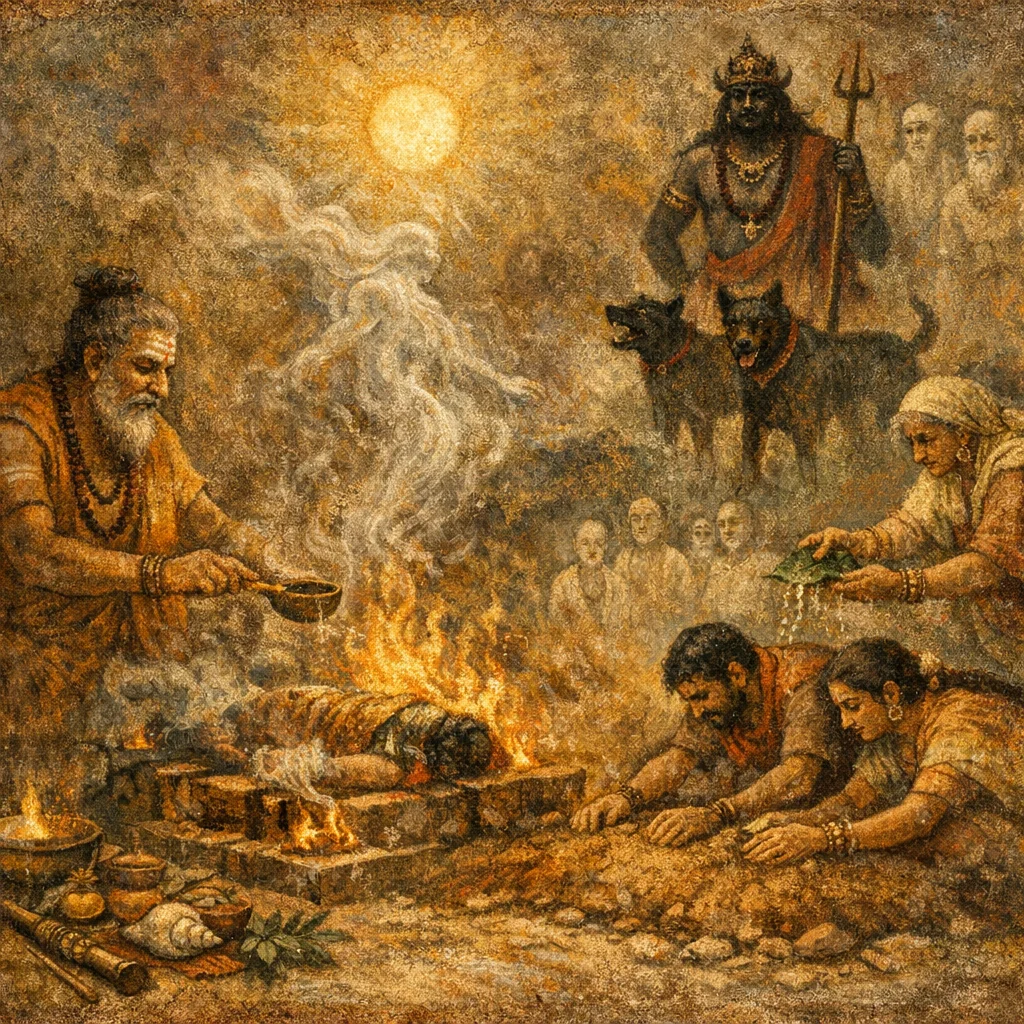
Sukta 2
Rishi: Atharvanic tradition (funerary/āyuṣya complex of AV 18; r̥ṣi attribution varies by anukramaṇī traditions)
Devata: Āyus (Longevity) / the impersonal life-measure (mātrā) as efficacious principle
Chandas: Anuṣṭubh (11+?; late Atharvanic cadence; refrain-like pāda structure)
Mantras
Mantra 1
पितृमेधः। यमाय सोमः पवते यमाय क्रियते हविः । यमं ह यज्ञो गच्छत्यग्निदूतो अरंकृतः
Pitṛmedha. For Yama is Soma purified; for Yama is the oblation prepared. Unto Yama verily the sacrifice goeth, with Agni for its messenger, duly made ready.
Mantra 2
यमाय मधुमत्तमं जुहोता प्र च तिष्ठत । इदं नम ऋषिभ्यः पूर्वजेभ्यः पूर्वेभ्यः पथिकृद्भ्यः
For Yama offer ye the most honey-sweet, and stand ye forth in readiness. This reverence be to the seers, to the fore-born, to the former ones, the makers of the path.
Mantra 3
यमाय घृतवत् पयो राज्ञे हविर्जुहोतन । स नो जीवेष्वा यमेद् दीर्घमायुः प्र जीवसे
For Yama, for the King, offer ye as oblation milk rich with ghee. May he, among us who live, apportion hither long life, that we may live on.
Mantra 4
मैनमग्ने वि दहो माभि शूशुचो मास्य त्वचं चिक्षिपो मा शरीरम्। शृतं यदा करसि जातवेदोऽथेमेनं प्र हिणुतात् पितॄँरुप
Burn him not utterly, O Agni; scorch him not too fiercely; strip not away his skin, nor rend his frame. When thou hast made him duly roasted, O Jātavedas, then send him forth unto the Fathers, to draw nigh.
Mantra 5
यदा शृतं कृणवो जातवेदोऽथेममेनं परि दत्तात् पितृभ्यः । यदो गच्छात्यसुनीतिमेतामथ देवानां वशनीर्भवाति
When thou hast made him duly roasted, O Jātavedas, then hand him over, wholly, unto the Fathers. And when he goeth upon this leading-forth of breath, then cometh he under the governance of the Gods.
Mantra 6
त्रिकद्रुकेभिः पवते षडुर्वीरेकमिद् बृहत्। त्रिष्टुब् गायत्री छन्दांसि सर्वा ता यम आर्पिता
With the three Kadru-streams it floweth purified; through the six broad regions—one only, yet the Vast. Triṣṭubh and Gāyatrī, the metres, all of them—these are consigned unto Yama.
Mantra 7
सूर्यं चक्षुषा गच्छ वातमात्मना दिवं च गच्छ पृथिवीं च धर्मभिः । अपो वा गच्छ यदि तत्र ते हितमोषधीषु प्रति तिष्ठा शरीरैः
Go to the Sun with thine eye; go to the Wind with thy breath-self; go to Heaven, and to Earth with rightful ordinances. Or go unto the Waters, if there be thy appointed good; in the Plants take thou thy station again, with thy bodily parts.
Mantra 8
अजो भागस्तपसस्तं तपस्व तं ते शोचिस्तपतु तं ते अर्चिः । यास्ते शिवास्तन्वोऽ जातवेदस्ताभिर्वहैनं सुकृतामु लोकम्
Unborn is the share of holy heat—do thou heat that; let thy blaze heat it, let thy flame-tongue [do so]. With those thy kindly forms, O Jātavedas, bear thou this man—yea—unto the world of the well-deserving.
Mantra 9
यास्ते शोचयो रंहयो जातवेदो याभिरापृणासि दिवमन्तरिक्षम्। अजं यन्तमनु ताः समृण्वतामथेतराभिः शिवतमाभिः शृतं कृधि
What flames are thine, what swift impellings, O Jātavedas, wherewith thou fillest heaven and the mid-air—let these attend the Unborn as he goeth, and make his way well-ordered; then, with thy other powers, the most auspicious, make thou the boon well-won and duly heard.
Mantra 10
अव सृज पुनरग्ने पितृभ्यो यस्त आहुतश्चरति स्वधावान्। आयुर्वसान उप यातु शेषः सं गच्छतां तन्वा सुवर्चाः
Send him away again, O Agni, unto the Fathers—him who, offered to thee, fareth on, possessed of svadhā. Let what remaineth, clothing itself with life, draw near; let it come together wholly with the body, in goodly radiance.
Mantra 11
अति द्रव श्वानौ सारमेयौ चतुरक्षौ शबलौ साधुना पथा। अधा पितॄन्त्सुविदत्रां अपीहि यमेन ये सधमादं मदन्ति
Haste past the two Dogs, Saramā’s brood, the four-eyed, the brindled, by the goodly path. Then go thou forth unto the Fathers, easy to be found, with Yama—unto them who in the common feast rejoice.
Mantra 12
यौ ते श्वानौ यम रक्षितारौ चतुरक्षौ पथिषदी नृचक्षसा । ताभ्यां राजन् परि धेह्येनं स्वस्त्यऽस्मा अनमीवं च धेहि
The two Dogs that are thine, O Yama, guardians, four-eyed, seated on the path, beholding men—with those two, O King, encompass thou this man; set for him welfare, and set him free from hurt.
Mantra 13
उरूणसावसुतृपावुदुम्बलौ यमस्य दूतौ चरतो जनां अनु । तावस्मभ्यं दृशये सूर्याय पुनर्दातामसुमद्येह भद्रम्
Broad-nosed, well-content with goodly store, udumbara-marked—Yama’s two messengers—these roam, following after men. Let those two, for us, give back for sight, for the Sun, the life-breath again—this day, here—auspicious good.
Mantra 14
सोम एकेभ्यः पवते घृतमेक उपासते । येभ्यो मधु प्रधावति तांश्चिदेवापि गच्छतात्
For some the Soma clarifies itself; some worship ghee. To whom the sweet mead runneth forth—unto those, even unto them also, may he go.
Mantra 15
ये चित् पूर्व ऋतसाता ऋतजाता ऋतावृधः । ऋषीन् तपस्वतो यम तपोजां अपि गच्छतात्
Even those of old, won by Order, born of Order, increased by Order—to the seers, the austere, O Yama, to the tapas-born, unto them also may he go.
Mantra 16
तपसा ये अनाधृष्यास्तपसा ये स्वऽर्ययुः । तपो ये चक्रिरे महस्तांश्चिदेवापि गच्छतात्
By tapas, who are unassailable; by tapas, who have gone to the sky-world; who by tapas have wrought greatness—unto those, even unto them also, may he go.
Mantra 17
ये युध्यन्ते प्रधनेषु शूरासो ये तनूत्यजः । ये वा सहस्रदक्षिणास्तांश्चिदेवापि गच्छतात्
They who fight in battles, the heroes; they who have left the body; or they who are thousand-fee givers—unto those, even unto them also, may he go.
Mantra 18
सहस्रणीथाः कवयो ये गोपायन्ति सूर्यम्। ऋषीन् तपस्वतो यम तपोजां अपि गच्छतात्
The thousand-guiding sages who guard the Sun—to the seers, the austere, O Yama, to the tapas-born, unto them also may he go.
Mantra 19
स्योनास्मै भव पृथिव्यनृक्षरा निवेशनी । यच्छास्मै शर्म सप्रथाः
Be gracious unto him, O Earth, uncrumbled, a home of rest; bestow on him broad-spreading shelter and sure protection.
Mantra 20
असंबाधे पृथिव्या उरौ लोके नि धीयस्व । स्वधा याश्चकृषे जीवन् तास्ते सन्तु मधुश्चुतः
In Earth’s unstraitened, spacious region, in the wide world, be thou set down. The svadhās which thou didst fashion while living—let them for thee be sweetly dropping honey.
Mantra 21
ह्वयामि ते मनसा मन इहेमान् गृहाँ उप जुजुषाण एहि । सं गच्छस्व पितृभिः सं यमेन स्योनास्त्वा वाता उप वान्तु शग्माः
With mind I call thy mind: hither, to these houses, come, consenting and well-pleased. Then go thou forth in company with the Fathers, in company with Yama; may kindly winds, strong to aid, blow round about thee.
Mantra 22
उत् त्वा वहन्तु मरुत उदवाहा उदप्रुतः । अजेन कृण्वन्तः शीतं वर्षेणोक्षन्तु बालिति
Up let the Maruts bear thee—upbearing, up-springing; with the goat making coolness, with rain let them sprinkle thee—so be it.
Mantra 23
उदह्वमायुरायुषे क्रत्वे दक्षाय जीवसे । स्वान् गच्छतु ते मनो अधा पितॄंरुप द्रव
Forth we call back life for life, for purpose, for skill, for living. Let thy mind go to its own; then hasten thou unto the Fathers.
Mantra 24
मा ते मनो मासोर्माङ्गानां मा रसस्य ते । मा ते हास्त तन्वः१ किं चनेह
Let not thy mind be lost; let not thy vital breath, nor thy limbs, nor thy sap be lost. Let not aught of thy body fail thee here—no, not the least thing.
Mantra 25
मा त्वा वृक्षः सं बाधिष्ट मा देवी पृथिवी मही। लोकं पितृषु वित्त्वैधस्व यमराजसु
Let not the wood oppress thee; let not the Goddess Earth, the mighty, press upon thee. Knowing, win thee a world among the Fathers; wax thou in the realms of King Yama.
Mantra 26
यत् ते अङ्गमतिहितं पराचैरपानः प्राणो य उ वा ते परेतः । तत् ते संगत्य पितरः सनीडा घासाद् घासं पुनरा वेशयन्तु
What limb of thine is set astray afar—what apāna, what prāṇa of thee, O departed—let the Fathers, of one abode, gathering it together for thee, cause it to enter again, portion by portion, from fodder unto fodder.
Mantra 27
अपेमं जीवा अरुधन् गृहेभ्यस्तं निर्वहत परि ग्रामादितः । मृत्युर्यमस्यासीद् दूतः प्रचेता असून् पितृभ्यो गमयां चकार
Forth from the houses the living held this man apart; him they bear forth hence, beyond the village. Death was Yama’s messenger, the wise; he wrought the leading of the vital breaths unto the Fathers.
Mantra 28
ये दस्यवः पितृषु प्रविष्टा ज्ञातिमुखा अहुतादश्चरन्ति । परापुरो निपुरो ये भरन्त्यग्निष्टानस्मात् प्र धमाति यज्ञात्
Those Dasyus who have entered among the Fathers, kinsmen-faced, who roam as eaters of the unoffered; those fortress-spoilers, fortress-breakers who bear away—Agni from this sacrifice blows them forth and drives them off.
Mantra 29
सं विशन्त्विह पितरः स्वा नः स्योनं कृण्वन्तः प्रतिरन्त आयुः । तेभ्यः शकेम हविषा नक्षमाणा ज्योग् जीवन्तः शरदः पुरूचीः
Let the Fathers, our own, enter together here; making for us a kindly resting-place, repelling away our life’s undoing. To them may we have power to reach with oblation, attaining their grace—living long, through many an autumn.
Mantra 30
यां ते धेनुं निपृणामि यमु ते क्षीर ओदनम्। तेना जनस्यासो भर्ता योऽत्रासदजीवनः
The milch-cow which I bestow on thee, and the milked rice-gruel which is thine—therewith be thou the people’s sustainer, thou who here wast lying lifeless.
Mantra 31
अश्वावतीं प्र तर या सुशेवार्क्षाकं वा प्रतरं नवीयः । यस्त्वा जघान वध्यः सो अस्तु मा सो अन्यद् विदत भागधेयम्
Cross thou forth the horse-rich passage, the kindly one—or the perilous wolfish crossing, the newer ford. He who smote thee down, let him be for slaying; let him not win any other allotted share.
Mantra 32
यमः परोऽवरो विवस्वान् ततः परं नाति पश्यामि किं चन। यमे अध्वरो अधि मे निविष्टो भुवो विवस्वानन्वाततान
Yama is the farther, the nearer; Vivasvant—beyond that I see not anything at all. In Yama is the rite for me established; Vivasvant hath stretched it along through the worlds.
Mantra 33
अपागूहन्नमृतां मर्त्येभ्यः कृत्वा सवर्णामदधुर्विवस्वते । उताश्विनावभरद् यत् तदासीदजहादु द्वा मिथुना सरण्यूः
They hid away the Immortal from mortal men; having made a like-formed one they set her for Vivasvant. And what she was, that the Aśvins brought again; Saraṇyū in sooth forsook the twain, the paired.
Mantra 34
ये निखाता ये परोप्ता ये दग्धा ये चोद्धिताः । सर्वांस्तानग्न आ वह पितॄन् हविषे अत्तवे
Whoso are buried, whoso are laid away afar, whoso are burnt, and whoso are taken up again,—all those, O Agni, bring thou hither: the Fathers, to partake of the oblation, to eat thereof.
Mantra 35
ये अग्निदग्धा ये अनग्निदग्धा मध्ये दिवः स्वधया मादयन्ते । त्वं तान् वेत्थ यदि ते जातवेदः स्वधया यज्ञं स्वधितिं जुषन्ताम्
Whether burnt by fire, or whether unburnt by fire, they who, in mid-heaven, with svadhā make them glad,—thou knowest them, if thou be Jātavedas: with svadhā let them take pleasure in the sacrifice, in their svadhā-portion.
Mantra 36
शं तप माति तपो अग्ने मा तन्वं१ तपः । वणेषु शुष्मो अस्तु ते पृथिव्यामस्तु यद्धरः
Burn thou for welfare; burn not overmuch, O Agni; scorch not the body. In the forests let thy fierce might be; upon the earth let be that which is thy containing support.
Mantra 37
ददाम्यस्मा अवसानमेतद् य एष आगन् मम चेदभूदिह। यमश्चिकित्वान् प्रत्येतदाह ममैष राय उप तिष्ठतामिह
I give to him this resting-place—if this one who hath come was indeed of mine, here. And Yama, the discerning, in answer hath said this: ‘This wealth of mine—let it abide here, let it stand fast here.’
Mantra 38
इमां मात्रां मिमीमहे यथापरं न मासातै । शते शरत्सु नो पुरा
This measure we do mete out, that it be not thereafter diminished: for us—unto a hundred autumns—aforetime in full.
Mantra 39
प्रेमां मात्रां मिमीमहे यथापरं न मासातै । शते शरत्सु नो पुरा
Forth this measure we do mete, that it be not thereafter spent in months: a hundred autumns—so for us, as in the days of old.
Mantra 40
अपेमां मात्रां मिमीमहे यथापरं न मासातै । शते शरत्सु नो पुरा
Away this measure we do mete, that it be not thereafter spent in months: a hundred autumns—so for us, as in the days of old.
Mantra 41
वी३मां मात्रां मिमीमहे यथापरं न मासातै । शते शरत्सु नो पुरा
In due division this measure we do mete, that it be not thereafter spent in months: a hundred autumns—so for us, as in the days of old.
Mantra 42
निरिमां मात्रां मिमीमहे यथापरं न मासातै । शते शरत्सु नो पुरा
Out this measure we do mete, that it be not thereafter spent in months: a hundred autumns—so for us, as in the days of old.
Mantra 43
उदिमां मात्रां मिमीमहे यथापरं न मासातै । शते शरत्सु नो पुरा
Upward this measure we do mete, that it be not thereafter spent in months: a hundred autumns—so for us, as in the days of old.
Mantra 44
समिमां मात्रां मिमीमहे यथापरं न मासातै । शते शरत्सु नो पुरा
Together we mete out this measured span, that the later portion fail not by months—(a life) of a hundred autumns for us, as of old ordained.
Mantra 45
अमासि मात्रां स्वऽरगामायुष्मान् भूयासम्। यथापरं न मासातै शते शरत्सु नो पुरा
Month after month (I claim) the measured portion that goes to heaven: may I be life-possessed; that the later share be not diminished by months—(a life) of a hundred autumns for us, as of old.
Mantra 46
प्राणो अपानो व्यान आयुश्चक्षुर्दृशये सूर्याय । अपरिपरेण पथा यमराज्ञः पितॄन् गच्छ
Breath, out-breath, pervading breath; life, and the eye—to seeing, to the Sun: by the farther path, the path of King Yama, go thou unto the Fathers.
Mantra 47
ये अग्रवः शशमानाः परेयुर्हित्वा द्वेषांस्यनपत्यवन्तः । ते द्यामुदित्याविदन्त लोकं नाकस्य पृष्ठे अधि दीध्यानाः
They who, the foremost, striving, passed beyond—leaving behind their hatreds, though childless—these found, with the uprising, a world in heaven, shining upon the ridge of the highest firmament.
Mantra 48
उदन्वती द्यौरवमा पीलुमतीति मध्यमा। तृतीया ह प्रद्यौरिति यस्यां पितर आसते
‘Watery’ is the lowest heaven; ‘Pīlumatī,’ so they call the middle; the third, verily, is ‘Pradyauḥ’—that wherein the Fathers sit established.
Mantra 49
ये न पितुः पितरो ये पितामहा य आविविशुरुर्व१न्तरिक्षम्। य आक्षियन्ति पृथिवीमुत द्यां तेभ्यः पितृभ्यो नमसा विधेम
The Fathers of our father, and the grandsires, who have entered the broad mid-air; who dwell on Earth and also in Heaven—to those Fathers with reverence would we render worshipful service.
Mantra 50
इदमिद् वा उ नापरं दिवि पश्यसि सूर्यम्। माता पुत्रं यथा सिचाभ्येऽनं भूम ऊर्णुहि
This verily is it: thou seest no other thing in heaven than the Sun. As a mother her son with the skirt (of her robe), so, O Earth, cover thou this man over.
Mantra 51
इदमिद् वा उ नापरं जरस्यन्यदितोऽपरम्। जाया पतिमिव वाससाभ्येऽनं भूम ऊर्णुहि
This verily is it: in wasting age there is no other thing beyond this. As a wife her husband with a garment, so, O Earth, cover thou this man over.
Mantra 52
अभि त्वोर्णोमि पृथिव्या मातुर्वस्त्रेण भद्रया । जीवेषु भद्रं तन्मयि स्वधा पितृषु सा त्वयि
Over thee I wrap the kindly garment of Earth the Mother. Among the living be welfare—let that be in me; among the Fathers be svadhā—let that be in thee.
Mantra 53
अग्नीषोमा पथिकृता स्योनं देवेभ्यो रत्नं दधथुर्वि लोकम्। उप प्रेष्यन्तं पूषणं यो वहात्यञ्जोयानैः पथिभिस्तत्र गच्छतम्
Agni and Soma, ye makers of the path, ye set a kindly treasure for the Gods, and spread abroad the world (of passage). Go ye unto Pūṣan who is being sent forth, who conveys (the dead) by paths more straight—go thither with him.
Mantra 54
पूषा त्वेतश्च्यावयतु प्र विद्वाननष्टपशुर्भुवनस्य गोपाः । स त्वैतेभ्यः परि ददत् पितृभ्योऽग्निर्देवेभ्यः सुविदत्रियेभ्यः
May Pūṣan, knowing well, the Guardian of the world whose cattle are not lost, set thee forward on this way. He, delivering thee hence, consigneth thee unto the Fathers; and Agni (consigneth thee) unto the Gods, the bounteous bestowers.
Mantra 55
आयुर्विश्वायुः परि पातु त्वा पूषा त्वा पातु प्रपथे पुरस्तात्। यत्रासते सुकृतो यत्र त ईयुस्तत्र त्वा देवः सविता दधातु
May Life, yea universal Life, encompass thee with protection; may Pūṣan guard thee on the forward path, going before. Where the well-doers sit, whither they have departed—there may the god Savitar set thee fast.
Mantra 56
इमौ युनज्मि ते वह्नी असुनीताय वोढवे । ताभ्यां यमस्य सादनं समितीश्चाव गच्छतात्
These two bearers I yoke for thee, for the leading forth of the soul, to bear thee onward. By those twain let him go down unto Yama’s dwelling, and unto the assemblies.
Mantra 57
एतत् त्वा वासः प्रथमं न्वागन्नपैतदूह यदिहाबिभः पुरा। इष्टापूर्तमनुसंक्राम विद्वान् यत्र ते दत्तं बहुधा विबन्धुषु
This garment hath now first come unto thee: bear thou it off, (and) bear off whatever fear thou hadst here of old. Knowing, pass thou along after thy iṣṭa and pūrta, where thy gifts are bestowed in many wise among thy several kindred.
Mantra 58
अग्नेर्वर्म परि गोभिर्व्ययस्व सं प्रोर्णुष्व मेदसा पीवसा च । नेत् त्वा धृष्णुर्हरसा जर्हृषाणो दधृग् विधक्षन् परीङ्खयातै
With Agni’s armour gird thee round with kine; spread it abroad; wholly envelop thee with fat and with rich unction. So shall not the bold assailant, raging with heat, the injurer, consuming, compass thee about to smite.
Mantra 59
दण्डं हस्तादाददानो गतासोः सह श्रोत्रेण वर्चसा बलेन । अत्रैव त्वमिह वयं सुवीरा विश्वा मृधो अभिमातीर्जयेम
Taking the staff from the hand of him whose breath is gone, with hearing, with splendour, with strength—here, even here, do thou remain; and here may we, rich in good heroes, conquer all assaults and all malignant plots.
Mantra 60
धनुर्हस्तादाददानो मृतस्य सह क्षत्रेण वर्चसा बलेन । समागृभाय वसु भूरि पुष्टमर्वाङ्त्वमेह्युप जीवलोकम्
Taking the bow from the hand of the dead, with kingly power, with splendour, with strength—grasp thou together abundant, thriving wealth; hitherward come thou, draw near unto the world of the living.
Frequently Asked Questions
It overlaps funerary/Pitṛ material, but its dominant aim is āyuṣya: to secure and extend the living person’s life-measure and repel forces that shorten life.
It is the allotted measure of life—treated as an efficacious principle that can be ‘meted out’ correctly and protected so it is not prematurely consumed by months or hostile influences.
No specific herbs are required by the sample verses; the hymn can be recited plainly. Where ritualized, simple havis (often with ghee) and a symbolic protective ‘covering’ can accompany the Pitṛ and Agni-varman portions.