Adhyaya 29
नरकासुरवधः, अदीतिकुण्डल-प्रत्यर्पणम्, तथा भारावतरण-लीला
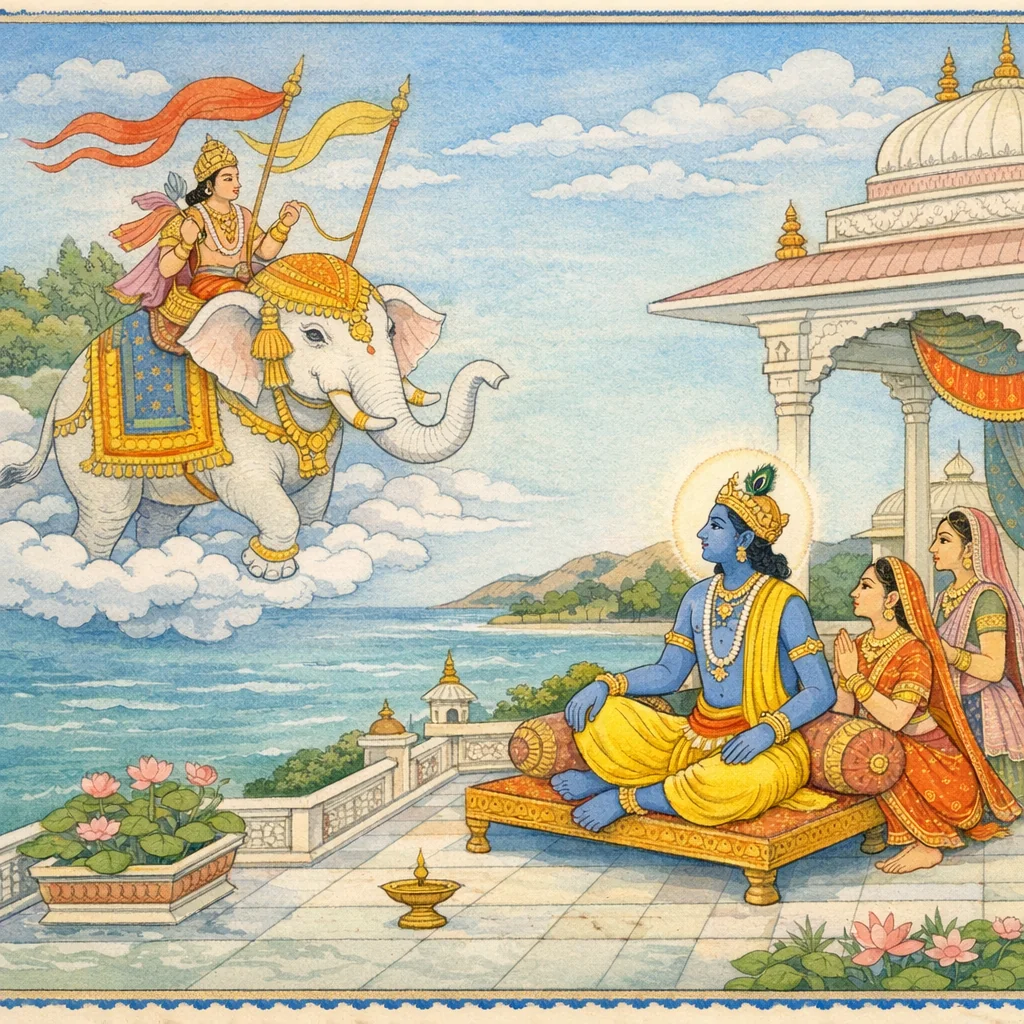
In Dvārakā, Indra (Śakra), mounted on Airāvata, comes to Śrī Kṛṣṇa to report Narakāsura’s outrages and to praise the Lord as the world’s protector. Parāśara tells Maitreya that Bhoma (Naraka), dwelling in Pragjyotiṣapura, abducted maidens, plundered divine treasures, and stole Aditi’s earrings (kuṇḍalas). Śrī Kṛṣṇa, with Satyabhāmā, rides Garuḍa to Pragjyotiṣa; with the Sudarśana-cakra he cuts the Māurava bonds and slays Mura, his seven thousand sons, Hayagrīva, and Pañcajana. In the great battle Govinda destroys the daityas by the thousand and finally kills Naraka with his cakra; Bhūmi Devī presents the kuṇḍalas, seeks forgiveness, and begs protection for her offspring, which the Lord grants. Accepting the jewels and beholding the many captive maidens, he sends elephants, horses, and riches to Dvārakā and then sets out for heaven to return Aditi’s kuṇḍalas.
Shlokas
Verse 1
द्वारवत्यां ततः शौरिं शक्रस् त्रिभुवनेश्वरः आजगामाथ मैत्रेय मत्तैरावतपृष्ठगः
Then, in Dvāravatī, Śakra—Indra, lord of the three worlds—came to Śauri (Śrī Kṛṣṇa); O Maitreya, he arrived seated upon the back of the rutting elephant Airāvata.
Verse 2
प्रविश्य द्वारकां सो ऽथ समेत्य हरिणा ततः कथयाम् आस दैत्यस्य नरकस्य विचेष्टितम्
Entering Dvārakā, he met with Hari and then recounted in full the misdeeds and violent outrages of the demon Naraka.
Verse 3
त्वया नाथेन देवानां मनुष्यत्वे ऽपि तिष्ठता प्रशमं सर्वदुःखानि नीतानि मधुसूदन
O Madhusūdana, by you—the Lord and refuge of the gods—even while abiding in human form, all their sufferings have been calmed and brought to perfect rest.
Verse 4
तपस्विजननाशाय सो ऽरिष्टो धेनुकस् तथा प्रवृत्तो यस् तथा केशी ते सर्वे निहतास् त्वया
To destroy ascetics and holy folk, Ariṣṭa, Dhenuka, and Keśī were set in motion; yet all of them were slain by you, O protector of dharma.
Verse 5
कंसः कुवलयापीडः पूतना बालघातिनी नाशं नीतास् त्वया सर्वे ये ऽन्ये जगदुपद्रवाः
By you, Kaṃsa, Kuvalayāpīḍa, Pūtanā the slayer of infants, and all other forces that tormented the world have been brought to their end.
Verse 6
युष्मद्दोर्दण्डसद्बुद्धिपरित्राते जगत्त्रये यज्वियज्ञांशसंप्राप्त्या तृप्तिं यान्ति दिवौकसः
When the three worlds are safeguarded by the righteous might of your arm and the clarity of your divine intelligence, the dwellers of heaven find satisfaction, nourished by the allotted portions of sacrifice that reach them through the sacrificer’s rite.
Verse 7
सो ऽहं साम्प्रतम् आयातो यन्निमित्तं जनार्दन तच् छ्रुत्वा तत्प्रतीकारप्रयत्नं कर्तुम् अर्हसि
O Janārdana, for that very cause which has compelled me, I have now come to You. Having heard it, You should undertake the effort that will serve as its remedy.
Verse 8
भौमो ऽयं नरको नाम प्राग्ज्योतिषपुरेश्वरः करोति सर्वभूतानाम् उपघातम् अरिंदम
O subduer of foes, this Naraka—known as Bhauma, lord of the city of Prāgjyotiṣa—is inflicting grievous harm upon all living beings.
Verse 9
देवसिद्धासुरादीनां नृपाणां च जनार्दन हृत्वा हि सो ऽसुरः कन्या रुरोध निजमन्दिरे
O Janārdana, even in the presence of gods, Siddhas, Asuras, and kings, that Asura seized the maiden and confined her within his own palace.
Verse 10
छत्रं यत् सलिलस्रावि तज् जहार प्रचेतसः मन्दरस्य तथा शृङ्गं हृतवान् मणिपर्वतम्
The water-shedding canopy was carried away by Pracetas; and he also bore off the peak of Mandara, as though seizing the jewel-like mountain itself from amid the waters.
Verse 11
अमृतस्राविणी दिव्ये मन्मातुः कृष्ण कुण्डले जहार सो ऽसुरो ऽदित्या वाञ्छत्य् ऐरावतं गजम्
O Kṛṣṇa, that Asura carried off my mother’s two divine earrings, distilling amṛta and wondrously dark-hued; and now he even seeks to seize Airāvata, the royal elephant, from Aditi as well.
Verse 12
दुर्नीतम् एतद् गोविन्द मया तस्य तवोदितम् यद् अत्र प्रतिकर्तव्यं तत् स्वयं परिमृश्यताम्
O Govinda, what I spoke to him on Your behalf was ill-judged. In this matter, what should be done—may You Yourself reflect and decide.
Verse 13
इति श्रुत्वा स्मितं कृत्वा भगवान् देवकीसुतः गृहीत्वा वासवं हस्ते समुत्तस्थौ वरासनात्
Hearing these words, the Blessed Lord—the son of Devakī—smiled; and taking Vāsava by the hand, He rose from His excellent seat.
Verse 14
संचिन्तितम् उपारुह्य गरुडं गगनेचरम् सत्यभामां समारोप्य ययौ प्राग्ज्योतिषं पुरम्
Having resolved His purpose, the Lord mounted Garuḍa, who moves through the heavens; and seating Satyabhāmā beside Him, He set out for the city of Prāgjyotiṣa.
Verse 15
आरुह्यैरावतं नागं शक्रो ऽपि त्रिदिशालयम् ततो जगाम मैत्रेय पश्यतां द्वारकौकसाम्
Mounting the elephant Airāvata, Śakra (Indra) then departed for Tridiśālaya—his celestial realm—O Maitreya, while the people of Dvārakā looked on.
Verse 16
प्राग्ज्योतिषपुरस्यासीत् समन्ताच् छतयोजनम् आचिता मौरवैः पाशैः क्षुरान्तैर् भूर् द्विजोत्तम
O best of the twice-born, the land around the city of Prāgjyotiṣa extended a hundred yojanas in every direction, and it was densely set with Māurava nooses—as though encircling it—whose ends were sharp as razors, a dreadful snare guarding that stronghold.
Verse 17
तांश् चिच्छेद हरिः पाशान् क्षिप्त्वा चक्रं सुदर्शनम् ततो मुरुः समुत्तस्थौ तं जघान च केशवः
Then Hari hurled the Sudarśana discus and severed those nooses. Muru rose again, but Keśava struck him down.
Verse 18
मुरोस् तु तनयान् सप्त सहस्रांस् तांस् ततो हरिः चक्रधाराग्निनिर्दग्धांश् चकार शलभान् इव
Then Hari, seeing Mura’s seven thousand sons, burned them with the fire that blazed from the Sudarśana discus—like moths consumed in a flame.
Verse 19
हत्वा मुरुं हयग्रीवं तथा पञ्चजनं द्विज प्राग्ज्योतिषपुरं धीमांस् त्वरावान् समुपाद्रवत्
O twice-born one, having slain Muru, Hayagrīva, and also Pañcajana, the wise Lord hastened onward and advanced against the city of Prāgjyotiṣa.
Verse 20
नरकेणास्य तत्राभून् महासैन्येन संयुगः कृष्णस्य यत्र गोविन्दो जघ्ने दैत्यान् सहस्रशः
There a great battle arose for Kṛṣṇa with Naraka, backed by a vast host; on that field Govinda struck down the Daityas by the thousand.
Verse 21
शस्त्रास्त्रवर्षं मुञ्चन्तं तं भौमं नरकं बली क्षिप्त्वा चक्रं द्विधा चक्रे चक्री दैतेयचक्रहा
As Naraka Bhauma poured forth a rain of weapons, the discus-bearing Lord hurled His Sudarśana and in an instant cleft the daitya host in two.
Verse 22
हते तु नरके भूमिर् गृहीत्वादितिकुण्डले उपतस्थे जगन्नाथं वाक्यं चेदम् अथाब्रवीत्
When Naraka had been slain, Bhūmi, the Earth-goddess, taking up Aditi’s earrings, approached Jagannātha, the Lord of the universe; and standing before Him, she spoke these words.
Verse 23
यदाहम् उद्धृता नाथ त्वया सूकरमूर्तिना त्वत्स्पर्शसंभवः पुत्रस् तदायं मय्य् अजायत
O Lord, when You lifted me up in the form of the Boar (Varāha), then by the sanctifying touch of Yours this son was conceived and came to be within me.
Verse 24
सो ऽयं त्वयैव दत्तो मे त्वयैव विनिपातितः गृहाण कुण्डले चेमे पालयास्य च संततिम्
This son was given to me by You alone—and by You alone he has been cast down. Receive these earrings, and protect his lineage as well.
Verse 25
भारावतरणार्थाय ममैव भगवान् इमम् अंशेन लोकम् आयातः प्रसादसुमुखः प्रभो
To lighten the burden of the earth, Bhagavān—my own Lord—has come into this world as a partial manifestation; that sovereign Master, gracious-faced and ever-merciful, has appeared.
Verse 26
त्वं कर्ता च विकर्ता च संहर्ता प्रभवो ऽप्ययः जगतां त्वं जगद्रूपः स्तूयते ऽच्युत किं तव
You alone are the maker and the arranger; You are the withdrawer of all, the source from which the worlds arise and the refuge into which they return. You are the very form of the universe. O Acyuta—when the whole cosmos praises You, what could any hymn of mine possibly add to You?
Verse 27
व्यापी व्याप्यः क्रिया कर्ता कार्यं च भगवान् यदा सर्वभूतात्मभूतस्य स्तूयते तव किं तदा
When the Blessed Lord is praised as the all-pervading One and that which is pervaded; as action itself, the doer, and the very fruit—when You, become the Self of all beings, are thus extolled, what could then remain?
Verse 28
परमात्मा त्वम् आत्मा च भूतात्मा चाव्ययो भवान् यदा तदा स्तुतिर् नास्ति किमर्था ते प्रवर्तते
You are the Supreme Self; You are the inner Self; You are the Self in all beings—imperishable Lord. If You are ever complete and lack nothing, for what purpose does praise arise and move toward You?
Verse 29
प्रसीद सर्वभूतात्मन् नरकेण कृतं हि यत् तत् क्षम्यताम् अदोषाय त्वत्सुतः स निपातितः
Be gracious, O Self of all beings. Whatever Naraka has done—let it be forgiven. Though without fault, that son of Yours has been struck down.
Verse 30
तथेति चोक्त्वा धरणीं भगवान् भूतभावनः रत्नानि नरकावासाज् जग्राह मुनिसत्तम
“So be it,” said the Blessed Lord, the nurturer of all beings; then, O best of sages, addressing the Earth, he retrieved the precious treasures from Naraka’s abode.
Verse 31
कन्यापुरे स कन्यानां षोडशातुलविक्रमः शताधिकानि ददृशे सहस्राणि महामुने
O great sage, in Kanyāpura he—whose valor was unrivaled even at the age of sixteen—beheld more than a hundred thousand maidens.
Verse 32
चतुर्दंष्ट्रान् गजांश् चोग्रान् षट्सहस्रान् स दृष्टवान् काम्बोजानां तथाश्वानां नियुतान्य् एकविंशतिम्
He beheld six thousand fierce elephants, four-tusked and formidable; and among the Kāmbojas he also saw horses reckoned by niyutas—twenty-one in number—an immense store of martial wealth.
Verse 33
कन्यास् ताश् च तथा नागांस् तांश् चाश्वान् द्वारकां पुरीम् प्रेषयाम् आस गोविन्दः सद्यो नरककिंकरैः
Govinda at once sent those maidens—together with the elephants and the horses—on to the city of Dvārakā, escorted immediately by the attendants who had formerly served Naraka.
Verse 34
ददृशे वारुणं छत्रं तथैव मणिपर्वतम् आरोपयाम् आस हरिर् गरुडे पतगेश्वरे
He beheld Varuṇa’s wondrous umbrella, and also the jewel-like mountain; and Hari placed these divine treasures upon Garuḍa, the sovereign of birds.
Verse 35
आरुह्य च स्वयं कृष्णः सत्यभामासहायवान् अदित्याः कुण्डले दातुं जगाम त्रिदिवालयम्
Then Kṛṣṇa himself, with Satyabhāmā as his companion, mounted his conveyance and set out for the abode of the gods, to restore to Aditi her earrings.
Frequently Asked Questions
Bhū-devī links Naraka’s origin to the Lord’s Varāha touch, then asks for forgiveness and protection of Naraka’s lineage—showing divine justice tempered by compassion and the Lord’s role as both origin and regulator of karmic outcomes.
The narrative frames it as restoration of rightful protection and social order after unlawful captivity; the Lord’s victory is not only martial but also dhārmic—reintegrating the harmed into the Lord’s safeguarded polity.