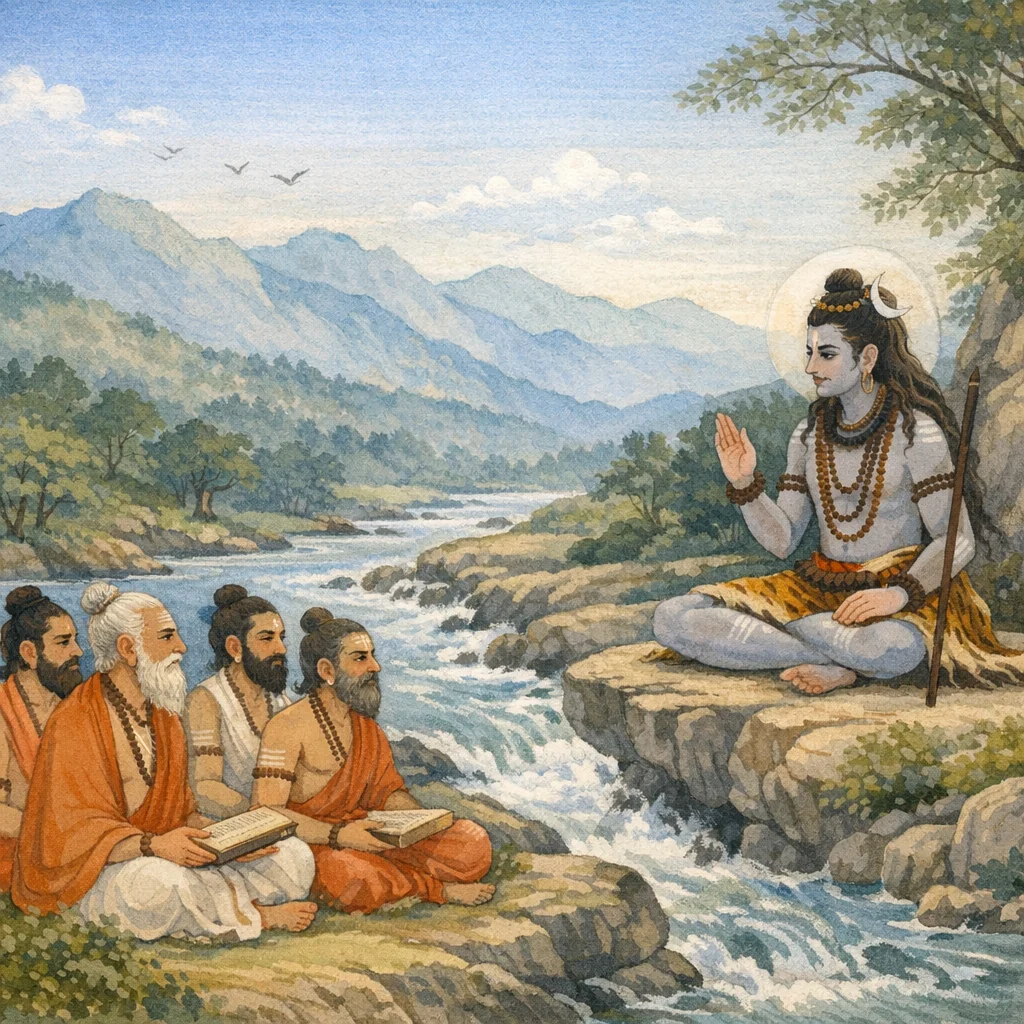
एकोनविंशतिशिवावतारवर्णनम् (Description of the Nineteen Manifestations/Avatāras of Śiva)
This adhyāya is framed as Śiva’s first-person revelation (śiva uvāca), presenting a yuga-indexed catalogue of Śiva’s manifestations/avatāras and their connected lineages—Vyāsa-figures, assisting sages, and named sons or disciples. The verses trace a chronology through late Dvāpara transitions and yuga framings, and place the events in sacred geography: the peaks of Himavat, Gaṅgādvāra/Haridvāra, Gandhamādana, and the Bālakhilya āśrama. The discourse reads like a register, fixing proper names (Tridhāmā Vyāsa; Atri in the “Hemakañcuka” form; Bali as a mahāmuni) and enumerating cohorts (four sons, groups of ṛṣis) to authenticate transmission lines and to show Śiva’s pedagogical support for Vyāsa and dharma in changing ages. Its esoteric teaching is that avatāra is not merely descent but a knowledge-function: Śiva appears where śāstra must be re-grounded, where tapas must be exemplified, and where nivṛtti-oriented sādhana must be reintroduced under historical pressure.
Shlokas
Verse 1
शिव उवाच । दशमे द्वापरे व्यासस्त्रिधामा नामतो मुनि । हिमवच्छिखरे रम्ये भृगुतुंगे नगोत्तमे
Śiva said: “In the tenth Dvāpara age, there was a sage named Vyāsa, known as Tridhāmā. He dwelt upon the lovely peak of the Himālaya—on Bhṛgutunga, the best among mountains.”
Verse 2
तत्रापि मम पुत्राश्च भृग्वाद्याः श्रुतिसंमिताः । बलबन्धुर्नरामित्रः केतुशृंगस्तपोधनः
“There too, my sons—beginning with Bhṛgu—were in full accord with the authority of the Vedas. (Among them were) Balabandhu, Narāmitra, Ketuśṛṅga, and Tapodhana.”
Verse 3
एकादशे द्वापरे तु व्यासश्च त्रिवृतो यदा । गंगाद्वारे कलौ नाम्ना तपोऽहं भविता तदा
In the eleventh Dvāpara age, when Vyāsa becomes known as Trivṛta, then in the Kali age I shall be born at Gaṅgādvāra bearing the name ‘Tapaḥ’ (Austerity).
Verse 4
लम्बोदरश्च लम्बाक्षः केशलम्वः प्रलम्बकः । तत्रापि पुत्राश्चत्वारो भविष्यन्ति दृढव्रताः
“(There are the Rudra-forms named) Lambodara, Lambākṣa, Keśalambva, and Pralambaka. From that line as well, four sons will be born—steadfast in their sacred vows.”
Verse 5
द्वादशे परिवर्त्ते तु शततेजाश्च वेदकृत् । तत्राप्यहं भविष्यामि द्वापरान्ते कलाविह
In the twelfth cycle of change, (I shall appear) as Śatatejā, the composer of the Vedas. Even there I shall manifest—at the close of the Dvāpara age—free from all diminution and fully endowed with divine power.
Verse 6
हेमकंचुकमासाद्य नाम्ना ह्यत्रिः परिप्लुतः । व्यासस्यैव साहाय्यार्थं निवृत्तिपथरोषणः
Having obtained the golden cuirass, Atri—his name now renowned—became fully empowered; and, for the very purpose of assisting Vyāsa, he was made ardent in the path of nivṛtti (renunciation), intent on spiritual withdrawal toward liberation under Śiva’s grace.
Verse 7
सर्वज्ञः समबुद्धिश्च साध्यः शर्वसुयोगिनः । तत्रेति पुत्राश्चत्वारो भविष्यन्ति महामुने
O great sage, they will be all-knowing, even-minded, and spiritually accomplished—perfected yogins devoted to Śarva (Śiva). In that line, four sons will be born.
Verse 8
त्रयोदशे युगे तस्मिन्धर्मो नारायणः सदा । व्यासस्तदाहं भविता बलिर्नाम महामुनिः
In that thirteenth age, Dharma will ever be Nārāyaṇa; and at that time I shall become the Vyāsa—the great sage named Bali.
Verse 9
बालखिल्याश्रमे गंधमादने पर्वतोत्तमे । सुधामा काश्यपश्चैव वसिष्ठो विरजाः शुभाः
In the hermitage of the Bālakhilya sages, upon the most excellent mountain Gandhamādana, the auspicious seers Sudhāmā, Kaśyapa, Vasiṣṭha, and the pure Virajā were present.
Verse 10
यदा व्यासस्तु रक्षाख्यः पर्याये तु चतुर्दशे । वंश आङ्गिरसे तत्र भविताहं च गौतमः
When, in the fourteenth succession, the Vyāsa named Rakṣa appears, then in that era—within the lineage of Aṅgiras—I shall be born as Gautama.
Verse 11
तत्रापि मम ते पुत्रा भविष्यन्ति कलौ तदा । अत्रिर्दवशदश्चैव श्रवणोथ श्रविष्कटः
There too, in the Kali age at that time, those sons of mine will come to be—Atri, Davaśadaśa, and also Śravaṇa, and then Śraviṣkaṭa.
Verse 12
व्यासः पञ्चदशे त्रय्यारुणिर्वै द्वापरे यदा । तदाहं भविता वेदशिरा वेदशिरस्तथा
When, in the Dvāpara age, the fifteenth Vyāsa is indeed Trayyāruṇi, then I shall become the sage Vedaśiras—known also as Vedaśiras.
Verse 13
महावीर्यं तदस्त्रं च वेदशीर्षश्च पर्वतः । हिमवत्पृष्ठमासाद्य सरस्वत्यास्तथोत्तरे
That mighty, potent divine weapon, and the mountain called Vedaśīrṣa—having reached the northern region by the back slopes of Himavān, near the Sarasvatī—came to be established there.
Verse 14
तत्रापि मम चत्वारो भविष्यन्ति सुता दृढाः । कुणिश्च कुणिबाहुश्च कुशरीरः कुनेत्रकः
There too, four steadfast sons of mine shall be born—Kuṇi, Kuṇibāhu, Kuśarīra, and Kunetraka.
Verse 15
व्यासो युगे षोडशे तु यदा देवो भविष्यति । तदा योगप्रदानाय गोकर्णो भविता ह्यहम्
When, in the sixteenth age, the divine sage Vyāsa is to appear, then—so that Yoga may be bestowed—I shall indeed become Gokarṇa.
Verse 16
तत्रैव च सुपुण्यं च गोकर्णं नाम तद्वनम् । तत्रापि योगिनः पुत्र भविष्यंतित्यम्बुसंमिताः
There itself is that exceedingly meritorious forest named Gokarṇa. And there too, it is declared, sons will be born to the yogins—numerous as the waters, countless in number.
Verse 17
काश्यपोप्युशनाश्चैव च्यवनोऽथ बृहस्पतिः । तेपि तेनैव मार्गेण गमिष्यन्ति शिवालयम्
Kāśyapa, Uśanā (Śukra), Cyavana, and Bṛhaspati as well—these too shall proceed by that very same path and attain Śivālaya, the abode of Śiva.
Verse 18
परिवर्त्ते सप्तदशे व्यासो देवकृतंजयः । गुहावासीति नाम्नाहं हिमवच्छिखरे शुभे
In the seventeenth cycle of change, the sage Vyāsa was known as Devakṛtañjaya. And I—bearing the name ‘Guhāvāsī’ (the Cave-dweller)—abode upon the auspicious peak of Himavān (the Himalaya).
Verse 19
महालये महोत्तुंगे शिवक्षेत्रं हिमाल यम् । उतथ्यो वामदेवश्च महायोगो महाबलः
In the lofty, supremely exalted Himalaya lies a sacred Śiva-kṣetra. There dwell Utathya and Vāmadeva—great yogins, endowed with immense spiritual power and strength.
Verse 20
परिवर्त्तेऽष्टादशे तु यदा व्यास ऋतंजयः । शिखाण्डीनामतोहं तद्धिमवच्छिखरे शुभे
But in the eighteenth cycle of time, when Vyāsa—called Ṛtaṃjaya, the conqueror of Truth—appeared, I was then born among the Śikhāṇḍīs, upon the auspicious peak of the Himalaya.
Verse 21
सिद्धक्षेत्रे महापुण्ये शिखण्डी नाम पर्वतः । शिखण्डिनो वनं वापि यत्र सिद्धनिषेवितम्
In the supremely sacred, greatly meritorious Siddha-kṣetra there is a mountain named Śikhaṇḍī; and there is also the forest of Śikhaṇḍī, a place frequented and served by perfected beings, the siddhas.
Verse 22
वाचःश्रवा रुचीकश्च स्यावास्यश्च यतीश्वरः । एते पुत्रा भविष्यन्ति तत्रापि च तपोधनाः
“Vācaḥśravā, Rucīka, Syāvāsya, and Yatīśvara—these will be born as sons there as well, all of them rich in austerity (tapas), true treasures of spiritual discipline.”
Verse 23
एकोनविंशे व्यासस्तु भरद्वाजो महामुनिः । तदाप्यहं भविष्यामि जटी माली च नामतः
In the nineteenth cycle, the Vyāsa will indeed be the great sage Bharadvāja. Even then, I shall manifest—by name—as Jaṭī and Mālī (the matted-haired and the garland-bearer).
Verse 24
हिमवच्छिखरे तत्र पुत्रा मेऽम्बुधिसंहिताः । हिरण्यनामा कौशल्यो लोकाक्षी प्रधिमिस्तथा
Upon the peak of Himavān, my sons were gathered together like a vast ocean—Hiraṇyanāmā, Kauśalya, Lokākṣī, and also Pradhimi.
Verse 25
परिवर्त्ते विंशतिमे भविता व्यास गौतमः । तत्राट्टहासनामाहमट्टहासप्रिया नराः
In the twentieth cycle of change, the Vyāsa will be Gautama. There I shall be known by the name ‘Aṭṭahāsa’, and the people there will be devoted to and delighted by Aṭṭahāsa.
Verse 26
तत्रैव हिमवत्पृष्ठे अट्टहासो महागिरिः । देवमानुषयक्षेन्द्रसिद्धचारणसेवितः
There itself, upon the back of Himavat, stands the great mountain called Aṭṭahāsa—revered and frequented by the gods, by human beings, by the lords of the Yakṣas, and by the Siddhas and Cāraṇas.
Verse 27
तत्रापि मम ते पुत्रा भवि ष्यन्ति सुयोगिनः । सुमन्तुर्बबरिर्विद्वान् कबंधः कुशिकन्धरः
“There too, those sons of mine will be born to you—accomplished yogins: Sumantu, Babari, the learned Kabandha, and Kuśikandhara.”
Verse 28
एकविंशे युगे तस्मिन् व्यासो वाचःश्रवा यदा । तदाहं दारुको नाम तस्माद्दारुवनं शुभम्
In that twenty-first yuga, when the sage Vyāsa was known as Vācaḥśravā, I bore the name Dāruka. From that very name arose the auspicious forest called Dāruvana.
Verse 29
तत्रापि मम ते पुत्रा भविष्यन्ति सुयोगिनः । प्लक्षो दार्भायणिश्चैव केतुमान् गौतमस्तथा
There too, those sons of mine will be born as accomplished yogins—Plakṣa, Dārbhāyaṇi, Ketumān, and also Gautama.
Verse 30
द्वाविंशे परिवर्ते तु व्यासः शुष्मायणो यदा । तदाप्यहं भविष्यामि वाराणस्यां महामुनिः
In the twenty-second cycle, when the Vyāsa will be Śuṣmāyaṇa, then I too shall appear in Vārāṇasī—O great sage—as a great ascetic.
Verse 31
नाम्ना वै लांगली भीमो यत्र देवाः सवासवाः । द्रक्ष्यंति मां कलौ तस्मिन्भवं चैव हलायुधम्
In that Kali age, the Devas—together with Indra—will behold me there, renowned by the name “Lāṅgalī Bhīma”; and they will also see Bhava (Śiva) Himself as Hālāyudha, the bearer of the plough.
Verse 32
तत्रापि मम ते पुत्रा भविष्यंति सुधार्मिकाः । भल्लवी मधुपिंगश्च श्वेतकेतुस्तथैव च
“There too, those sons of yours will be born as My own—truly righteous and devoted to dharma: Bhallavī, Madhupiṅga, and likewise Śvetaketu.”
Verse 33
परिवर्ते त्रयोविंशे तृणबिन्दुर्यदा मुनिः । श्वेतो नाम तदाहं वै गिरौ कालंजरे शुभे
In the twenty-third cycle of time, when the sage Tṛṇabindu appeared, I indeed manifested then as Śveta upon the auspicious mountain Kālañjara.
Verse 34
तत्रापि मम ते पुत्रा भविष्यन्ति तपस्विनः । उशिको बृहदश्वश्च देवलः कविरेव च
“There too, My sons will be born through you—great ascetics: Uśika, Bṛhadaśva, Devala, and Kavi.”
Verse 35
परिवर्ते चतुर्विंशे व्यासो यक्षो यदा विभुः । शूली नाम महायोगी तद्युगे नैमिषे तदा
In the twenty-fourth cycle (parivarta), when the mighty Śiva assumed the office of Vyāsa among the Yakṣas, that great Yogin was known as Śūlī; and in that very age he manifested there at Naimiṣa.
Verse 36
तत्रापि मम ते शिष्या भविष्यन्ति तपस्विनः । शालिहोत्रोऽग्निवेशश्च युवनाश्वः शरद्वसुः
“There too, those ascetic ones will become My disciples—Śālihotra, Agniveśa, Yuvanāśva, and Śaradvasu.”
Verse 37
पंचविंशे यदा व्यासः शक्तिर्नाम्ना भविष्यति । तदाप्यहं महायोगी दण्डी मुण्डीश्वरः प्रभुः
When, in the twenty-fifth age, the Vyāsa will be known by the name Śakti, then I too shall manifest as the great Yogin—the Lord Daṇḍī, Muṇḍīśvara, the Sovereign.
Verse 38
तत्रापि मम ते शिष्या भविष्यन्ति तपस्विनः । छगलः कुण्डकर्णश्च कुम्भाण्डश्च प्रवाहकः
There too, those ascetics will become My disciples—Chagala, Kuṇḍakarṇa, Kumbhāṇḍa, and Pravāhaka.
Verse 39
व्यासः पराशरो यर्हि षड्विंशे भविताप्यहम् । पुरं भद्रवटं प्राप्य सहिष्णुर्नाम नामतः
When, in the twenty-sixth age, Vyāsa—Parāśara—comes to be, I too shall manifest. Reaching the city called Bhadravaṭa, I will be known by the name “Sahiṣṇu.”
Verse 40
तत्रापि मम ते शिष्या भविष्यन्ति तपस्विनः । उलूको विद्युतश्चैव शम्बूको ह्याश्वलायनः
There too, those ascetic ones will become My disciples—Ulūka, Vidyuta, and also Śambūka, as well as Āśvalāyana.
Verse 41
सप्तविंशे यदा व्यासो जातूकर्ण्यो भविष्यति । प्रभासतीर्थमाश्रित्य सोमशर्मा तदाप्यहम्
In the twenty-seventh turn, when Vyāsa becomes Jātūkarṇya, then I too—becoming Somaśarmā—shall dwell, taking refuge at the sacred Prabhāsa tīrtha.
Verse 42
इति द्विचत्वारिंशावताराः
Thus are concluded the forty-two incarnations (manifest forms) of Lord Rudra-Śiva.
Verse 43
अष्टाविंशे द्रापरे तु पराशरसुतो हरिः । यदा व्यासो भविष्यामि नाम्ना द्वैपायनः प्रमुः
“In the twenty-eighth Dvāpara age, Hari, the son of Parāśara, will appear; then I shall become Vyāsa, renowned by the name Dvaipāyana.”
Verse 44
तदा षष्ठेन चांशेन कृष्णः पुरुषसत्तमः । वसुदेवसुतः श्रेष्ठो वासुदेवो भविष्यति
Then, with a sixth portion (of divine power), Kṛṣṇa—the best among men—will be born as the excellent son of Vasudeva, and will become known as Vāsudeva.
Verse 45
तदाप्यहं भविष्यामि योगात्मा योगमायया । लोकविस्मापनार्थाय ब्रह्मचारिशरीरकः
“Even then, by My Yogamāyā, I shall manifest as the very Self of Yoga, assuming the body of a brahmacārin (celibate ascetic) in order to bewilder the worlds (and conceal My true divine intent).”
Verse 46
श्मशाने मृतमुत्सृज्य दृष्ट्वा कायमनामयम् । ब्राह्मणानां हितार्थाय प्रविष्टो योगमायया
Having cast off the dead body in the cremation-ground and beholding a body free from affliction, he—by Yogamāyā—entered it for the welfare of the brāhmaṇas.
Verse 47
दिव्यां मेरुगुहां पुण्यां त्वया सार्द्धं च विष्णुना । भविष्यामि तदा ब्रह्मंल्लकुली नामनामतः
O Brahmā, then—together with you and with Viṣṇu—I shall enter that divine and holy cave of Meru, and I shall manifest there bearing the name Lakulī.
Verse 48
कायावतार इत्येवं सिद्धक्षेत्रं परं तदा । भविष्यति सुविख्यातं यावद्भूमिर्धरिष्यति
Thus, that supreme sacred Siddha-kṣetra will then be known as “Kāyāvatāra,” and it will remain renowned for as long as the earth endures.
Verse 49
तत्रापि मम ते शिष्या भविष्यन्ति तपस्विनः । कुशिकश्चैव गर्गश्च मित्रः कौरुष्य एव च
There too, those ascetic ones will become my disciples—namely Kuśika, Garga, Mitra, and also Kauruṣya.
Verse 50
योगिनो ब्राह्मणा वेदपारगा ऊर्द्ध्वरेतसः । प्राप्य माहेश्वरं योगं गमिष्यंति शिवं पुरम्
Yogins—Brahmanas who have crossed to the far shore of the Vedas and who preserve their vital energy—having attained Maheshvara’s Yoga, will go to Shiva’s own city (abode).
Verse 51
वैवस्वतेऽन्तरे सम्यक् प्रोक्ता हि परमात्मना । योगेश्वरावताराश्च सर्वावर्तेषु सुव्रताः
In the Vaivasvata Manvantara, these matters were indeed taught clearly by the Supreme Self (Paramātman). And in every cosmic cycle as well, the incarnations of the Lord of Yoga (Śiva)—those of holy vows—manifest.
Verse 52
व्यासाश्चैवाष्टविंशत्का द्वापरेद्वापरे विभो । योगेश्वरावतारश्च प्रारंभे च कलौ कलौ
O mighty Lord, in each Dvāpara age there are indeed twenty-eight Vyāsas; and at the beginning of each Kali age, the Lord of Yoga (Śiva) also manifests by incarnation.
Verse 53
योगेश्वरावताराणां योगमार्गप्रवर्द्धकाः । महाशैवाश्च चत्वारः शिष्याः प्रत्येकमव्यया
For the incarnations of the Lord of Yoga (Śiva), there are four great Śaiva disciples—each imperishable—who promote and expand the path of Yoga.
Verse 54
एते पाशुपताः शिष्या भस्मोद्धूलितविग्रहाः । रुद्राक्षमालाभरणास्त्रिपुण्ड्रांकितमस्तकाः
These are the Pāśupata disciples—whose bodies are smeared with sacred ash (bhasma/vibhūti), who wear garlands of Rudrākṣa beads, and whose heads are marked with the Tripuṇḍra, the three horizontal lines of vibhūti—the distinctive signs of devotion to Lord Rudra.
Verse 55
शिष्या धर्मरताः सर्वे वेदवेदांगपारगाः । लिंगार्चनरता नित्यं बाह्याभ्यन्तरतः स्थिताः
All the disciples were devoted to dharma, fully accomplished in the Vedas and the Vedāṅgas. Ever intent on worship of the Śiva-liṅga, they remained steadfast—outwardly in conduct and inwardly in heart.
Verse 56
भक्त्या मयि च योगेन ध्याननिष्ठा जितेन्द्रियाः । संख्यया द्वादशाधिक्य शतं च गणिता बुधैः
Those who, with devotion to Me and through yoga, remain steadfast in meditation and have conquered their senses—the wise have reckoned them, by count, as one hundred and twelve.
Verse 57
इत्येतद्वै मया प्रोक्तमवतारेषु लक्षणम् । मन्वादिकृष्णपर्यन्तमष्टाविंशद्युगक्रमात्
Thus have I indeed declared the distinguishing marks of the divine descents. According to the ordered succession of the twenty-eight yugas, this account extends from the Manu-epoch onward up to the advent of Kṛṣṇa.
Verse 58
तत्र श्रुतिसमूहानां विधानं ब्रह्मलक्षणम् । भविष्यति तदा कल्पे कृष्णद्वैपायनो यदा
There, the orderly arrangement of the multitude of Śrutis—bearing the mark of Brahman—shall come to be in that kalpa, when Kṛṣṇa-Dvaipāyana (Vyāsa) appears.
Verse 59
इत्येवमुक्त्वा ब्रह्माणमनुगृह्य महेश्वरः । पुनः संप्रेक्ष्य देवेशस्तत्रैवान्तरधीयत
Having spoken thus, Mahādeva, in grace, blessed Brahmā. Then the Lord of the Devas looked once more, and right there He vanished from sight.
Frequently Asked Questions
It presents a yuga-by-yuga theological catalogue in which Śiva declares future/past manifestations aligned with changing Dvāpara transitions and the needs of dharma and śāstric transmission—often framed as Śiva assisting or reconstituting Vyāsa-functions and sage-lineages to preserve knowledge.
The chapter’s ‘symbolism’ is primarily structural: names, numbers (e.g., nineteen forms; repeated groups of four sons), and pilgrimage geographies operate as indexing devices that encode authority. ‘Avatāra’ signifies a knowledge-function—Śiva’s appearance where tapas, equanimity (samabuddhi), and nivṛtti must be reinstalled as living hermeneutics of scripture.
The sampled material foregrounds Śiva’s own avatāra-identities and associated roles (e.g., Atri in a Hemakañcuka designation; Bali as a mahāmuni; yuga-linked appearances at Gaṅgādvāra), emphasizing Śiva’s multi-form pedagogical presence rather than a single iconic form; Gaurī is not prominent in the provided excerpts.