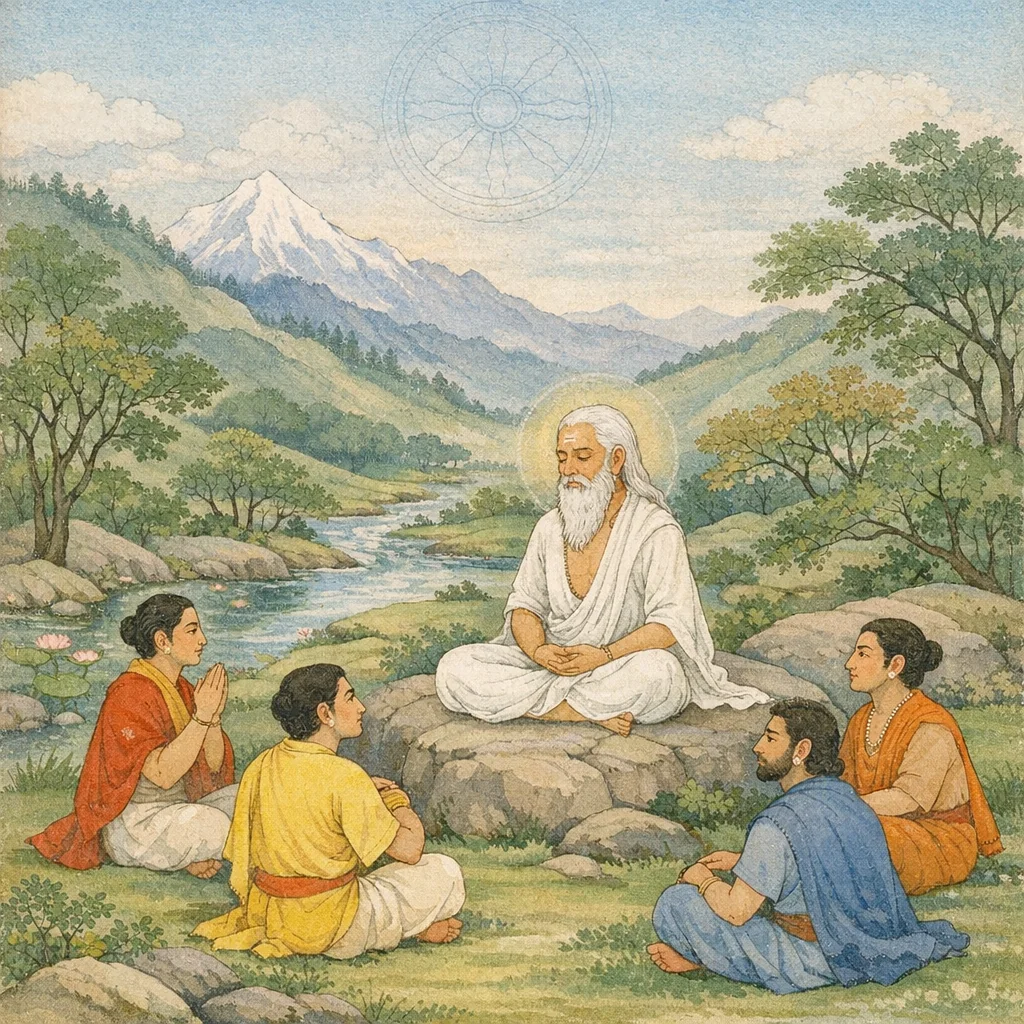
ऋषभचरित्रवर्णनम् (Ṛṣabha-caritra-varṇanam) — “Account of Ṛṣabha’s Sacred Narrative”
This chapter is presented as a transmitted teaching: Nandīśvara tells Sanatkumāra that the Śaṃkara-carita to be related was lovingly conveyed by Rudra to Brahmā for the enduring good of all beings. The narration then shifts to Śiva’s own voice, fixing the account in precise Purāṇic time—the seventh (Vārāha) kalpa and a manvantara horizon, with the sequence of yugas noted. Śiva explains a deliberate manifestation for loka-anugraha, and especially for brāhmaṇa-hitā, the welfare of brahmins and the safeguarding of sacred learning, near the close of a Dvāpara cycle, extending into Kali-yuga conditions. A prophecy follows: Śiva will appear as a great muni named Śveta in the Himavat region (notably at Chāgala peak), with disciples bearing śikhā and “Śveta-” epithets (Śveta, Śvetaśikha, Śvetāśva, Śvetalohita). Their discipline is dhyāna-yoga, culminating in entry into Śiva’s abode. The chapter ends by stating the devotee’s fruit: true knowledge of Śiva as the imperishable reality yields parabrahma-samādhi and a state beyond birth, death, and old age.
Shlokas
Verse 1
नन्दीश्वर उवाच । सनत्कुमार सर्वज्ञ चरितं शांकरं मुदा । रुद्रेण कथितं प्रीत्या ब्रह्मणे सुखदं सदा
Nandīśvara said: “O all-knowing Sanatkumāra, with joy I shall relate the sacred Śaṅkara-charita—the divine account of Lord Śiva—which Rudra once narrated lovingly to Brahmā, and which is ever a source of bliss.”
Verse 2
शिव उवाच । सप्तमे चैव वाराहे कल्पे मन्वन्तराभिधे । कल्पेश्वरोऽथ भगवान्सर्वं लोकप्रकाशनः
Śiva said: “In the seventh—indeed, in the Varāha Kalpa—during the period called a Manvantara, the Blessed Lord, as Kalpeśvara, the Illuminator who makes all the worlds manifest, then revealed Himself.”
Verse 3
मर्नोर्वैवस्वतस्यैव ते प्रपुत्रो भविष्यति । तदा चतुर्युगाश्चैव तस्मिन्मन्वन्तरे विधे
O Vidhe, Creator, you shall become the great-grandson of Vaivasvata Manu; and in that very Manvantara, the cycle of the four Yugas will proceed in due order.
Verse 4
अनुग्रहार्थं लोकानां ब्राह्मणानां हिताय च । उत्पश्यामि विधे ब्रह्मन्द्वापराख्ययुगान्तिके
For the sake of showing grace to the worlds, and for the welfare of the brāhmaṇas, O Vidhe, O Brahmā, I manifest Myself at the close of the age called Dvāpara.
Verse 5
युगप्रवृत्त्या च तदा तस्मिंश्च प्रथमे युगे । द्वापरे प्रथमे ब्रह्मन्यदा व्यासः स्वयंप्रभुः
And thus, with the commencement of the cycles of ages, in that very first Yuga—and again, O Brahman, at the beginning of the Dvāpara age—there appeared Vyāsa, the self-effulgent one, by his own divine power.
Verse 6
तदाहं ब्राह्मणार्थाय कलौ तस्मिन्युगान्तिके । भविष्यामि शिवायुक्तः श्वेतो नाम महामुनिः
Therefore, for the welfare of the brāhmaṇas, at that end-juncture of the age in Kali, I shall manifest—united with Śiva—as the great sage named Śveta.
Verse 7
हिमवच्छिखरे रम्ये छागले पर्वतोत्तमे । तदा शिष्याः शिखायुक्ता भविष्यन्ति विधे मम
On the delightful peak of Himavat, on the excellent mountain called Chāgala, then—O Ordainer—my disciples will be those who bear the sacred topknot (śikhā).
Verse 8
श्वेतः श्वेतशिखश्चैव श्वेताश्वः श्वेतलोहितः । चत्वारो ध्यानयोगात्ते गमिष्यन्ति पुरं मम
“Śveta, Śvetaśikha, Śvetāśva, and Śvetalohita—these four, through the discipline of dhyāna-yoga, shall attain My own city, My divine abode.”
Verse 9
ततो भक्ता भविष्यन्ति ज्ञात्वा मां तत्त्वतोऽव्ययम् । जन्ममृत्युजराहीनाः परब्रह्मसमाधयः
Thereafter, having known Me in truth as the imperishable Reality, they become devotees. Free from birth, death, and old age, they abide absorbed in samādhi upon the Supreme Brahman—Śiva, the Lord (Pati) who grants liberation.
Verse 10
द्रष्टुं शक्यो नरैर्नाहमृते ध्यानात्पितामह । दानधर्मादिभिर्वत्स साधनैः कर्महेतुभिः
O Pitāmaha (Grandfather Brahmā), men cannot behold Me except through meditation. Dear one, not by means such as charity, ritual virtue, and other disciplines that are causes of action (karma) can I be truly seen.
Verse 11
द्वितीये द्वापरे व्यासः सत्यो नाम प्रजापतिः । यदा तदा भविष्यामि सुतारो नामतः कलौ
In the second Dvāpara age, the Vyāsa will be the Prajāpati named Satya. And in the Kali age, whenever the occasion arises, I shall manifest as Sūta, known by the name Sutāra.
Verse 12
तत्रापि मे भविष्यन्ति शिष्या वेदविदो द्विजाः । दुन्दुभिः शतरूपश्च हृषीकः केतुमांस्तथा
There too, I shall have disciples—twice-born sages well-versed in the Vedas: Dundubhi, Śatarūpa, Hṛṣīka, and likewise Ketumān.
Verse 13
चत्वारो ध्यानयोगात्ते गमिष्यन्ति पुरं मम । ततो मुक्ता भविष्यन्ति ज्ञात्वा मां तत्त्वतोऽव्ययम्
Those four, by the discipline of meditation-yoga, shall reach My divine city. Thereafter they will be liberated, having known Me in truth as the imperishable, undecaying Reality.
Verse 14
तृतीये द्वापरे चैव यदा व्यासस्तु भार्गवः । तदाप्यहं भविष्यामि दमनस्तु पुरान्तिके
In the third Dvāpara age, when the sage Vyāsa will be Bhārgava, then I too shall manifest—becoming Daman, near the city’s outskirts.
Verse 15
तत्रापि च भविष्यन्ति चत्वारो मम पुत्रकाः । विशोकश्च विशेषश्च विपापः पापनाशनः
There too, four sons of Mine shall come into being—Viśoka, Viśeṣa, Vipāpa, and Pāpanāśana—free from sorrow, distinguished in nature, and destroyers of sin.
Verse 16
शिष्यैः साहाय्यं व्यासस्य करिष्ये चतुरानन । निवृत्तिमार्गं सुदृढं वर्त्तयिष्ये कलाविह
O four-faced Brahmā, with My disciples I shall assist Vyāsa, and I shall firmly establish the path of Nivṛtti—the inward way that turns from worldly entanglement toward liberation—throughout this age.
Verse 17
चतुर्थे द्वापरे चैव यदा व्यासोंऽगिराः स्मृतः । तदाप्यहं भविष्यामि सुहोत्रो नाम नामतः
In the fourth Dvāpara age as well, when Vyāsa is remembered as “Āṅgirasa,” then I too shall manifest, known by the name Suhotra.
Verse 18
तत्रापि मम ते पुत्राश्चत्वारो योगसाधकाः । भविष्यंति महात्मानस्तन्नामानि ब्रुवे विधे
Even there, O Ordainer (Brahmā), four sons of yours—great-souled ones devoted to the discipline of Yoga—will come to be. I shall now tell you their names.
Verse 19
सुमुखो दुर्मुखश्चैव दुदर्भो दुरतिक्रमः । शिष्यैः साहाय्यं व्यासस्य करिष्येऽहं तदा विधे
Sumukha, Durmukha, Dudarbha, and Duratikrama—together with my disciples—shall then render assistance to Vyāsa, O Creator (Vidhe).
Verse 20
पञ्चमे द्वापरे चैव व्यासस्तु सविता स्मृतः । तदा योगी भविष्यामि कंको नाम महातपाः
In the fifth Dvāpara age, the Vyāsa will be known as Savitā. At that time I shall become a great ascetic yogin, named Kaṅka, endowed with mighty austerities.
Verse 21
तत्रापि मम ते पुत्राश्चत्वारो योगसाधकाः । भविष्यन्ति महात्मानस्तन्नामानि शृणुष्व मे
“There too, four sons of mine will be born to you—great-souled ones, accomplished in the practice of Yoga. Now listen from me to their names.”
Verse 22
सनकः सनातनश्चैव प्रभुर्यश्च सनन्दनः । विभुः सनत्कुमारश्च निर्मलो निरहंकृतिः
Sanaka, Sanātana, Prabhu, and Sanandana; Vibhu and Sanatkumāra—these immaculate sages, free from egoism, are counted among the foremost devotees and knowers of Śiva.
Verse 23
तत्रापि कंकनामाहं साहाय्यं सवितुर्विधे । व्यासस्य हि करिष्यामि निवृत्तिपथवर्द्धकः
There too, I—named Kaṅkana—shall render assistance to that Ordainer (Brahmā), the Sun-like Creator. Indeed, I will serve Vyāsa as one who increases the path of nivṛtti—the inward way of withdrawal that leads to liberation.
Verse 24
परिवर्ते पुनः षष्ठे द्वापरे लोककारकः । कर्ता वेदविभागस्य मृत्युर्व्यासो भविष्यति
Again, in the sixth cycle, in the Dvāpara age, the World-Creator will manifest as Mṛtyu‑Vyāsa, who will arrange and divide the Vedas for the welfare of beings.
Verse 25
तदाऽप्यहं भविष्यामि लोकाक्षिर्नाम नामतः । व्यासस्य सुसाहा य्यार्थं निवृत्तिपथवर्द्धनः
Even then, I shall manifest under the name Lokākṣi. For Vyāsa’s noble aid, I will be one who increases the path of nivṛtti—the inward way of renunciation leading toward liberation.
Verse 26
तत्रापि शिष्याश्चत्वारो भविष्यन्ति दृढव्रताः । सुधामा विरजाश्चैव संजयो विजयस्तथा
There too, there shall be four disciples, steadfast in their vows—Sudhāmā, Virajā, Saṃjaya, and likewise Vijaya.
Verse 27
सप्तमे परिवर्ते तु यदा व्यासः शतक्रतुः । तदाप्यहं भविष्यामि जैगीषव्यो विभुर्विधे
O all-pervading Ordainer (Brahmā), when, in the seventh cycle of change, the compiler of the Veda becomes Śatakratu (Indra), then I too shall manifest—known as Jaigīṣavya—so that the divine order may be upheld.
Verse 28
योगं संद्रढयिष्यामि महायोगविचक्षणः । काश्यां गुहान्तरे संस्थो दिव्यदेशे कुशास्तरिः
Skilled in the Great Yoga, I shall now make My Yoga firm and unwavering—dwelling in Kāśī, seated within a cave in that divine region, upon a seat of sacred kuśa grass.
Verse 29
साहाय्यं च करिष्यामि व्यासस्य हि शतक्रतोः । उद्धरिष्यामि भक्तांश्च संसारभयतो विधे
I shall indeed render assistance to Vyāsa and to Śatakratu (Indra); and, O Vidhī (Brahmā), I shall also deliver My devotees from the fear of saṃsāra, the worldly round of transmigration.
Verse 30
तत्रापि मम चत्वारो भविष्यन्ति सुता युगे । सारस्वतश्च योगीशो मेघवाहः सुवाहनः
There too, in that age, I shall have four sons: Sārasvata, Yogīśa, Meghavāha, and Suvāhana.
Verse 31
अष्टमे परिवर्ते हि वसिष्ठो मुनिसत्तमः । कर्त्ता वेदविभागस्य वेदव्यासो भविष्यति
Indeed, in the eighth cycle of manifestation, the foremost sage Vasiṣṭha will become Vedavyāsa—the arranger who will divide and systematize the Vedas.
Verse 32
तत्राप्यहं भविष्यामि नामतो दधिवाहनः । व्यासस्य हि करिष्यामि साहाय्यं योगवित्तम
Even there, I shall manifest—known by the name Dadhivāhana—and indeed I shall render assistance to Vyāsa, the knower of Yoga, in accomplishing his work.
Verse 33
कपिलश्चासुरिः पञ्चशिखः शाल्वलपूर्वकः । चत्वारो योगिनः पुत्रा भविष्यन्ति समा मम
“Kapila, Āsuri, Pañcaśikha, and Śālvala—these four shall be my sons, yogins equal to me in spiritual attainment.”
Verse 34
नवमे परिवर्ते तु तस्मिन्नेव युगे विधे । भविष्यति मुनिश्रेष्ठो व्यासः सारस्वताह्वयः
O Creator (Brahmā), in that very age, in the ninth cycle of change, there shall arise the foremost of sages—Vyāsa, renowned by the name Sārasvata.
Verse 35
व्यासस्य ध्यायतस्तस्य निवृत्तिपथवृद्धये । तदाप्यहं भविष्यामि ऋषभो नामतः स्मृतः
For the increase of Vyāsa’s path of renunciation, as he meditates, I too shall manifest at that very time—remembered by the name Ṛṣabha.
Verse 36
पराशरश्च गर्गश्च भार्गवो गिरिशस्तथा । चत्वारस्तत्र शिष्या मे भविष्यन्ति सुयोगिनः
“Parāśara, Garga, Bhārgava, and also Giriśa—these four will be my disciples there, accomplished yogins.”
Verse 37
तैः साकं द्रढयिष्यामि योगमार्गं प्रजापते । करिष्यामि साहाय्यं वै वेदव्यासस्य सन्मुने
Along with them, O Prajāpati, I shall firmly establish the path of Yoga; and indeed, O venerable sage, I shall render assistance to the noble Vedavyāsa.
Verse 38
तेन रूपेण भक्तानां बहूनां दुःखिनां विधे । उद्धारं भवतोऽहं वै करिष्यामि दयाकरः
O Creator (Brahmā), in that very form I shall indeed bring deliverance to many sorrowing devotees; for I am compassionate by nature.
Verse 39
सोऽवतारो विधे मे हि ऋषभाख्यस्सुयोगकृत् । सारस्वतव्यासमनः कर्त्ता नानोतिकारकः
O Brahmā (Vidhe), that incarnation of Mine—known as Ṛṣabha—establishes the supreme discipline of Yoga. He is the author of the Sarasvata-Vyāsa tradition, and his mind is steady; he does not engage in acts that cause harm or transgression.
Verse 40
अवतारेण मे येन भद्रायुर्नृपबालकः । जीवितो हि मृतः क्ष्वेडदोषतो जनकोज्झितः
By that incarnation of Mine, the prince-child Bhadrāyu—though already as good as dead due to the affliction of poison, and abandoned by his own father—was indeed restored to life.
Verse 41
प्राप्तेऽथ षोडशे वर्षे तस्य राजशिशोः पुनः । ययौ तद्वेश्म सहसा ऋषभः स मदात्मकः
Then, when that royal child attained his sixteenth year, Ṛṣabha—his mind inflamed with pride and passion—suddenly went again to that residence.
Verse 42
पूजितस्तेन स मुनिः सद्रूपश्च कृपानिधिः । उपादिदेश तद्धर्मान्राज्ययोगान्प्रजापते
Thus honored by him, that sage—of noble form and an ocean of compassion—then instructed Prajāpati in those very duties (dharma) and in the disciplines of righteous kingship (rājya-yoga).
Verse 43
ततः स कवचं दिव्यं शंखं खङ्गं च भास्वरम् । ददौ तस्मै प्रसन्नात्मा सर्वशत्रुविनाशनम्
Then, with a gracious and serene heart, he bestowed upon him a divine cuirass, a conch, and a radiant sword—armaments that destroy all enemies.
Verse 44
तदङ्ग भस्मनामृश्य कृपया दीनवत्सलः । स द्वादशसहस्रस्य गजानां च बलं ददौ
Then, compassionately touching his body with the sacred ash (bhasma), that protector of the distressed bestowed upon him the strength of twelve thousand elephants.
Verse 45
इति भद्रायुषं सम्यगनुश्वास्य समातृकम् । ययौ स्वैरगतस्तस्यां पूजितस्त्वृषभः प्रभुः
Having thus properly consoled Bhadrāyuṣa along with his mother, the Lord—Vṛṣabha—who had been duly worshiped there, departed freely on His own way.
Verse 46
भद्रायुरपि राजर्षिर्जित्वा रिपुगणान्विधे । राज्यं चकार धर्मेण विवाह्य कीर्त्तिमालिनीम्
O Vidhi (Brahmā), the royal sage Bhadrāyu too, having conquered hosts of enemies, ruled his kingdom in accordance with dharma, after marrying Kīrtimālinī.
Verse 47
इत्थं प्रभावं ऋषभोऽवतारः शङ्करस्य मे । सतां गतिर्दीनबन्धुर्नवमः कथितस्तव
Thus, I have described to you the majestic power of Śaṅkara’s incarnation as Ṛṣabha—he who is the refuge of the virtuous and the compassionate friend of the distressed—declared as the ninth (incarnation).
Verse 48
ऋषभस्य चरित्रं हि परमं पावनं महत् । स्वर्ग्यं यशस्यमायुष्यं श्रोतव्यं च प्रयत्नतः
Indeed, the sacred life-story of Ṛṣabha is supremely purifying and great. It bestows heavenly merit, fame, and longevity; therefore it should be listened to with earnest effort.
Frequently Asked Questions
The chapter advances a theological argument via prophetic narrative: Śiva intentionally manifests in a future yuga-context (near Dvāpara’s end / into Kali conditions) as the muni Śveta, to benefit the world and sustain brāhmaṇic tradition—demonstrating that divine descent functions as pedagogical grace rather than mere mythic spectacle.
The repeated “Śveta-” naming and the emphasis on śikhā and Himalayan locale encode purity, ascetic discipline, and lineage-markers of Vedic transmission; together they signal that liberation here is mediated by disciplined dhyāna-yoga and correct tattva-jñāna, not by external power alone.
Śiva is highlighted in a sage-form (muni-rūpa) as Śveta, accompanied by four disciples (Śveta, Śvetaśikha, Śvetāśva, Śvetalohita) whose yogic practice leads to Śiva’s abode; Gaurī is not foregrounded in the provided chapter sample.