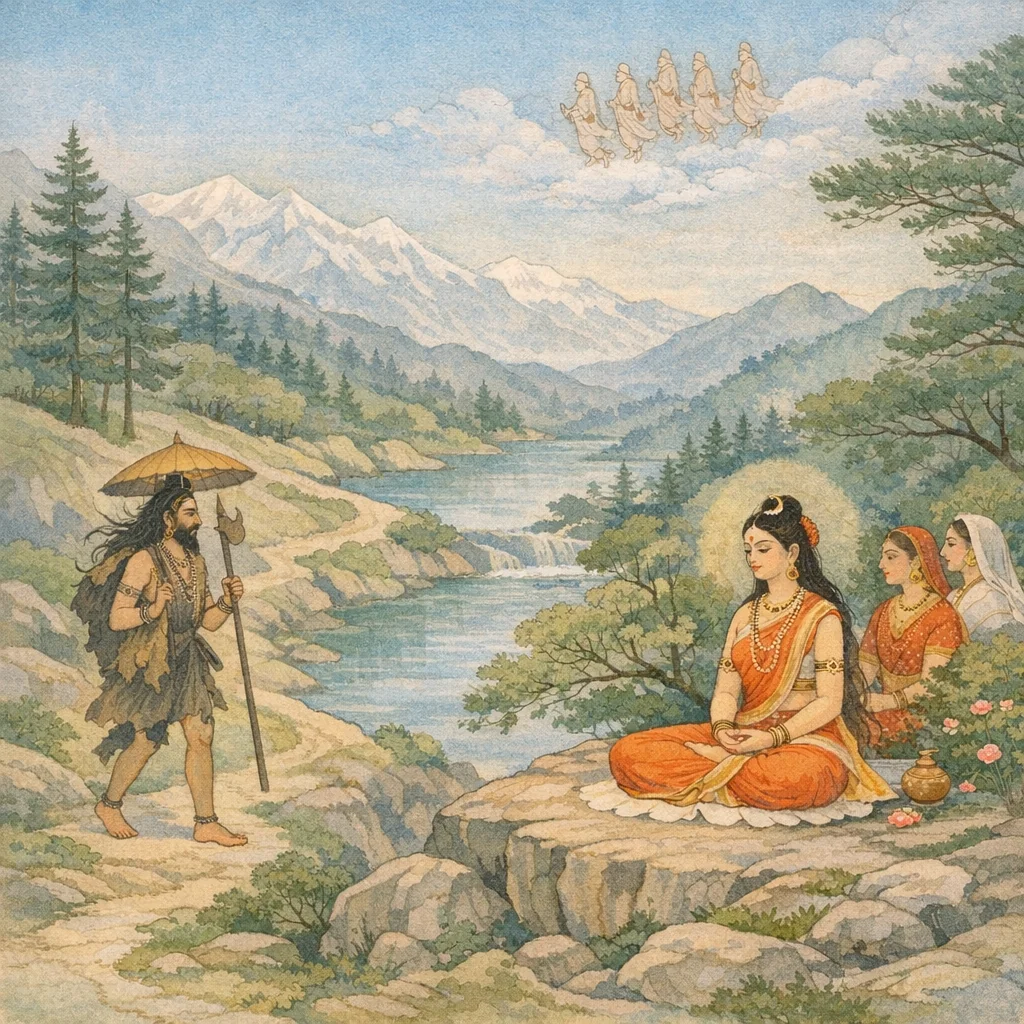
Jaṭilāvatāra-Parīkṣā: Pārvatyāḥ Tapasāṃ Parīkṣaṇam (The Jaṭilā Episode and the Testing of Pārvatī’s Austerity)
This adhyāya presents Nandīśvara’s instruction to Sanatkumāra through a purifying avatāra narrative focused on Śiva’s jaṭila form, the matted-haired ascetic. It recalls Satī’s abandonment of her body at Dakṣa’s sacrifice and her rebirth as Pārvatī, Menā’s daughter linked with Himavat, showing the unbroken intent to unite with Śaṅkara. Pārvatī performs intense tapas in the forest with her companions, seeking Śiva as husband. Śiva, adept in many līlās, sends the Saptarṣis to test the genuineness and steadiness of her austerity; they cannot shake her resolve and return to report. After they depart, Śiva decides to examine her directly, first appearing as a radiant brahmacārī/aged brāhmaṇa bearing staff and umbrella, then assuming the jaṭila form and going to Girijā’s grove. The inner teaching is that divine “tests” reveal niṣṭhā, purify intention, and ripen ascetic heat into readiness for grace and union.
Shlokas
Verse 1
नन्दीश्वर उवाच । सनत्कुमार सुप्रीत्या शिवस्य परमात्मनः । अवतारं शृणु विभोर्जटिलाह्वं सुपावनम्
Nandīśvara said: “O Sanatkumāra, with deep joy in Śiva, the Supreme Self, I shall speak. Hear, O mighty one, the supremely purifying descent (avatāra) of that all-pervading Lord known as ‘Jaṭila’—the matted-haired form.”
Verse 2
नवे वयसि सद्भोगसाधने सुखकारणे । महोपचारसद्भोगैर्वृथैव त्वं तपस्यसि
In the freshness of youth—suited to refined enjoyments and the pursuit of worldly pleasures that bring comfort—you instead perform austerities in vain, even amid abundant luxuries and elaborate delights.
Verse 4
सा गत्वा गहनेऽरण्ये तेपे सुवि मलं तपः । शंकरम्पतिमिच्छन्ती सखीभ्यां संयुता शिवा । तत्तपःसुपरीक्षार्थं सप्तर्षीन्प्रैषयच्छिवः । तपःस्थानं तु पार्वत्या नानालीलाविशारदः
She went into a dense forest and performed austerity of surpassing purity, longing for Śaṅkara as her husband. That auspicious Lady, Śivā, accompanied by her two companions, undertook this penance. To test the true worth of her tapas, Lord Śiva—skilled in many divine līlās—sent the Seven Ṛṣis to the place where Pārvatī was practicing austerity.
Verse 5
ते गत्वा तत्र मुनयः परीक्षां चक्रुरादरात् । तस्याः सुयत्नतो नैव समर्था ह्यभवंश्च ते
Having gone there, the sages conducted their examination with reverent care; yet, even with great effort, they could not fathom her true state.
Verse 6
तत्रागत्य शिवं नत्वा वृत्तान्तं च निवेद्य तत् । तदाज्ञां समनुप्राप्य स्वर्लोकं जग्मुरादरात्
Arriving there, they bowed to Lord Śiva and reported the entire account. Having duly received His command, they departed with reverence for Svarga, the celestial realm.
Verse 7
गतेषु मुनिषु स्वस्थानं शंकरः स्वयम् । परीक्षितुं शिवावृत्तमैच्छत्सूतिकरः प्रभुः
When the sages had departed for their own abodes, Śaṅkara Himself—the sovereign Lord who brings forth the worlds—desired to examine the conduct and sacred observances of the Śiva-vrata, the vow of Śiva.
Verse 8
सुप्रसन्नस्तपस्वीच्छाशमनादयमीश्वरः । ब्रह्मचर्य्यस्वरूपोऽभूत्तदाद्भुततरः प्रभुः
To pacify the desire of the ascetics, this Lord—exceedingly gracious—then assumed the very form of brahmacarya, perfect celibate discipline. In that moment, the Sovereign became even more wondrous.
Verse 9
अतीव स्थविरो विप्रदेहधारी स्वतेजसा । प्रज्वलन्मनसा हृष्टो दण्डी छत्री महोज्जलः
He appeared exceedingly aged, bearing the form of a brahmin; by His own innate splendor He shone forth. With a mind blazing in spiritual power, He was joyful—holding a staff and a parasol, brilliantly radiant.
Verse 10
धृत्वैवं जटिलं रूपं जगाम गिरिजावनम् । अतिप्रीतियुतः शम्भुश्शङ्करो भक्तवत्सलः
Assuming such a matted-haired ascetic form, Śambhu—Śaṅkara, ever tender toward His devotees—went to the forest of Girijā, filled with overflowing delight.
Verse 11
तत्रापश्यस्त्थितान्देवीं सखीभिः परिवारिताम् । वेदिकोपरि शुद्धान्तां शिवामिव विधोः कलाम्
There he beheld the Goddess standing, surrounded by her companions—pure and radiant upon the altar-platform—appearing like Śivā herself, like a spotless digit of the Moon.
Verse 12
शंभुर्निरीक्ष्य तान्देवीं ब्रह्मचारिस्वरूपवान् । उपकण्ठं ययौ प्रीत्या चोत्सुकी भक्तवत्सलः
Śambhu, having gazed upon the Goddess, assumed the form of a celibate ascetic who keeps brahmacarya. In loving joy, eager at heart, he—the tender guardian of devotees—drew close to her.
Verse 13
आगतं सा तदा दृष्ट्वा ब्राह्मणं तेजसाद्भुतम् । अंगेषु लोमशं शान्तं दण्डचर्मसमन्वितम्
Then she saw a brāhmaṇa arrive, wondrous in radiance—his limbs covered with hair, his demeanor calm, bearing a staff and a deerskin.
Verse 14
ब्रह्मचर्य्यधरं वृद्धं जटिलं सकमण्डलुम् । अपूजयत्परप्रीत्या सर्वपूजोपहारकैः
With deep reverence, she worshipped the aged ascetic—steadfast in brahmacarya, with matted locks and a kamaṇḍalu (water-pot)—offering every customary article of honor and worship.
Verse 15
ततस्ता पार्वतीदेवी पूजितं परया मुदा । कुशलं पर्यपृच्छत्तं ब्रह्मचारिणमादरात्
Then Goddess Pārvatī, having worshipped him with supreme joy and due reverence, courteously inquired after the well-being of that brahmacārin.
Verse 16
ब्रह्मचारिस्वरूपेण कस्त्वं हि कुत आगतः । इद्ं वनं भासयसि वद वेदविदां वर
Assuming the form of a celibate ascetic, who indeed are you, and from where have you come? You illumine this forest—tell me, O best among the knowers of the Vedas.
Verse 17
नन्दीश्वर उवाच । इति पृष्टस्तु पार्वत्या ब्रह्मचारी स वै द्विजः । प्रत्युवाच द्रुतम्प्रीत्या शिवाभावपरीक्षया
Nandīśvara said: Thus questioned by Pārvatī, that brahmacārin—indeed a learned twice-born—promptly replied with joy, for he was testing her steadfast devotion and understanding of Śiva’s true nature.
Verse 18
ब्रह्मचार्य्युवाच । अहमिच्छाभिगामी च ब्रह्मचारी द्विजोस्मि वै । तपस्वी सुखदोऽन्येषामुपकारी न संशयः
The brahmacārin said: “I move by my own will. I am indeed a celibate student, a twice-born. I am an ascetic, a giver of happiness to others, and a benefactor—of this there is no doubt.”
Verse 19
नन्दीश्वर उवाच । इत्युक्त्वा ब्रह्मचारी स शंकरो भक्तवत्सलः । तस्थिवानुपकण्ठं स गोपायन्रूपमात्मनः
Nandīśvara said: Having spoken thus, that brahmacārī Śaṅkara—ever tender toward His devotees—stood nearby, carefully maintaining His own assumed form (as a protector).
Verse 20
ब्रह्मचार्य्युवाच । किम्ब्रवीमि महादेवि कथनीयन्न विद्यते । महानर्थकरं वृत्तं दृश्यते विकृतं महत्
The Brahmacārin said: “O Mahādevī, what can I say? There is nothing here that ought to be spoken. A grievously perverse course of events is seen—one that brings great calamity.”
Verse 22
का त्वं कस्यासि तनया किमर्थं विजने वने । तपश्चरसि दुर्धर्षं मुनिभिः प्रयतात्मभिः
“Who are you? Whose daughter are you? For what purpose do you undertake such formidable tapas here in this lonely forest—an austerity so hard that even self-restrained sages find it difficult to accomplish?”
Verse 23
नन्दीश्वर उवाच । इति तद्वचनं श्रुत्वा प्रहस्य परमेश्वरी । उवाच वचनं प्रीत्या ब्रह्मचारिणमुत्तमम्
Nandīśvara said: Having heard his words, the Supreme Goddess (Pārvatī) smiled; and with affectionate joy she spoke to that excellent brahmacārin, the noble ascetic.
Verse 24
पार्वत्युवाच । शृणु विप्र ब्रह्मचारिन्मदवृत्तमखिलं मुने । जन्म मे भारते वर्षे साम्प्रतं हिमवद्गृहे
Pārvatī said: “Listen, O brahmin sage and brahmacārin; hear from me my whole account, O muni. My birth took place in Bhārata-varṣa, and now I dwell in the house of Himavān.”
Verse 25
पूर्वं दक्षगृहे जन्म सती शङ्करकामिनी । योगेन त्यक्तदेहाहं तातेन पतिनिन्दिना
“Formerly I was born in Dakṣa’s house as Satī, the beloved who yearned for Śaṅkara. By the power of yoga I abandoned that body, because my father reviled my Lord and husband.”
Verse 26
अत्र जन्मनि संप्राप्य सुपुण्येन शिवो द्विज । मां त्यक्त्वा भस्मसात्कृत्वा मन्मथं स जगाम ह
“O twice-born one, in this very life, through great merit, I attained Śiva; yet he left me, and having reduced Manmatha (Kāma) to ashes, he went on his way.”
Verse 27
प्रयाते शङ्करे तापाद्व्रीडिताहं पितुर्गृहात् । आगच्छमत्र तपसे गुरुवाक्येन संयता
When Śaṅkara had departed, I—burning with sorrow and overcome with shame—left my father’s house. Restrained by my teacher’s command, I came here to undertake austerities (tapas).
Verse 28
मनसा वचसा साक्षात्कर्मणा पतिभावतः । सत्यम्ब्रवीमि नोऽसत्यं संवृतः शङ्करो मया
With my mind, with my words, and with my deeds—directly, and with the devoted attitude of a faithful spouse (patibhāva)—I speak the truth and not falsehood: Śaṅkara, Lord Śiva, has been wholly embraced and held close by me.
Verse 29
जानामि दुर्लभं वस्तु कथम्प्राप्यं मया भवेत् । तथापि मनसौत्सुक्यात्तप्यते मे तपोऽधुना
I know this attainment is exceedingly rare, and I wonder how it could ever be gained by me. Yet, because my mind is filled with yearning, my tapas—my austerity—burns within me even now.
Verse 30
हित्वेन्द्रप्रमुखान्देवान्विष्णुम्ब्रह्माणमप्यहम् । पतिम्पिनाकपाणिं वै प्राप्तुमिच्छामि सत्यतः
Casting aside even Indra and the other gods—and even Viṣṇu and Brahmā—I truly desire to attain Pati, the Lord who bears the Pināka bow.
Verse 31
नन्दीश्वर उवाच । इत्येवं वचनं श्रुत्वा पार्वत्या हि सुनिश्चितम् । मुने स जटिलो रुद्रो विहसन्वाक्यमब्रवीत्
Nandīśvara said: “O sage, having thus heard Pārvatī’s firmly resolved words, that matted-haired Rudra smiled and then spoke.”
Verse 32
जटिल उवाच । हिमाचलसुते देवि का बुद्धिः स्वीकृता त्वया । रुद्रार्थं विबुधान्हित्वा करोषि विपुलन्तपः
Jaṭila said: “O Goddess, daughter of Himācala, what resolve have you adopted? For the sake of Rudra, abandoning the company of the gods, you undertake immense austerity.”
Verse 33
जानाम्यहं च तं रुद्रं शृणु त्वम्प्रवदामि ते । वृषध्वजस्स रुद्रो हि विकृतात्मा जटाधरः
I know that Rudra; listen, and I shall declare Him to you. He is indeed Rudra, bearing the bull as His emblem—of wondrous, transcendent nature—and He is the matted-haired Lord.
Verse 34
एकाकी च सदा नित्यं विरागी च विशेषतः । तस्मात्त्वं तेन रुद्रेण मनो योक्तुं न चार्हसि
He (Rudra) is ever solitary, eternally self-abiding, and, above all, completely dispassionate. Therefore, you are not fit to bind your mind to that Rudra as an object of worldly attachment.
Verse 35
सर्वं विरुद्धं रूपादि तव देवि हरस्य च । मह्यं न रोचते ह्येतद्यदीच्छसि तथा कुरु
O Goddess, everything—beginning with outward form—between you and Hara seems opposed and mismatched. This does not please me at all; yet, if this is what you truly desire, then act accordingly.
Verse 36
नन्दीश्वर उवाच । इत्युक्त्वा च पुना रुद्रो ब्रह्मचारिस्वरूपवान् । निनिन्द बहुधात्मानं तदग्रे तां परीक्षितुम्
Nandīśvara said: Having spoken thus, Rudra—assuming the form of a brahmacārin—again censured himself in many ways before her, in order to test her.
Verse 37
तच्छ्रुत्वा पार्वती देवी विप्रवाक्यं दुरासदम् । प्रत्युवाच महाक्रुद्धा शिवनिन्दापरं च तम्
Hearing those harsh and unbearable words spoken by the brāhmaṇa, the Goddess Pārvatī, greatly enraged, replied to him, for he was intent on reviling Śiva.
Verse 38
एतावद्धि मया ज्ञातं कश्चिद्धन्यो भविष्यति । परन्तु सकलं ज्ञातमवध्यो दृश्यतेऽधुना
“This much alone have I understood: surely someone blessed by grace will arise. Yet now it seems the whole truth has been comprehended, and the Invincible One is seen clearly at present.”
Verse 39
ब्रह्मचारिस्वरूपेण कश्चित्त्वं धूर्त आगतः । शिवनिन्दा कृता मूढ त्वया मन्युरभून्मम
O deceitful one—having come here in the guise of a brahmacārin, you have, in your delusion, spoken in contempt of Śiva. Because of you, anger has arisen in me.
Verse 40
शिवं त्वं च न जानासि शिवात्त्वं हि बहिर्मुखः । त्वत्पूजा च कृता यन्मे तस्मात्तापयुताऽभवम्
You do not truly know Śiva, for you have turned your face away from Śiva. Yet since you once worshipped me, for that reason I became burdened with suffering, bearing the pain of austerity.
Verse 41
शिवनिन्दां करोतीह तत्त्वमज्ञाय यः पुमान् । आजन्मसंचितं पुण्यं तस्य भस्मीभवत्युत
Whoever, not understanding the true principle (tattva) of Śiva, reviles Him in this world—indeed, all the merit accumulated since birth is reduced to ashes.
Verse 42
शिवविद्वेषिणं स्पृष्ट्वा प्रायश्चित्तं समाचरेत्
Having touched one who harbors hatred toward Śiva, one should duly perform prāyaścitta—an expiatory rite—for purification.
Verse 43
रे रे दुष्ट त्वया प्रोक्तमहं जानामि शंकरम् । निश्चयेन न विज्ञातः शिव एव परः प्रभुः
“Hey, wicked one! You claim, ‘I know Śaṅkara.’ But surely you have not truly understood that Śiva alone is the Supreme Lord.”
Verse 44
यथा तथा भवेद्रुद्रो मायया बहुरूपवान् । ममाभीष्टप्रदोऽत्यन्तं निर्विकारः सताम्प्रियः
Rudra becomes “this” or “that,” assuming countless forms through His māyā. Yet He is ever the giver of my cherished boons—utterly changeless and beloved of the righteous.
Verse 45
नन्दीश्वर उवाच । इत्युक्त्वा तं शिवा देवी शिवतत्त्वं जगाद सा । यत्र ब्रह्मतया रुद्रः कथ्यते निर्गुणोऽव्ययः
Nandīśvara said: Having thus spoken to him, the Goddess Śivā expounded the principle of Śiva—where Rudra is taught as Brahman itself, attributeless (nirguṇa) and imperishable (avyaya).
Verse 46
तदाकर्ण्य वचो देव्या ब्रह्मचारी स वै द्विजः । पुनर्वचनमादातुं यावदेव प्रचक्रमे
Hearing the Goddess’s words, that brahmacārī—indeed the twice-born one—at once set about to speak again, preparing to reply.
Verse 47
प्रोवाच गिरिजा तावत्स्वसखीं विजयान्द्रुतम् । शिवासक्तमनोवृत्तिः शिवनिन्दापराङ्मुखी
Then Girijā (Pārvatī) quickly spoke to her own friend Vijayā—her mind wholly absorbed in Śiva, and turning away from any disparagement of Śiva.
Verse 48
गिरिजोवाच । वारणीयः प्रयत्नेन सख्ययं हि द्विजाधमः । पुनर्वक्तुमनाश्चायं शिवनिन्दां करिष्यति
Girījā (Pārvatī) said: “With every effort, restrain this vile brāhmaṇa, for he is bent on mischief. He longs to speak again and will slander Śiva.”
Verse 49
न केवलं भवेत्पापं निन्दाकर्तुः शिवस्य हि । यो वै शृणोति तन्निन्दां पापभाक्स भवेदिह
Indeed, sin does not belong only to the one who reviles Śiva; whoever merely listens to that reviling becomes a sharer of that sin in this very life.
Verse 50
शिवनिन्दाकरो वध्यस्सर्वथा शिवकिंकरैः । ब्राह्मणश्चेत्स वै त्याज्यो गन्तव्यं तत्स्थलाद्द्रुतम्
One who reviles Lord Śiva is, in every way, fit to be punished by Śiva’s attendants. Even if such a person is a brāhmaṇa, he must be shunned, and one should quickly depart from that place.
Verse 51
अयन्दुष्टः पुनर्निंदां करिष्यति शिवस्य हि । ब्राह्मणत्वादवध्यश्च त्याज्योऽदृश्यश्च सर्वथा
“This wicked man will indeed again commit blasphemy of Śiva. Yet, because he is a brāhmaṇa, he is not to be slain; rather, he must be completely renounced and kept out of sight in every way.”
Verse 53
नन्दीश्वर उवाच । इत्युक्त्वा चोमया यावत्पदमुत्क्षिप्यते मुने । असौ तावच्छिवः साक्षादाललम्बे पटं स्वयम्
Nandīśvara said: “O sage, as soon as Umā had spoken thus and was just lifting her foot, at that very moment Śiva Himself directly caught hold of the cloth with His own hand.”
Verse 54
कृत्वा स्वरूपं दिव्यं च शिवाध्यानं यथा तथा । दर्शयित्वा शिवायै तामुवाचावाङ्मुखी शिवः
Having assumed a divine form and demonstrated the proper method of meditating upon Śiva, Lord Śiva—his face turned downward in inward absorption—showed it to Devī (Śivā) and then spoke to her.
Verse 55
शिव उवाच । कुत्र त्वं यासि मां हित्वा न त्वन्त्याज्या मया शिवे । मया परीक्षितासि त्वं दृढभक्तासि मेऽनघे
Śiva said: “Where are you going, leaving Me behind, O auspicious one? You are not to be abandoned by Me. I have tested you, O sinless one; you are steadfast in devotion to Me.”
Verse 56
ब्रह्मचारिस्वरूपेण भावमिच्छुस्त्वदीयकम् । तवोपकण्ठमागत्य प्रावोचं विविधं वचः
Desiring to draw forth the inner intention that was in you, I assumed the form of a brahmacārin. Then, coming close to you, I spoke to you in many ways—varied words meant to test and reveal your resolve.
Verse 57
प्रसन्नोस्मि दृढं भक्त्या शिवे तव विशेषतः । चित्तेप्सितं वरं ब्रूहि नादेयं विद्यते तव
I am truly pleased—especially with your steadfast devotion to Śiva. Speak the boon your heart desires; for you, there is nothing that cannot be granted.
Verse 58
अद्यप्रभृति ते दासस्तपोभिः प्रेमनिर्भरे । कृतोऽस्मि तव सौन्दर्य्यात्क्षण एको युगायते
From this day onward I have become Your servant; my austerities now overflow with love. By the beauty of Your divine form, even a single moment feels to me like an age (a yuga).
Verse 59
त्यज्यतां च त्वया लज्जा मम पत्नी सनातनी । एहि प्रिये त्वया साकं द्रुतं यामि स्वकं गिरिम्
“Set aside your shyness, O my eternal consort. Come, beloved; together with you I shall go swiftly to my own mountain abode.”
Verse 60
इत्युक्तवति देवेशे शिवाति मुदमाप सा । तपोदुःखन्तु यत्सर्वं तज्जहौ द्रुतमेव हि
When the Lord of the gods, Śiva, had spoken thus, she became supremely joyful. Indeed, all the distress that had arisen from her austerities was cast off at once.
Verse 61
ततः प्रहृष्टा सा दृष्ट्वा दिव्यरूपं शिवस्य तत् । प्रत्युवाच प्रभुं प्रीत्या लज्जयाधो मुखी शिवा
Then she—Śivā (Pārvatī)—rejoiced on beholding that divine form of Lord Śiva. With loving delight, yet with modesty and her face lowered, she replied to the Lord.
Verse 62
शिवोवाच । यदि प्रसन्नो देवेश करोषि च कृपां मयि । पतिर्मे भव देवेश इत्युक्तश्शिवया शिवः
She said: “O Lord of the gods, if You are pleased and show compassion toward me, then, O Lord of the gods, be my husband.” Thus spoke Śivā (the Goddess) to Śiva.
Verse 63
गृहीत्वा विधिवत्पाणिं कैलासं स तया ययौ । पतिं तं गिरिजा प्राप्य देवकार्यं चकार सा
Having duly taken her hand in the prescribed rite, he went with her to Kailāsa. Girijā, having attained him as her Lord, then carried out the work of the gods.
Verse 64
इति प्रोक्तस्तु ते तात ब्रह्मचारि स्वरूपकः । शिवावतारो हि मया शिवाभावपरीक्षकः
“Thus, dear child, I have told you about that form—the Brahmacārī, the celibate ascetic. He is indeed an incarnation of Śiva, assumed by me to test the presence of true Śiva-bhāva (devotion and inner orientation to Śiva).”
Verse 65
इदमाख्यानमनघं परमं व्याहृतं मया । य एतच्छृणुयात्प्रीत्या सुखी गतिमाप्नुयात्
This flawless, supreme sacred account has been proclaimed by me. Whoever listens to it with loving devotion (bhakti) attains happiness and reaches the highest state—moksha, liberation.
Verse 92
स्थलमेतद्द्रुतं हित्वा यास्यामोऽन्यत्र मा चिरम् । यथा संभाषणं न स्यादनेनाविदुषा पुनः
“Leave this place at once; let us go elsewhere without delay, so that we may not have to speak again with this ignorant person.”
Frequently Asked Questions
The chapter narrates Pārvatī’s austerities undertaken to attain Śiva, the dispatch of the Saptarṣis to test her resolve, their failure to disturb her, and Śiva’s subsequent decision to test her directly by adopting an ascetic/brahmacārī and jaṭila disguise.
The ‘test’ functions as a ritualized epistemology of readiness: it externalizes inner firmness, purifies motivation, and demonstrates that true tapas is not performative but unwavering under scrutiny—thereby converting ascetic effort into a mature receptivity to grace (anugraha).
Śiva is highlighted in an ascetic register—brahmacārī/aged-brāhmaṇa-like examiner and jaṭila (matted-hair) form—while Gaurī appears as Pārvatī/Girijā/Śivā, the reborn Satī, characterized by steadfast tapas aimed at marital-spiritual union with Śaṅkara.