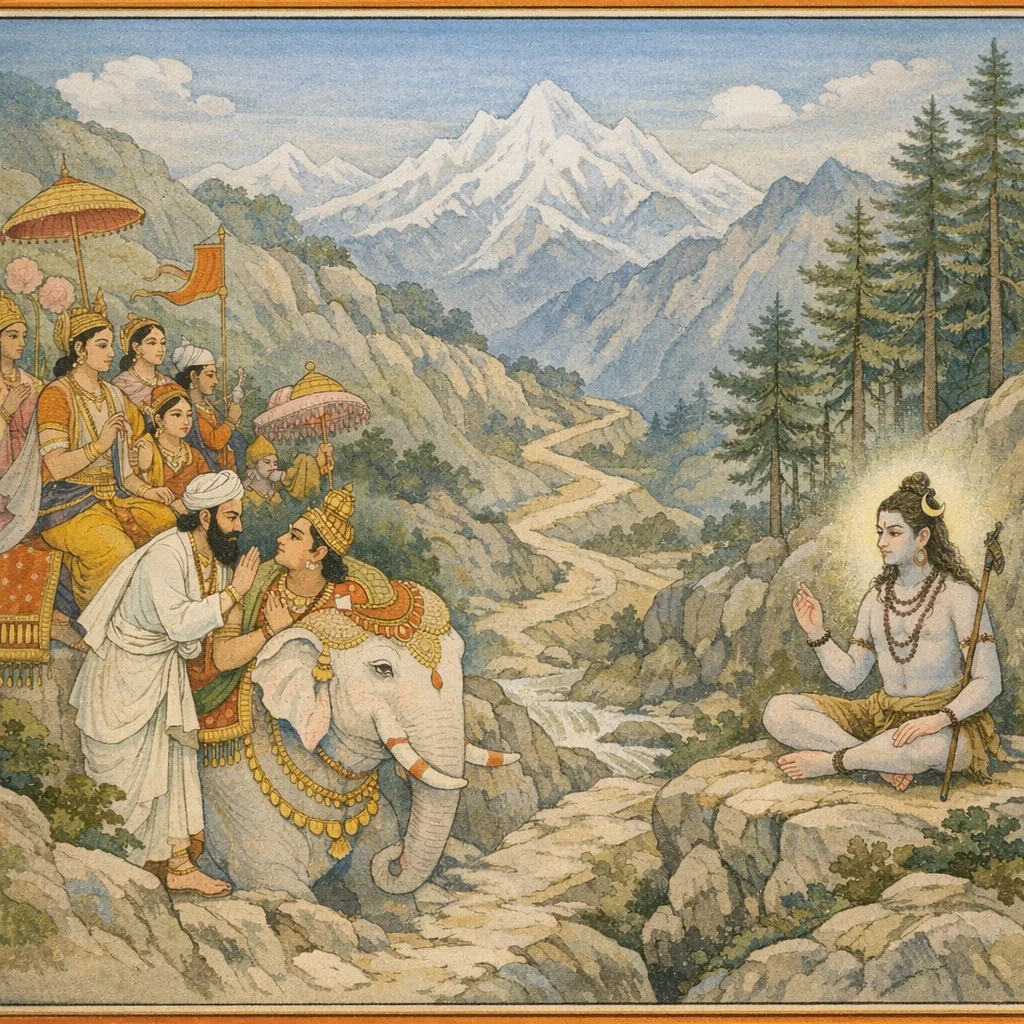
अवधूतेश्वरलीला (Avadhūteśvara-līlā) — Śiva Tests Indra’s Pride on the Way to Kailāsa
Nandīśvara recounts an episode in which Indra (Śakra), accompanied by his guru and an assembly of gods, approaches Kailāsa seeking Śiva’s darśana. Śaṅkara, perceiving their arrival and wishing to test the inner motive of their pilgrimage, assumes an avadhūta form—a fearsome digambara ascetic, blazing with awe-inspiring radiance—and stands directly in the path, blocking passage. The simple devotional journey thus becomes a trial of entitlement and discernment. Indra, speaking from authority and pride, questions the ascetic about his identity and origin and whether Śiva is present or has gone elsewhere, failing to recognize that the very obstacle is Śiva’s own līlā made manifest. The esoteric teaching is that access to the Divine is not bargained through rank, but granted through humility, recognition of the sacred in unexpected forms, and the dissolution of ego that mistakes office for spiritual worth.
Shlokas
Verse 1
नन्दीश्वर उवाच । शृणु त्वं ब्रह्मपुत्राद्यावतारं परमेशितुः । अवधूतेश्वराह्वं वै शक्रगर्वापहारकम्
Nandīśvara said: “Listen now to the incarnation of the Supreme Lord, beginning with the account told for Brahmā’s son. It is indeed called ‘Avadhūteśvara’, the form that removes the pride of Śakra (Indra).”
Verse 2
शक्रः पुरा हि सगुरुः सर्वदेवसमन्वितः । दर्शनं कर्तुमीशस्य कैलासमगमन्मुने
O sage, in former times Śakra (Indra), accompanied by his preceptor and attended by all the gods, went to Kailāsa in order to obtain the auspicious vision (darśana) of the Lord (Īśa, Śiva).
Verse 3
अथ गुर्विन्द्रयोर्ज्ञात्वागमनं शंकरस्तयोः । परीक्षितुं च तद्भावं स्वदर्शनरतात्मनोः
Then Śaṅkara, learning that the Guru and Indra were drawing near, went forth to meet them—wishing to test the inner disposition of those two whose minds were absorbed in the bliss of beholding Him.
Verse 4
अवधूतस्वरूपोऽभून्नानालीलाकरः प्रभुः । दिगंबरो महाभीमो ज्वलदग्निसमप्रभः
The Lord assumed the form of the Avadhūta—supremely detached—yet He, the sovereign, displayed manifold divine sports. Sky-clad and exceedingly awe-inspiring, He shone with a radiance like blazing fire.
Verse 5
सोऽवधूतस्वरूपो हि मार्गमारुद्ध्य सद्गतिः । लंबमानपटः शंभुरतिष्ठच्छोभिताकृतिः
Assuming the form of an avadhūta ascetic, Śambhu blocked the way; He Himself is the truly auspicious refuge. With garments hanging loosely, Śiva stood there—His very form radiant and resplendent.
Verse 6
अथ तौ गुरुशक्रौ च गच्छन्तौ शिव सन्निधिम् । अद्राष्टांपुरुषं भीमं मार्गमध्येऽद्भुताकृतिम्
Then the Guru and Śakra, while proceeding toward the holy presence of Śiva, beheld on the way a fearsome man of wondrous, extraordinary form standing in the middle of the path.
Verse 7
अथ शक्रो मुनेऽपृच्छत्स्वाधिकारेण दुर्मदः । पुरुषं तं स्वमार्गान्तः स्थितमज्ञाय शंकरम्
Then Śakra (Indra), intoxicated with pride in his own authority, questioned the sage, not recognizing that the Person standing at the end of his very path was Śaṅkara (Lord Śiva).
Verse 8
शक्र उवाच । कस्त्वं दिगंबराकारावधूतः कुत आगतः । किन्नाम तव विख्यातं तत्त्वतो वद मेऽचिरम्
Śakra (Indra) said: “Who are you—an avadhūta in the guise of a Digambara, sky-clad? From where have you come? What is your famed name? Tell me the truth of it without delay.”
Verse 9
स्वस्थाने संस्थितः शंभुः किम्वान्यत्र गतोऽधुना । दर्शनार्थं हि तस्याहं गच्छामि सगुरुस्सुरैः
Is Śambhu now established in His own abode, or has He gone elsewhere? For the very sake of beholding Him, I am setting forth—together with my preceptor and the devas.
Verse 10
नन्दीश्वर उवाच । शक्रेणेत्थं स पृष्टश्च किंचिन्नोवाच पूरुषः । लीलागृहीतदेहस्स शङ्करो मदहा प्रभुः
Nandīśvara said: Thus questioned by Śakra (Indra), that Person did not speak at all. He was Lord Śaṅkara, the sovereign who destroys pride, who had assumed a body only as līlā—divine play.
Verse 11
शक्रः पुनरपृच्छत्तं नोवाच स दिगंबरः । अविज्ञातगतिश्शम्भुर्महाकौतुककारकः
Indra questioned Him again, but that Digambara did not reply. Śambhu—whose ways are beyond ordinary knowing—meant to bring forth a great wonder, showing that the Lord’s movement and purpose cannot be measured by a limited mind.
Verse 12
पुनः पुरन्दरोऽपृच्छ्त्त्रैलोक्याधिपतिस्स्वराट् । तूष्णीमास महायोगी महालीलाकरस्स वै
Once again Purandara (Indra), the sovereign lord of the three worlds, questioned him; but that Great Yogi—Shiva, the very author of mighty divine play—remained silent.
Verse 13
इत्थं पुनः पुनः पृष्टः शक्रेण स दिगम्बरः । नोवाच किंचिद्भगवाञ्शक्रदर्प्पजिघांसया
Thus, though questioned again and again by Śakra (Indra), that sky-clad Lord spoke nothing—intent on subduing and destroying Indra’s pride.
Verse 14
अथ चुक्रोध देवेशस्त्रैलोक्यैश्वर्य्यगर्वितः । उवाच वचनं क्रोधात्तं निर्भर्त्स्य जटाधरम्
Then the Lord of the gods, intoxicated with pride in his sovereignty over the three worlds, became angry. In that fury he spoke harsh words, rebuking the matted-haired ascetic (Śiva).
Verse 15
इन्द्र उवाच । पृच्छमानोऽपि रे मूढ नोत्तरं दत्तवानसि । अतस्त्वां हन्मि वज्रेण कस्ते त्रातास्ति दुर्मते
Indra said: “O fool! Even though I questioned you, you gave no reply. Therefore I shall strike you down with the thunderbolt—who is there to protect you, O wicked-minded one?”
Verse 16
इत्युदीर्य्य ततो वज्री संनिरीक्ष्य क्रुधा हि तम् । हन्तुन्दिगम्बरं वज्रमुद्यतं स चकार ह
Having spoken thus, Indra (the wielder of the thunderbolt) then fixed his gaze upon him in anger, and, intending to strike down the sky-clad ascetic, he raised his thunderbolt to slay him.
Verse 17
वज्रहस्तं च तं दृष्ट्वा शक्रं शीघ्रं सदाशिवः । चकार स्तम्भनं तस्य वज्रपातस्य शंकरः
Seeing Śakra (Indra) with the thunderbolt (vajra) raised in his hand, Sadāśiva acted at once—Śaṅkara arrested that very strike and rendered it powerless.
Verse 18
ततः स पुरुषः कुद्धः करालाक्षो भयंकरः । द्रुतमेव प्रजज्वाल तेजसा प्रदहन्निव
Then that being, enraged—terrible-eyed and awe-inspiring—blazed forth at once, as though scorching everything with the fiery splendor of his radiance.
Verse 19
बाहुप्रतिष्टम्भभुवा मन्युनान्तश्शचीपतिः । समदह्यत भोगीव मंत्ररुद्धपराक्रमः
Hemmed in and immobilized, his arms held fast, Indra—Śacī’s lord—was consumed by the blaze of wrath, like a serpent scorched; his heroic power was bound and restrained by mantra.
Verse 20
दृष्ट्वा वृहस्पतिस्त्वेनम्प्रज्वलन्तं स्वतेजसा । पुरुषं तं धियामास प्रणनाम हरं द्रुतम्
Seeing the Supreme Person—Hara—blazing with His own innate splendor, Bṛhaspati grew inwardly composed in reverent awareness and at once swiftly bowed down to Him.
Verse 21
कृताञ्जलिपुटो भूत्वा ततो गुरुरुदारधीः । दण्डवत्कौ पुनर्नत्वा प्रभुं तुष्टाव भक्तितः
Then the noble-minded Guru, joining his palms in reverence, again bowed down in full daṇḍavat prostration and, with devotion, praised the Lord—the supreme Master.
Verse 22
गुरुरुवाच । देवदेव महादेव शरणागतवत्सल । प्रसन्नो भव गौरीश सर्वेश्वर नमोऽस्तु ते
The Guru said: “O God of gods, O Mahādeva—tender to those who seek refuge in You—be gracious, O Lord of Gaurī, O Supreme Lord of all. Salutations to You.”
Verse 23
मायया मोहितास्सर्वे ब्रह्मविष्ण्वादयोपि ते । त्वां न जानन्ति तत्त्वेन जानन्ति त्वदनुग्रहात्
All of them—even Brahmā, Viṣṇu, and the others—are deluded by Your Māyā. They do not know You in Your true reality; they come to know You only by Your grace.
Verse 24
नन्दीश्वर उवाच । बृहस्पतिरिति स्तुत्वा स तदा शंकरम्प्रभुम् । पादयोः पातयामास तस्येशस्य पुरन्दरम्
Nandīśvara said: Having praised the Lord Śaṅkara, the sovereign Master, with the words “(He is) Bṛhaspati,” Purandara (Indra) then cast himself down at the feet of that Lord, the Supreme Ruler.
Verse 25
ततस्तात सुराचार्य्यः कृताञ्जलिरुदारधीः । बृहस्पतिरुवाचेदं प्रश्रयावनतः सुधीः
Then, O dear one, Bṛhaspati—the revered preceptor of the gods—of noble understanding, with palms joined in reverence and with a humble bow, spoke these words with discerning wisdom.
Verse 26
बृहस्पतिरुवाच । दीननाथ महादेव प्रणतन्तव पादयोः । समुद्धर च मां तत्त्वं क्रोधं न प्रणयं कुरु
Bṛhaspati said: “O Mahādeva, refuge of the helpless, I bow at Your feet. Lift me up and establish me in the truth; do not turn Your wrath toward me.”
Verse 27
तुष्टो भव महादेव पाहीन्द्रं शरणागतम् । वह्निरेष समायाति भालनेत्रसमुद्भवः
“Be gracious, O Mahādeva. Protect Indra, who has come seeking refuge. This fire—born from the Eye upon Your forehead—now advances toward us.”
Verse 28
नन्दीश्वर उवाच । इत्याकर्ण्य गुरोर्वाक्यमवधूताकृतिः प्रभुः । उवाच करुणासिंधुर्विहसन्स सदूतिकृत्
Nandīśvara said: Thus hearing the words of his guru, the Lord—appearing in the guise of an avadhūta—smiled gently. That ocean of compassion then spoke, acting as a benevolent mediator and messenger.
Verse 29
अवधूत उवाच । क्रोधाच्च निस्सृतन्तेजो धारयामि स्वनेत्रतः । कथं हि कंचुकीं सर्पस्संधत्ते चोज्ज्ञितां पुनः
Avadhūta said: “From anger, fiery radiance has burst forth; I restrain it from my own eyes. How could a serpent take up again the slough it has cast off, and put it on once more?”
Verse 30
इति श्रीशिवमहापुराणे तृतीयायां शतरुद्रसंहितायां नन्दी श्वरसनत्कुमारसंवादे अवधूतेश्वरशिवावतारचरित्रवर्णनं नाम त्रिंशोऽध्यायः
Thus, in the Śrī Śiva Mahāpurāṇa, in the Third Book, the Śatarudra Saṃhitā—within the dialogue between Nandīśvara and Sanatkumāra—ends the thirtieth chapter, entitled “The Description of the Life and Deeds of the Śiva-incarnation known as Avadhūteśvara.”
Verse 31
बृहस्पतिरुवाच । हे देव भगवन्भक्ता अनुकम्प्याः सदैव हि । भक्तवत्सलनामेति स्वं सत्यं कुरु शंकर
Bṛhaspati said: “O Deva, O Blessed Lord—your devotees are ever worthy of compassion. Since you are renowned as ‘Bhaktavatsala’, tenderly devoted to your devotees, O Śaṅkara, make your own name (and promise) true.”
Verse 32
क्षेप्तुमन्यत्र देवेश स्वतेजोऽत्युग्रमर्हसि । उद्धर्ता सर्वभक्तानां समुद्धर पुरन्दरम्
O Lord of the gods, it befits you to direct your exceedingly fierce divine radiance elsewhere. You are the deliverer of all devotees—therefore, lift up and save Purandara (Indra).
Verse 33
नन्दीश्वर उवाच । इत्युक्तो गुरुणा रुद्रो भक्तवत्सलनामभाक् । प्रत्युवाच प्रसन्नात्मा सुरेज्यम्प्रणतार्तिहा
Nandīśvara said: Thus addressed by his guru, Rudra—renowned as “the tender guardian of devotees”—replied with a serene heart. He is the One worshipped by the gods, and the remover of the distress of those who bow to him.
Verse 34
रुद्र उवाच । प्रीतस्तेहं सुराचार्य्य ददामि वरमुत्तमम् । इन्द्रस्य जीवदानेन जीवेति त्वं प्रथाम्व्रज
Rudra said: “O preceptor of the gods, I am pleased with you. I grant you the supreme boon. Since you have bestowed life upon Indra, go forth into renown by the name ‘Jīva’ (Life).”
Verse 35
समुद्भूतोऽनलो योयं भालनेत्रात्सुरा सहः । एनन्त्यक्ष्याम्यहं दूरे यथेन्द्रं नैव पीडयेत्
“O gods, this blazing fire has arisen from the eye in the Lord’s forehead. I shall drive it far away, so that it may not afflict Indra at all.”
Verse 36
नन्दीश्वर उवाच । इत्युक्त्वा स करे धृत्वा स्वतेजोऽनलमद्भुतम् । भालनेत्रसमुद्भूतं प्राक्षिपल्लवणाम्भसि
Nandīśvara said: Having spoken thus, he took into his hand that wondrous fiery radiance—his own blazing tejas, born from the (Lord’s) eye upon the forehead—and cast it into the salty waters.
Verse 37
अथो शिवस्य तत्तेजो भालनेत्रसमुद्भवम् । क्षिप्तं च लवणाम्भोधौ सद्यो बालो बभूव ह
Then that blazing divine energy of Lord Śiva—born from the eye upon His forehead—was cast into the salt ocean; and at once it became a child.
Verse 38
स जलन्धरनामाभूत्सिन्धुपुत्रोऽसुरेश्वरः । तं जघान महेशानो देवप्रार्थनया प्रभुः
He became known as Jalandhara, the son of Sindhu, a sovereign lord among the asuras. At the prayer of the devas, the Supreme Lord Maheśāna struck him down.
Verse 39
इत्थं कृत्वा सुचरितं शंकरो लोकशंकरः । अवधूतस्वरूपेण ततश्चान्तर्हितोऽभवत्
Thus, having performed this noble deed, Śaṅkara—the benefactor of the worlds—then, assuming the form of an avadhūta (the detached ascetic), became hidden from view.
Verse 40
बभूवुः सकला देवाः सुखिनश्चातिनिर्भयाः । गुरुशक्रौ भयान्मुक्तौ जग्मतुः सुखमुत्तमम्
Then all the gods became joyful and utterly fearless. And Guru (Bṛhaspati) and Śakra (Indra), freed from fear, attained the highest bliss.
Verse 41
यदर्थे गमनोद्युक्तौ दर्शनं प्राप्य तस्य तौ । कृतार्थौ गुरुशक्रौ हि स्वस्थानं जग्मतुर्मुदा
Having obtained the vision of Him for whose sake they had set out, those two—Bṛhaspati (the Guru of the gods) and Indra—felt their purpose fulfilled, and joyfully returned to their own abode.
Verse 42
अवधूतेश्वराह्वोऽवतारस्ते कथितो मया । परमेशस्य परमानन्ददः खलदण्डदः
Thus I have told you of that incarnation named Avadhūteśvara—an embodiment of the Supreme Lord (Parameśa), bestowing the highest bliss upon the devoted and administering punishment to the wicked.
Verse 43
इदमाख्यानमनघं यशस्यं स्वर्ग्यमेव च । भुक्तिमुक्तिप्रदं दिव्यं सर्वकामफलप्रदम्
This sacred narrative is spotless and fame-bestowing; it leads to heaven as well. It is divine, granting both worldly enjoyment and liberation, and it bestows the fruits of all righteous desires.
Verse 44
य इदं शृणुयान्नित्यं श्रावयेद्वा समाहितः । इह सर्वसुखं भुक्त्वा सोन्ते शिवगतिं लभेत्
Whoever, with a collected mind, continually listens to this sacred teaching—or causes it to be recited for others—enjoys all happiness in this world and, in the end, attains the supreme state of Śiva.
Frequently Asked Questions
The chapter presents Śiva’s Avadhūteśvara-līlā: Indra, arriving for darśana with his guru and the devas, is stopped by a terrifying digambara ascetic who is actually Śiva in disguise. The theological argument is that divine proximity cannot be claimed by celestial rank; it is conditioned by inner disposition.
The avadhūta form signifies radical transcendence of social markers and institutional authority: Śiva appears outside the grammar of prestige so that the seeker’s perception is purified. The ‘obstruction’ on the road functions as a mirror for ego—forcing recognition that the sacred may appear as the marginal, the frightening, or the unclassifiable.
Śiva is highlighted as ‘Avadhūteśvara’—Śaṅkara adopting an avadhūta-like, awe-inspiring digambara embodiment (līlā-gṛhīta-deha) explicitly aimed at removing Śakra’s arrogance (śakra-garva-apahāraka).