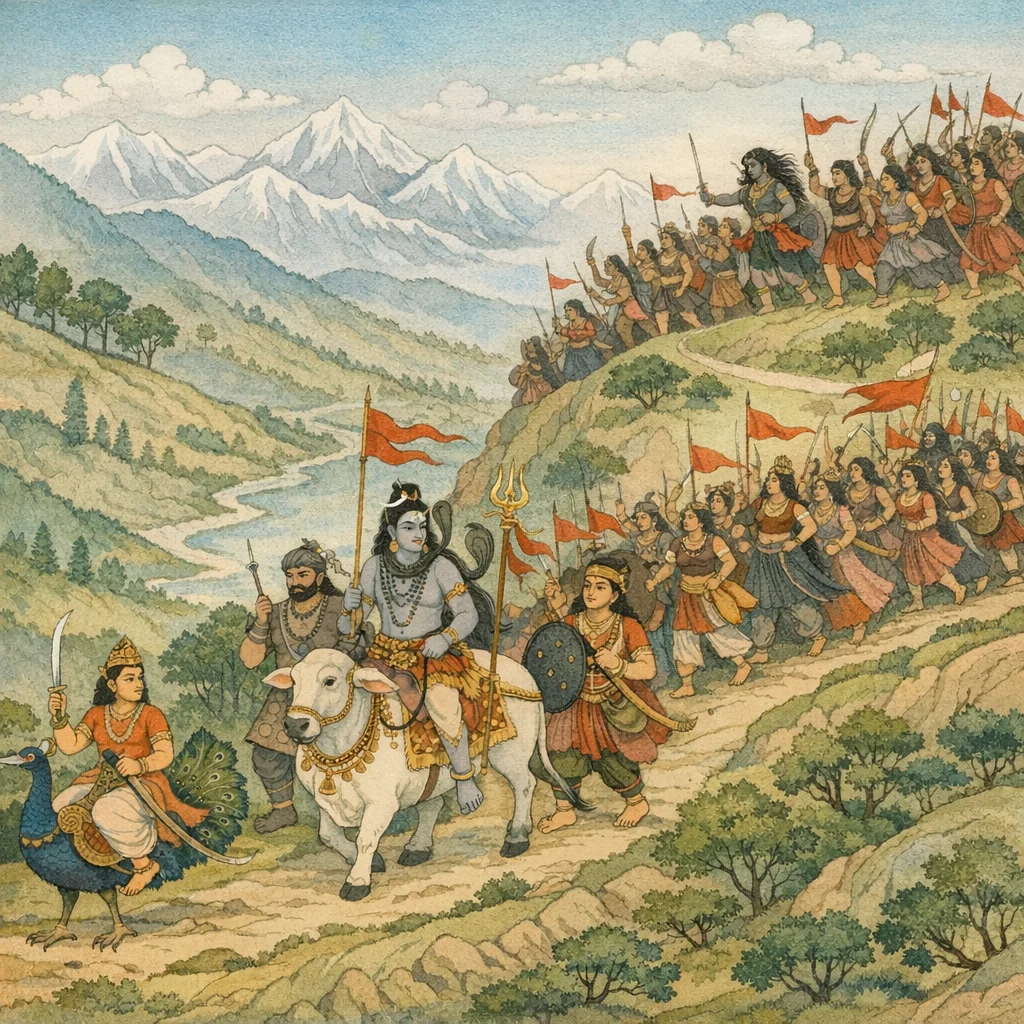
शिवस्य सैन्यप्रयाणम् तथा गणपतिनामावलिः (Śiva’s Mobilization for War and the Catalogue of Gaṇa Commanders)
Adhyāya 33 turns from counsel to immediate military mobilization. Sanatkumāra relates that, on hearing the provocation, Girīśa (Rudra/Śiva) answers with controlled wrath and issues commands to his warrior attendants. Rudra addresses Vīrabhadra, Nandin, Kṣetrapāla, and the Aṣṭabhairavas, ordering all gaṇas to arm themselves and prepare for battle. He sends the two Kumāras (Skanda and Gaṇeśa) forth under his command, directs Bhadrakālī to advance with her own host, and declares his own urgent departure to destroy Śaṅkhacūḍa. The chapter then depicts Maheśāna marching out with the army, followed joyfully by the vīra-gaṇas. A key feature is the formal, enumerative register of gaṇa leaders and notable attendants (such as Vīrabhadra, Nandī, Mahākāla, Viśālākṣa, Bāṇa, Piṅgalākṣa, Vikampana, Virūpa, Vikṛti, Maṇibhadra, and others), establishing a hierarchy of commanders and their troop-counts (koṭi-gaṇas, tens, eights).
Shlokas
Verse 1
सनत्कुमार उवाच । तस्य तद्वाक्यमाकर्ण्य सुरराट् ततः । सक्रोधः प्राह गिरिशो वीरभद्रादिकान्गणान्
Sanatkumāra said: Hearing those words, the Lord of the gods thereupon—Giriśa (Śiva)—with rising wrath, addressed the gaṇas beginning with Vīrabhadra.
Verse 2
रुद्र उवाच । हे वीरभद्र हे नंदिन्क्षेत्रपालष्टभैरवाः । सर्वे गणाश्च सन्नद्धास्सायुधा बलशालिनः
Rudra said: “O Vīrabhadra! O Nandī! O Kṣetrapāla and the Eight Bhairavas! Let all the Gaṇas—fully armed, well-prepared, and endowed with strength—stand ready.”
Verse 3
कुमाराभ्यां सहैवाद्य निर्गच्छंतु ममाज्ञया । स्वसेनया भद्रकाली निर्गच्छतु रणाय च । शंखचूडवधार्थाय निर्गच्छाम्यद्य सत्वरम्
“By my command, let them go out today together with the two Kumāras. Let Bhadrakālī also march to battle with her own army. For the purpose of slaying Śaṅkhacūḍa, I too shall set out today at once.”
Verse 4
सनत्कुमार उवाच । इत्याज्ञाप्य महेशानो निर्ययौ सैन्यसंयुतः । सर्वे वीरगणास्तस्यानु ययुस्संप्रहर्षिताः
Sanatkumāra said: Thus having issued His command, Maheśvara set forth, accompanied by His army; and all the heroic hosts followed after Him, filled with great joy.
Verse 5
एतस्मिन्नंतरे स्कंदगणेशौ सर्वसैन्यपौ । यततुर्मुदितौ नद्धौ सायुधौ च शिवांतिके
Meanwhile, Skanda and Gaṇeśa—both commanders of the entire host—joyfully made ready, fully armoured and bearing weapons, and took their stand near Lord Śiva.
Verse 6
वीरभद्रश्च नन्दी च महाकालस्सुभद्रकः । विशालाक्षश्च बाणश्च पिंगलाक्षो विकंपनः
Vīrabhadra and Nandī; Mahākāla and Subhadraka; Viśālākṣa and Bāṇa; Piṅgalākṣa and Vikaṃpana—these were among the mighty gaṇas, the attendants of Lord Śiva, named in that host.
Verse 7
विरूपो विकृतिश्चैव मणिभद्रश्च बाष्कलः । कपिलाख्यो दीर्घदंष्द्रो विकरस्ताम्रलोचनः
“(Among Śiva’s attendants were) Virūpa, Vikṛti, Maṇibhadra and Bāṣkala; also Kapila, Dīrgha-daṃṣṭra (the long-fanged one), Vikara, and Tāmra-locana (the copper-eyed one).”
Verse 8
कालंकरो बलीभद्रः कालजिह्वः कुटीचरः । बलोन्मत्तो रणश्लाघ्यो दुर्जयो दुर्गमस्तथा
‘Kālaṅkara, Balībhadra, Kāla-jihva, and Kuṭīcara; Balonmatta—proud with strength; Raṇaślāghya—renowned in battle; Durjaya—hard to conquer; and Durgama—difficult to approach as well.’
Verse 9
इत्यादयो गणेशानास्सैन्यानां पतयो वराः । तेषां च गणनां वच्मि सावधानतया शृणु
Thus, and in other ways, these are the excellent Gaṇeśas—the lords and commanders of the armies. Now I shall recount their enumeration; listen with careful attention.
Verse 10
शंखकर्णः कोटिगणैर्युतः परविमर्दकः । दशभिः केकराक्षश्च विकृतोऽष्टाभिरेव च
Śaṅkhakarṇa, attended by crores of gaṇas, a crusher of the enemy host; and Kekarākṣa with ten companies, and Vikṛta likewise with eight companies—thus these commanders advanced in the battle.
Verse 11
चतुष्षष्ट्या विशाखश्च नवभिः पारियात्रिकः । षड्भिस्सर्वान्तकः श्रीमांस्त थैव विकृताननः
Viśākha stood with sixty-four attendants; Pāriyātrika with nine; the illustrious Sarvāntaka with six; and likewise Vikṛtānana—thus were Śiva’s gaṇas arrayed for battle.
Verse 12
जालको हि द्वादशभिः कोटिभिर्गणपुंगवः । सप्तभिस्समदः श्रीमान्दुन्दुभोऽष्टाभिरेव च
Jālaka, a foremost leader among the Gaṇas, was accompanied by twelve koṭis. The illustrious Samada was with seven koṭis, and Dundubha likewise with eight koṭis.
Verse 13
पंचभिश्च करालाक्षः षड्भिस्संदारको वरः । कोटिकोटिभिरेवेह कंदुकः कुंडकस्तथा
Karālākṣa, the fierce-eyed one, advanced here with five hosts. The excellent Saṃdāraka came with six. And Kaṃduka—along with Kuṇḍaka as well—came here with hosts numbering crores upon crores.
Verse 14
विष्टंभोऽष्टाभिरेवेह गणपस्सर्वस त्तमः । पिप्पलश्च सहस्रेण संनादश्च तथाविधः
Here, the foremost Gaṇapa named Viṣṭambha stood supported by eight attendants. Pippala stood with a thousand, and Saṃnāda too in the same manner—each accompanied by his own great host.
Verse 15
आवेशनस्तथाष्टाभिस्त्वष्टभिश्चन्द्रतापनः । महाकेशः सहस्रेण कोटीनां गणपो वृतः
Likewise, Āveśana came with eight attendant hosts, and Candratāpana with another eight; and Mahākeśa, the leader of Śiva’s gaṇas, was surrounded by a thousand crores of gaṇas.
Verse 16
कुंडी द्वादशभिर्वीरस्तथा पर्वतकश्शुभः । कालश्च कालकश्चैव महाकालश्शतेन वै
Kuṇḍī came with twelve heroes; likewise the auspicious Parvataka arrived. Kāla and Kālaka also came, and Mahākāla indeed arrived with a hundred warriors.
Verse 17
अग्निकश्शत कोट्या च कोट्याग्निमुख एव च । आदित्यो ह्यर्द्धकोट्या च तथा चैवं घनावहः
There were Agnis numbering a hundred crores, and likewise hosts with a crore of fiery mouths. The Ādityas were fifty millions in number; and in the same way the cloud-bearers, bringers of rain, were present in vast multitudes.
Verse 18
सनाहश्च शतेनैव कुमुदः कोटिभिस्तथा । अमोघः कोकिलश्चैव शतकोट्या सुमंत्रकः
Sanāha came with a hundred forces; Kumuda with crores. Amogha and Kokila also arrived; and Sumantraka came with a hundred crores—thus the hosts assembled for the battle.
Verse 19
काकपादः कोटिषष्ट्या षष्ट्या संतानकस्तथा । महाबलश्च नवभिः पञ्चभिर्मधुपिंगल
Kākapāda, the commander, led sixty crores; Saṃtānaka likewise led sixty. Mahābala led nine, and Madhupiṅgala led five divisions of forces.
Verse 20
नीलो नवत्या देवेशः पूर्णभद्रस्तथैव च । कोटीनां चैव सप्तानां चतुर्वक्त्रो महाबलः
Nīla (the Blue One) is the Lord of the gods, presiding over ninety crores. Likewise Pūrṇabhadra; and Caturvaktra (the Four-faced One), of great might, presides over seven crores.
Verse 21
कोटिकोटिसहस्राणां शतैर्विंशतिभिस्तथा । तत्राजग्मुस्तथा वीरास्ते सर्वे संगरोत्सवे
By crores upon crores and by thousands—indeed, by hundreds and twenties as well—those heroic warriors all arrived there, eager for the festival-like occasion of battle.
Verse 22
भूतकोटिसहस्रेण प्रमथैर्कोटिभि स्त्रिभिः । वीरभद्रश्चतुष्षष्ट्या लोमजानां त्रिकोटिभिः
Vīrabhadra advanced accompanied by a thousand crores of bhūtas, by three crores of pramathas, and by three crores of the fierce Lomajas—sixty-four in number as their foremost leaders.
Verse 23
काष्ठारूढश्चतुःषष्ट्या सुकेशो वृषभस्तथा । विरूपाक्षश्च भगवांश्चतुष्षष्ट्या सनातनः
Along with those sixty-four attendant hosts was Kāṣṭhārūḍha; likewise Sukeśa and Vṛṣabha. And with another sixty-four hosts came Virūpākṣa—the Blessed Lord, the Eternal One.
Verse 24
तालकेतुः षडास्यश्च पंचास्यश्च प्रतापवान् । संवर्तकस्तथा चैत्रो लंकुलीशस्स्वयं प्रभुः
There were Tālketu, Ṣaḍāsya, and the mighty Paṃcāsya; also Saṃvartaka and Caitra; and Laṅkulīśa himself—the Lord.
Verse 25
लोकांतकश्च दीप्तात्मा तथा दैत्यांतकः प्रभुः । देवो भृङ्गीरिटिः श्रीमान्देवदेवप्रियस्तथा
There too stood Lokāntaka, radiant in spirit; and the Lord Daityāntaka, destroyer of the Daityas. The god Bhṛṅgīriṭi was also present—illustrious, and beloved of the Deva of devas.
Verse 26
अशनिर्भानुकश्चैव चतुः षष्ट्या सहस्रशः । कंकालः कालकः कालो नन्दी सर्वान्तकस्तथा
And there was Aśanir-bhānuka as well, manifesting in sixty-four thousand forms. There were Kaṅkāla, Kālaka, Kāla, and also Nandī with Sarvāntaka—Śiva’s dreadful powers that bring all things to their destined end.
Verse 27
एते चान्ये च गणपा असंख्याता महाबलाः । युद्धार्थं निर्ययुः प्रीत्या शंखचूडेन निर्भयाः
These and many other Gaṇas—countless and immensely powerful—set forth for battle with joy, fearless even in the presence of Śaṅkhacūḍa.
Verse 28
सर्वे सहस्रहस्ताश्च जटामुकुटधारिणः । चन्द्ररेखावतंसाश्च नीलकंठास्त्रिलोचनाः
All of them were thousand-armed, wearing crowns of matted locks; adorned with the crescent-moon mark, they were blue-throated and three-eyed.
Verse 29
रुद्राक्षाभरणास्सर्वे तथा सद्भस्मधारिणः । हारकुंडलकेयूरमुकुटाद्यैरलंकृताः
All of them wore ornaments of rudrākṣa and also bore the sacred ash; they were adorned with necklaces, earrings, armlets, crowns, and other decorations.
Verse 30
ब्रह्मेन्द्रविष्णुसंकाशा अणिमादिगुणैर्वृताः । सूर्यकोटिप्रतीकाशाः प्रवीणा युद्धकर्मणि
They appeared with splendor comparable to Brahmā, Indra, and Viṣṇu; endowed with the yogic perfections beginning with aṇimā, they shone like crores of suns and were fully adept in the arts of war.
Verse 31
वायुश्च वरुणश्चैव बुधश्च मंगलश्च वै । ग्रहाश्चान्ये महेशेन कामदेवश्च वीर्यवान्
Vāyu and Varuṇa, Budha (Mercury) and Maṅgala (Mars), and the other planetary powers as well—together with the mighty Kāmadeva—were all arrayed and empowered by Maheśa, Lord Śiva.
Verse 32
किं बहूक्तेन देवर्षे सर्वलोकनिवासिनः । ययुश्शिवगणास्सर्वे युद्धार्थं दानवैस्सह
“What need is there to say more, O divine sage? All the Śiva-gaṇas, dwelling throughout all the worlds, set forth together with the Dānavas for the purpose of battle.”
Verse 33
इति श्रीशिवमहापुराणे द्वितीयायां रुद्रसंहितायां पञ्चमे युद्धखण्डे शङ्खचूडवधे महादेवयुद्धयात्रावर्णनं नाम त्रय स्त्रिंशत्तमोऽध्यायः
Thus, in the Śrī Śiva Mahāpurāṇa—within the Second Book, the Rudra-saṃhitā, in the Fifth section called the Yuddha-khaṇḍa—ends the thirty-third chapter, entitled “The Description of Mahādeva’s War-March,” in the account of the slaying of Śaṅkhacūḍa.
Verse 34
हुताशनश्च चन्द्रश्च विश्वकर्माश्विनौ च तौ । कुबेरश्च यमश्चैव निरृतिर्नलकूबरः
Agni, the Fire-god, and Soma, the Moon; Viśvakarmā and the twin Aśvins; Kubera and Yama, as well as Nirṛti and Nalakūbara—these too were present, arrayed in that great conflict.
Verse 36
उग्रदंष्ट्रश्चोग्रदण्डः कोरटः कोटभस्तथा । स्वयं शतभुजा देवी भद्रकाली महेश्वरी
She is called Ugradaṃṣṭrā, bearing the fierce staff Ugradaṇḍa; she is Koraṭā and Koṭabhā as well. Indeed, the Goddess herself—hundred-armed—Bhadrakālī, Maheśvarī, Śiva’s supreme Power, stood forth in manifestation.
Verse 37
रत्नेन्द्रसारनिर्माणविमानोपरि संस्थिता । रक्तवस्त्रपरीधाना रक्तमाल्यानुलेपना
Seated upon a celestial vimāna fashioned from the very essence of the lord of gems, she was clad in red garments, adorned with red garlands, and anointed with red unguents.
Verse 38
नृत्यंती च हसंती च गायंती सुस्वरं मुदा । अभयं ददती स्वेभ्यो भयं चारिभ्य एव सा
Dancing, laughing, and singing sweetly with joy, she bestowed abhaya—fearlessness—upon her own devotees, while to the enemies she granted only fear.
Verse 39
बिभ्रती विकटां जिह्वां सुलोलां योजनायताम् । शंखचक्रगदापद्मखङ्गचर्मधनुश्शरान्
She bore a fearsome tongue, swaying and extended to the span of a yojana; and she held the conch, discus, mace, lotus, sword, shield, bow, and arrows—manifesting a formidable, weapon-bearing form in the battle.
Verse 40
खर्परं वर्तुलाकारं गंभीरं योजनायतम् । त्रिशूलं गगनस्पर्शिं शक्तिं च योजनायताम्
He beheld a vast kharpara, circular in form and deep, extending for a yojana; and also a trident that seemed to touch the sky, along with a spear likewise stretching a yojana—terrible emblems of overwhelming might in that battle.
Verse 41
मुद्गरं मुसलं वक्त्रं खङ्गं फलकमुल्बणम् । वैष्णवास्त्रं वारुणास्त्रं वायव्यं नागपाशकम्
“(He took up) a hammer, a pestle, a fierce (weapon) for striking, a sword, and a formidable shield; and also the Vaiṣṇava missile, the Varuṇa missile, the Vāyu missile, and the serpent-noose.”
Verse 42
नारायणास्त्रं गांधर्वं ब्रह्मास्त्रं गारुडं तथा । पार्जन्यं च पाशुपतं जृंभणास्त्रं च पार्वतम्
Then were unleashed the Nārāyaṇa-weapon, the Gāndharva-weapon, the Brahmā-weapon, and likewise the Gāruḍa-weapon; also the Pārjanya-weapon, the Pāśupata-weapon, the Jṛmbhaṇa-weapon, and the Pārvatā-weapon.
Verse 43
महावीरं च सौरं च कालकालं महानलम् । महेश्वरास्त्रं याम्यं च दंडं संमोहनं तथा
He then employed the mighty Mahāvīra and the Saura (solar) missile, Kālakāla—the very “death of Death”—and the blazing Mahānala; and also the Maheśvara-weapon, the Yāmya (of Yama), the Daṇḍa (rod of chastisement), and likewise the Saṃmohana (weapon of delusion).
Verse 44
समर्थमस्त्रकं दिव्यं दिव्यास्त्रं शतकं परम् । बिभ्रती च करैस्सर्वैरन्यान्यपि च सा तदा
Then she—fully capable and battle-ready—bore a wondrous array of celestial weapons: indeed, a supreme hundredfold set of divine missiles, and other arms as well, held in all her hands.
Verse 45
आगत्य तस्थौ सा तत्र योगिनीनां त्रिकोटिभिः । सार्द्धं च डाकिनीनां वै विकटानां त्रिकोटिभिः
Having arrived there, she stood accompanied by three crores of Yoginīs, and indeed together with three crores of fierce, formidable Ḍākinīs.
Verse 46
भूतप्रेतपिशाचाश्च कूष्माण्डा ब्रह्मराक्षसाः । वेताला राक्षसाश्चैव यक्षाश्चैव सकिन्नराः
There were bhūtas, pretas, and piśācas; kūṣmāṇḍas and brahma-rākṣasas; and also vetālas, rākṣasas, yakṣas, and kinnaras as well.
Verse 47
तश्चैवाभिवृतः स्कंदः प्रणम्य चन्द्रशेखरम् । पितुः पार्श्वे सहायो यः समुवास तदाज्ञया
Then Skanda too, thus surrounded by the divine hosts, bowed to Chandrashekhara (Lord Śiva). As the helper at his father’s side, he remained there in obedience to Śiva’s command.
Verse 48
अथ शम्भुस्समानीय स्वसैन्यं सकलं तदा । युद्धार्थमगमद्रुद्रश्शंङ्खचूडेन निर्भयः
Then Śambhu, having gathered all His own forces, set out for battle. Fearless, Rudra advanced to confront Śaṅkhacūḍa.
Verse 49
चन्द्रभागानदीतीरे वटमूले मनोहरे । तत्र तस्थौ महादेवो देवनिस्ता रहेतवे
On the bank of the Chandrabhāgā river, at the enchanting root of a banyan tree, Mahādeva remained there—becoming the very cause for the deliverance of the gods.
Frequently Asked Questions
Śiva orders a full martial mobilization—Vīrabhadra, Nandin, Kṣetrapāla, the Aṣṭabhairavas, Skanda, Gaṇeśa, and Bhadrakālī—for the campaign explicitly aimed at the destruction of Śaṅkhacūḍa.
The chapter presents Rudra’s ‘wrath’ as a disciplined cosmic function: an executive energy that activates a structured retinue to restore order, with Śakti (Bhadrakālī) operating as inseparable power in action.
The text highlights Śiva’s gaṇa-manifestations through named commanders (notably Vīrabhadra and Nandin) and the Aṣṭabhairavas, alongside Bhadrakālī as the martial Śakti leading her own force.