नारदतपोवर्णनम् (Nārada’s Austerities Described)
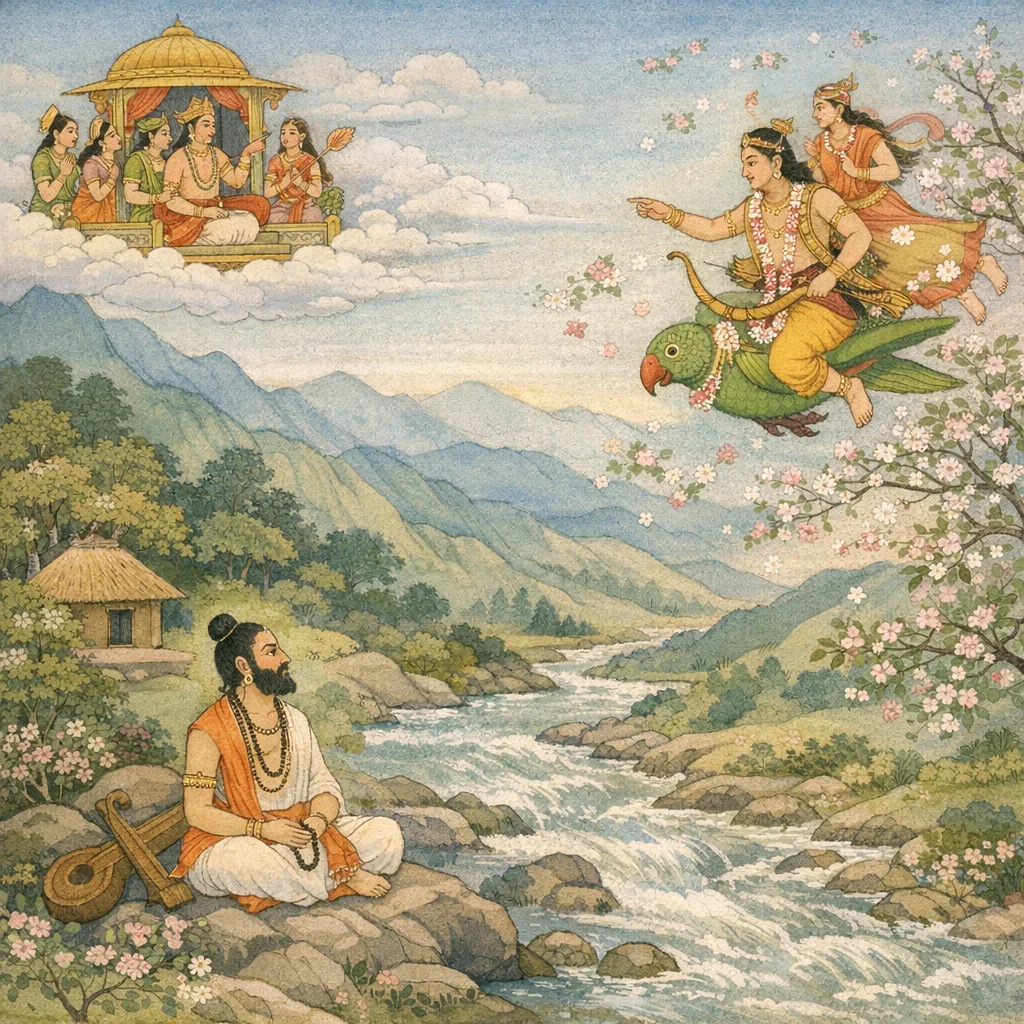
Adhyāya 2 begins with Sūta describing Nārada—Brahmā’s son, disciplined and devoted to tapas—seeking an ideal Himalayan cave-region beside a swift divine river. He reaches a radiant, ornamented āśrama and performs prolonged austerities: steady posture, silence, prāṇāyāma, and purification of intellect, culminating in samādhi marked by the nondual insight “ahaṃ brahma,” yielding knowledge aimed at direct realization of Brahman. The force of his tapas disturbs the cosmos; Śakra/Indra grows mentally agitated, fearing a threat to his sovereignty. To create an obstacle (vighna), Indra summons Smara/Kāma, deity of desire, and with self-interested cunning orders him to disrupt Nārada’s concentration through desire. The chapter thus sets a classic Purāṇic tension between yogic inwardness and heavenly politics, portraying desire as both cosmic energy and a peril on the path to liberation.
Shlokas
Verse 1
सूत उवाच । एतस्मिन्समये विप्रा नारदो मुनिसत्तमः । ब्रह्मपुत्रो विनीतात्मा तपोर्थं मन आदधे
Sūta said: At that time, O brāhmaṇas, Nārada—the best of sages—Brahmā’s son, humble and self-controlled, set his mind upon undertaking tapas (austerity) for spiritual attainment.
Verse 2
इति श्रीशिवमहापुराणे द्वितीयायां रुद्रसंहितायां प्रथमखंडे सृष्ट्युपाख्याने नारदतपोवर्णनं नाम द्वितीयोऽध्यायः
Thus, in the Śrī Śiva Mahāpurāṇa—within the Second Saṃhitā, the Rudra-saṃhitā—under the First section, the Sṛṣṭi-khaṇḍa (account of creation), concludes the Second Chapter called “The Description of Nārada’s Penance.”
Verse 3
तत्राश्रमो महादिव्यो नानाशोभासमन्वितः । तपोर्थं स ययौ तत्र नारदो दिव्यदर्शनः
There stood a supremely divine āśrama, adorned with many kinds of splendor. For the sake of tapas and spiritual attainment, Nārada—endowed with divine vision—went there.
Verse 4
तां दृष्ट्वा मुनिशार्दूलस्तेपे स सुचिरं तपः । बध्वासनं दृढं मौनी प्राणानायम्य शुद्धधीः
Having seen her, that tiger among sages undertook austerity for a long time. Establishing a firm posture, observing sacred silence, and regulating the life-breath through prāṇāyāma, he remained of purified understanding—steadfastly intent on Śiva-realization.
Verse 5
चक्रे मुनिस्समाधिं तमहम्ब्रह्मेति यत्र ह । विज्ञानं भवति ब्रह्मसाक्षात्कारकरं द्विजाः
O twice-born sages, the seer entered that samādhi wherein the realization arises, “I am Brahman”; from it is born the higher, discerning knowledge that brings direct vision of Brahman.
Verse 6
इत्थं तपति तस्मिन्वै नारदे मुनिसत्तमे । चकंपेऽथ शुनासीरो मनस्संतापविह्वलः
While that supreme sage Nārada was performing such austerities, Śunāsīra (Indra) then began to tremble, overwhelmed by the burning distress in his mind.
Verse 7
मनसीति विचिंत्यासौ मुनिर्मे राज्यमिच्छति । तद्विघ्नकरणार्थं हि हरिर्यत्नमियेष सः
Thinking to himself, “This sage desires my kingdom,” Hari (Viṣṇu) indeed set himself to effort, intending to create an obstacle to that desire.
Verse 8
सस्मार स्मरं शक्रश्चेतसा देवनायकः । आजगाम द्रुतं कामस्समधीर्महिषीसुतः
Indra, the lord and leader of the gods, mentally called to mind Smara (Kāma). At once, Kāma—swift and resolute, the son of a queen—quickly came there.
Verse 9
अथागतं स्मरं दृष्ट्वा संबोध्य सुरराट् प्रभुः । उवाच तं प्रपश्याशु स्वार्थे कुटिलशेमुषिः
Then, seeing Kāma (Smara) arrive, the sovereign lord of the gods addressed him and said at once—he whose mind was crafty in pursuit of his own purpose.
Verse 10
इन्द्र उवाच । मित्रवर्य्य महावीर सर्वदा हितकारक । शृणु प्रीत्या वचो मे त्वं कुरु साहाय्यमात्मना
Indra said: “O best of friends, O great hero, ever a doer of what is beneficial—listen with affection to my words, and render me assistance by your own strength.”
Verse 11
त्वद्बलान्मे बहूनाञ्च तपोगर्वो विनाशितः । मद्राज्यस्थिरता मित्र त्वदनुग्रहतस्सदा
By your power, the pride born of austerities in me and in many others has been destroyed. O friend, the stability of my kingdom is ever sustained by your grace.
Verse 12
हिमशैलगुहायां हि मुनिस्तपति नारदः । मनसोद्दिश्य विश्वेशं महासंयमवान्दृढः
Indeed, in a cave of the Himālaya, the sage Nārada performed austerities—steadfast in great self-restraint—fixing his mind inwardly upon Viśveśa, the Lord of the universe.
Verse 13
याचेन्न विधितो राज्यं स ममेति विशंकितः । अद्यैव गच्छ तत्र त्वं तत्तपोविघ्नमाचर
If he does not ask for the kingdom according to due ordinance, he may suspect, ‘This (kingdom) is mine.’ Go there this very day, and create an obstacle to that austerity of his.
Verse 14
इत्याज्ञप्तो महेन्द्रेण स कामस्समधु प्रियः । जगाम तत्स्थलं गर्वादुपायं स्वञ्चकार ह
Thus commanded by Mahendra (Indra), Kāma—fond of spring and intoxicated honey—went to that very place. Out of pride, he devised his own stratagem there.
Verse 15
रचयामास तत्राशु स्वकलास्सकला अपि । वसंतोपि स्वप्रभावं चकार विविधं मदात्
Thereupon, he quickly brought forth all his own powers (kalās) in their fullness. Even Spring, exhilarated as it were, manifested its distinctive splendor in manifold ways.
Verse 16
न बभूव मुनेश्चेतो विकृतं मुनिसत्तमाः । भ्रष्टो बभूव तद्गर्वो महेशानुग्रहेण ह
O best of sages, that muni’s mind did not become distorted; by Mahesha’s grace, his pride was cast down.
Verse 17
शृणुतादरतस्तत्र कारणं शौनकादयः । ईश्वरानुग्रहेणात्र न प्रभावः स्मरस्य हि
Listen attentively, O Śaunaka and the other sages, to the reason for this: by the grace of Īśvara, Lord Śiva, in that matter, Kāma truly had no power there.
Verse 18
अत्रैव शम्भुनाऽकारि सुतपश्च स्मरारिणा । अत्रैव दग्धस्तेनाशु कामो मुनितपोपहः
Here itself Śambhu—the foe of Smara (Kāma)—performed austere penance; and here itself Kāma, the disturber of sages’ austerities, was swiftly burned by Him.
Verse 19
कामजीवनहेतोर्हि रत्या संप्रार्थितैस्सुरैः । सम्प्रार्थित उवाचेदं शंकरो लोकशंकरः
For the very purpose of restoring Kāma (the god of desire) to life, and being earnestly entreated by Rati together with the gods, Śaṅkara—benefactor of the worlds—thus spoke in response to their supplication.
Verse 20
कंचित्समयमासाद्य जीविष्यति सुराः स्मरः । परं त्विह स्मरोपायश्चरिष्यति न कश्चन
“After some time, O gods, Kāma (Smara) will live again. But here and now, no one will undertake any means to revive him.”
Verse 21
इह यावद्दृश्यते भूर्जनैः स्थित्वाऽमरास्सदा । कामबाणप्रभावोत्र न चलिष्यत्यसंशयम्
So long as this condition is seen here—while the immortals remain established and steady—the force of Kāma’s arrows will not prevail here; of this there is no doubt.
Verse 22
इति शंभूक्तितः कामो मिथ्यात्मगतिकस्तदा । नारदे स जगामाशु दिवमिन्द्रसमीपतः
Thus, by Śambhu’s utterance, Kāma—whose very course is illusory and self-deceptive—then quickly departed from Nārada and went to heaven, to the vicinity of Indra.
Verse 23
आचख्यौ सर्ववृत्तांतं प्रभावं च मुनेः स्मरः । तदाज्ञया ययौ स्थानं स्वकीयं स मधुप्रियः
Smara (Kāma) narrated the entire account and also described the sage’s spiritual power. Then, by that sage’s command, Madhupriya departed for his own abode.
Verse 24
विस्मितोभूत्सुराधीशः प्रशशंसाथ नारदम् । तद्वृत्तांतानभिज्ञो हि मोहितश्शिवमायया
The lord of the gods became astonished and then praised Nārada; for, being unaware of the true course of those events, he was deluded by Śiva’s Māyā.
Verse 25
दुर्ज्ञेया शांभवी माया सर्वेषां प्राणिनामिह । भक्तं विनार्पितात्मानं तया संमोह्यते जगत्
Śāmbhavī Māyā—the power of Śiva—is difficult for all embodied beings to comprehend in this world. Devoid of devotion and without self-surrender, the entire universe is deluded by that very Māyā.
Verse 26
नारदोऽपि चिरं तस्थौ तत्रेशानुग्रहेण ह । पूर्णं मत्वा तपस्तत्स्वं विरराम ततो मुनिः
By the grace of Īśāna (Lord Śiva), Nārada too remained there for a long time. Then, considering his own tapas to have reached fulfillment, the sage ceased from that austerity.
Verse 27
कामोप्यजेयं निजं मत्वा गर्वितोऽभून्मुनीश्वरः । वृथैव विगतज्ञानश्शिवमायाविमोहितः
Even Kāma, deeming himself invincible, became puffed up with pride. But his knowledge proved futile, for he was deluded by Śiva’s Māyā.
Verse 28
धन्या धन्या महामाया शांभवी मुनिसत्तमाः । तद्गतिं न हि पश्यंति विष्णुब्रह्मादयोपि हि
Blessed—truly blessed—is that great Māyā, Śāmbhavī, the power of Śiva, O best of sages; for even Viṣṇu and Brahmā and the others do not perceive her course and mode of operation.
Verse 29
तया संमोहितोतीव नारदो मुनिसत्तमः । कैलासं प्रययौ शीघ्रं स्ववृत्तं गदितुं मदी
Thoroughly deluded by her, Nārada—the best of sages—quickly set out for Kailāsa, intent on reporting his own experience to me.
Verse 30
रुद्रं नत्वाब्रवीत्सर्वं स्ववृत्तङ्गर्ववान्मुनिः । मत्वात्मानं महात्मानं स्वप्रभुञ्च स्मरञ्जयम्
Having bowed to Rudra, the sage—puffed up with pride in his own conduct—spoke out everything. Considering himself a great soul and remembering his own imagined supremacy, he sought victory.
Verse 31
तच्छ्रुत्वा शंकरः प्राह नारदं भक्तवत्सलः । स्वमायामोहितं हेत्वनभिज्ञं भ्रष्टचेतसम्
Hearing that, Śaṅkara—ever affectionate to His devotees—spoke to Nārada, who had been deluded by His own Māyā, who did not understand the true cause, and whose mind had become confounded.
Verse 32
रुद्र उवाच । हे तात नारद प्राज्ञ धन्यस्त्वं शृणु मद्वचः । वाच्यमेवं न कुत्रापि हरेरग्रे विशेषतः
Rudra said: “O dear son Nārada, truly wise—blessed are you. Listen to my words. This matter should not be spoken of anywhere; above all, it should not be spoken in the presence of Hari (Viṣṇu).”
Verse 33
पृच्छमानोऽपि न ब्रूयाः स्ववृत्तं मे यदुक्तवान् । गोप्यं गोप्यं सर्वथा हि नैव वाच्यं कदाचन
“Even if you are questioned, do not disclose what you have told me about your own affair. It must be kept secret—secret in every way; indeed, it must never be spoken of at any time.”
Verse 34
शास्म्यहं त्वां विशेषेण मम प्रियतमो भवान् । विष्णुभक्तो यतस्त्वं हि तद्भक्तोतीव मेऽनुगः
“I instruct you with special care, for you are most dear to me. Since you are a devotee of Viṣṇu, you are truly devoted to Him—and therefore you are exceedingly devoted to Me as well.”
Verse 35
शास्तिस्मेत्थञ्च बहुशो रुद्रस्सूतिकरः प्रभुः । नारदो न हितं मेने शिवमायाविमोहितः
“Thus the Lord—Rudra, the sovereign cause of creation—reprimanded him again and again. But Nārada, bewildered by Śiva’s māyā, did not accept what was truly beneficial.”
Verse 36
प्रबला भाविनी कर्म गतिर्ज्ञेया विचक्षणैः । न निवार्या जनैः कैश्चिदपीच्छा सैव शांकरी
The wise should know that the course of karma is mighty and unfailingly yields its fruit. No being can hinder it in any way, for that irresistible will itself is Śāṅkarī—the divine ordinance of Śiva.
Verse 37
ततस्स मुनिवर्यो हि ब्रह्मलोकं जगाम ह । विधिं नत्वाऽब्रवीत्कामजयं स्वस्य तपोबलात्
Thereupon that foremost sage went to Brahmaloka. Bowing to Vidhi (Brahmā), he declared that by the power of his own austerities he had conquered Kāma—desire.
Verse 38
तदाकर्ण्य विधिस्सोथ स्मृत्वा शम्भुपदाम्बुजम् । ज्ञात्वा सर्वं कारणं तन्निषिषेध सुतं तदा
Hearing this, Brahmā remembered the lotus-feet of Śambhu (Śiva). Knowing the true cause of all things, he at once restrained his son from that deed.
Verse 39
मेने हितन्न विध्युक्तं नारदो ज्ञानिसत्तमः । शिवमायामोहितश्च रूढचित्तमदांकुरः
Nārada, foremost among the wise, deemed beneficial what was not truly enjoined by right knowledge and the śāstras; for, deluded by Śiva’s Māyā, the sprout of pride had taken firm root in his mind.
Verse 40
शिवेच्छा यादृशी लोके भवत्येव हि सा तदा । तदधीनं जगत्सर्वं वचस्तंत्यांत स्थितं यतः
Whatever Śiva’s will becomes in the world, exactly so it comes to be. For the entire universe depends upon Him, since it stands established at the end of the thread of His command—His governing Word.
Verse 41
नारदोऽथ ययौ शीघ्रं विष्णुलोकं विनष्टधीः । मदांकुरमना वृत्तं गदितुं स्वं तदग्रतः
Then Nārada, his discernment clouded, swiftly went to Viṣṇu’s realm; his mind sprouting with pride, he intended to relate his own episode in Viṣṇu’s presence.
Verse 42
आगच्छंतं मुनिन्दृष्ट्वा नारदं विष्णुरादरात् । उत्थित्वाग्रे गतोऽरं तं शिश्लेषज्ञातहेतुकः
Seeing the sage Nārada approaching, Viṣṇu rose respectfully, went forward to meet him, and embraced him—though he did not yet know the reason for Nārada’s visit.
Verse 43
स्वासने समुपावेश्य स्मृत्वा शिवपदाम्बुजम् । हरिः प्राह वचस्तथ्यं नारदं मदनाशनम्
Seating Nārada upon his own seat, Hari (Viṣṇu), after remembering the lotus-feet of Śiva, spoke truthful words to Nārada—the subduer of desire.
Verse 44
विष्णुरुवाच । कुत आगम्यते तात किमर्थमिह चागतः । धन्यस्त्वं मुनिशार्दूल तीर्थोऽहं तु तवागमात्
Viṣṇu said: “From where have you come, dear one, and for what purpose have you arrived here? O tiger among sages, you are indeed blessed; and by your very coming, this sacred place becomes a true tīrtha for me.”
Verse 45
विष्णुवाक्यमिति श्रुत्वा नारदो गर्वितो मुनिः । स्ववृत्तं सर्वमाचष्ट समदं मदमोहितः
Hearing those words of Viṣṇu, the sage Nārada—swollen with pride—recounted his entire conduct, deluded by intoxication and arrogance.
Verse 46
श्रुत्वा मुनिवचो विष्णुस्समदं कारणं ततः । ज्ञातवानखिलं स्मृत्वा शिवपादाम्बुजं हृदि
Having heard the sage’s words, Viṣṇu then understood the true cause in its entirety; and remembering within his heart the lotus-feet of Lord Śiva, he came to know everything.
Verse 47
तुष्टाव गिरिशं भक्त्या शिवात्मा शैवराड् हरिः । सांजलिर्विसुधीर्नम्रमस्तकः परमेश्वरम्
Hari (Viṣṇu)—whose inner being was devoted to Śiva and who was foremost among Śiva’s devotees—praised Girīśa with bhakti. With purified understanding, he stood with palms joined and head bowed, worshipping the Supreme Lord (Parameśvara).
Verse 48
विष्णुरुवाच । देवदेव महादेव प्रसीद परमेश्वर । धन्यस्त्वं शिव धन्या ते माया सर्व विमोहिनी
Viṣṇu said: “O God of gods, O Mahādeva, be gracious, O Supreme Lord. Blessed are You, O Śiva—blessed indeed is Your Māyā, the power that fully deludes all beings.”
Verse 49
इत्यादि स स्तुतिं कृत्वा शिवस्य परमात्मनः । निमील्य नयने ध्यात्वा विरराम पदाम्बुजम्
Having thus offered a hymn of praise to Śiva, the Supreme Self, he closed his eyes and meditated; then he became still, resting inwardly at the lotus-feet (of the Lord).
Verse 50
यत्कर्तव्यं शंकरस्य स ज्ञात्वा विश्वपालकः । शिवशासनतः प्राह हृदाथ मुनिसत्तमम्
Having understood what was to be done for Śaṅkara, the Protector of the universe, acting under Śiva’s command, then spoke from his heart to the best of sages.
Verse 51
विष्णुरुवाच । धन्यस्त्वं मुनिशार्दूल तपोनिधिरुदारधीः । भक्तित्रिकं न यस्यास्ति काममोहादयो मुने
Viṣṇu said: “Blessed are you, O tiger among sages—an ocean of austerity and possessed of a noble intellect. For one in whom the threefold devotion is absent, O sage, desire, delusion, and the rest surely arise.”
Verse 52
विकारास्तस्य सद्यो वै भवंत्यखिलदुःखदाः । नैष्ठिको ब्रह्मचारी त्वं ज्ञानवैराग्यवान्सदा
For him, the mind’s distortions arise at once and become the givers of every sorrow. But you are a steadfast lifelong brahmacārin, ever endowed with true knowledge and dispassion.
Verse 53
कथं कामविकारी स्या जन्मना विकृतस्सुधीः । इत्याद्युक्तं वचो भूरि श्रुत्वा स मुनिसत्तमः
Hearing at length such words as, “How could a truly wise one be altered by desire, or be distorted by birth?”, that foremost of sages listened with keen attention.
Verse 54
विजहास हृदा नत्वा प्रत्युवाच वचो हरिम् । नारद उवाच । किं प्रभावः स्मरः स्वामिन्कृपा यद्यस्ति ते मयि
Smiling, and bowing from the heart, Nārada replied to Hari: “O Lord, if You have compassion for me, tell me—what is the power and true efficacy of Smara, the God of Love?”
Verse 55
इत्युक्त्वा हरिमानम्य ययौ यादृच्छिको मुनिः
Having spoken thus, the sage Yādṛcchika bowed with reverence to Hari (Viṣṇu) and departed.
Frequently Asked Questions
Nārada undertakes intense tapas and enters “ahaṃ brahma” samādhi; Indra, fearing loss of sovereignty, summons Kāma (Smara) to obstruct the sage’s austerity.
It marks a nondual contemplative culmination of samādhi—knowledge oriented toward direct realization (brahma-sākṣātkāra)—and signals why the ascetic’s power alarms the gods.
Kāma/Smara embodies desire as a deliberate vighna deployed by Indra; the narrative frames desire and self-interested celestial politics as primary disruptors of yogic steadiness.