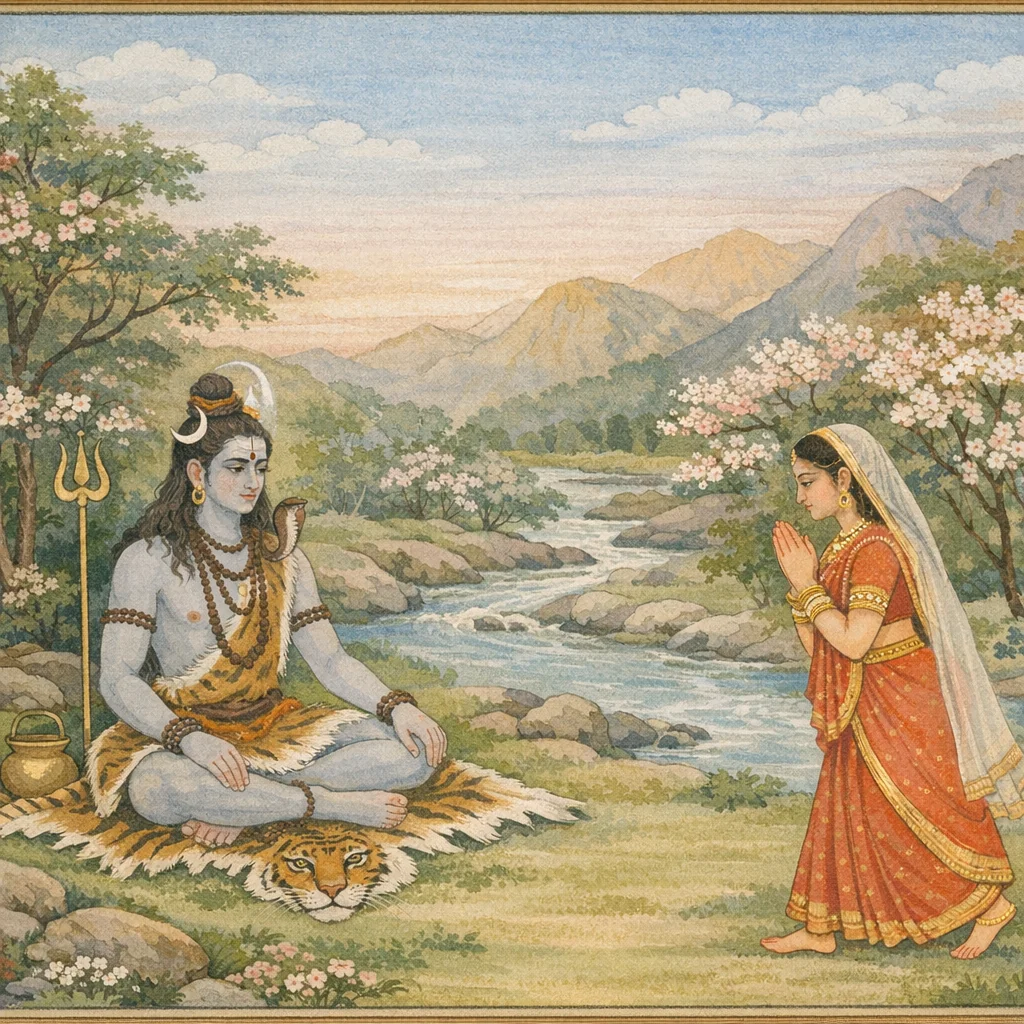
सतीकृतप्रार्थना तथा परतत्त्वजिज्ञासा — Satī’s Prayer and Inquiry into the Supreme Principle
Adhyāya 23 begins with Brahmā narrating that after a long period of divine recreation (vihāra) with Śaṅkara, Satī becomes inwardly satisfied and a spirit of detachment (virāga) arises in her. In a private audience she approaches Śiva with formal devotion—prostration and añjali—and offers a compact, theologically rich hymn: Śiva as Devadeva and Mahādeva, ocean of compassion and savior of the afflicted; and also as the supreme Puruṣa beyond rajas-sattva-tamas, both nirguṇa and saguṇa, the witnessing principle and the immutable Lord. Having acknowledged her blessedness as his beloved and her contentment in their companionship, Satī turns to a liberating request: she seeks the knowledge of the “paraṃ tattvam” that grants happiness and enables the jīva to cross the suffering of saṃsāra with ease. She asks for the teaching by which even a sense-oriented being may attain the highest state and cease to be saṃsārī, questioning solely for the uplift of living beings.
Shlokas
Verse 1
ब्रह्मोवाच । एवं कृत्वा विहारं वै शंकरेण च सा सती । संतुष्टा साभवच्चाति विरागा समजायत
Brahmā said: After thus sporting in divine pastimes with Śaṅkara, Satī became wholly content; and within her arose deep vairāgya—profound dispassion.
Verse 2
एकस्मिन्दिवसे देवी सती रहसि संगता । शिवं प्रणम्य सद्भक्त्या न्यस्योच्चैः सुकृतांजलिः
One day the Goddess Satī met (Lord Śiva) in private. Bowing to Śiva with true devotion, and joining her well-formed hands in reverent añjali, she spoke aloud.
Verse 3
सुप्रसन्नं प्रभुं नत्वा सा दक्षतनया सती । उवाच सांजलिर्भक्त्या विनयावनता ततः
Having bowed to the supremely gracious Lord, Satī—the daughter of Dakṣa—then spoke with her palms joined, filled with devotion and bowed down in humility.
Verse 4
सत्युवाच । देवदेव महादेव करुणा सागर प्रभो । दीनोद्धर महायोगिन् कृपां कुरु ममोपरि
Satī said: “O God of gods, O Mahādeva, O Lord—ocean of compassion; O uplifter of the humble, O great Yogin—bestow Your grace upon me.”
Verse 5
त्वं परः पुरुषस्स्वामी रजस्सत्त्वतमः परः । निर्गुणस्सगुणस्साक्षी निर्विकारी महाप्रभुः
You are the Supreme Person, the sovereign Lord—transcending rajas, sattva, and tamas. You are beyond qualities and yet manifest with qualities; the witnessing Consciousness, changeless, the Great Lord.
Verse 6
धन्याहं ते प्रिया जाता कामिनी सुविहारिणी । जातस्त्वं मे पतिस्स्वामिन्भक्तिवात्सल्यतो हर
“Blessed am I—having become your beloved, a loving consort who delights in your company. And you, O Hara, out of tender affection for devotion (bhakti), have become my husband and my lord.”
Verse 7
कृतो बहुसमा नाथ विहारः परमस्त्वया । संतुष्टाहं महेशान निवृत्तं मे मनस्ततः
O Lord, for many years you have shared with me the highest delight of divine companionship. O Maheśāna, I am fully content; therefore my mind has grown quiet and withdrawn from further seeking.
Verse 8
ज्ञातुमिच्छामि देवेश परं तत्त्वं सुखावहम् । यं न संसारदुःखाद्वै तरेज्जीवोंजसा हर
I wish to know, O Lord of the gods, that supreme Reality which bestows true bliss—without which, O Hara, the individual soul cannot easily cross beyond the sorrow of worldly existence.
Verse 9
यत्कृत्वा विषयी जीवस्स लभेत्परमं पदम् । संसारी न भवेन्नाथ तत्त्वं वद कृपां कुरु
O Lord, by doing what can a soul—though absorbed in sense-objects—attain the supreme state and no longer remain bound to saṃsāra? Out of compassion, declare to me the true principle (tattva).
Verse 10
ब्रह्मोवाच । इत्यपृच्छत्स्म सद्भक्त्या शंकरं सा सती मुने । आदिशक्तिर्महेशानी जीवोद्धाराय केवलम्
Brahmā said: Thus, O sage, Satī—She who is the Primordial Power, the great Queen of Maheśa—questioned Śaṅkara with true devotion, solely for the upliftment and liberation of embodied souls.
Verse 11
आकर्ण्य तच्छिवः स्वामी स्वेच्छयोपात्तविग्रहः । अवोचत्परमप्रीतस्सतीं योगविरक्तधीः
Having heard that, Lord Śiva—the sovereign who assumes a form by His own free will—spoke to Satī with deep displeasure, His mind detached through the power of yoga.
Verse 12
शिव उवाच । शृणु देवि प्रवक्ष्यामि दाक्षायणि महेश्वरि । परं तत्त्वं तदेवानुशयी मुक्तो भवेद्यतः
Śiva said: “Listen, O Goddess—O Dākṣāyaṇī, O great sovereign Lady. I shall declare the supreme Reality; by abiding in that alone, one becomes liberated.”
Verse 13
परतत्त्वं विजानीहि विज्ञानं परमेश्वरी । द्वितीयं स्मरणं यत्र नाहं ब्रह्मेति शुद्धधीः
“O Parameśvarī, know the Supreme Reality as true spiritual discernment. That is the second recollection: where, with a purified intellect, one remembers, ‘I am not Brahman (the Absolute).’”
Verse 14
तद्दुर्लभं त्रिलोकेस्मिंस्तज्ज्ञाता विरलः प्रिये । यादृशो यस्सदासोहं ब्रह्मसाक्षात्परात्परः
That Reality is exceedingly rare to attain in the three worlds, O beloved, and one who truly knows It is indeed very rare. Such as I am eternally—directly realized as Brahman—I am the Supreme beyond the beyond.
Verse 15
तन्माता मम भक्तिश्च भुक्तिमुक्तिफलप्रदा । सुलभा मत्प्रसादाद्धि नवधा सा प्रकीर्तिता
That (divine) Mother is indeed My devotion—bestowing the fruits of both worldly enjoyment and liberation. By My grace it is easily attained, and it is proclaimed to be of nine kinds.
Verse 16
भक्तौ ज्ञाने न भेदो हि तत्कर्तुस्सर्वदा सुखम् । विज्ञानं न भवत्येव सति भक्तिविरोधिनः
Between devotion (bhakti) and true spiritual knowledge (jñāna) there is, indeed, no real difference; for the practitioner of that path there is happiness at all times. But if one harbors opposition to devotion, realized discernment (vijñāna) never truly arises.
Verse 17
भक्त्या हीनस्सदाहं वै तत्प्रभावाद्गृहेष्वपि । नीचानां जातिहीनानां यामि देवि न संशयः
“Devi, if I am devoid of devotion, then—due to its overpowering influence—I will surely end up even in the houses of the lowly and of those bereft of noble birth; of this there is no doubt.”
Verse 18
सा भक्तिर्द्विविधा देवि सगुणा निर्गुणा मता । वैधी स्वाभाविकी या या वरा सा त्ववरा स्मृता
O Goddess, that devotion (bhakti) is held to be of two kinds: with attributes (saguṇā) and without attributes (nirguṇā). Of these, the devotion that is rule-guided (vaidhī) and the devotion that is natural and spontaneous (svābhāvikī)—the former is considered superior, while the latter is remembered as inferior.
Verse 19
नैष्ठिक्या नैष्ठिकी भेदाद्द्विविधे द्विविधे हि ते । षड्विधा नैष्ठिकी ज्ञेया द्वितीयैकविधा स्मृता
Because of the distinction between the ‘naiṣṭhikya’ and the ‘naiṣṭhikī’, these are indeed twofold. Of these, the naiṣṭhikī is to be understood as sixfold, while the second (naiṣṭhikya) is remembered as of a single kind.
Verse 20
विहिताविहिताभेदात्तामनेकां विदुर्बुधाः । तयोर्बहुविधत्वाच्च तत्त्वं त्वन्यत्र वर्णितम्
Because of the distinction between what is enjoined and what is forbidden, the wise know that (that discipline/observance) has many forms. And since both of these are of many kinds, their true principle has been explained elsewhere.
Verse 21
ते नवांगे उभे ज्ञेये वर्णिते मुनिभिः प्रिये । वर्णयामि नवांगानि प्रेमतः शृणु दक्षजे
“O beloved, these two sets of navāṅga, the ninefold members, are to be understood as the sages have described. I shall now explain the nine members—listen with love, O daughter of Dakṣa.”
Verse 22
श्रवणं कीर्तनं चैव स्मरणं सेवनं तथा । दास्यं तथार्चनं देवि वंदनं मम सर्वदा
O Devi, for Me these are always dear and efficacious: listening (to My glory), chanting it, remembering Me, devoted service, the attitude of servanthood, worship, and reverent salutation.
Verse 23
सख्यमात्मार्पणं चेति नवांगानि विदुर्बुधाः । उपांगानि शिवे तस्या बहूनि कथितानि वै
The wise know these as the nine limbs of devotion: friendship with the Lord and the offering of one’s very self to Him. Indeed, many subsidiary limbs of that devotion to Śiva have also been described.
Verse 24
शृणु देवि नवांगानां लक्षणानि पृथक्पृथक् । मम भक्तेर्मनो दत्त्वा भक्ति मुक्तिप्रदानि हि
Listen, O Goddess, to the distinct characteristics of the ninefold devotion, each in turn. When the mind is offered into devotion to Me, that devotion indeed becomes the giver of liberation.
Verse 25
कथादेर्नित्यसम्मानं कुर्वन्देहादिभिर्मुदा । स्थिरासनेन तत्पानं यत्तच्छ्रवणमुच्यते
This is called true śravaṇa (listening): joyfully offering constant reverence to the sacred narration and the like, and ‘drinking’ it while seated steadily—honouring it with one’s body and all one’s faculties.
Verse 26
हृदाकाशेन संपश्यञ् जन्मकर्माणि वै मम । प्रीत्याचोच्चारणं तेषामेतत्कीर्तनमुच्यते
Beholding, through the inner sky of the heart, My births and divine deeds, and then joyfully uttering them with love—this is what is called kīrtana, devotional glorification.
Verse 27
व्यापकं देवि मां दृष्ट्वा नित्यं सर्वत्र सर्वदा । निर्भयत्वं सदा लोके स्मरणं तदुदाहृतम्
“O Goddess, by beholding Me as all-pervading—ever, everywhere, at all times—one attains constant fearlessness in the world; this is what is declared to be true smaraṇa, remembrance of Śiva.”
Verse 28
अरुणोदयमारभ्य सेवाकालेंचिता हृदा । निर्भयत्वं सदा लोके स्मरणं तदुदाहृतम्
From sunrise onward, when the heart remains steadily engaged at the time of devoted service, one attains constant fearlessness in the world—this is declared to be true remembrance of Śiva.
Verse 29
सदा सेव्यानुकूल्येन सेवनं तद्धि गोगणैः । हृदयामृतभोगेन प्रियं दास्यमुदाहृतम्
To serve the One who is to be served, always in a manner pleasing to Him—this indeed the wise call ‘service’. When offered with the nectar-like relish of the heart, such loving dāsya, servitude in devotion, is declared most dear to the Lord.
Verse 30
सदा भृत्यानुकूल्येन विधिना मे परात्मने । अर्पणं षोडशानां वै पाद्यादीनां तदर्चनम्
Always, with the disciplined spirit of a devoted attendant and according to proper rite, offer unto Me—the Supreme Self (Paramātman)—the sixteen traditional services beginning with water for washing the feet; that offering itself is true worship of Me.
Verse 31
मंत्रोच्चारणध्यानाभ्यां मनसा वचसा क्रमात् । यदष्टांगेन भूस्पर्शं तद्वै वंदनमुच्यते
When, in due order, one recites the mantra and meditates—applying mind and speech—and then touches the earth with all eight limbs, that act is indeed called vandana, reverential prostration.
Verse 32
मंगलामंगलं यद्यत्करोतीतीश्वरो हि मे । सर्वं तन्मंगलायेति विश्वासः सख्यलक्षणम्
Whether my Lord (Īśvara, Śiva) brings about what seems auspicious or inauspicious, I am certain that all of it is for my highest good. Such unwavering trust is the very mark of true friendship with Śiva.
Verse 33
कृत्वा देहादिकं तस्य प्रीत्यै सर्वं तदर्पणम् । निर्वाहाय च शून्यत्वं यत्तदात्मसमर्पणम्
To make even one’s body and all else an offering for His delight—offering everything to Him—and, to sustain that life, to remain as though “empty,” free from possessiveness: this indeed is the surrender of one’s very self to Him.
Verse 34
नवांगानीति मद्भक्तेर्भुक्तिमुक्तिप्रदानि च । मम प्रियाणि चातीव ज्ञानोत्पत्तिकराणि च
These are the nine limbs of devotion to Me; they bestow both worldly enjoyment and liberation (mukti). They are exceedingly dear to Me, and they also cause true spiritual knowledge to arise.
Verse 35
उपांगानि च मद्भक्तेर्बहूनि कथितानि वै । बिल्वादिसेवनादीनि समू ह्यानि विचारतः
Many subsidiary limbs of devotion to Me (Śiva) have indeed been described—such as the reverential offering and use of bilva leaves and related observances—when these are thoughtfully gathered and considered in due order.
Verse 36
इत्थं सांगोपांगभक्तिर्मम सर्वोत्तमा प्रिये । ज्ञानवैराग्यजननी मुक्तिदासी विराजते
Thus, O beloved, this devotion to Me (Śiva)—complete in all its parts and auxiliaries—shines as the highest of all. It gives birth to true knowledge and dispassion (vairāgya), and it stands as the handmaid that leads one to liberation (mokṣa).
Verse 37
सर्वकर्मफलोत्पत्तिस्सर्वदा त्वत्समप्रिया । यच्चित्ते सा स्थिता नित्यं सर्वदा सोति मत्प्रियः
She who is ever-present, the source from which the fruits of all actions arise, is as dear to you as your own self. Whoever keeps her fixed in his heart at all times—he is always exceedingly dear to Me.
Verse 38
त्रैलोक्ये भक्तिसदृशः पंथा नास्ति सुखावहः । चतुर्युगेषु देवेशि कलौ तु सुविशेषतः
O Goddess, within the three worlds there is no path equal to devotion (bhakti) that so surely bestows bliss. Among all the four yugas—and most especially in the Kali Yuga—this is pre-eminently true.
Verse 39
कलौ तु ज्ञानवैरागो वृद्धरूपौ निरुत्सवौ । ग्राहकाभावतो देवि जातौ जर्जर तामति
But in the age of Kali, O Devī, spiritual knowledge and dispassion take on the form of old age—joyless and without celebration. Lacking worthy recipients, they are said to be born into a state of decay and infirmity.
Verse 40
कलौ प्रत्यक्षफलदा भक्तिस्सर्वयुगेष्वपि । तत्प्रभावादहं नित्यं तद्वशो नात्र संशयः
In the Kali age, devotion (bhakti) grants visible and immediate results; indeed, in every age it is efficacious. By the power of that devotion, I am eternally brought under its sway—of this there is no doubt.
Verse 41
यो भक्तिमान्पुमांल्लोके सदाहं तत्सहायकृत् । विघ्नहर्ता रिपुस्तस्य दंड्यो नात्र च संशयः
Whoever in this world is a man of devotion—of him I am ever the helper. Any enemy who creates obstacles and undermines his welfare is surely punishable; of this there is no doubt.
Verse 42
भक्तहेतोरहं देवि कालं क्रोधपरिप्लुतः । अदहं वह्निना नेत्रभवेन निजरक्षकः
O Devī, for the sake of my devotee, I—overwhelmed by wrath—burned Kāla (Death/Time) with the fire that arose from my eye, remaining my own protector.
Verse 43
भक्तहेतोरहं देवि रव्युपर्यभवं किल । अतिक्रोधान्वितः शूलं गृहीत्वाऽन्वजयं पुरा
O Goddess, for the sake of My devotee I once went up above the Sun; then, filled with intense wrath, I took up the trident and pursued the offender in former times.
Verse 44
भक्तहेतोरहं देवि रावणं सगणं क्रुधा । त्यजति स्म कृतो नैव पक्षपातो हि तस्य वै
O Goddess, for the sake of My devotee, in anger I abandoned Rāvaṇa together with his attendants; truly, I never showed him any partiality.
Verse 45
भक्तहेतोरहं देवि व्यासं हि कुमतिग्रहम् । काश्या न्यसारयत् क्रोधाद्दण्डयित्वा च नंदिना
O Goddess, for the sake of My devotee, in anger I had the sage Vyāsa—whose mind was seized by misguided understanding—driven out of Kāśī, and I had him chastised through Nandin.
Verse 46
किं बहूक्तेन देवेशि भक्त्याधीनस्सदा ह्यहम् । तत्कर्तुं पुरुषस्यातिवशगो नात्र संशयः
What need is there for many words, O Goddess? I am ever dependent upon devotion (bhakti). To accomplish that, I am wholly under the sway of the devoted soul—of this there is no doubt.
Verse 47
ब्रह्मोवाच । इत्थमाकर्ण्य भक्तेस्तु महत्त्वं दक्षजा सती । जहर्षातीव मनसि प्रणनाम शिवं मुदा
Brahmā said: Thus, having heard of the greatness of devotion (bhakti), Satī—the daughter of Dakṣa—rejoiced exceedingly in her heart and, with joy, bowed down to Lord Śiva.
Verse 48
पुनः पप्रच्छ सद्भक्त्या तत्काण्डविषयं मुने । शास्त्रं सुखकरं लोके जीवोद्धारपरायणम्
Then again, with sincere devotion, she questioned the sage about that section—a scripture that brings well-being to the world and is wholly devoted to the upliftment and liberation of souls.
Verse 49
सयंत्रमंत्रशास्त्रं च तन्माहात्म्यं विशेषतः । अन्यानि धर्मवस्तूनि जीवोद्धारकराणि हि
And (he spoke of) the scriptures of yantras and mantras, and especially their greatness; and also other religious teachings—indeed, those dharmic matters that become instruments for the upliftment and liberation of the embodied soul.
Verse 50
शंकरोपि तदाकर्ण्य सतीं प्रश्नं प्रहृष्टधीः । वर्णयामास सुप्रीत्या जीवोद्धाराय कृत्स्नशः
Hearing Satī’s question, Śaṅkara too—his mind delighted—explained everything in full with great affection, for the upliftment and liberation of embodied beings.
Verse 51
तत्र शास्त्रं सयंत्रं हि सपंचाङ्गं महेश्वरः । बभाषे महिमानं च तत्तद्दैववरस्य वै
There, Mahādeva (Maheśvara) expounded the sacred teaching together with its supporting discipline and its fivefold components; and he also declared the greatness of each of those excellent divine observances.
Verse 52
सेतिहासकथं तेषां भक्तमाहात्म्यमेव च । सवर्णाश्रमधर्मांश्च नृपधर्मान् मुनीश्वर
O best of sages, it also teaches the narratives of sacred history connected with them, the very greatness of bhakti, the duties of varṇa and āśrama, and the righteous duties of kings.
Verse 53
सुतस्त्रीधर्ममाहात्म्यं वर्णाश्रममनश्वरम् । वैद्यशास्त्रं तथा ज्योतिश्शास्त्रं जीवसुखावहम्
Sūta declared: “(This scripture teaches) the greatness of a son’s duty and of a woman’s dharma; the enduring order of varṇa and āśrama; and likewise the sciences of medicine and astrology (jyotiṣa)—disciplines that bring well-being and happiness to embodied beings.”
Verse 54
सामुद्रिकं परं शास्त्रमन्यच्छास्त्राणि भूरिशः । कृपां कृत्वा महे शानो वर्णयामास तत्त्वतः
Out of compassion, Lord Maheśāna expounded in truth the supreme Sāmudrika-śāstra, along with many other treatises, explaining them according to their real principles.
Verse 55
इत्थं त्रिलोकसुखदौ सर्वज्ञौ च सतीशिवौ । लोकोपकारकरणधृतसद्गुणविग्रहौ
Thus Satī and Śiva—both omniscient and bestowers of joy upon the three worlds—assumed forms endowed with noble virtues, solely to accomplish the welfare of all beings.
Verse 56
चिक्रीडाते बहुविधे कैलासे हिमवद्गिरौ । अन्यस्थलेषु च तदा परब्रह्मस्वरूपिणौ
Then those two—whose true essence is the Supreme Brahman—sported in many ways upon Kailāsa in the Himavat mountains, and likewise at other places at that time.
Frequently Asked Questions
Satī, after enjoying divine companionship with Śiva, privately approaches him and—through praise and humility—requests instruction on the supreme tattva that liberates beings from saṃsāra.
The passage models the transition from fulfillment to vairāgya and from devotion (stuti) to liberating knowledge (tattva-jñāna), presenting inquiry itself as an act of compassion for the jīva’s uplift.
Śiva is highlighted as both transcendent and immanent: beyond the three guṇas, yet also the personal lord (Mahādeva) and the inner witness (sākṣī), approached through grace and bhakti.