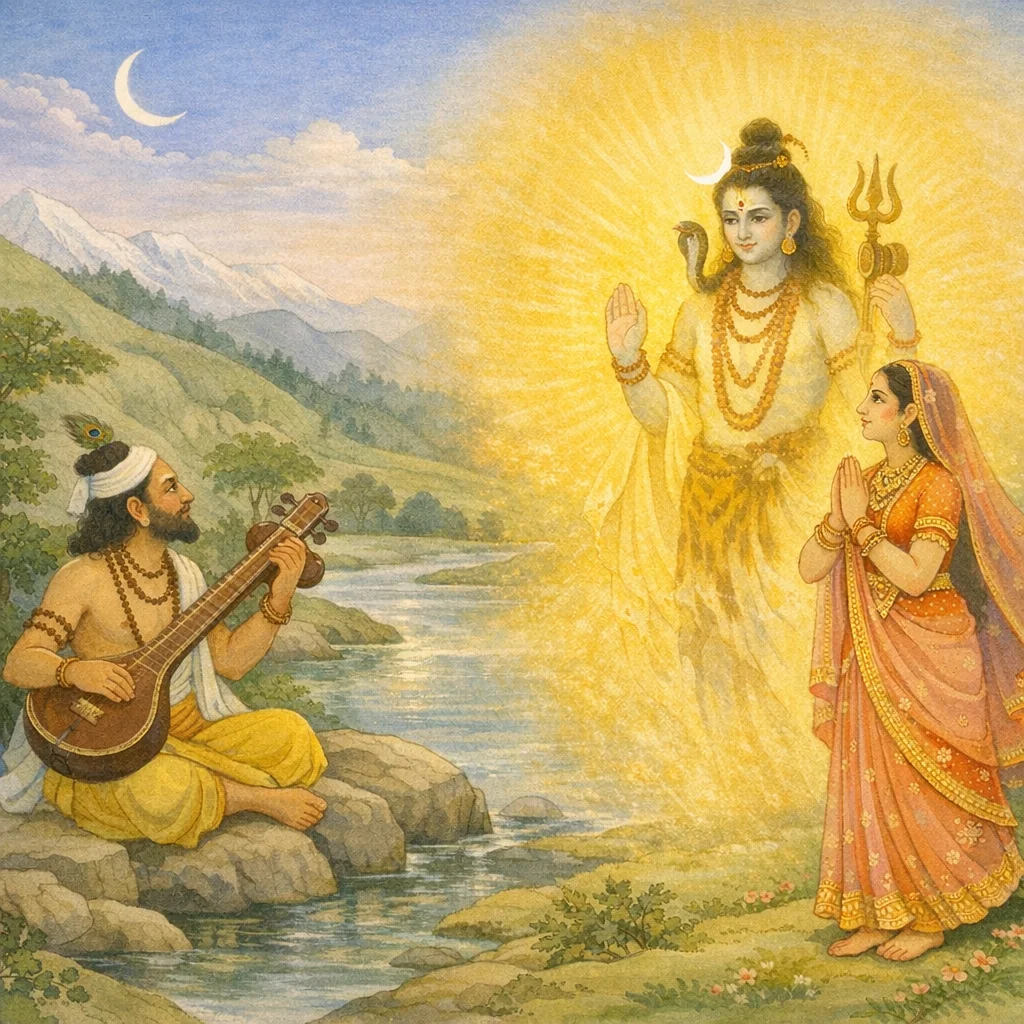
शिवरूपदर्शनम् (Menā’s Vision of Śiva’s Divine Form)
Adhyāya 45 presents a persuasion-and-darśana sequence, framed by Brahmā’s report and Nārada’s direct speech. Urged by Viṣṇu to aid the divine task (devakārya), Nārada approaches Śambhu and praises him with many kinds of hymns. Pleased, Śiva reveals an extraordinary, supreme divine form, expressly marked by compassion. Rejoicing in the vision—said to surpass even Manmatha in beauty—Nārada returns to Menā and urges her to behold Śiva’s unsurpassed form. Menā, amazed, accepts the testimony and then directly perceives Śiva’s radiance and auspicious beauty: splendor like countless suns, perfect limbs, wondrous garments, many ornaments, a serene smile, a luminous complexion, and the crescent moon adorning him. The chapter moves from divine mission → praise → gracious epiphany → transmission of the vision to Menā → detailed iconographic description affirming Śiva’s form as both beautiful and salvific.
Shlokas
Verse 1
ब्रह्मोवाच । एतस्मिन्नन्तरे त्वं हि विष्णुना प्रेरितो द्रुतम् । अनुकूलयितुं शंभुमयास्तन्निकटे मुने
Brahmā said: Meanwhile, urged by Viṣṇu, you quickly went near Śambhu, O sage, in order to win His favor.
Verse 2
तत्र गत्वा स वै रुद्रो भवता सुप्रबोधितः । स्तोत्रैर्नानाविधैस्स्तुत्वा देवकार्यचिकीर्षया
Having gone there, you fully roused Rudra to action. Then, intending to accomplish the gods’ divine task, you praised Him with many kinds of hymns.
Verse 3
श्रुत्वा त्वद्वचनं प्रीत्या शंभुना धृतमद्भुतम् । स्वरूपमुत्तमन्दिव्यं कृपालुत्वं च दर्शितम्
Hearing your words with joy, Śambhu assumed a wondrous demeanor; He revealed His supreme, divine nature and also displayed His compassion.
Verse 4
तद्दृष्ट्वा सुन्दरं शम्भुं स्वरूपम्मन्मथा धिकम् । अत्यहृष्यो मुने त्वं हि लावण्यपरमायनम्
Seeing that beautiful Śambhu—whose very form surpassed even Manmatha, the god of love—O sage, you were exceedingly delighted, for He is the supreme abode of all loveliness.
Verse 5
स्तोत्रैर्नानाविधैस्स्तुत्वा परमानन्दसंयुतः । आगच्छस्त्वं मुने तत्र यत्र मेना स्थिताखिलैः
Having praised the Lord with many kinds of hymns and being filled with supreme bliss, he said: “O sage, come there—where Menā stands, surrounded by all.”
Verse 6
तत्रागत्य सुप्रसन्नो मुनेऽतिप्रेमसंकुलः । हर्षयंस्तां शैलपत्नी मेनान्त्वं वाक्यमब्रवीः
Arriving there, O sage, he was exceedingly pleased and overflowing with affection. Gladdening that lady of the mountain—Menā, the wife of Himavat—he spoke these words to her.
Verse 7
नारद उवाच । मेने पश्य विशालाक्षि शिवरूपमनुत्तमम् । कृता शिवेन तेनैव सुकृपा करुणात्मना
Nārada said: “O wide-eyed one, behold that unsurpassed form of Śiva. By that very Śiva—whose nature is compassion—grace (sukṛpā) has indeed been bestowed.”
Verse 8
ब्रह्मोवाच । श्रुत्वा सा तद्वचो मेना विस्मिता शैलकामिनी । ददर्श शिवरूपन्तत्परमानन्ददायकम्
Brahmā said: Hearing those words, Menā—the mountain-lady—was astonished; and then she beheld the form of Śiva, a vision that bestows supreme bliss.
Verse 9
कोटिसूर्यप्रतीकाशं सर्वावयवसुन्दरम् । विचित्रवसनं चात्र नानाभूषणभूषितम्
He shone with a radiance like that of a crore of suns; every limb of His was beautiful. There He wore wondrous garments and was adorned with many kinds of ornaments.
Verse 10
सुप्रसन्नं सुहासं च सुलावण्यं मनोहरम् । गौराभं द्युतिसंयुक्तं चन्द्ररेखाविभूषितम्
He was exceedingly serene, gently smiling, and possessed of exquisite beauty—captivating to the mind. Radiant with a fair, luminous splendor, He was adorned with the crescent-moon mark.
Verse 11
सर्वैर्देवगणैः प्रीत्या विष्ण्वाद्यस्सेवितं तथा । सूर्येण च्छत्रितं मूर्ध्नि चन्द्रेण च विशोभितम्
Lovingly served by all the hosts of gods—by Viṣṇu and the others as well—its head was shaded by the Sun like a royal parasol, and it was further adorned by the Moon.
Verse 12
सर्वथा रमणीयं च भूषितस्य विभूषणैः । वाहनस्य महाशोभा वर्णितुं नैव शक्यते
Adorned in every way with splendid ornaments, that divine mount appeared utterly enchanting; indeed, its great radiance and beauty cannot truly be described in words.
Verse 13
गंगा च यमुना चैव विधत्तः स्म सुचामरे । सिद्धयोऽष्टौ पुरस्तस्य कुर्वन्ति स्म सुनर्त्तनम्
Gaṅgā and Yamunā, too, were appointed to fan him with splendid cāmaras; and the eight Siddhis, standing before him, performed an auspicious dance.
Verse 14
मया चैव तदा विष्णुरिन्द्राद्या ह्यमरास्तथा । स्वं स्वं वेषं सुसम्भूष्य गिरिशेनाचरन्युताः
Then, along with me, Viṣṇu, Indra, and the other devas too—each beautifully adorned in their own distinctive attire—moved about in the company of Girīśa (Lord Śiva).
Verse 15
तथा जयेति भाषन्तो नानारूपा गणास्तदा । स्वलङ्कृतमहामोदा गिरीशपुरतोऽचरन्
Then those gaṇas—assuming many wondrous forms—moved about before Lord Girīśa, crying, “Victory! Victory!” Adorned with their own ornaments and filled with great delight, they joyfully ranged in his presence.
Verse 16
सिद्धाश्चोपसुरास्सर्वे मुनयश्च महासुखाः । ययुश्शिवेन सुप्रीतास्सकलाश्चापरे तथा
All the Siddhas, the attendant deities (Upasuras), and the sages—filled with great joy—departed, thoroughly pleased with Lord Śiva; and so too did all the others.
Verse 17
एवन्देवादयस्सर्वे कुतूहलसमन्विताः । परंब्रह्म गृणन्तस्ते स्वपत्नीभिरलंकृताः
Thus all the gods and the other celestial beings, filled with eager wonder, praised the Supreme Brahman (Śiva); and they appeared resplendent, adorned and accompanied by their own consorts.
Verse 18
विश्वावसुमुखास्तत्र ह्यप्सरोगणसंयुताः । गायन्तोप्यग्रतस्तस्य परमं शाङ्करं यशः
There, headed by Viśvāvasu and accompanied by companies of Apsarās, they sang before him the supreme glory of Śaṅkara (Lord Śiva).
Verse 19
इत्थं महोत्सवस्तत्र बभूव मुनिस त्तम । नानाविधो महेशे हि शैलद्वारि च गच्छति
Thus, O best of sages, a grand festival arose there. For when Mahādeva proceeds to Śailadvāra, celebrations of many kinds naturally take place, drawn by devotion to the Lord who grants grace and liberation.
Verse 20
तस्मिंश्च समये तत्र सुषमा या परात्मनः । वर्णितुं तां विशेषेण कश्शक्नोति मुनीश्वर
And at that time, in that very place, the unsurpassed excellence of the Supreme Self (Śiva) shone forth. O lord among sages, who indeed has the power to describe that glory in full detail?
Verse 21
तथाविधं च तन्दृष्ट्वा मेना चित्रगता इव । क्षणमासीत्ततः प्रीत्या प्रोवाच वचनं मुने
Seeing him in that very form, Menā became for a moment as if painted in a picture—motionless with wonder. Then, filled with affection, she spoke these words, O sage.
Verse 22
मेनोवाच । धन्या पुत्री मदीया च यया तप्तं महत्तपः । यत्प्रभावान्महेशान त्वं प्राप्त इह मद्गृहे
Mena said: “Blessed indeed is my daughter, for she has performed great austerity. O Maheśāna, by the power of that tapas you have come here, into my home.”
Verse 23
मया कृता पुरा या वै शिवनिन्दा दुरत्यया । तां क्षमस्व शिवास्वामिन्सुप्रसन्नो भवाधुना
Whatever grievous and hard-to-overcome slander of Lord Śiva I committed in the past—O Śiva, my Lord—please forgive that. Be fully gracious and pleased with me now.
Verse 24
ब्रह्मोवाच । इत्थं सम्भाष्य सा मेना संस्तूयेन्दुललाटकम् । साञ्जलिः प्रणता शैलप्रिया लज्जापराऽभवत्
Brahmā said: Having spoken thus, Menā praised the Beloved of the Mountain—He whose forehead bears the crescent moon. With palms joined she bowed in reverence, and Śailapriyā (Pārvatī) became exceedingly modest and bashful.
Verse 25
तावत्स्त्रियस्समाजग्मुर्हित्वा कामाननेकशः । बह्व्यस्ताः पुरवासिन्यश्शिवदर्शनलालसाः
Just then many women gathered together, casting aside their various worldly desires. They were numerous city-dwelling women, all eager for the blessed darśana—the sacred sight—of Lord Śiva.
Verse 26
मज्जनं कुर्वती काचित्तच्चूर्णसहिता ययौ । द्रष्टुं कुतूहलाढ्या च शङ्करं गिरिजावरम्
Then a certain maiden, while engaged in bathing and carrying her fragrant powder, went forth—eager with curiosity—to behold Śaṅkara, the noble bridegroom of Girijā (Pārvatī).
Verse 27
काचित्तु स्वामिनस्सेवां सखीयुक्ता विहाय च । सुचामरकरा प्रीत्यागाच्छम्भोर्दर्शनाय वै
But one maiden, accompanied by her friend, set aside her service to her mistress; holding a fine yak-tail fan in her hand, she joyfully went to behold Śambhu (Lord Śiva).
Verse 28
काचित्तु बालकं हित्वा पिबन्तं स्तन्यमादरात् । अतृप्तं शङ्करन्द्रष्टुं ययौ दर्शनलालसा
One woman, leaving her little child who was eagerly drinking milk at her breast—still unsatisfied—went forth, driven by a longing for the auspicious sight (darśana) of Lord Śaṅkara.
Verse 29
रशनां बध्नती काचित्तयैव सहिता ययौ । वसनं विपरीतं वै धृत्वा काचिद्ययौ ततः
One woman departed while fastening her waist-belt, accompanied by that other. Then another woman went away after donning her garment the wrong way round.
Verse 30
भोजनार्थं स्थितं कान्तं हित्वा काचिद्ययौ प्रिया । द्रष्टुं शिवावरं प्रीत्या सतृष्णा सकुतूहला
Leaving her beloved who sat ready for the meal, a dear woman went forth—joyful and eager—to behold the excellent Lord Śiva, filled with longing and curiosity.
Verse 31
काचिद्धस्ते शलाकां च धृत्वांजनकरा प्रिया । अञ्जित्वैकाक्षि सन्द्रष्टुं ययौ शैलसुतावरम्
A certain beloved lady, holding an eyeliner-stick in her hand and carrying collyrium (añjana), applied it to one eye and went to see the excellent daughter of the mountain, Pārvatī.
Verse 32
काचित्तु कामिनी पादौ रञ्जयन्ती ह्यलक्तकैः । श्रुत्वा घोषं च तद्धित्वा दर्शनार्थमुपागता
One young woman, while dyeing her feet with red lac, heard a commotion; abandoning that at once, she came forward, eager to behold what had happened.
Verse 33
इत्यादि विविधं कार्यं हित्वा वासं स्त्रियो ययुः । दृष्ट्वा तु शांकरं रूपं मोहं प्राप्तास्तदाऽभवन्
Thus, abandoning their various household tasks, the women went out; but on beholding Śaṅkara’s form, they at once became bewildered—overpowered by delusion and fascination.
Verse 34
ततस्ताः प्रेमसंविग्नाश्शिवदर्शनहर्षिताः । निधाय हृदि तन्मूर्तिं वचनं चेदमब्रुवन्
Then those women, deeply stirred by love and rejoicing in the darśana of Śiva, enshrined that very form of His within their hearts and spoke these words.
Verse 35
पुरवासिन्य ऊचुः । नेत्राणि सफलान्यासन्हिमवत्पुरवासिनाम् । यो योऽपश्यददो रूपं तस्य वै सार्थकं जनुः
The women of the city said: “Blessed indeed are the eyes of the residents of Himavat’s city. Whoever beheld that wondrous form—truly, for that person birth itself became meaningful and fulfilled.”
Verse 36
तस्यैव सफलं जन्म तस्यैव सफलाः क्रियाः । येन दृष्टश्शिवस्साक्षात्सर्वपापप्रणाशकः
Truly fulfilled is the birth of that person, and truly fruitful are that person’s actions—by whom Lord Śiva is seen directly, He who destroys all sins.
Verse 37
पार्वत्या साधितं सर्वं शिवार्थं यत्तपः कृतम् । धन्येयं कृतकृत्येयं शिवा प्राप्य शिवम्पतिम्
All the austerity that Pārvatī performed for the sake of Śiva has been fully accomplished. Blessed indeed is this Śivā (Pārvatī); her purpose is fulfilled, for she has attained Śiva as her Lord and Consort.
Verse 38
यदीदं युगलं ब्रह्मा न युंज्याच्छिवयोर्मुदा । तदा च सकलोऽप्यस्य श्रमो निष्फलतामियात्
If Brahmā does not, with gladness, unite this pair—Śiva and Pārvatī—as husband and wife, then all his effort in this matter would indeed become fruitless.
Verse 39
सम्यक् कृतं तथा चात्र योजितं युग्ममुत्तमम् । सर्वेषां सार्थता जाता सर्वकार्यसमुद्भवा
“All has been done rightly, and here the most excellent pair has been duly united. Thus the purpose of all has been fulfilled, and from this union the arising of every great undertaking becomes possible.”
Verse 40
विना तु तपसा शम्भोर्दर्शनं दुर्लभन्नृणाम् । दर्शनाच्छंकरस्यैव सर्वे याताः कृतार्थताम्
Without austerity, O Śambhu, the darśana—the sacred vision—of Śiva is difficult for human beings to attain. Yet by the very darśana of Śaṅkara alone, all of them became fulfilled, having reached the true purpose of life.
Verse 41
लक्ष्मीर्नारायणं लेभे यथा वै स्वामिनम्पुरा । तथासौ पार्वती देवी हरम्प्राप्य सुभूषिता
Just as Lakṣmī formerly obtained Nārāyaṇa as her Lord, so the goddess Pārvatī, having attained Hara (Śiva) as her Lord, became splendidly adorned—fulfilled in auspiciousness and divine grace.
Verse 42
ब्रह्माणं च यथा लेभे स्वामिनं वै सरस्वती । तथासौ पार्वती देवी हरम्प्राप्य सुभूषिता
Just as Sarasvatī attained Brahmā as her lord, so the Goddess Pārvatī—having attained Hara (Śiva) as her divine consort—became beautifully adorned and fulfilled.
Verse 43
वयन्धन्याः स्त्रियस्सर्वाः पुरुषास्सकला वराः । ये ये पश्यन्ति सर्वेशं शंकरं गिरिजापतिम्
“We are blessed—indeed all women are blessed, and all men are most fortunate—whoever beholds Śaṅkara, the Lord of all, the Auspicious One, the Consort of Girijā (Pārvatī).”
Verse 44
ब्रह्मोवाच इत्थमुक्त्वा तु वचनं चन्दनैश्चाक्षतैरपि । शिवं समर्चयामासुर्लाजान्ववृषुरादरात्
Brahmā said: Having thus spoken those words, they then worshipped Śiva with sandal paste and unbroken rice as well, and—full of reverence—showered Him with parched grains as an offering.
Verse 45
तस्थुस्तत्र स्त्रियः सर्वा मेनया सह सोत्सुकाः । वर्णयन्त्योऽधिकम्भाग्यम्मेनायाश्च गिरेरपि
There, all the women stood together with Menā, full of eager joy, extolling the exceptional good fortune of Menā and of the Mountain-king (Himālaya) as well.
Verse 46
कथास्तथाविधाश्शृण्वंस्तद्वामा वर्णिताश्शुभाः । प्रहृष्टोऽभूत्प्रभुः सर्वैर्मुने विष्ण्वादिभिस्तदा
O sage, hearing such accounts—auspiciously described by Vāmā—the Lord was filled with delight; and all the assembled deities, beginning with Viṣṇu, rejoiced as well.
Frequently Asked Questions
Nārada, prompted by Viṣṇu for a divine purpose, praises Śiva; Śiva reveals his supreme compassionate form; Nārada then leads Menā to witness that form, establishing her direct darśana.
The chapter encodes a Śaiva epistemology: stuti purifies intention, and darśana functions as validated knowledge (pramāṇa-like certainty) grounded in grace—beauty and radiance signify transcendence made accessible.
A luminous, serene, ornamented Śiva-form: koṭi-sūrya-like radiance, perfect limbs, varied garments and ornaments, gentle smile, bright complexion, and the crescent moon (candrarekhā) as a key iconographic marker.