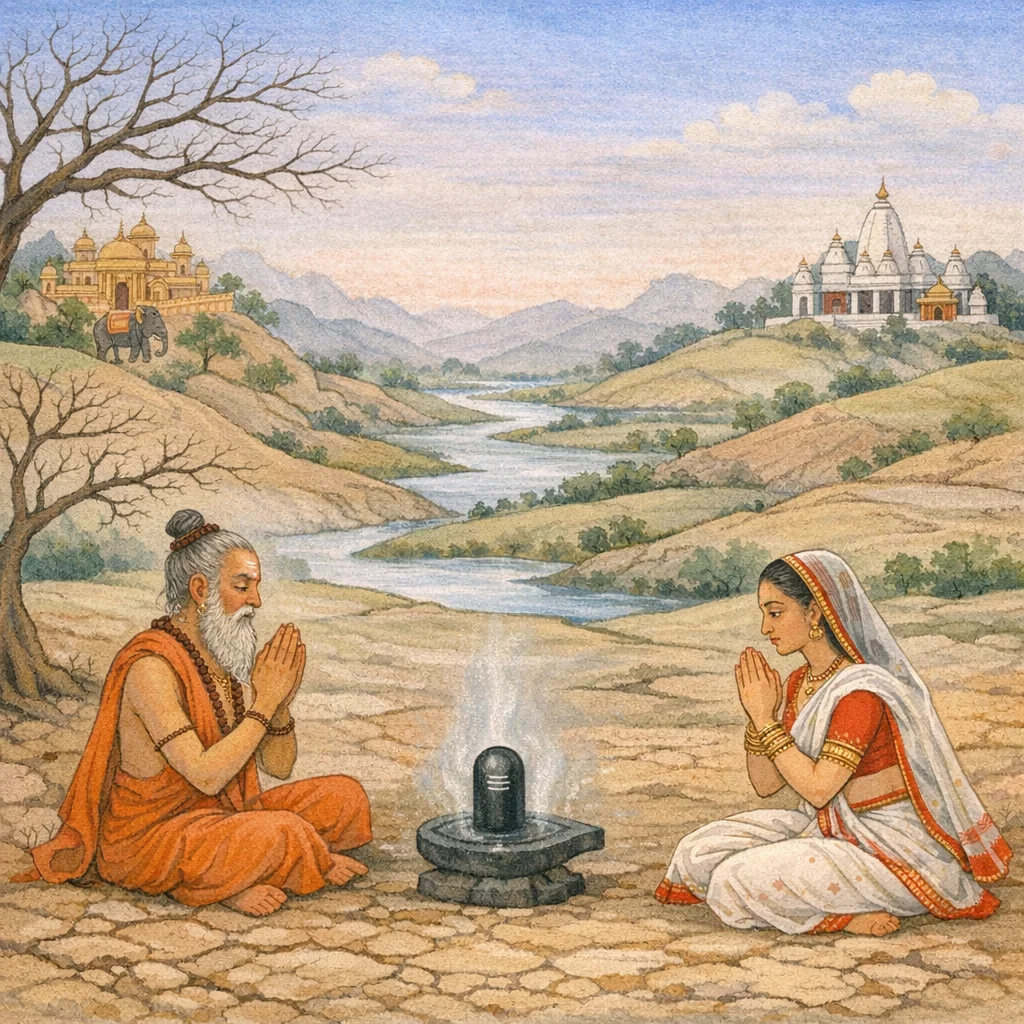
Anasūyā–Atri Tapas-Varṇana (Description of Anasūyā and Atri’s Austerities)
Adhyāya 3 is cast as Sūta’s discourse to the assembled ṛṣis, opening with a directional map of liṅgas around Citrakūṭa/Brahmapurī: Mattagajendrakā at Brahmapurī (said to have been installed by Brahmā and to grant sarva-kāma-samṛddhi), Koṭīśa to the east (bestowing all boons), and Paśupati to the west of the Godāvarī. The account then turns southward to the arising of Atrīśvara—Śiva manifesting of His own accord (svayam) for the welfare of the worlds and for Anasūyā’s joy. When the sages ask how Hara becomes Atrīśvara, Sūta affirms the purifying power of continual hearing of this narrative. The chapter places Atri’s severe tapas, performed with Anasūyā, in the forest Kāmada-vana near Citrakūṭa, and introduces a crisis: a devastating hundred-year drought afflicts all beings, setting the stage for Śaṅkara’s compassionate appearance and the teaching that the same Śaṅkara acts directly even when described as appearing by an aṃśa.
Shlokas
Verse 1
सूत उवाच । ब्रह्मपुर्यां चित्रकूटं लिंगं मत्तगजेन्द्रकम् । ब्रह्मणा स्थापितं पूर्वं सर्वकामसमृद्धिदम्
Sūta said: In the city of Brahmā (Brahmapurī) stands the Citra-kūṭa Liṅga, known as Mattagajendra. In ancient times Brahmā established it, and it bestows the complete fulfillment of all worthy desires.
Verse 2
तत्पूर्वदिशि कोटीशं लिंगं सर्ववरप्रदम् । गोदावर्य्याः पश्चिमे तल्लिंगं पशुपतिनामकम्
To the east of that place stands the Koṭīśa Liṅga, bestower of every boon. And to the west of the Godāvarī is that Liṅga known by the name Paśupati.
Verse 3
इति श्रीशिवमहापुराणे चतुर्थ्यां कोटिरुद्रसंहितायामनसूयात्रितपोवर्णनं नाम तृतीयो ऽध्यायः
Thus, in the Śrī Śiva Mahāpurāṇa—within the Fourth Book, the Koṭirudra-saṃhitā—ends the Third Chapter, entitled “The Description of Anasūyā’s Threefold Austerity.”
Verse 4
प्रादुर्भूतः स्वयं देवो ह्यनावृष्ट्यामजीवयत् । स एव शंकरः साक्षादंशेन स्वयमेव हि
In that time of drought, the Lord Himself manifested and restored life to the beings. He alone is Śaṅkara in person—indeed, He Himself, even by a portion of His own power.
Verse 5
ऋषय ऊचुः । सूतसूत महाभाग कथमत्रीश्वरो हरः । उत्पन्नः परमो दिव्यस्तत्त्वं कथय सुव्रत
The sages said: “O Sūta, O noble one—how did the Supreme, divine Lord Hara, who is known here as Atrīśvara, become manifest? O you of excellent vows, please explain to us the true principle (tattva) of this.”
Verse 6
सूत उवाच । साधु पृष्ठमृषिश्रेष्ठाः कथयामि कथां शुभाम् । यां कथां सततं श्रुत्वा पातकैर्मुच्यते ध्रुवम्
Sūta said: “O best of sages, you have asked well. I shall narrate to you this auspicious sacred account—by continually hearing which one is surely released from sins.”
Verse 7
दक्षिणस्यां दिशि महत् कामदं नाम यद्वनम् । चित्रकूटसमीपेस्ति तपसां हितदं सताम्
In the southern direction there is a great forest named Kāmada, the granter of desires. It lies near Citrakūṭa and is beneficial for the austerities of the virtuous, supporting the tapas of the saintly.
Verse 8
तत्र च ब्रह्मणः पुत्रो ह्यत्रिनामा ऋषिः स्वयम् । तपस्तेपेऽति कठिनमनसूयासमन्वितः
There, indeed, Brahmā’s son—the sage Atri himself—performed exceedingly austere tapas, accompanied by Anasūyā (his wife).
Verse 9
पूर्वं कदाचित्तत्रैव ह्यनावृष्टिरभून्मुने । दुःखदा प्राणिनां दैवाद्विकटा शतवार्षिकी
Formerly, O sage, in that very place there arose a drought—by the force of destiny—terribly severe, bringing suffering to living beings, and it lasted for a hundred years.
Verse 10
वृक्षाश्शुष्कास्तदा सर्वे पल्लवानि फलानि च । नित्यार्थं न जलं क्वापि दृष्टमासीन्मुनीश्वराः
O lords among sages, at that time all the trees were dried up—leaves and fruits as well; and for daily needs, water was seen nowhere at all.
Verse 11
आर्द्रीभावो न लभ्येत खरा वाता दिशो दश । हाहाकारो महानासीत्पृथिव्यां दुःखदोऽति हि
No moisture could be found anywhere; harsh winds blew from all ten directions. A great cry of distress arose upon the earth, exceedingly painful to all beings.
Verse 12
संवर्तं चैव भूतानां दृष्ट्वात्रि गृहिणी प्रिया । साध्वी चैवाब्रवीदत्रिं मया दुःखं न सह्यते
Seeing the calamity and dissolution befalling living beings, Atri’s beloved wife—the virtuous lady—said to the sage Atri: “This sorrow cannot be borne by me.”
Verse 13
समाधौ च विलीनोभूदासने संस्थितः स्वयम् । प्राणायामं त्रिरावृत्त्या कृत्वा मुनिवरस्तदा
Seated by himself upon his posture, the foremost sage became absorbed in samādhi; and having performed prāṇāyāma in three cycles, he entered deep inner stillness.
Verse 14
ध्यायति स्म परं ज्योतिरात्मस्थमात्मना च सः । अत्रिर्मुनिवरो ज्ञानी शंकरं निर्विकारकम्
The sage Atri—best among munis and established in knowledge—meditated with his own inner self upon the Supreme Light abiding within, upon Śaṅkara, the changeless Lord.
Verse 15
स्वामिनि ध्यानलीने च शिष्यास्ते दूरतो गताः । अन्नं विना तदा ते तु मुक्त्वा तं स्वगुरुं मुनिम्
When their master became absorbed in dhyāna, those disciples went off to a distant place; and then, lacking food, they abandoned that sage who was their own guru.
Verse 16
एकाकिनी तदा जाता सानसूया पतिव्रता
Then she became all alone, free from malice and jealousy, steadfast in her vow of devoted fidelity to her husband.
Verse 17
सिषेवे सा च सततं तं मुदा मुनिसत्तमम् । पार्थिवं सुन्दरं कृत्वा मंत्रेण विधि पूर्वकम्
Rejoicing, she continually served that foremost of sages. She fashioned a beautiful earthen liṅga and, with mantra, performed worship according to proper rule and rite, fulfilling the prescribed observances.
Verse 18
मानसैरुपचारैश्च पूजयामास शंकरम् । तुष्टाव शंकरं भक्त्या संसेवित्वा मुहुर्मुहुः
With mental offerings and acts of devotion, she worshipped Śaṅkara. Having served him again and again, she praised Śaṅkara with heartfelt bhakti.
Verse 19
बद्धाञ्जलिपुटा भूत्वा प्रक्रम्य स्वामिनं शिवम् । दण्डवत्प्रणिपातेन प्रतिप्रक्रमणं तदा
Then, with palms joined in reverence, they circumambulated their Lord Śiva; and, offering a full prostration (daṇḍavat), they withdrew and departed in humility.
Verse 20
चकार सुचरित्रा सानसूया मुनिकामिनी । दैत्याश्च दानवाः सर्वे दृष्ट्वा तु सुन्दरीं तदा
Then the virtuous Anasūyā—beloved of the sage and famed for her noble conduct—acted accordingly. At that time, all the Daityas and Dānavas, on seeing that beautiful lady, became stirred in mind.
Verse 21
विह्वलाश्चाभवंस्तत्र तेजसा दूरतः स्थिताः । अग्निं दृष्ट्वा यथा दूरे वर्तन्ते तद्वदेव हि
There they became bewildered and, unable to bear that radiance, remained at a distance. Indeed, just as people keep far away on seeing a blazing fire, so did they stay away in the same manner.
Verse 22
तथैनां च तदा दृष्ट्वा नायान्तीह समीपगाः । अत्रेश्च तपसश्चैवानसूया शिवसेवनम्
And then, seeing her, they did not come near her. For Atri’s austerity and Anasūyā’s devoted service to Lord Śiva were formidable and sanctifying.
Verse 23
विशिष्यते स्म विप्रेन्द्रा मनोवाक्कायसंस्कृतम । तावत्कालं तु सा देवी परिचर्यां चकार ह
O foremost of Brahmins, her refined purity of mind, speech, and body became ever more excellent. During that entire period, that Divine Goddess continued her devoted service and attendance.
Verse 24
यावत्कालं मुनिवरः प्राणायामपरायणः । तौ दम्पती तदा तत्र स्वस्व कार्यपरायणौ
For as long as the excellent sage remained wholly absorbed in the discipline of prāṇāyāma, that husband and wife, in that very place, stayed intent upon their respective duties.
Verse 25
संस्थितौ मुनिशार्दूल नान्यः कश्चित्परः स्थितः । एवं जातं तदा काले ह्यत्रिश्च ऋषिसत्तमः
O tiger among sages, they remained firmly established there, and no other being of higher standing was present. Thus, at that time, the excellent sage Atri also came into manifestation (appeared there).
Verse 26
ध्याने च परमे लीनो न व्यबुध्यत किंचन । अनसूयापि सा साध्वी स्वामिनं वै शिवं तथा
Absorbed in the supreme meditation, he did not awaken to anything at all. That virtuous Anasūyā too, in the same way, remained wholly intent upon her Lord—Śiva.
Verse 27
नान्यत्परं किंचिज्जानीते स्म च सा सती । तस्यैव तपसा सर्वे तस्याश्च भजनेन च
That virtuous Satī knew nothing whatsoever as higher than Him alone. Indeed, everything was sustained and accomplished by His austerity (tapas), and likewise through her devoted worship of Him.
Verse 28
देवाश्च ऋषयश्चैव गंगाद्यास्सरितस्तथा । दर्शनार्थं तयोः सर्वाः परे प्रीत्या समाययुः
The devas and the sages, and likewise the rivers beginning with the Gaṅgā—all of them, filled with supreme joy, came together for the sake of beholding those two (divine ones).
Verse 29
दृष्ट्वा च तत्तपस्सेवां विस्मयं परमं ययुः । तयोस्तदद्भुतं दृष्ट्वा समूचुर्भजनं वरम्
Seeing that intense service of tapas, they were struck with the highest amazement. Beholding the wondrous state of those two, they then spoke of the supreme way of bhajana—the worship of Lord Śiva.
Verse 30
उभयोः किं विशिष्टं च तपसो भजनस्य च । अत्रेश्चैव तपः प्रोक्तमनसूयानुसेवनम्
“What is the special distinction between tapas (austerity) and bhajana (devotional worship)? In the case of Sage Atri, his ‘tapas’ is declared to be none other than devoted attendance upon and service to Anasūyā.”
Verse 31
तत्सर्वमुभयोर्दृष्ट्वा समूचुर्भजनं वरम् । पूर्वैश्च ऋषिभिश्चैव दुष्करं तु तपः कृतम्
Seeing all that on both sides, they declared that bhajana—devotional worship—is the highest path; for even the ancient sages had undertaken arduous tapas only to attain that divine realization.
Verse 32
एतादृशं तु केनापि क्व कृतं नैतदब्रुवन् । धन्योऽयं च मुनिर्धन्या तथेयमनसूयिका
They said, “Nowhere have we heard that anyone has ever performed such a deed as this. Blessed indeed is this muni—and blessed too is Anasūyā, free from envy.”
Verse 33
यदैताभ्यां परप्रीत्या क्रियते सुतपः पुनः । एतादृशं शुभं चैतत्तपो दुष्करमुत्तमम्
When such noble tapas is performed again with supreme devotion through these two means, it becomes truly auspicious—an excellent tapas, exceedingly difficult to accomplish.
Verse 34
त्रिलोक्यां क्रियते केन साम्प्रतं ज्ञायते न हि । तयोरेव प्रशंसां च कृत्वा ते तु यथागतम्
“In the three worlds—even now—it is not truly known by whom this is being done.” Having praised those two, they departed, returning as they had come.
Verse 35
गतास्ते च तदा तत्र गंगा न गिरिशं विना । गंगा मद्भजनप्रीता साध्वी धर्मविमोहिता
Then they went there, and Gaṅgā did not go without Girīśa (Lord Śiva). Gaṅgā—delighting in My worship—was a virtuous lady, her mind wholly absorbed, as though enraptured, in dharma.
Verse 36
कृत्वोपकारमेतस्या गमिष्यामीत्युवाच सा । शिवोऽपि ध्यानसम्बद्धो मुनेरत्रेर्मुनीश्वराः
Having rendered help to her, she said, “Now I shall go.” O best of sages, Śiva too remained there, bound in deep meditation, in the presence of the sage Atri.
Verse 37
पूर्णांशेन स्थितस्तत्र कैलासं तं जगाम ह । पंचाशच्च तथा चात्र चत्वारि ऋषिसत्तमाः
Abiding there in the full plenitude of His divine being, He then went to that Kailāsa. And in this account, O best of sages, there were fifty-four eminent ṛṣis.
Verse 38
वर्षाणि च गतान्यासन्वृष्टिर्नैवाभवत्तदा । यावच्चाप्यत्रिणा ह्येवं तपसा ध्यानमाश्रितम्
Years passed, yet in that time no rain fell at all—so long as the sage Atri remained thus established in tapas and meditative absorption (dhyāna).
Verse 39
अनसूया तदा नैव गृह्णामीतीषणा कृता । एवं च क्रियमाणे हि मुनिना तपसि स्थिते । अनसूयासुभजने यज्जातं श्रूयतामिति
Then Anasūyā made a firm resolve: “I shall not accept it.” While the sage remained established in tapas and this was being carried out, hear now what occurred in Anasūyā’s auspicious dwelling.
Frequently Asked Questions
It argues for Śiva’s responsive manifestation in history and geography: during a prolonged anāvṛṣṭi (hundred-year drought), Śaṅkara appears (prādurbhūta) for loka-upakāra and specifically in relation to Atri–Anasūyā’s tapas, grounding the origin/authority of Atrīśvara.
Directional placement of liṅgas functions as a ritual-epistemic map: sacred space is structured so that divine power is encountered as ‘located’ presence; the drought motif encodes Śiva as both cosmic regulator and compassionate savior, while śravaṇa is presented as a direct soteriological instrument (pāpa-kṣaya) parallel to tapas.
Śiva is highlighted as Atrīśvara (self-manifest for Atri–Anasūyā and world-benefit), alongside the named liṅga-forms Mattagajendrakā, Koṭīśa, and Paśupati, each presented as a distinct access-point with specific boon-conferring profiles.