Gaṅgā-Avataraṇa and the Naming of Gaṅgādvāra (गङ्गावतरणम्—गङ्गाद्वारप्रसिद्धिः)
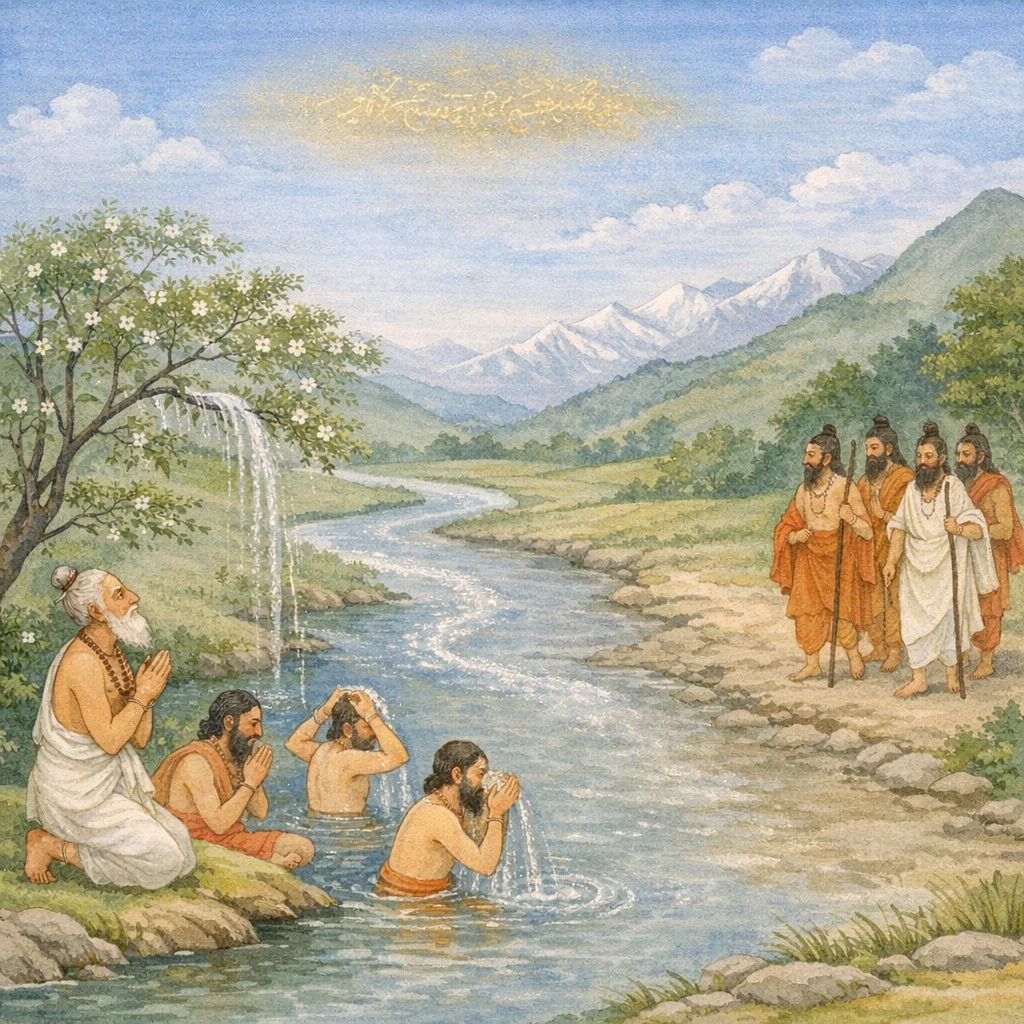
Adhyāya 27 unfolds through questions: the ṛṣis ask about Gaṅgā’s origin in her watery form and the consequences for the brahmins who afflicted Gautama. Sūta relates that, invoked by Gautama, Gaṅgā descends swiftly from Brahmā’s mountain realm, issuing as a stream from an udumbara branch. Gautama bathes in joy with his disciples and other sages, and the place becomes famed as “Gaṅgādvāra,” beautiful and sin-destroying even by mere sight. Rival sages, driven by competition, arrive to bathe; seeing them, Gaṅgā vanishes, and Gautama repeatedly supplicates and praises her with folded hands. A celestial voice then arises from Gaṅgā in the sky, turning the narrative into instruction: tīrtha-darśana and one’s moral disposition—sādhutva or asādhutva—stand at the chapter’s theological center.
Shlokas
Verse 1
ऋषय ऊचुः । गंगा च जलरूपेण कुतो जाता वद प्रभो । तन्माहात्म्यं विशेषेण कुतो जात वद प्रभो
The sages said: “O Lord, tell us—how did Gaṅgā arise in the form of water? And tell us in particular: from where did her special greatness (māhātmya) originate?”
Verse 2
यैर्विप्रैर्गौतमायेव दुःखं दत्तं दुरात्मभिः । तेषां किंच ततो जातमुच्यतां व्यास सद्गुरो
O Vyāsa, true Guru—please tell what further consequence arose for those wicked-minded brāhmaṇas by whom suffering was inflicted upon Gautama.
Verse 3
सूत उवाच । एवं संप्रार्थिता गंगा गौतमेन तदा स्वयम् । ब्रह्मणश्च गिरेर्विप्रा द्रुतं तस्मादवातरत्
Sūta said: Thus earnestly entreated by Gautama at that time, the river Gaṅgā—O venerable brāhmaṇas—swiftly descended from that mountain of Brahmā (the heavenly abode).
Verse 4
औदुंबरस्य शाखायास्तत्प्रवाहो विनिस्सृतः । तत्र स्नानं मुदा चक्रे गौतमो विश्रुतो मुनिः
From a branch of the udumbara tree, a sacred stream flowed forth. There the renowned sage Gautama joyfully performed his ritual bath.
Verse 5
गौतमस्य च ये शिष्या अन्ये चैव महर्षयः । समागताश्च ते तत्र स्नानं चक्रुर्मुदान्विताः
There too arrived Gautama’s disciples, along with other great seers; and, filled with joy, they performed the sacred bath at that holy place.
Verse 6
गंगाद्वारं च तन्नाम प्रसिद्धमभवत्तदा । सर्वपापहरं रम्यं दर्शनान्मुनिसत्तमः
From that time it became renowned by the name “Gaṅgādvāra.” O best of sages, it is a delightful holy place that removes all sins—merely by being seen (darśana).
Verse 7
गौतमस्पर्द्धिनस्ते च ऋषयस्तत्र चागताः । स्नानार्थं तांश्च सा दृष्ट्वा ह्यंतर्धानं गता द्रुतम्
Those sages—rivals of Gautama—also arrived there. Seeing them come for bathing, she quickly vanished from sight (through concealment).
Verse 8
मामेति गौतमस्तत्र व्याजहार वचो द्रुतम् । मुहुर्मुहुः स्तुवन् गंगां सांजलिर्नतमस्तकः
There, Gautama quickly spoke the words, “Come to me.” Again and again he praised the Goddess Gaṅgā, standing with joined palms and his head bowed in reverence.
Verse 9
गौतम उवाच । इमे च श्रीमदांधाश्च साधवो वाप्यसाधवः । एतत्पुण्यप्रभावेण दर्शनं दीयतां त्वया
Gautama said: “These people too—though prosperous, yet blind—whether righteous or unrighteous: by the power of this sacred merit, grant them your divine vision.”
Verse 10
सूत उवाच । ततो वाणी समुत्पन्ना गंगाया व्योममंडलात् । तच्छृणुध्वमृषिश्रेष्ठा गंगावचनमुत्तमम्
Sūta said: Then, from Gaṅgā in the circle of the sky, a voice arose. O best of sages, listen to that excellent utterance spoken by Gaṅgā.
Verse 11
एते दुष्टतमाश्चैव कृतघ्नाः स्वामिद्रोहिणः । जाल्माः पाखंडिनश्चैव द्रष्टुं वर्ज्याश्च सर्वदा
Such people are indeed the most wicked—ungrateful, betrayers of their own masters, base and deceitful, and hypocritical heretics; they should always be avoided, even to the point of not seeking their company or sight.
Verse 12
गौतम उवाच । मातश्च श्रूयतामेतन्महता गिर एव च । तस्मात्त्वया च कर्त्तव्यं सत्यं च भगवद्वचः
Gautama said: “O Mother, hear this also—spoken with great earnestness. Therefore, you must act accordingly, and you must uphold as true the word of the Lord.”
Verse 13
अपकारिषु यो लोक उपकारं करोति वै । तेन पूतो भवाम्यत्र भगवद्वचनं त्विदम्
Whoever, even among those harmed by others, truly renders help in return—by that very benevolence he becomes purified here itself. This is indeed the word of the Lord.
Verse 14
सूत उवाच । इति श्रुत्वा मुनेर्वाक्यं गौतमस्य महात्मनः । पुनर्वाणी समुत्पन्ना गंगाया व्योममंडलात्
Sūta said: Having thus heard the words of the great-souled sage Gautama, a voice once again arose from the heavenly sphere of the Goddess Gaṅgā.
Verse 15
कथ्यते हि त्वया सत्यं गौतमर्षे शिवं वचः । तथापि संग्रहार्थ च प्रायश्चितं चरंतु वै
O sage Gautama, what you have spoken is indeed true and in accord with Śiva’s sacred word. Even so, for the sake of order and as a guiding precedent, let them surely perform the prescribed expiation (prāyaścitta).
Verse 16
शतमेकोत्तरं चात्र कार्य्यं प्रक्रमणं गिरेः । भवच्छासनतस्त्वेतैस्त्वदधीनैर्विशेषतः
“Here, the circumambulation of the mountain is to be performed one hundred and one times. And this, especially, shall be carried out by those under your authority, in accordance with your command.”
Verse 17
ततश्चैवाधिकारश्च जायते दुष्टकारिणाम् । मद्दर्शने विशेषेण सत्यमुक्तं मया मुने
“Thereafter, even those who commit evil deeds come to gain entitlement (to purification and right conduct). Especially through the vision of Me, this is truly what I have declared, O sage.”
Verse 18
सूत उवाच । इति श्रुत्वा वचस्तस्याश्चक्रुर्वै ते तथाऽखिलाः । संप्रार्थ्य गौतमं दीनाः क्षंतव्यो नोऽपराधकः
Sūta said: Hearing her words, all of them did exactly as instructed. Then, in humility, they earnestly entreated Gautama, saying, “Please forgive us—we have committed an offense.”
Verse 19
एवं कृते तदा तेन गौतमेन तदाज्ञया । कुशावर्तं नाम चक्रे गङ्गाद्वारादधोगतम्
When this had been done, then Gautama—acting in accordance with that command—formed a sacred whirlpool-current called Kuśāvarta, flowing downward from Gaṅgādvāra (Haridvāra).
Verse 20
ततः प्रादुरभूत्तत्र सा तस्य प्रीतये पुनः । कुशावर्तं च विख्यातं तीर्थमासीत्तदुत्तमम्
Then she manifested there once more, for his satisfaction. That supremely excellent sacred ford became renowned as Kuśāvarta Tīrtha.
Verse 21
तत्र स्नातो नरो यस्तु मोक्षाय परिकल्पते । त्यक्त्वा सर्वानघान्सद्यो विज्ञानं प्राप्य दुर्लभम्
But whoever bathes there and dedicates himself to liberation (mokṣa), casting off all sins at once, attains that rare vijñāna—spiritual realization that leads to mokṣa.
Verse 22
गौतमो ऋषयश्चान्ये मिलिताश्च परस्परम् । लज्जितास्ते तदा ये च कृतघ्ना ह्यभवन्पुरा
Then Gautama and the other sages gathered together among themselves. Those who had earlier been ungrateful became ashamed at that time.
Verse 23
ऋषय ऊचुः । अस्माभिरन्यथा सूत श्रुतं तद्वर्णयामहे । गौतमस्तान्द्विजान् क्रुद्धश्शशापेति प्रबुध्यताम्
The sages said: “O Sūta, we have heard this account in a different way; therefore we shall relate it accordingly. Let it be clearly understood that Gautama, angered, pronounced a curse upon those twice-born men (dvija).”
Verse 24
सूत उवाच । द्विजास्तदपि सत्यं वै कल्पभेदसमाश्रयात् । वर्णयामि विशेषेण तां कथामपि सुव्रता
Sūta said: “O twice-born sages, that too is indeed true, for it depends upon the differences of the aeons (kalpas). Therefore, O you of noble vows, I shall describe that narrative as well—clearly and in detail.”
Verse 25
गौतमोपि ऋषीन्दृष्ट्वा तदा दुर्भिक्षपीडितान् । तपश्चकार सुमहद्वरुणस्य महात्मनः
Seeing the sages then tormented by famine, Gautama too undertook a very great austerity, directed toward the great-souled Varuṇa, seeking relief and the restoration of dharma.
Verse 26
अक्षय्यं कल्पयामास जलं वरुणदां यया । ततो व्रीहीन्यवांश्चैव वापयामास भूरिशः
By that power of devotion, he made the water bestowed by Varuṇa inexhaustible. Then the bountiful Lord had rice and barley sown as well.
Verse 27
इति श्रीशिवमहापुराणे चतुर्थ्यां कोटिरुद्रसंहितायां त्र्यंबकेश्वरज्योतिर्लिंग माहात्म्यवर्णनं नाम सप्तविंशोध्यायः
Thus, in the Śrī Śiva Mahāpurāṇa, in the Fourth section, the Koṭirudra-saṃhitā, ends the twenty-seventh chapter entitled “The Description of the Greatness of the Tryambakeśvara Jyotirliṅga.”
Verse 28
कदाचित्तत्स्त्रियो दुष्टा जलार्थमपमानिताः । ऊचु पतिभ्यस्ताः क्रुद्धा गौतमेर्ष्याकरं वचः
Once, those wicked women—insulted while seeking water—angrily spoke to their husbands words that stirred up envy against Gautama.
Verse 29
ततस्ते भिन्नमतयो गां कृत्वा कृत्रिमां द्विजाः । तद्धान्यभक्षणासक्तां चक्रुस्तां कुटिलाशयाः
Then those twice-born men—divided in opinion and crooked at heart—fashioned an artificial cow, and made her intent on eating that grain.
Verse 30
स्वधान्यभक्षणासक्तां गां दृष्ट्वा गौतमस्तदा । तृणेन ताडयामास शनैस्तां संनिवारयन्
Then Gautama, seeing the cow intent on eating his own grain, gently struck her with a blade of grass, slowly trying to restrain her.
Verse 31
तृणसंस्पर्शमात्रेण सा भूमौ पतिता च गौः । मृता ह्यभूत्क्षणं विप्रा भाविकर्मवशात्तदा
By the mere touch of a blade of grass, that cow fell upon the ground and, in an instant, died—O brāhmaṇas—at that time, being under the compelling force of karma destined to ripen.
Verse 32
गौर्हता गौतमेनेति तदा ते कुटिलाशयाः । एकत्रीभूय तत्रत्यैः सकला ऋषयोऽवदन्
Then those crooked-hearted ones cried, “The cow has been slain by Gautama!” Gathering together, all the sages who were present there spoke out (in accusation).
Verse 33
ततस्स गौतमो भीतो गौर्हतेति बभूव ह । चकार विस्मयं नार्यहल्याशिष्यैश्शिवानुगः
Then Gautama grew afraid, thinking, “A cow has been slain!” And the devotee of Śiva—having been instructed by the lady Ahalyā—was filled with astonishment.
Verse 34
ततस्स गौतमो ज्ञात्वा तां गां क्रोधसमाकुलः । शशाप तानृषीन् सर्वान् गौतमो मुनिसत्तमः
Then the sage Gautama, having understood what lay behind that cow, became overwhelmed with anger; the best of sages, Gautama, pronounced a curse upon all those rishis.
Verse 35
गौतम उवाच । यूयं सर्वे दुरात्मानो दुःखदा मे विशेषतः । शिवभक्तस्य सततं स्युर्वेदविमुखास्सदा
Gautama said: “All of you are of wicked disposition, and you cause me suffering—especially so. For a devotee of Śiva, you remain forever turned away from the Veda, at all times.”
Verse 36
अद्यप्रभृति वेदोक्ते सत्कर्मणि विशेषतः । मा भूयाद्भवतां श्रद्धा शैवमार्गे विमुक्तिदे
From today onward, let your faith not remain confined—especially—to the Veda-enjoined righteous rites alone; may your devotion arise in the Śaiva path, the giver of liberation.
Verse 37
अद्यप्रभृति दुर्मार्गे तत्र श्रद्धा भवेत्तु वः । मोक्षमार्गविहीने हि सदा श्रुतिबहिर्मुखे
From this day onward, let your faith not rest upon that evil path—bereft of the way to mokṣa and ever turned away from the Vedic revelation.
Verse 38
अद्यप्रभृति भालानि मृल्लिप्तानि भवन्तु वः । स्रसध्वं नरके यूयं भालमृल्लेपनाद्द्विजाः
“From this day onward, let your foreheads be smeared with clay. O twice-born ones, because of this clay-plastering of the forehead, may you fall into hell.”
Verse 39
भवंतो मा भविष्यंतु शिवैक परदैवताः । अन्यदेवसमत्वेन जानंतु शिवमद्वयम्
“May you not remain merely those who hold Śiva alone as the supreme deity; rather, knowing Śiva as the non-dual Reality, understand Him as the very equal essence present in all the gods.”
Verse 40
मा भूयाद्भवतां प्रीतिश्शिवपूजादिकर्मणि । शिवनिष्ठेषु भक्तेषु शिवपर्वसु सर्वदा
May your devotion ever increase in acts such as the worship of Lord Śiva—always, in the company of devotees firmly established in Śiva, and on sacred festivals dedicated to Śiva.
Verse 41
अद्य दत्ता मया शापा यावंतो दुःखदायकाः । तावंतस्संतु भवतां संततावपि सर्वदा
“As many curses as I have uttered today—each a bringer of sorrow—so many may they remain upon you, and upon your progeny as well, always.”
Verse 42
अशैवास्संतु भवतां पुत्रपौत्रादयो द्विजाः । पुत्रैस्सहैव तिष्ठंतु भवंतो नरके ध्रुवम्
O brāhmaṇas, may your sons, grandsons, and descendants become non-Śaivas; and may you yourselves, together with your sons, certainly remain in hell.
Verse 43
ततो भवंतु चण्डाला दुःखदारिद्र्यपीडिताः । शठा निन्दाकरास्सर्वे तप्तमुद्रांकितास्सदा
“Therefore, let them become outcastes (caṇḍālas), tormented by sorrow and poverty—deceitful, all given to slander—ever bearing the marks of branding.”
Verse 44
सूत उवाच । इति शप्त्वा मुनीन् सर्वान् गौतमस्स्वाश्रमं ययौ । शिवभक्तिं चकाराति स बभूव सुपावनः
Sūta said: Having thus cursed all the sages, Gautama went back to his own hermitage. There he devoted himself intensely to bhakti toward Lord Śiva, and by that devotion he became exceedingly purified and sanctified.
Verse 45
ततस्तैः खिन्नहृदया ऋषयस्तेखिला द्विजाः । कांच्यां चक्रुर्निवासं हि शैवधर्मबहिष्कृताः
Then those sages—indeed all the twice-born—became heavy-hearted; cast out from the discipline of Śiva, they made their dwelling in Kāñcī.
Verse 46
तत्पुत्राश्चाभवन्सर्वे शैवधर्मबहिष्कृताः । अग्रे तद्वद्भविष्यंति कलौ बहुजनाः खलाः
And all his sons became those who stood outside the Śaiva Dharma. In the time to come, in the Kali age as well, many people will likewise become wicked—turning away from the discipline of devotion and right conduct taught for the worship of Lord Śiva.
Verse 47
इति प्रोक्तमशेषेण तद्वृत्तं मुनिसत्तमाः । पूर्ववृत्तमपि प्राज्ञाः श्रुतं सर्वैस्तु चादरात्
Thus, O best of sages, that entire account has been related in full. And the earlier narrative too—O wise ones—has been heard by all with reverent attention.
Verse 48
इति वश्च समाख्यातो गौतम्याश्च समुद्भवः । माहात्म्यमुत्तमं चैव सर्वपापहरं परम्
Thus have I explained to you the origin of the Gautamī, together with her supreme glory—most excellent indeed, and the highest remover of all sins.
Verse 49
त्र्यंबकस्य च माहात्म्यं ज्योतिर्लिंगस्य कीर्तितम् । यच्छ्रुत्वा सर्वपापेभ्यो मुच्यते नात्र संशयः
Thus has been proclaimed the sacred greatness of Tryambaka—the Jyotirliṅga. Whoever hears it is freed from all sins; of this there is no doubt.
Verse 50
अतः परं प्रवक्ष्यामि वैद्यनाथेश्वरस्य हि । ज्योतिर्लिंगस्य माहात्म्यं श्रूयतां पापहारकम्
Therefore, hereafter I shall expound the glory of Vaidyanātheśvara—the Jyotirliṅga. Listen, for it is the remover of sins.
Frequently Asked Questions
The chapter narrates Gaṅgā’s responsive descent upon Gautama’s invocation, the establishment of Gaṅgādvāra as a recognized tīrtha, and the theological claim that darśana/snānā at such a locus is intrinsically pāpa-hara (sin-removing), while divine presence may withdraw in response to contentious or impure intent.
Gaṅgā’s emergence from an udumbara branch encodes the idea that sanctity can localize through a living axis (tree/branch as a conduit), while her disappearance before rival sages dramatizes a Purāṇic principle: tīrtha is not merely physical water but a moral-ritual field where intention and humility condition access to grace.
No distinct Śiva or Gaurī form is foregrounded in the sampled verses; instead, the chapter centers Gaṅgā as a sacral power whose authority is articulated through a celestial voice, functioning as a Shaiva-aligned tīrtha medium rather than an iconographic manifestation.