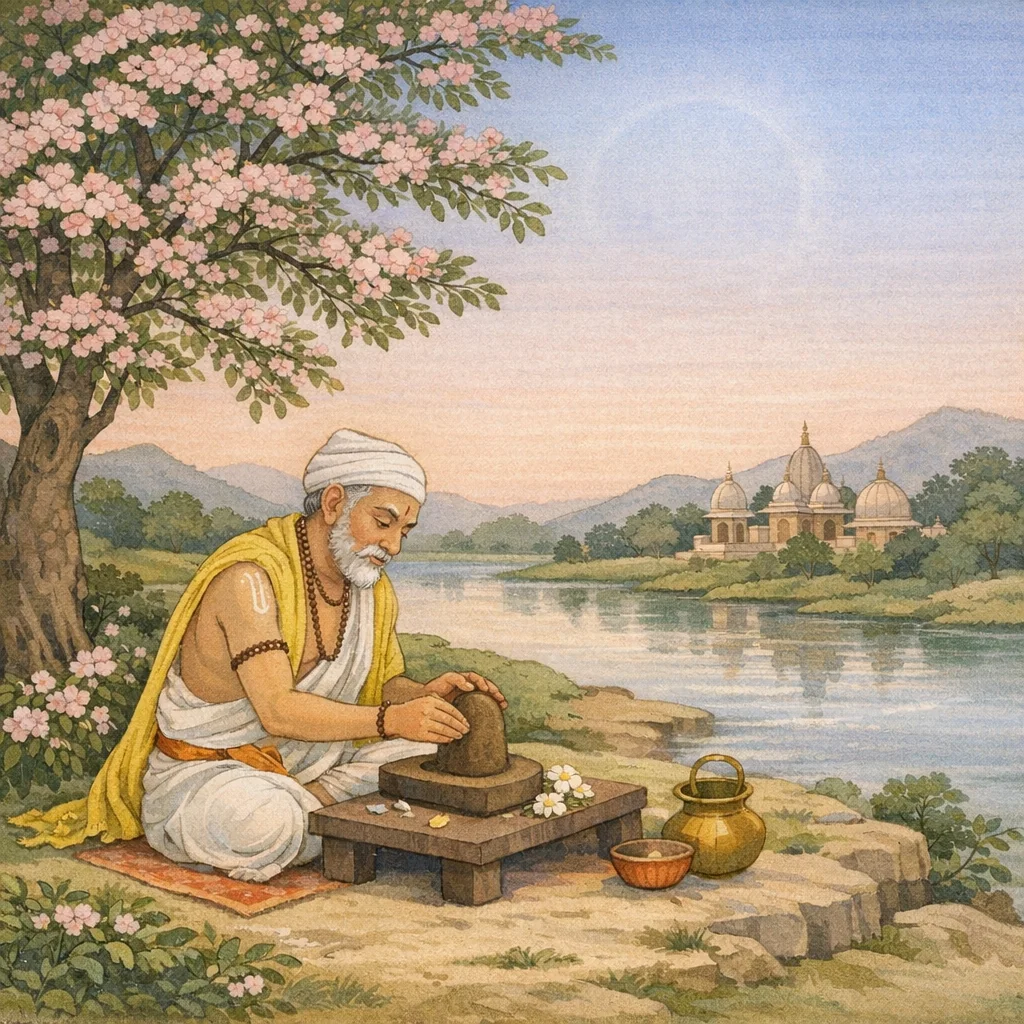
अवंतीस्थ-ब्राह्मणकथा तथा तृतीय-ज्योतिर्लिङ्गोपाख्यान-प्रस्तावना (Avanti Brahmin Narrative and Prelude to the Third Jyotirliṅga)
Adhyāya 16 begins with the ṛṣis addressing Sūta, praising his Vyāsa-derived omniscience and admitting that, even after hearing of the Jyotirliṅgas, their contentment is not complete. They earnestly request the account of the “third” Jyotirliṅga. Sūta replies that the company of sādhus is itself sanctifying and promises to narrate a divine, sin-destroying, purifying story to be heard with full attention. The scene is set in Avantī (Ujjayinī), a beautiful city that purifies the world, is beloved of Śiva, and grants liberation to embodied beings. A model brāhmaṇa is introduced—devoted to auspicious deeds, Vedic study, and Vedic rites—who continually worships Śiva and daily adores an earthen (pārthiva) liṅga. Through right knowledge he attains the fruit of all rites and the “path of the good.” The narrative then mentions his four sons, also devoted to Śiva and respectful to their parents; three are named in order—Devapriya (eldest), Priyamedhā (second), and Kṛta (third), described as a bearer of dharma and firm in vows—preparing for the ensuing Jyotirliṅga-focused development.
Shlokas
Verse 1
ऋषय ऊचुः । सूत सर्वं विजानासि वस्तु व्यास प्रसादतः । ज्योतिषां च कथां श्रुत्वा तृप्तिर्नैव प्रजायते
The sages said: “O Sūta, by the grace of Vyāsa you know every matter in its truth. Yet even after hearing the sacred account of the Jyotis—the Jyotirliṅgas—no satisfaction arises within us at all.”
Verse 2
तस्मात्त्वं हि विशेषेण कृपां कृत्वातुलां प्रभो । ज्योतिर्लिंगं तृतीयं च कथय त्वं हि नोऽधुना
Therefore, O Lord, be especially gracious—showing your incomparable compassion—and now tell us of the third Jyotirliṅga.
Verse 3
सूत उवाच । धन्योऽहं कृतकृत्योऽहं श्रीमतां भवतां यदि । गतश्च संगमं विप्रा धन्या वै साधुसंगतिः
Sūta said: “Blessed am I; fulfilled is my life, since I have attained communion with you illustrious brāhmaṇa sages. Truly, the company of the righteous is itself a blessing.”
Verse 4
अतो मत्वा स्वभाग्यं हि कथयिष्यामि पावनीम् । पापप्रणाशिनीं दिव्यां कथां च शृणुतादरात्
Therefore, deeming this your own good fortune, I shall narrate this purifying account—divine and destructive of sins. Listen to this sacred story with reverent attention.
Verse 5
अवंती नगरी रम्या मुक्तिदा सर्वदेहिनाम् । शिवप्रिया महापुण्या वर्तते लोकपावनी
The lovely city of Avantī bestows liberation upon all embodied beings. Beloved of Śiva and supremely meritorious, it stands as a purifier of the worlds.
Verse 6
तत्रासीद्बाह्मणश्रेष्ठश्शुभकर्मपरायणः । वेदाध्ययनकर्त्ता च वेदकर्मरतस्सदा
There lived a foremost Brāhmaṇa, devoted to auspicious duties—one who diligently studied the Vedas and was ever engaged in the Vedic rites.
Verse 7
अग्न्याधानसमायुक्तश्शिवपूजारतस्सदा । पार्थिवीं प्रत्यहं मूर्तिं पूजयामास वै द्विजः
Endowed with the rite of maintaining the sacred fires (agnyādhāna) and ever devoted to the worship of Śiva, that twice-born brāhmaṇa worshipped each day an earthen form (pārthiva-mūrti) as a support for Śiva’s presence.
Verse 8
सर्वकर्मफलं प्राप्य द्विजो वेदप्रियस्सदा । सतां गतिं समालेभे सम्यग्ज्ञानपरायणः
Having obtained the fruit of all righteous deeds, the twice-born—ever devoted to the Vedas—attained the blessed path of the holy, wholly dedicated to right knowledge that leads to Śiva-realization.
Verse 9
तत्पुत्रास्तादृशाश्चासंश्चत्वारो मुनिसत्तमाः । शिवपूजारता नित्यं पित्रोरनवमास्सदा
His sons too were of the same nature—four foremost sages—ever devoted to the worship of Lord Śiva, and always obedient and respectful toward their parents.
Verse 10
देवप्रियश्च तज्ज्येष्ठः प्रियमेधास्ततः परम् । तृतीयस्तु कृतो नाम धर्मवाही च सुव्रतः
Among them, the eldest was Devapriya. Next came Priyamedhā. The third was named Kṛta—upright in conduct—one who bore and upheld dharma, and firm in sacred vows.
Verse 11
तेषां पुण्यप्रतापाच्च पृथिव्यां सुखमैधत । शुक्लपक्षे यथा चन्द्रो वर्द्धते च निरंतरम्
By the radiant power of their accumulated merit, happiness flourished upon the earth; just as the moon steadily increases without interruption in the bright fortnight (śukla-pakṣa).
Verse 12
तथा तेषां गुणास्तत्र वर्द्धन्ते स्म सुखावहाः । ब्रह्मतेजोमयी सा वै नगरी चाभवत्तदा
Thus, in that place their auspicious qualities continued to increase, bringing spiritual ease and well-being; and at that time the city itself became suffused with the radiance of Brahman, resplendent with sacred brilliance.
Verse 13
एतस्मिन्नन्तरे तत्र यज्जातं वृत्तमुत्तमम् । श्रूयतां तद्द्विजश्रेष्ठाः कथयामि यथाश्रुतम्
Meanwhile, O best of the twice-born, listen to the most excellent event that occurred there. I shall narrate it exactly as I have heard it.
Verse 14
पर्वते रत्नमाले च दूषणाख्यो महासुरः । बलवान्दैत्यराजश्च धर्मद्वेषी निरन्तरम्
On the Ratnamālā mountain there lived a great asura named Dūṣaṇa—mighty, a king among the daityas, and one who bore unceasing hatred toward dharma.
Verse 15
ब्रह्मणो वरदानाच्च जगतुच्छीचकार ह । देवा पराजितास्तेन स्थानान्निस्सारितास्तथा
Empowered by Brahmā’s boon, he threw the worlds into upheaval. By him the gods were defeated and were likewise driven out from their celestial abodes.
Verse 16
इति श्रीशिवमहापुराणे चतुर्थ्यां कोटिरुद्रसंहितायां महाकालज्योतिर्लिंगमाहात्म्यवर्णनं नाम षोडशोऽध्यायः
Thus, in the Śrī Śiva Mahāpurāṇa, in the Fourth (Koṭirudra) Saṃhitā, ends the sixteenth chapter entitled “The Description of the Glory of the Mahākāla Jyotirliṅga.”
Verse 17
यावंतो वेदधर्माश्च तावंतो दूरतः कृताः । तीर्थेतीर्थे तथा क्षेत्रे धर्मो नीतश्च दूरतः
All the duties enjoined by the Vedas were cast far away; and from pilgrimage to pilgrimage, from sacred region to sacred region, righteousness itself was driven far off.
Verse 18
अवंती नगरी रम्या तत्रैका दृश्यते पुनः । इत्थं विचार्य तेनैव यत्कृतं श्रूयतां हि तत्
“Avantī is a delightful city; there, indeed, a certain sacred presence is seen again. Having reflected thus, listen now to what was done by him.”
Verse 19
बहुसैन्यसमायुक्तो दूषणस्स महासुरः । तत्रस्थान्ब्रह्मणान्सर्वानुद्दिश्य समुपाययौ
The great asura Dūṣaṇa, accompanied by a vast army, advanced there, directing his intent toward all the Brāhmaṇas who were staying in that place.
Verse 20
तत्रागत्य स दैत्येन्द्रश्चतुरो दैत्यसत्तमान् । प्रोवाचाहूय वचनं विप्र द्रोही महाखलः
Arriving there, that lord of the Daityas—utterly wicked and hostile to the brāhmaṇas—summoned four of the foremost Daityas and addressed them in words.
Verse 21
दैत्य उवाच । किमेते ब्राह्मणा दुष्टा न कुर्वंति वचो मम । वेदधर्मरता एते सर्वे दंड्या मते मम
The Daitya said: “Why do these wicked brāhmaṇas not carry out my command? Since they are devoted to the dharma of the Vedas, in my view they all deserve punishment.”
Verse 22
सर्वे देवा मया लोके राजानश्च पराजिताः । वशे किं ब्राह्मणाश्शक्या न कर्तुं दैत्यसत्तमाः
“All the gods in this world—and even the kings—have been defeated by me. O best of Daityas, what is there that cannot be done? Are not even the brāhmaṇas capable of being brought under control?”
Verse 23
यदि जीवितुमिच्छा स्यात्तदा धर्मं शिवस्य च । वेदानां परमं धर्मं त्यक्त्वा सुखसुभागिनः
If one truly wishes to live well and meaningfully, one should follow the Dharma of Lord Śiva. Those who abandon the supreme Dharma taught by the Vedas become mere seekers of comfort and worldly fortune.
Verse 24
अन्यथा जीवने तेषां संशयश्च भविष्यति । इति सत्यं मया प्रोक्तं तत्कुरुध्वं विशंकिताः
Otherwise, doubt will indeed arise regarding their very survival. Thus have I spoken the truth—therefore do it, O you who are uncertain.
Verse 25
सूत उवाच । इति निश्चित्य ते दैत्याश्चत्वारः पावका इव । चतुर्दिक्षु तदा जाताः प्रलये च यथा पुरा
Sūta said: Having thus resolved, those four Daityas—like blazing fires—then spread out into the four directions, just as in former times at the dissolution (pralaya).
Verse 26
ते ब्राह्मणास्तथा श्रुत्वा दैत्यानामुद्यमं तदा । न दुःखं लेभिरे तत्र शिवध्यान परायणाः
Hearing then of the Daityas’ aggressive undertaking, those brāhmaṇas—steadfastly devoted to meditation on Śiva—did not experience sorrow in that place.
Verse 27
धैर्यं समाश्रितास्ते च रेखामात्रं तदा द्विजाः । न चेलुः परमध्यानाद्वराकाः के शिवाग्रतः
Then those brāhmaṇa sages, taking refuge in steadfast courage, became as if mere lines—motionless. Poor souls, absorbed in the highest meditation, they did not stir at all before Śiva’s very presence.
Verse 28
एतस्मिन्नन्तरे तैस्तु व्याप्तासीन्नगरी शुभा । लोकाश्च पीडितास्तैस्तु ब्राह्मणान्समुपाययुः
Meanwhile, that auspicious city became overrun by them. Harassed and afflicted by those oppressors, the people then approached the Brahmins for refuge and counsel—seeking the righteous means by which protection may be obtained through dharma and devotion to Lord Śiva.
Verse 29
लोका ऊचुः । स्वामिनः किं च कर्त्तव्यं दुष्टाश्च समुपागताः । हिंसिता बहवो लोका आगताश्च समीपतः
The people said: “O master, what should now be done? Wicked men have arrived. Many people have been harmed, and they have come close at hand.”
Verse 30
सूत उवाच । तेषामिति वचश्श्रुत्वा वेदप्रियसुताश्च ते । समूचुर्ब्राह्मणास्तान्वै विश्वस्ताश्शंकरे सदा
Sūta said: Hearing those words, the sons of Vedapriya—those brāhmaṇas who ever trusted in Śaṅkara—addressed them in reply.
Verse 31
ब्राह्मणा ऊचुः । श्रूयतां विद्यते नैव बलं दुष्टभयावहम् । न शस्त्राणि तथा संति यच्च ते विमुखाः पुनः
The brāhmaṇas said: “Listen—there is truly no strength here that can inspire fear in the wicked. Nor do we possess such weapons; moreover, those who were on your side have again turned away from you.”
Verse 32
सामान्यस्यापमानो नो ह्याश्रयस्य भवेदिह । पुनश्च किं समर्थस्य शिवस्येह भविष्यति
Here, the slighting of an ordinary person may indeed harm one who depends on him; but what, again, could possibly happen here to the all-competent Lord Śiva?
Verse 33
शिवो रक्षां करोत्वद्यासुराणां भयतः प्रभुः । नान्यथा शरणं लोके भक्तवत्सलतश्शिवात्
May Lord Śiva, the sovereign Lord, protect you today from the fear of the asuras. In this world there is no other refuge—because of His tender love for devotees—apart from Śiva.
Verse 34
सूत उवाच । इति धैर्यं समास्थाय समर्चां पार्थिवस्य च । कृत्वा ते च द्विजाः सम्यक्स्थिता ध्यानपरायणाः । दृष्टा दैत्येन तावच्च ते विप्रास्सबलेन हि
Sūta said: “Thus, having gathered their courage and duly performed the worship of the earthen (pārthiva) form, those twice-born brāhmaṇas stood firmly, wholly devoted to meditation. At that very moment, however, those brāhmaṇas were seen by the daitya, who had his forces with him.”
Verse 35
दूषणेन वचः प्रोक्तं हन्यतां वध्यतामिति । तच्छ्रुतं तैस्तदा नैव दैत्यप्रोक्तं वचो द्विजैः । वेदप्रियसुतैश्शंभोर्ध्यानमार्गपरायणैः
With malice he uttered, “Strike them down—kill them.” But on hearing those words, the twice-born sons of Vedapriya—devoted to Śambhu and steadfast on the path of meditation—did not accept the demon’s command at all.
Verse 36
अथ यावत्स दुष्टात्मा हन्तुमैच्छद्द्विजांश्च तान् । तावच्च प्रार्थिवस्थाने गर्त्तं आसीत्सशब्दकः
Then, just as that wicked-souled one sought to kill those brāhmaṇas, at that very moment a pit appeared on the ground, resounding with a great roar.
Verse 37
गर्तात्ततस्समुत्पन्नः शिवो विकटरूपधृक् । महाकाल इति ख्यातो दुष्टहंता सतां गतिः
Then, from that pit, Śiva arose bearing a formidable form. He became renowned as Mahākāla—the slayer of the wicked and the refuge and final goal of the righteous.
Verse 38
महाकालस्समुत्पन्नो दुष्टानां त्वादृशामहम् । खल त्वं ब्राह्मणानां हि समीपाद्दूरतो व्रज
“I am Mahākāla, arisen to chastise the wicked like you. O vile one, go far away—keep away from the proximity of the brāhmaṇas.”
Verse 39
इत्युक्त्वा हुंकृतेनैव भस्मसात्कृतवांस्तदा । दूषणं च महाकालः शंकरस्सबलं द्रुतम्
Thus having spoken, Mahākāla Śaṅkara, by the mere utterance of “huṃ,” instantly reduced Dūṣaṇa and all his forces to ashes.
Verse 40
कियत्सैन्यं हतं तेन किंचित्सैन्यं पलायितम् । दूषणश्च हतस्तेन शिवेनेह परात्मना
By Him, a great portion of the army was slain, and a small part of the forces fled. Dūṣaṇa too was killed there by that Śiva—the Supreme Self—who had manifested in this place.
Verse 41
सूर्यं दृष्ट्वा यथा याति संक्षयं सर्वशस्तमः । तथैव च शिवं दृष्ट्वा तत्सैन्यं विननाश ह
Just as darkness of every kind is destroyed on seeing the sun, so too, on beholding Lord Śiva, that opposing army perished utterly.
Verse 42
देवदुन्दुभयो नेदुः पुष्पवृष्टिः पपात ह । देवास्समाययुस्सर्वे हरिब्रह्मादयस्तथा
The celestial drums resounded, and a rain of flowers fell. Then all the gods assembled there—Vishnu, Brahma, and the others as well—honouring the auspicious manifestation of the Lord.
Verse 43
भक्त्या प्रणम्य तं देवं शंकरं लोकशंकरम् । तुष्टुवुर्विविधैः स्तोत्रैः कृतांजलिपुटा द्विजाः
Bowing in devotion to that Deva—Śaṅkara, the benefactor of the worlds—the twice-born sages, with hands joined in añjali, praised Him with many kinds of hymns.
Verse 44
ब्राह्मणांश्च समाश्वास्य सुप्रसन्नश्शिवस्स्वयम् । वरं ब्रूतेति चोवाच महाकालो महेश्वरः
Having reassured the brāhmaṇas, Śiva Himself—fully gracious and pleased—spoke. That Mahākāla, Maheśvara, said: “Speak now; ask for a boon.”
Verse 45
तच्छ्रुत्वा ते द्विजास्सर्वे कृताञ्जलिपुटास्तदा । सुप्रणम्य शिवं भक्त्या प्रोचुस्संनतमस्तकाः
Hearing that, all those twice-born sages then joined their palms in reverence. Bowing deeply to Lord Śiva with devotion, with heads humbly lowered, they spoke.
Verse 46
द्विजा ऊचुः । महाकाल महादेव दुष्टदण्डकर प्रभो । मुक्तिं प्रयच्छ नश्शंभो संसारांबुधितश्शिव
The twice-born (brahmins) said: “O Mahākāla, O Mahādeva, O Lord who chastises the wicked! O Śambhu, grant us liberation—O Śiva, (lift us) from the ocean of worldly existence.”
Verse 47
अत्रैव लोकरक्षार्थं स्थातव्यं हि त्वया शिव । स्वदर्शकान्नराञ्छम्भो तारय त्वं सदा प्रभो
O Śiva, for the protection of the worlds you must remain here indeed. O Śambhu, O Lord—always ferry across (liberate) the people who behold you (and come for your darśana).
Verse 48
सूत उवाच । इत्युक्तस्तैश्शिवस्तत्र तस्थौ गर्ते सुशोभने । भक्तानां चैव रक्षार्थं दत्त्वा तेभ्यश्च सद्गतिम्
Sūta said: Thus addressed by them, Lord Śiva remained there in that beautiful hollow to protect His devotees, and He granted them sadgati—the true auspicious goal.
Verse 49
द्विजास्ते मुक्तिमापन्नाश्चतुर्द्दिक्षु शिवास्पदम् । क्रोशमात्रं तदा जातं लिंगरूपिण एव च
Those twice-born ones attained liberation, and in the four directions the abode of Śiva appeared. At that time a manifestation in Liṅga-form also arose, extending to the measure of one krośa.
Verse 50
महाकालेश्वरो नाम शिवः ख्यातश्च भूतले । तं दृष्ट्वा न भवेत्स्वप्ने किंचिद्दुःखमपि द्विजाः
On earth, Śiva is renowned by the name Mahākāleśvara. O twice-born ones, having beheld Him, not even in a dream does the slightest sorrow arise.
Verse 51
यंयं काममपेक्ष्यैव तल्लिंगं भजते तु यः । तंतं काममवाप्नोति लभेन्मोक्षं परत्र च
Whoever worships that Liṅga with a particular wish in mind attains that very desired object; and in the hereafter, he also gains liberation.
Verse 52
एतत्सर्वं समाख्यातं महाकालस्य सुव्रताः । समुद्भवश्च माहात्म्यं किमन्यच्छ्रोतुमिच्छथ
O you of noble vows, I have thus fully narrated everything—both the manifestation and the glory of Mahākāla. What else do you wish to hear?
Frequently Asked Questions
The sages formally petition Sūta to narrate the ‘third’ Jyotirliṅga, and Sūta begins the frame-story by relocating the discourse to Avantī and introducing exemplary Shaiva-Vedic householders whose lives become the narrative vehicle for the Jyotirliṅga account.
Avantī is presented as a mokṣa-competent sacred geography (a place where liberation is thematically near), while the daily worship of a temporary earthen liṅga symbolizes repeatable inner construction of sacred presence—discipline (niyama), purity, and focused cognition—transforming routine ritual into a stable contemplative orientation toward Śiva.
Rather than a named anthropomorphic form, the chapter foregrounds Śiva’s presence through the liṅga paradigm—specifically the Jyotirliṅga as a theophany to be narrated and the pārthiva-liṅga as a daily ritual form—linking Śiva’s transcendence to accessible, localized worship.