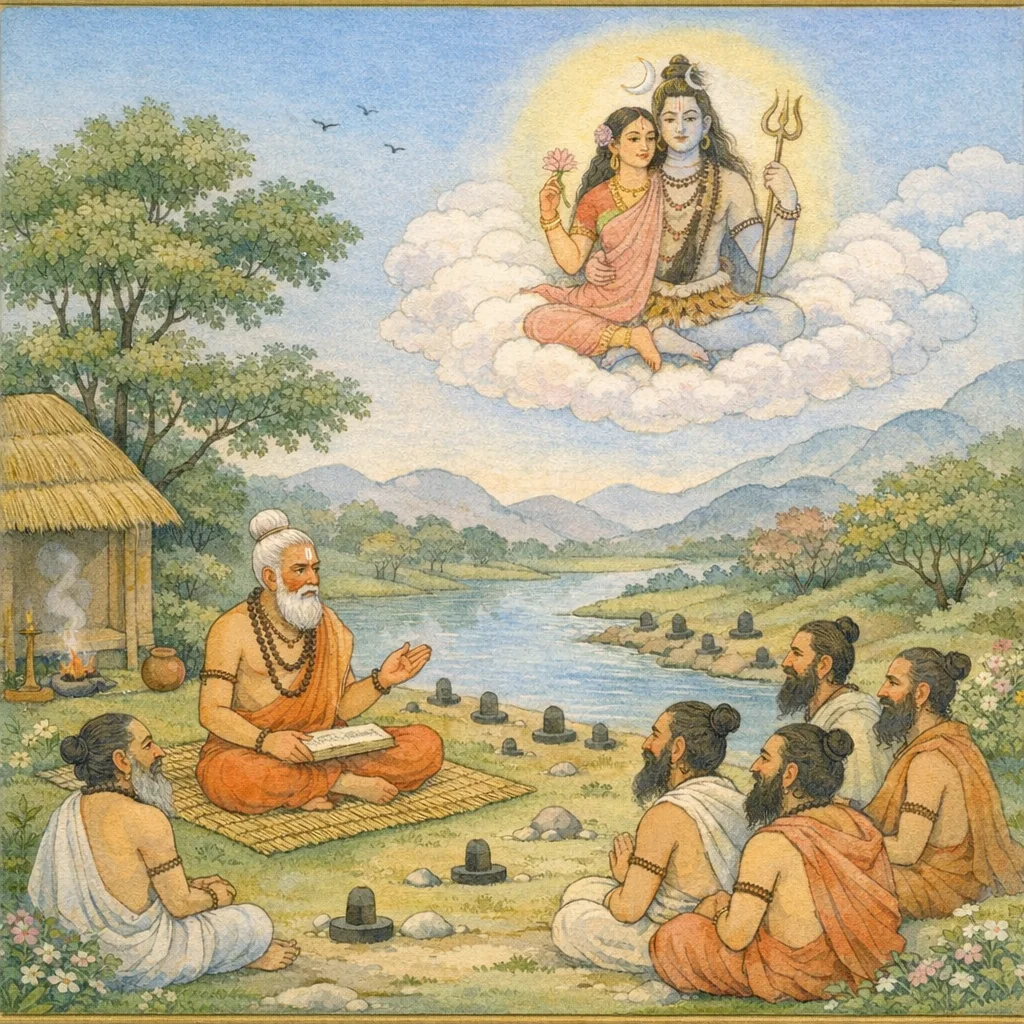
ज्योतिर्लिङ्ग-तदुपलिङ्ग-माहात्म्यवर्णनम् (Narration of the Greatness of the Jyotirliṅga and Associated Liṅgas)
Adhyāya 1 begins with an elevated benediction to Ardhanārīśvara, portraying Śiva as the changeless substratum who, through māyā, manifests as the world, and whose grace bestows both svarga and apavarga. A second maṅgala verse invokes Śiva’s auspicious, serene form, marked by the moon-digit and calming the threefold afflictions (tāpatraya). The scene then shifts into dialogue: the ṛṣis praise Sūta’s earlier account of Śiva’s avatāra-mahātmyas and request further teaching focused on the greatness of liṅgas, asking for an enumerative description of divine liṅgas found in tīrthas and famed places for the welfare of the world. Sūta agrees to speak briefly out of affection and duty. The chapter states a key doctrine: Śiva’s liṅgas are innumerable—indeed, earth and cosmos are said to be “liṅga-made” (liṅga-maya)—establishing the sacred symbol’s identity with totality and grounding the later site-catalogues and māhātmya lists of the Saṃhitā.
Shlokas
Verse 1
इति श्रीशिवमहापुराणे चतुर्थ्यां कोटिरुद्रसंहितायां ज्योतिर्लिगतदुपलिंग माहात्म्यवर्णनं नाम प्रथमोऽध्यायः
Thus, in the Śrī Śiva Mahāpurāṇa, in the Fourth Book—the Koṭirudrasaṃhitā—begins the First Chapter, entitled “The narration of the glory of the Jyotirliṅga and the Tadupaliṅga.”
Verse 2
कृपाललितवीक्षणं स्मितमनोज्ञवक्त्राम्बुजं शशांककलयोज्ज्वलं शमितघोरतापत्रयम् । करोतु किमपि स्फुरत्परमसौख्यसच्चिद्वपुर्धराधरसुताभुजोद्वलयितं महो मंगलम्
May that supremely auspicious Lord Śiva—whose glance is softened by compassion, whose lotus-face is lovely with a gentle smile, whose brow shines with the crescent moon, and who stills the dreadful threefold afflictions—grant us some wondrous blessing: He whose very form is Existence and Consciousness, flashing with the highest bliss, and who is embraced by the radiant arms of the Mountain’s Daughter (Pārvatī).
Verse 3
ऋषय ऊचुः । सम्यगुक्तं त्वया सूत लोकानां हितकाम्यया । शिवावतारमाहात्म्यं नानाख्यानसमन्वितम्
The sages said: “O Sūta, you have spoken rightly—out of a desire for the welfare of all beings—about the greatness of Lord Śiva’s descents, enriched with many sacred narratives.”
Verse 4
पुनश्च कथ्यतां तात शिवमाहात्म्यमुत्तमम् । लिंगसम्बन्धि सुप्रीत्या धन्यस्त्वं शैवसत्तमः
“O dear one, please narrate again the supreme glory of Lord Śiva—especially that which is connected with the Liṅga. Through your deep, joyful devotion to the Liṅga, you are truly blessed, O best among Śaivas.”
Verse 5
शृण्वन्तस्त्वन्मुखाम्भोजान्न तृप्तास्स्मो वयं प्रभो । शैवं यशोऽमृतं रम्यं तदेव पुनरुच्यताम्
“O Lord, even as we listen to the nectar-like words flowing from the lotus of Your mouth, we are not satisfied. Therefore, may that delightful, immortal glory of Śiva be spoken again—once more.”
Verse 6
पृथिव्यां यानि यानि लिंगानि तीर्थेतीर्थे शुभानि हि । अन्यत्र वा स्थले यानि प्रसिद्धानि स्थितानि वै
Whatever auspicious Śiva-liṅgas exist upon the earth—at every tīrtha (sacred ford) and also those established elsewhere in places renowned in the world—all of them are to be revered as holy manifestations of Śiva.
Verse 7
तानि तानि च दिव्यानि लिंगानि परमेशितुः । व्यासशिष्य समाचक्ष्व लोकानां हितकाम्यया
O disciple of Vyāsa, for the welfare of the worlds, please describe to us—one by one—those divine Liṅgas of the Supreme Lord, Parameśvara.
Verse 8
सूत उवाच । साधुपृष्टमृषिश्रेष्ठ लोकानां हितकाम्यया । कथयामि भवत्स्नेहात्तानि संक्षेपतो द्विजाः
Sūta said: O best of sages, you have asked well, seeking the welfare of the worlds. Out of affection for you, O twice-born ones, I shall relate those matters concisely.
Verse 9
सर्वेषां शिवलिंगानां मुने संख्या न विद्यते । सर्वं लिंगमयी भूमिः सर्वलिंगमयं जगत्
O sage, the number of Śiva-liṅgas is beyond knowing. The whole earth is pervaded by the Liṅga, and the entire universe is filled with the Liṅga—revealing that the Lord’s sacred emblem is present everywhere as the support and sign of Śiva.
Verse 10
लिंगमयानि तीर्थानि सर्वं लिंगे प्रतिष्ठितम् । संख्या न विद्यते तेषां तानि किंचिद्ब्रवीम्यहम्
All tīrthas (sacred fords and holy places) are of the nature of the Liṅga, and everything is established in the Liṅga. Their number cannot be known; therefore I shall speak of only a few of them.
Verse 11
यत्किंचिद्दृश्यते दृश्यं वर्ण्यते स्मर्यते च यत् । तत्सर्वं शिवरूपं हि नान्यदस्तीति किंचन
Whatever is seen as an object of perception—whatever is described in words and whatever is remembered in the mind—all of that is truly of the nature of Śiva. There exists nothing whatsoever apart from Him.
Verse 12
तथापि श्रूयताम्प्रीत्या कथयामि यथाश्रुतम् । लिंगानि च ऋषिश्रेष्ठाः पृथिव्यां यानि तानि ह
Even so, listen with glad devotion; I shall recount, just as I have heard, those sacred Śiva-liṅgas that exist upon the earth, O best of sages.
Verse 13
पाताले चापि वर्तन्ते स्वर्गे चापि तथा भुवि । सर्वत्र पूज्यते शम्भुः सदेवासुरमानुषैः
In Pātāla, in Svarga, and likewise on the earth, He is present. Everywhere Śambhu is worshipped—by the devas, the asuras, and human beings alike.
Verse 14
त्रिजगच्छम्भुना व्याप्तं सदेवासुरमानुषम् । अनुग्रहाय लोकानां लिंगरूपेण सत्तमाः
The three worlds—together with the gods, demons, and human beings—are pervaded by Śambhu. For the grace of all beings, that Supreme One abides in the form of the Liṅga.
Verse 15
अनुग्रहाय लोकानां लिंगानि च महेश्वरः । दधाति विविधान्यत्र तीर्थे चान्यस्थले तथा
Out of compassion for the worlds, Maheshvara establishes diverse forms of the Śiva-liṅga—here in sacred pilgrimage places, and likewise in other locations—so that beings may receive His grace.
Verse 16
यत्रयत्र यदा शंभुर्भक्त्या भक्तैश्च संस्मृतः । तत्रतत्रावतीर्याथ कार्यं कृत्वा स्थितस्तदा
Wherever and whenever Śambhu is remembered by devotees with true devotion, there and then He manifests; having accomplished the needed divine purpose, He abides there accordingly.
Verse 17
लोकानामुपकारार्थं स्वलिंगं चाप्यकल्पयत् । तल्लिंगं पूजयित्वा तु सिद्धिं समधिगच्छति
For the welfare of all worlds, he also manifested his own Liṅga. By worshipping that very Liṅga, a devotee surely attains spiritual accomplishment (siddhi).
Verse 18
पृथिब्यां यानि लिंगानि तेषां संख्या न विद्यते । तथापि च प्रधानानि कथ्यते च मया द्विजाः
O twice-born sages, the Liṅgas that exist upon the earth are beyond all counting. Even so, I shall describe to you the chief and foremost among them.
Verse 19
प्रधानेषु च यानीह मुख्यानि प्रवदाम्यहम् । यच्छ्रुत्वा सर्वपापेभ्यो मुच्यते मानवः क्षणात्
Among the many eminent matters taught here, I shall now declare the foremost ones—by hearing which a person is freed from all sins in an instant.
Verse 20
ज्योतिर्लिंगानि यानीह मुख्यमुख्यानि सत्तम । तान्यहं कथयाम्यद्य श्रुत्वा पापं व्यपोहति
O best among the virtuous, I shall today recount those Jyotirlingas that are foremost among the foremost here. By hearing of them, sin is driven away.
Verse 21
सौराष्ट्रे सोमनाथं च श्रीशैले मल्लिकार्जुनम् । उज्जयिन्यां महाकालमोंकारे परमेश्वरम्
In Saurāṣṭra is (the Jyotirliṅga) Somanātha; on Śrīśaila is Mallikārjuna. In Ujjayinī is Mahākāla, and at Oṃkāra is Parameśvara, the Supreme Lord.
Verse 22
केदारं हिमवत्पृष्ठे डाकिन्यां भीमशंकरम् । वाराणस्यां च विश्वेशं त्र्यम्बकं गौतमीतटे
Kedāra is manifest on the Himalayan range; Bhīmaśaṅkara is in the Ḍākinī region; Viśveśa is in Vārāṇasī; and Tryambaka is on the bank of the Gautamī (Godāvarī).
Verse 23
वैद्यनाथं चिताभूमौ नागेशं दारुकावने । सेतुबंधे च रामेशं घुश्मेशं च शिवालये
Vaidyanātha is manifest on the cremation-ground; Nāgeśa is in the Dārukā forest; Rāmeśa is at Setubandha; and Ghuśmeśa is in the sacred abode, Śivālaya.
Verse 24
द्वादशैतानि नामानि प्रातरुत्थाय यः पठेत् । सर्वपापविनिर्मुक्तः सर्वसिद्धिफलं लभेत्
Whoever, rising at dawn, recites these twelve Names is freed from all sins and attains the full fruit of every spiritual accomplishment—culminating in Śiva’s grace that grants purity, protection, and auspicious fulfilment.
Verse 25
यं यं काममपेक्ष्यैव पठिष्यन्ति नरोत्तमाः । प्राप्स्यंति कामं तं तं हि परत्रेव मुनीश्वराः
O best of sages, whatever desire noble people keep in view and recite this sacred account for, that very desire they surely attain—indeed, even in the hereafter.
Verse 26
ये निष्कामतया तानि पठिष्यन्ति शुभाशयाः । तेषां च जननीगर्भे वासो नैव भविष्यति
Those of auspicious intent who recite those sacred teachings with desirelessness—free from worldly motives—shall not have to dwell again in a mother’s womb.
Verse 27
एतेषां पूजनेनैव वर्णानां दुःखना शनम् । इह लोके परत्रापि मुक्तिर्भवति निश्चितम्
By the worship of these alone, the sufferings of people of all classes are gradually destroyed. In this world and also in the hereafter, liberation (mokṣa) surely arises—this is certain.
Verse 28
ग्राह्यमेषां च नैवेद्यं भोजनीयं प्रयत्नतः । तत्कर्तुः सर्व्वपापानि भस्मसाद् यान्ति वै क्षणात्
One should accept the offered naivedya (consecrated food) and partake of it with due care. For the performer of this act, all sins are instantly reduced to ashes in a moment.
Verse 29
ज्योतिषां चैव लिंगानां बह्मादिभिरलं द्विजाः । विशेषतः फलं वक्तुं शक्यते न परैस्तथा
O twice-born sages, even Brahmā and the other gods are not capable of describing in full detail the specific spiritual fruits that arise from the worship of the Jyotirliṅgas; others are still less able to do so.
Verse 30
एकं च पूजितं येन षण्मासं तन्निरन्तरम् । तस्य दुःखं न जायेत मातृकुक्षिसमुद्भवम्
Whoever worships the One (Lord Śiva) continuously for six months—without interruption—will not be born into the sorrow that arises from dwelling in the mother’s womb.
Verse 31
हीनयोनौ यदा जातो ज्योतिर्लिंगं च पश्यति । तस्य जन्म भवेत्तत्र विमले सत्कुले पुनः
Even if one is born in a low condition, when one beholds the Jyotirliṅga, that person thereafter is born again in a pure and virtuous family—indeed, in an auspicious lineage.
Verse 32
सत्कुले जन्म संप्राप्य धनाढ्यो वेदपारगः । शुभकर्म तदा कृत्वा मुक्तिं यात्यनपायिनीम्
Having obtained birth in a noble family—endowed with wealth and well-versed in the Vedas—one who then performs auspicious deeds aligned with dharma attains liberation (mokṣa) that does not fall away, irreversible.
Verse 33
म्लेच्छो वाप्यन्त्यजो वापि षण्ढो वापि मुनीश्वराः । द्विजो भूत्वा भवेन्मुक्तस्तस्मात्तद्दर्शनं चरेत्
O best of sages, even a foreigner, an outcaste, or even a eunuch—by the Lord’s grace—can obtain the sacred status of the twice-born (dvija) and become liberated. Therefore one should undertake the holy act of seeking His darśana: the auspicious vision of Śiva, especially at the Jyotirliṅga.
Verse 34
ज्योतिषां चोपलिंगानि श्रूयन्तामृषिसत्तमाः
O best of sages, please hear also the distinguishing signs of the sacred Jyotis—the Jyotirliṅgas.
Verse 35
सोमेश्वरस्य यल्लिंगमन्तकेशमुदाहृतम् । मह्यास्सागरसंयोगे तल्लिंगमुपलिङ्गकम्
That liṅga of Someśvara, spoken of as “Antakeśa” and situated where the earth meets the ocean, should be understood as an Upaliṅga—a subsidiary liṅga—of that Jyotirliṅga.
Verse 36
मल्लिकार्जुनसंभूतमुपलिंगमुदाहृतम् । रुद्रेश्वरमिति ख्यातं भृगुकक्षे सुखावहम्
That subsidiary liṅga which arose from (the holy presence of) Mallikārjuna is declared to be an Upaliṅga. It is famed as Rudreśvara; in Bhṛgukakṣa it bestows well-being and happiness upon devotees.
Verse 37
महाकालभवं लिंगं दुग्धेशमिति विश्रुतम् । नर्मदायां प्रसिद्धं तत्सर्वपापहरं स्मृतम्
That Liṅga, born of Mahākāla, is renowned as Dugdhēśa. Celebrated on the bank of the Narmadā, it is remembered as the remover of all sins.
Verse 38
ओंकारजं च यल्लिंगं कर्दमेशमिति श्रुतम् । प्रसिद्धं बिन्दुसरसि सर्वकामफलप्रदम्
That Liṅga which is born of Oṁ is known as Kardameśvara. Renowned at Bindusarasa, it bestows the fruits of all righteous desires.
Verse 39
केदारेश्वरसंजातं भूतेशं यमुना तटे । महापापहरं प्रोक्तं पश्यतामर्चतान्तथा
On the bank of the Yamunā is Bhūteśa, arisen as Kedāreśvara. It is proclaimed to destroy even great sins—for those who behold it and likewise worship it.
Verse 40
भीमशंकरसंभूतं भीमेश्वरमिति स्मृतम् । सह्याचले प्रसिद्धं तन्महाबलविवर्द्धनम्
Born of Bhīma-Śaṅkara, He is remembered as Bhīmeśvara. Renowned in the Sahya mountain-range, that Jyotirliṅga increases great strength and spiritual power.
Verse 41
नागेश्वरसमुद्भूतं भूतेश्वरमुदाहृतम् । मल्लिकासरस्वतीतीरे दर्शनात्पापहारकम्
That Lord is renowned as Bhūteśvara, arisen as Nāgeśvara. On the bank of the Mallikā-Sarasvatī, His very sight removes sins.
Verse 42
रामेश्वराच्च यज्जातं गुप्तेश्वरमिति स्मृतम् । घुश्मेशाच्चैव यज्जातं व्याघ्रेश्वरमिति स्मृतम्
That which manifested from Rāmeśvara is remembered as “Gupteśvara.” And that which manifested from Ghuśmeśa is likewise remembered as “Vyāghreśvara.”
Verse 43
ज्योतिर्लिंगोपलिंगानि प्रोक्तानीह मया द्विजाः । दर्शनात्पापहारीणि सर्वकामप्रदानि च
O twice-born sages, I have here declared the Jyotirliṅgas and the subsidiary liṅgas. By their very darśana—sacred sight and audience—they remove sins and bestow the fulfillment of all rightful desires.
Verse 44
एतानि सुप्रधानानि मुख्यतां हि गतानि च । अन्यानि चापि मुख्यानि श्रूयतामृषिसत्तमा
These have been declared the most eminent and have indeed attained the status of the principal ones. Yet there are other principal matters as well—listen to them, O best of sages.
Frequently Asked Questions
Rather than a discrete līlā episode, the chapter establishes the theological premise for later catalogues: sages request a survey of renowned liṅgas at tīrthas, and Sūta anchors that request in a doctrinal claim that liṅgas are innumerable because the world itself is ‘liṅga-made’.
The liṅga is treated as a total symbol (not merely a localized icon): ‘sarvaliṅgamayaṃ jagat’ frames the emblem as a way to read reality itself as Śiva’s presence, while Ardhanārīśvara encodes the inseparability of consciousness and power (Śiva–Śakti) as the basis of manifestation.
Ardhanārīśvara is explicitly praised (Śiva with Pārvatī forming one integrated body), emphasizing Śiva’s luminous sovereignty together with Śakti as the operative dimension of grace and world-appearance.