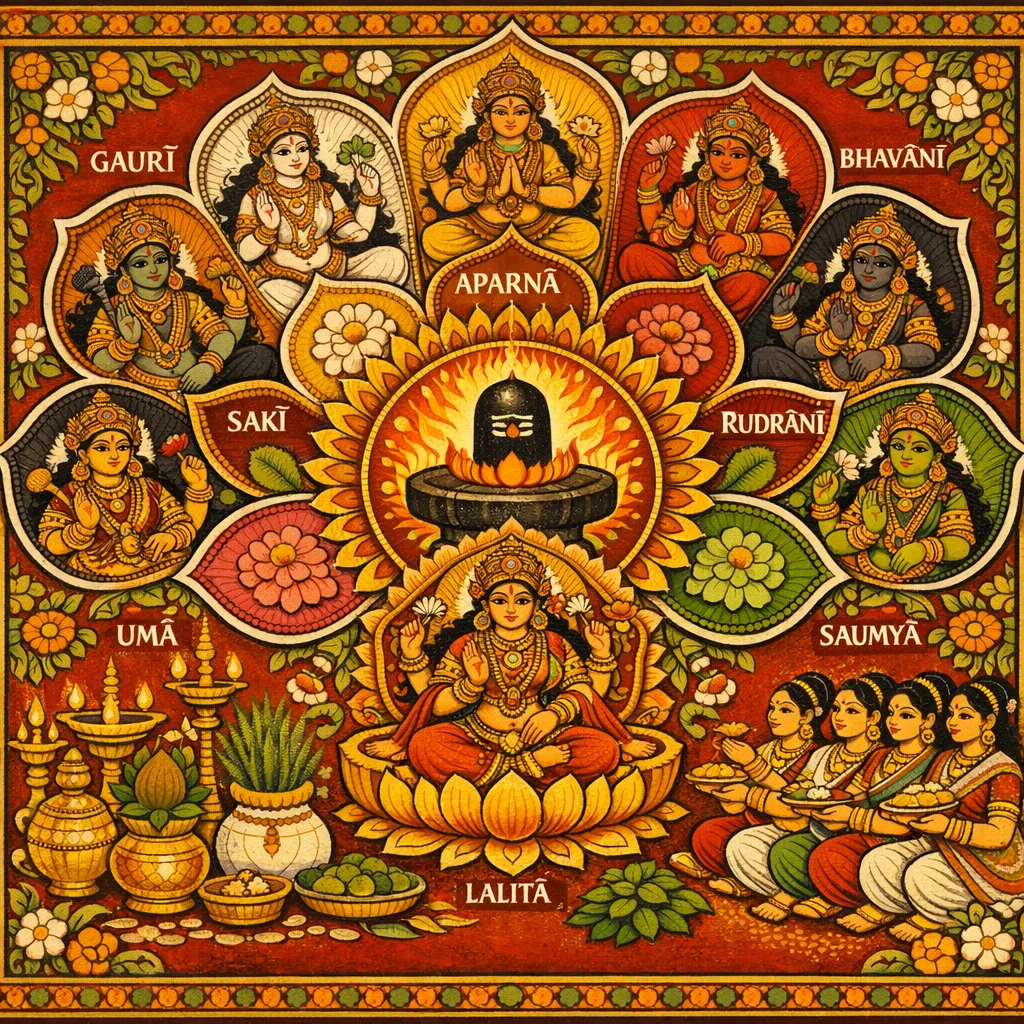
Adhyaya 62: The Observance of Ananta-Tritiya (Giritanaya Vrata): Lalita–Gauri Worship for Fortune, Health, and Liberation
अनन्ततृतीया-व्रतविधानम् (गिरितनया-व्रतम्)
Speaker: Vaivasvata Manu, Lord Matsya (Janārdana), Īśvara (as cited within Matsya’s reply), Umā (as the original questioner in the cited teaching)
Manu asks Janārdana for a single observance that grants saubhāgya (marital fortune), ārogya (health), imperishable post-mortem merit, and bhukti–mukti (worldly enjoyment and liberation). Matsya replies by citing an authoritative precedent—Īśvara’s teaching to Umā on Kailāsa—and then sets forth the Ananta-tṛtīyā vow: its proper time (the bright fortnight’s tṛtīyā in specified months), bathing and tilaka, rules of conduct, and a structured order of worship. The rite includes limb-by-limb salutations to the Goddess under many names, the drawing of a twelve-petalled lotus maṇḍala, and the installation of the Goddess’s forms in the directions and at the center together with Rudra and Lalitā. The chapter adds communal duties (honoring suvāsinīs), insists on guru-veneration, prescribes month-wise flower offerings, defines purificatory substances and prāśana, details gifts and paired worship counts, warns against financial deceit, lists exemptions and impurity rules, and concludes with exalted merit for performers, reciters, and hearers.
Key Concepts
Shlokas in Adhyaya 62
Verse 1
*मनुरुवाच सौभाग्यारोग्यफलदम् अमुत्राक्षय्यकारकम् भुक्तिमुक्तिप्रदं देव तन्मे ब्रूहि जनार्दन //
Manu said: “O God Janārdana, tell me of that observance which bestows the fruits of good fortune and health, which makes one’s merit imperishable in the hereafter, and which grants both worldly enjoyment and liberation.”
Verse 2
*मत्स्य उवाच यदुमायाः पुरा देव उवाच पुरसूदनः कैलासशिखरासीनो देव्या पृष्टस्तदा किल //
Lord Matsya said: “Formerly, in response to Umā, the Lord—Purasūdana, the slayer of the demon Pura—spoke while seated upon the peak of Kailāsa, when the Goddess questioned him then indeed.”
Verse 3
कथासु सम्प्रवृत्तासु धर्म्यासु ललितासु च तदिदानीं प्रवक्ष्यामि भुक्तिमुक्तिफलप्रदम् //
As these righteous and delightful narratives proceed, I shall now expound that teaching which bestows the fruits of worldly enjoyment and liberation.
Verse 4
*ईश्वर उवाच शृणुष्वावहिता देवि तथैवानन्तपुण्यकृत् नराणामथ नारीणाम् आराधनमनुत्तमम् //
Īśvara said: “Listen with full attention, O Goddess, to that unsurpassed mode of worship—an endless source of merit—for both men and women.”
Verse 5
नभस्ये वाथ वैशाखे पुण्यमार्गशिरस्य च शुक्लपक्षे तृतीयायां सुस्नातो गौरसर्षपैः //
In the month of Nabhasya, or in Vaiśākha, and also in the auspicious month of Mārgaśīrṣa—on the third lunar day (tṛtīyā) of the bright fortnight—one should bathe thoroughly, using yellow (golden) mustard seeds.
Verse 6
गोरोचनं सगोमूत्रम् उष्णं गोशकृतं तथा दधिचन्दनसम्मिश्रं ललाटे तिलकं न्यसेत् सौभाग्यारोग्यदं यस्मात् सदा च ललिताप्रियम् //
One should place upon the forehead a tilaka made from gorocanā, together with cow’s urine, warm cow-dung, and a mixture of curd (dadhi) and sandalwood; for it bestows good fortune and health, and is ever pleasing to the Goddess Lalitā.
Verse 7
प्रतिपक्षं तृतीयासु पुमानापीतवाससी धारयेदथ रक्तानि नारी चेदथ संयता //
On the third day of each fortnight, a man should wear garments that are not yellow; and if a woman is in her monthly course (menstrual flow), then she should remain restrained and self-controlled, observing the prescribed discipline.
Verse 8
विधवा धातुरक्तानि कुमारी शुक्लवाससी देवीं तु पञ्चगव्येन ततः क्षीरेण केवलम् स्नापयेन्मधुना तद्वत् पुष्पगन्धोदकेन च //
A widow should use red mineral pigment (dhātu-rakta), and an unmarried maiden, clad in white garments, should bathe the Goddess—first with pañcagavya, then with pure milk alone; likewise she should bathe Her with honey, and also with water fragrant with flowers.
Verse 9
पूजयेच्छुक्लपुष्पैश्च फलैर्नानाविधैरपि धान्यकाजाजिलवणैर् गुडक्षीरघृतान्वितैः //
One should perform worship with white flowers and with many kinds of fruits as well—along with coriander seed, cumin, salt, and offerings accompanied by jaggery, milk, and ghee.
Verse 10
शुक्लाक्षततिलैरर्च्यां ततो देवीं सदार्चयेत् पादाद्यभ्यर्चनं कुर्यात् प्रतिपक्षं वरानने //
After offering white rice-grains (akṣata) and sesame, one should then worship the Goddess continually. O fair-faced one, one should perform adoration beginning with her feet and so on, in each fortnight.
Verse 11
वरदायै नमः पादौ तथा गुल्फौ नमः श्रियै अशोकायै नमो जङ्घे पार्वत्यै जानुनी तथा //
Salutations to Varadā at the feet; likewise salutations to Śrī at the ankles. Salutations to Aśokā at the shanks; and likewise to Pārvatī at the knees.
Verse 12
ऊरू मङ्गलकारिण्यै वामदेव्यै तथा कटिम् पद्मोदरायै जठरम् उरः कामश्रियै नमः //
Salutations to the thighs that bestow auspiciousness; to Vāmadevī at the left side; likewise to the waist. Salutations to the belly that is lotus-like; to the abdomen; and to the chest that is the splendor of Kāma (beauty and attraction).
Verse 13
करौ सौभाग्यदायिन्यै बाहू हरमुखश्रियै मुखं दर्पणवासिन्यै स्मरदायै स्मितं नमः //
Salutations to her hands that bestow good fortune; to her arms that are the splendor of Hara’s (Śiva’s) face; to her face that dwells in the mirror; and to her smile that awakens Smara (love and desire).
Verse 14
गौर्यै नमस्तथा नासाम् उत्पलायै च लोचने तुष्ट्यै ललाटमलकान् कात्यायन्यै शिरस्तथा //
Salutations to Gaurī as the nose; to Utpalā as the two eyes. Salutations to Tuṣṭi as the forehead and the eyebrows; and to Kātyāyanī as the head.
Verse 15
नमो गौर्यै नमो धिष्ण्यै नमः कान्त्यै नमः श्रियै रम्भायै ललितायै च वासुदेव्यै नमो नमः //
Salutations to Gaurī; salutations to Dhīṣṇyā, the Divine Abode. Salutations to Kānti, Radiance; salutations to Śrī, Prosperity. Salutations to Rambhā and to Lalitā; salutations again and again to Vāsudevī.
Verse 16
एवं सम्पूज्य विधिवद् अग्रतः पद्ममालिखेत् पत्त्रैर्द्वादशभिर्युक्तं कुङ्कुमेन सकर्णिकम् //
Thus, after duly offering worship according to the prescribed rite, one should draw a lotus in front, furnished with twelve petals, and with its pericarp (karṇikā) indicated, using kuṅkuma (saffron).
Verse 17
पूर्वेण विन्यसेद्गौरीम् अपर्णां च ततः परम् भवानीं दक्षिणे तद्वद् रुद्राणीं च ततः परम् //
On the eastern side one should install Gaurī, and thereafter Aparṇā; on the southern side likewise one should install Bhavānī, and thereafter Rudrāṇī.
Verse 18
विन्यसेत्पश्चिमे सौम्यां सदा मदनवासिनीम् वायव्ये पाटलामुग्राम् अन्तरेण ततो ऽप्युमाम् //
One should install the gentle Saumyā in the western quarter—ever as the beloved abode of Madana (Kāma). In the north‑west (vāyavya) one should place the fierce Pāṭalā; and in the intermediate position thereafter, one should place Umā as well.
Verse 19
मध्ये यथास्वं मांसाङ्गां मङ्गलां कुमुदां सतीम् रुद्रं च मध्ये संस्थाप्य ललितां कर्णिकोपरि कुसुमैरक्षतैर्वार्भिर् नमस्कारेण विन्यसेत् //
In the center, one should place—each in their proper position—Māṃsāṅgā, Maṅgalā, Kumudā, and the virtuous Satī. Having installed Rudra in the very middle, one should place Lalitā upon the lotus’s pericarp (karṇikā), arranging them with flowers, unbroken grains of rice, and water, accompanied by reverential salutations.
Verse 20
गीतमङ्गलनिर्घोषान् कारयित्वा सुवासिनीः पूजयेद्रक्तवासोभी रक्तमाल्यानुलेपनैः सिन्दूरं स्नानचूर्णं च तासां शिरसि पातयेत् //
Having arranged auspicious singing and festive acclamations, one should honor the married women (suvāsinīs) with red garments, red garlands, and red unguents; and one should sprinkle vermilion (sindūra) and bathing-powder upon their heads.
Verse 21
सिन्दूरकुङ्कुमस्नानम् अतीवेष्टतमं यतः तथोपदेष्टारमपि पूजयेद्यत्नतो गुरुम् न पूज्यते गुरुर्यत्र सर्वास्तत्राफलाः क्रियाः //
Since bathing and adorning oneself with vermilion (sindūra) and saffron (kuṅkuma) is held to be exceedingly cherished, so too should one diligently honor the Guru—the very instructor. Where the Guru is not revered, all actions and rites performed there become fruitless.
Verse 22
नभस्ये पूजयेद्गौरीम् उत्पलैरसितैः सदा बन्धुजीवैराश्वयुजे कार्त्तिके शतपत्त्रकैः //
In the month of Nabhasya (Bhādrapada), one should always worship Goddess Gaurī with dark-blue lotuses; in Āśvayuja (Āśvina) with bandhujīva flowers; and in Kārttika with śatapattraka (hundred-petalled) flowers.
Verse 23
जातीपुष्पैर्मार्गशीर्षे पौषे पीतैः कुरण्टकैः कुन्दकुङ्कुमपुष्पैस्तु देवीं माघे तु पूजयेत् सिन्दुवारेण जात्या वा फाल्गुने ऽप्यर्चयेदुमाम् //
In Mārgaśīrṣa, one should worship (the Goddess) with jāti (jasmine) flowers; in Pauṣa, with yellow kuraṇṭaka blossoms; in Māgha, one should worship the Goddess with kunda and kuṅkuma flowers; and in Phālguna too, one should worship Umā with sinduvāra or with jasmine.
Verse 24
चैत्रे तु मल्लिकाशोकैर् वैशाखे गन्धपाटलैः ज्येष्ठे कमलमन्दारैर् आषाढे च नवाम्बुजैः कदम्बैरथ मालत्या श्रावणे पूजयेत्सदा //
In the month of Caitra one should worship with mallikā (jasmine) and aśoka blossoms; in Vaiśākha with fragrant pāṭalā flowers; in Jyeṣṭha with lotus and mandāra blooms; and in Āṣāḍha with fresh, newly opened lotuses. In Śrāvaṇa, one should always worship with kadamba flowers and with mālatī.
Verse 25
गोमूत्रं गोमयं क्षीरं दधि सर्पिः कुशोदकम् बिल्वपत्त्रार्कपुष्पं च यवान्गोशृङ्गवारि च //
Cow’s urine, cow-dung, milk, curd (dadhi), and ghee; water sanctified with kuśa grass; bilva leaves and arka flowers; barley; and water poured (or kept) in a cow-horn—these are the purificatory substances to be used in the rite.
Verse 26
पञ्चगव्यं च बिल्वं च प्राशयेत्क्रमशस्तदा एतद्भाद्रपदाद्यं तु प्राशनं समुदाहृतम् //
Then one should ingest, in the proper sequence, pañcagavya and bilva (the bael fruit/leaf). This is declared to be the prescribed prāśana—ritual ingestion—for the commencement of the month of Bhādrapada.
Verse 27
प्रतिपक्षं च मिथुनं तृतीयायां वरानने पूजयित्वार्चयेद्भक्त्या वस्त्रमाल्यानुलेपनैः //
O fair-faced lady, on the third lunar day (Tṛtīyā) one should first worship the complementary pair, and then, with devotion, offer reverent worship with garments, garlands, and fragrant unguents.
Verse 28
पुंसः पीताम्बरे दद्यात् स्त्रियै कौसुम्भवाससी निष्पावाजाजिलवणम् इक्षुदण्डगुडान्वितम् तस्यै दद्यात्फलं पुष्पं सुवर्णोत्पलसंयुतम् //
One should give a man yellow garments, and to a woman clothing dyed in kāusumbha (saffron hue). Along with these, one should offer niṣpāva (beans), ajājī (cumin), and salt, together with sugarcane stalks and jaggery. To her one should also give fruit and flowers, accompanied by a golden lotus.
Verse 29
यथा न देवि देवेशस् त्वां परित्यज्य गच्छति तथा माम् उद्धराशेषदुःखसंसारसागरात् //
O Goddess, just as the Lord of the gods never departs by abandoning you, so too rescue me from the ocean of saṃsāra, filled with unending sorrow.
Verse 30
कुमुदा विमलानन्ता भवानी च सुधा शिवा ललिता कमला गौरी सती रम्भाथ पार्वती //
Kumudā—the Immaculate and Endless One; Bhavānī; Sudhā; Śivā; Lalitā; Kamalā; Gaurī; Satī; Rambhā; and Pārvatī—these are her revered names.
Verse 31
नभस्यादिषु मासेषु प्रीयतामित्युदीरयेत् व्रतान्ते शयनं दद्यात् सुवर्णकमलान्वितम् //
In the months beginning with Nabhas (Bhādrapada), one should utter, “May (the deity) be pleased.” At the conclusion of the vow, one should gift a ceremonial bed adorned with golden lotus ornaments.
Verse 32
मिथुनानि चतुर्विंशद् दश द्वो च समर्चयेत् अष्टौ षड्वाप्यथ पुनश् चानुमासं समर्चयेत् //
One should duly worship in paired sets—twenty-four, ten, and also two; likewise eight and six; and again one should perform the worship month by month.
Verse 33
पूर्वं दत्त्वा तु गुरवे शेषानप्यर्चयेद्बुधः उक्तानन्ततृतीयैषा सदानन्तफलप्रदा //
After first giving the due offering to the guru, the wise person should then worship the remaining as well. Thus is declared this Ananta-tṛtīyā observance, which ever bestows endless fruit.
Verse 34
सर्वपापहरां देवि सौभाग्यारोग्यवर्धिनीम् न चैनां वित्तशाठ्येन कदाचिदपि लङ्घयेत् नरो वा यदि वा नारी वित्तशाठ्यात् पतत्यधः //
O Goddess, this observance removes all sins and increases good fortune and health. One should never violate it at any time through deceit regarding wealth; whether a man or a woman, by such financial dishonesty one falls down into misfortune.
Verse 35
गर्भिणी सूतिका नक्तं कुमारी वाथ रोगिणी यद्यशुद्धा तदान्येन वारयेत्प्रयता स्वयम् //
A pregnant woman, a woman in the post‑partum state, one observing a night‑vow (or fasting at night), an unmarried girl, or a sick woman—if she is in a state of impurity, then she should be restrained from the rite by another person; but if necessary, she herself, being careful, should refrain.
Verse 36
इमामनन्तफलदां यस्तृतीयां समाचरेत् कल्पकोटिशतं साग्रं शिवलोके महीयते //
Whoever duly performs this third-day observance (Tṛtīyā), which bestows endless rewards, is honored in Śiva’s world for a full hundred crores of kalpas, and more.
Verse 37
वित्तहीनो ऽपि कुरुते वर्षत्रयमुपोषणैः पुष्पमन्त्रविधानेन सो ऽपि तत्फलमाप्नुयात् //
Even a person without wealth, by observing fasts for three years and performing worship according to the prescribed rite of flower-offerings accompanied by mantras, attains that same fruit (merit).
Verse 38
नारी वा कुरुते या तु कुमारी विधवाथवा सापि तत्फलमाप्नोति गौर्यनुग्रहलालिता //
Whether it is a woman, a maiden, or even a widow who performs it—she too attains that very fruit, cherished by the favor and grace of Gaurī.
Verse 39
इति पठति शृणोति वा य इत्थं गिरितनयाव्रतम् इन्द्रवाससंस्थः मतिमपि च ददाति सो ऽपि देवैर् अमरवधूजनकिंनरैश्च पूज्यः //
Whoever thus recites (this account) or even hears of this Giritanayā-vrata, and who, dwelling in Indra’s heavenly abode, also bestows understanding (upon others)—he too becomes worthy of honor by the gods, by the celestial maidens, and by the Kinnaras.
Frequently Asked Questions
Adhyaya 62 teaches the Ananta-tṛtīyā (Giritanayā) vrata as a complete ritual discipline designed to grant fortune and health while also supporting bhukti–mukti. It emphasizes correct timing (bright tṛtīyā), purity measures (pañcagavya, kuśodaka, bilva), structured Goddess worship (limb-salutations and multi-name reverence), lotus-maṇḍala installation with directional placements, honoring suvāsinīs, and the indispensable requirement of guru-pūjā for the rite to bear fruit.
This chapter is primarily Vrata-Dharma and ritual theology (Shakta–Shaiva worship). It includes maṇḍala/installation geometry (a 12-petalled lotus diagram), which is adjacent to Vastu-style spatial ordering, but it is not a temple-construction chapter. Genealogy and creation narratives are not central here; instead, the focus is on observance rules, purity, offerings, dana, and promised spiritual results.
The text states that the instructor (guru/upadeṣṭṛ) must be worshiped diligently because the efficacy of ritual action depends on right transmission and reverence. It explicitly warns that where the guru is not honored, all rites and actions performed there become fruitless (aphalāḥ).
A lotus with twelve petals and a marked pericarp (karṇikā) is drawn in front using kuṅkuma. Deity-forms of the Goddess are installed in directions and intermediate positions, with Rudra established at the very center and Lalitā placed upon the pericarp, using flowers, unbroken rice grains (akṣata), water, and salutations.
Yes. It prescribes specific flowers by lunar months (e.g., dark-blue lotuses in Bhādrapada; bandhujīva in Āśvina; śatapattraka in Kārttika; jasmine in Mārgaśīrṣa; yellow kuraṇṭaka in Pauṣa; kunda and saffron-flowers in Māgha; sinduvāra/jasmine in Phālguna; and further month-wise choices through Śrāvaṇa).
The chapter gives differentiated procedures (e.g., widow using red mineral pigment; maiden in white bathing the Goddess with pañcagavya and milk) and states that if a pregnant woman, post-partum woman, night-vow observer, unmarried girl, or sick woman is in impurity, she should be restrained from the rite by another; if necessary she should herself refrain carefully.