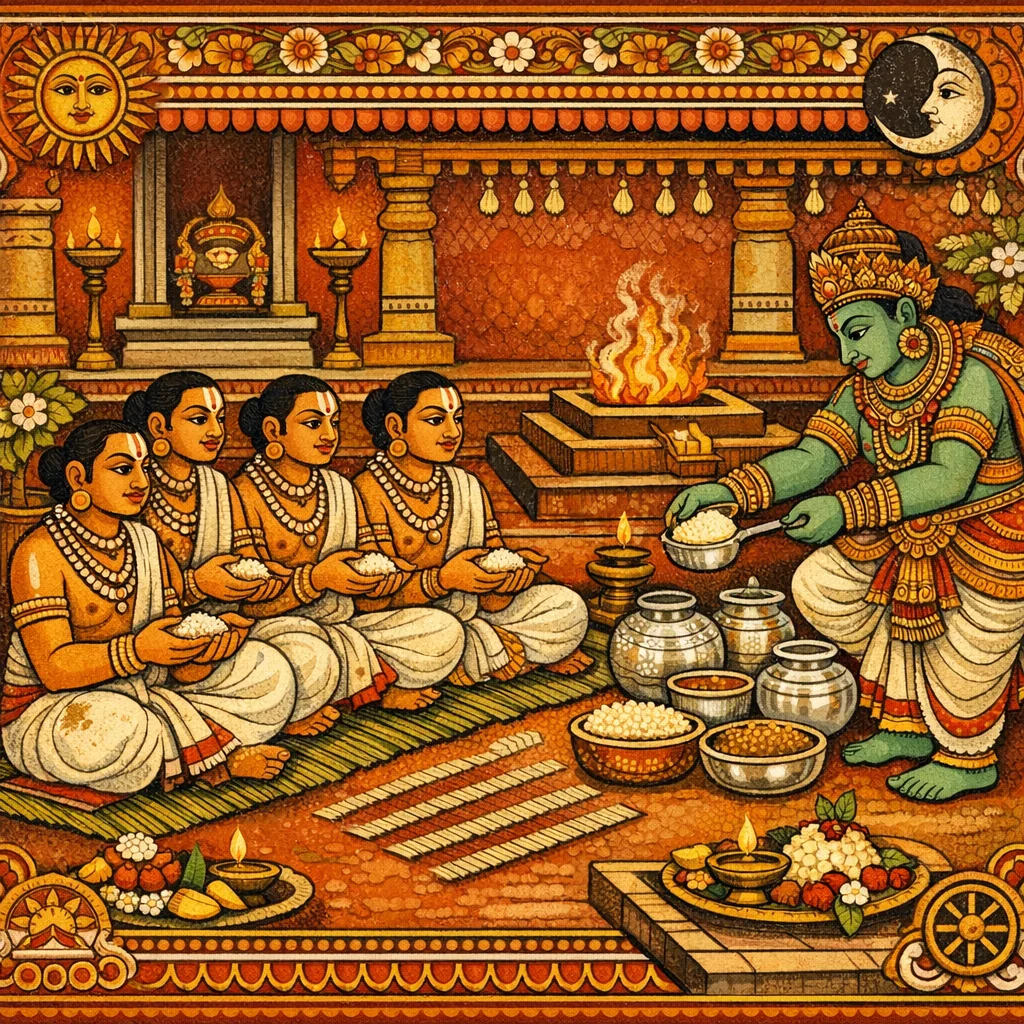
Adhyaya 17: Sādhāraṇa Śrāddha: General Ancestral Rite, Auspicious Times, Procedure, and Akṣaya (Imperishable) Gifts
साधारणश्राद्धविधिः (अक्षयदानकाल-निर्णय सहितः)
Speaker: Sūta
In Sūta’s discourse to the king, he conveys Viṣṇu’s teaching on the universally applicable, repeatable Sādhāraṇa śrāddha for the ancestors. The chapter moves from calendrical rules—parva days, saṅkrānti, eclipses, and specific tithis, nakṣatras, and yogas—to the ritual sequence: selecting brāhmaṇas, preparing the site, consecrating water and grains with Vedic formulas, performing Vaiśvadeva and then the Pitṛ-kārya with arghya, piṇḍa offerings, feeding, recitation, gifts, blessings, and concluding bali. It ends by widening eligibility to those without upanayana, those away from home, and śūdras (without Vedic mantras), and then introduces the next type, the ābhyudayika (prosperity) śrāddha for joyful auspicious occasions.
Key Concepts
Shlokas in Adhyaya 17
Verse 1
*सूत उवाच अतः परं प्रवक्ष्यामि विष्णुना यदुदीरितम् श्राद्धं साधारणं नाम भुक्तिमुक्तिफलप्रदम् //
Sūta said: “Now I shall expound what was proclaimed by Viṣṇu—namely the ‘general’ (sādhāraṇa) śrāddha, which bestows the fruits of both worldly enjoyment and liberation.”
Verse 2
अयने विषुवे युग्मे सामान्ये चार्कसंक्रमे अमावास्याष्टकाकृष्णपक्षे पञ्चदशीषु च //
During the ayana (solstices), the viṣuva (equinoxes), the paired periods (yugma), on common occasions, and also at the Sun’s ingress into a new zodiac sign (ārka-saṅkrama); likewise on amāvāsyā (new-moon day), on the Aṣṭakā days, in the dark fortnight (kṛṣṇa-pakṣa), and on the fifteenth lunar days (pañcadaśī)—these times are to be taken into account for observance.
Verse 3
आर्द्रामघारोहिणीषु द्रव्यब्राह्मणसंगमे गजच्छायाव्यतीपाते विष्टिवैधृतिवासरे //
On the days of the nakṣatras Ārdrā, Maghā, and Rohiṇī; at a conjunction involving wealth and a brāhmaṇa; during Gaja-chāyā and Vyatīpāta; and on days marked by Viṣṭi (Bhadrā) and Vaidhṛti—these times are regarded as unsuitable for commencing auspicious undertakings.
Verse 4
वैशाखस्य तृतीयायां नवमी कार्त्तिकस्य च पञ्चदशी च माघस्य नभस्ये च त्रयोदशी //
The third lunar day (tṛtīyā) of Vaiśākha, the ninth (navamī) of Kārttika, the fifteenth (pañcadaśī) of Māgha, and the thirteenth (trayodaśī) of Nabhasya (Bhādrapada) are declared to be especially auspicious days of observance.
Verse 5
युगादयः स्मृता ह्य् एता दत्तस्याक्षय्यकारिकाः तथा मन्वन्तरादौ च देयं श्राद्धं विजानता //
These times—beginning with the yugas—are remembered as conferring imperishable (akṣaya) fruit upon gifts. Likewise, at the commencement of a Manvantara, one who understands should perform the śrāddha rites.
Verse 6
अश्वयुक्छुक्लनवमी द्वादशी कार्त्तिके तथा तृतीया चैत्रमासस्य तथा भाद्रपदस्य च //
The ninth day of the bright fortnight in Aśvayuja, the twelfth day in Kārttika, and likewise the third day in the month of Caitra, and also (the third day) in Bhādrapada—these tithis are declared especially auspicious for religious observance.
Verse 7
फाल्गुनस्य ह्य् अमावास्या पौषस्यैकादशी तथा आषाढस्यापि दशमी माघमासस्य सप्तमी //
The new-moon day of Phālguna, the eleventh lunar day of Pauṣa, the tenth lunar day of Āṣāḍha, and the seventh lunar day of the month of Māgha are to be observed with special regard.
Verse 8
श्रावणस्याष्टमी कृष्णा तथाषाढी च पूर्णिमा कार्त्तिकी फाल्गुनी चैत्री ज्येष्ठपञ्चदशी सिता मन्वन्तरादयश् चैता दत्तस्याक्षय्यकारिकाः //
The dark eighth (Aṣṭamī) of Śrāvaṇa; the full-moon day of Āṣāḍha; likewise the full-moon days of Kārttika, Phālguna, and Caitra; the bright fifteenth of Jyeṣṭha; and Manvantara and similar sacred occasions—gifts given at these times become causes of imperishable (akṣaya) merit.
Verse 9
यस्यां मन्वन्तरस्यादौ रथमास्ते दिवाकरः माघमासस्य सप्तम्यां सा तु स्याद्रथसप्तमी //
That seventh lunar day (saptamī) of the month of Māgha—on which, at the very beginning of a Manvantara, the Sun (Divākara) is said to mount his chariot—is indeed known as Ratha-saptamī.
Verse 10
पानीयमप्यत्र तिलैर्विमिश्रं दद्यात्पितृभ्यः प्रयतो मनुष्यः श्राद्धं कृतं तेन समाः सहस्रं रहस्यमेतत्पितरो वदन्ति //
Here, even water mixed with sesame seeds should be offered—by a disciplined person—to the Ancestors (Pitṛs). By that act, a śrāddha is as though performed for a thousand years; this is a secret teaching, say the Pitṛs.
Verse 11
वैशाख्यामुपरागेषु तथोत्सवमहालये तीर्थायतनगोष्ठेषु दीपोद्यानगृहेषु च //
Likewise in the month of Vaiśākha, during eclipses, at festival-times and in great temples, in assemblies held at sacred fords (tīrthas) and sanctuaries, and also in lamp-offerings, pleasure-gardens, and homes—(these observances are to be performed).
Verse 12
विविक्तेषूपलिप्तेषु श्राद्धं देयं विजानता विप्रान्पूर्वे परे चाह्नि विनीतात्मा निमन्त्रयेत् //
Knowing the proper procedure, one should offer the śrāddha in a secluded, freshly plastered (purified) place; and with a disciplined, humble mind, one should invite Brāhmaṇas either in the forenoon or in the afternoon.
Verse 13
शीलवृत्तगुणोपेतान् वयोरूपसमन्वितान् द्वौ दैवे त्रींस्तथा पित्र्य एकैकमुभयत्र वा //
One should choose (Brāhmaṇas) endowed with good conduct, proper livelihood, and virtues—also possessing suitable age and appearance: two for the offering to the gods, three for the offering to the ancestors; or else one each for both rites, or a single one for both.
Verse 14
भोजयेत्सुसमृद्धो ऽपि न प्रसज्जते विस्तरे विश्वान्देवान्यवैः पुष्पैर् अभ्यर्च्यासनपूर्वकम् //
Even if one is very prosperous, one should not become attached to extravagant display. Having first offered a seat (āsana), one should worship all the gods with barley-grains (yava) and flowers.
Verse 15
पूरयेत्पात्रयुग्मं तु स्थाप्य दर्भपवित्रकम् शं नो देवीत्य् अपः कुर्याद् यवो ऽसीति यवानपि //
He should fill a pair of vessels, setting in place the purifying darbha-grass. Reciting “Śaṃ no devīḥ…”, he should consecrate the water; and reciting “yavo ’si”, he should likewise sanctify the barley grains.
Verse 16
गन्धपुष्पैश्च संपूज्य वैश्वदेवं प्रति न्यसेत् विश्वे देवास इत्याभ्याम् आवाह्य विकिरेद्यवान् //
Having duly worshipped with fragrances and flowers, one should place the offering for the Vaiśvadeva. Then, invoking the Viśvedevas with the words “viśve devāsaḥ…”, one should scatter barley grains as an offering.
Verse 17
गन्धपुष्पैर् अलंकृत्य या दिव्येत्यर्घ्यमुत्सृजेत् अभ्यर्च्य ताभ्यामुत्सृष्टं पितृकार्यं समारभेत् //
Having adorned with fragrant substances and flowers, one should pour out the arghya (water-offering) with the mantra “yā divyā”. After worshipping, one should then commence the rites for the ancestors (pitṛ-kārya) with what has been offered by those two, together with the arghya.
Verse 18
दर्भासनं तु दत्त्वादौ त्रीणि पात्राणि पूरयेत् खपवित्राणि कृत्वादौ शं नो देवीत्य् अपः क्षिपेत् //
First, having placed a seat of darbha grass, one should fill three vessels. Having first purified them by the prescribed act, one should sprinkle water into them while reciting “Śaṃ no devīḥ….”
Verse 19
तिलो ऽसीति तिलान्कुर्याद् गन्धपुष्पादिकं पुनः पात्रं वनस्पतिमयं तथा पर्णमयं पुनः //
Reciting “tilo ’si” (“You are sesame”), one should prepare and offer sesame; and again add fragrances, flowers, and the like. The vessel should be made of plant material, and again, one made of leaves.
Verse 20
जलजं वाथ कुर्वीत तथा सागरसम्भवम् सौवर्णं राजतं वापि पितॄणां पात्रमुच्यते //
One should prepare a vessel made of lotus-born material, or of that which arises from the ocean; and a vessel of gold or of silver is also declared suitable for the Pitṛs in ancestral rites.
Verse 21
रजतस्य कथा वापि दर्शनं दानमेव वा राजतैर् भाजनैरेषाम् अथवा रजतान्वितैः //
Even recounting the virtues of silver, or merely beholding it, or indeed giving it in charity—one may accomplish the intended offerings using vessels made of silver, or vessels furnished with silver.
Verse 22
वार्यपि श्रद्धया दत्तम् अक्षयायोपकल्पते तथार्घ्यपिण्डभोज्यादौ पितॄणां राजतं मतम् //
Even water, when offered with faith, becomes a cause of imperishable merit. Likewise, in offerings such as arghya, piṇḍa, and the food served in śrāddha, the Pitṛs are said to be especially pleased by gifts made in silver.
Verse 23
शिवनेत्रोद्भवं यस्मात् तस्मात्तत्पितृवल्लभम् अमङ्गलं तद्यत्नेन देवकार्येषु वर्जयेत् //
Since it is said to have arisen from Śiva’s eye, it is therefore dear to the Pitṛs. Being inauspicious, one should carefully avoid it in rites performed for the gods.
Verse 24
एवं पात्राणि संकल्प्य यथालाभं विमत्सरः या दिव्येति पितुर्नाम गोत्रैर्दर्भकरो न्यसेत् //
Thus, having arranged the ritual vessels according to one’s means, free from envy, one should place the darbha-grass in the prescribed manner, uttering the father’s name together with the gotra, and the invocation “yā divyā”.
Verse 25
पितॄन् आवाहयिष्यामि कुर्वित्युक्तस्तु तैः पुनः उशन्तस्त्वा तथायन्तु ऋग्भ्याम् आवाहयेत्पितॄन् //
When instructed by them, he should again say, “I shall invoke the Pitṛs; I am performing the rite.” Then, reciting the two Ṛk-verses beginning with “uśantaḥ tvā…”, he should invoke the ancestors.
Verse 26
या दिव्येत्यर्घ्यमुत्सृज्य दद्याद्गन्धादिकांस्ततः हस्तात्तदुदकं पूर्वं दत्त्वा संस्रवमादितः //
Reciting “yā divyā…”, one should pour out the arghya-offering; thereafter one should present fragrant substances and the other ritual articles. From the hand, one should first let that water be given as a preliminary trickle (saṃsrava), right at the beginning.
Verse 27
पितृपात्रे निधायाथ न्युब्जमुत्तरतो न्यसेत् पितृभ्यः स्थानमसीति निधाय परिषेचयेत् //
Having placed it in the vessel meant for the ancestors, one should then set the vessel down with its mouth turned downward to the north. Placing it with the utterance, “You are the seat for the Pitṛs,” one should sprinkle water all around it.
Verse 28
तत्रापि पूर्ववत्कुर्याद् अग्निकार्यं विमत्सरः उभाभ्यामपि हस्ताभ्याम् आहृत्य परिवेषयेत् //
There too, just as before, let him—free from envy—perform the required acts connected with the sacred fire; and, having brought (the food/offerings) with both hands, he should duly serve it around (to those to be honored).
Verse 29
प्रशान्तचित्तः सततं दर्भपाणिरशेषतः गुणाढ्यैः सूपशाकैस्तु नानाभक्ष्यैर्विशेषतः //
With a mind ever tranquil, holding sacred darbha grass in hand, he should perform the rite completely—especially with wholesome, nourishing soups and vegetable preparations, and with various kinds of food-offerings in particular.
Verse 30
अन्नं तु सदधिक्षीरं गोघृतं शर्करान्वितम् मासं प्रीणाति वै सर्वान् पितॄनित्याह केशवः //
Food prepared with curd and milk, enriched with cow’s ghee (goghṛta) and mixed with sugar, is said to satisfy all the Pitṛs (ancestral spirits) for a month—thus declares Keśava (Viṣṇu).
Verse 31
द्वौ मासौ मत्स्यमांसेन त्रीन्मासान्हारिणेन तु औरभ्रेणाथ चतुरः शाकुनेनाथ पञ्च वै //
With the flesh of fish one may obtain satisfaction for two months; with deer-flesh for three months; with the flesh of sheep for four months; and with the flesh of birds, indeed, for five months.
Verse 32
षण्मासं छागमांसेन तृप्यन्ति पितरस्तथा सप्त पार्षतमांसेन तथाष्टाव् एणजेन तु //
By goat-meat the Pitṛs (ancestors) remain satisfied for six months; by the meat of a ‘pārṣata’ animal they are satisfied for seven months; and by the meat of eṇa (antelope/deer) they are satisfied for eight months.
Verse 33
दश मासांस्तु तृप्यन्ति वराहमहिषामिषैः शशकूर्मजमांसेन मासानेकादशैव तु //
With the flesh of boar and buffalo, the Ancestors are satisfied for ten months; and with the meat of hare and of tortoise, they are satisfied for eleven months.
Verse 34
संवत्सरं तु गव्येन पयसा पायसेन च रौरवेण च तृप्यन्ति मासान्पञ्चदशैव तु //
By cow’s milk—whether as milk itself or as sweet rice (pāyasa)—they are satisfied for a full year; and (those in) Raurava are satisfied for fifteen months.
Verse 35
वार्ध्रीणसस्य मांसेन तृप्तिर् द्वादशवार्षिकी कालशाकेन चानन्ता खड्गमांसेन चैव हि //
By eating the meat of the vārdhrīṇasa, one attains a satisfaction lasting twelve years; by eating kālaśāka, the satisfaction is unending—and likewise, it is said, with the meat of the khaḍga.
Verse 36
यत्किंचिन्मधुसम्मिश्रं गोक्षीरं घृतपायसम् दत्तमक्षयमित्याहुः पितरः पूर्वदेवताः //
The Pitṛs—those ancient divine ones—declare that whatever is offered mixed with honey, namely cow’s milk and pāyasa (rice cooked in ghee), becomes an akṣaya gift, imperishable in its merit.
Verse 37
स्वाध्यायं श्रावयेत्पित्र्यं पुराणान्यखिलानि च ब्रह्मविष्ण्वर्करुद्राणां सूक्तानि विविधानि च //
He should cause the pitṛ-related portions of svādhyāya (Vedic recitation) to be heard, and also the Purāṇas in their entirety, as well as various sūkta hymns addressed to Brahmā, Viṣṇu, Arka (the Sun), and Rudra.
Verse 38
इन्द्राग्निसोमसूक्तानि पावनानि स्वशक्तितः बृहद्रथंतरं तद्वज् ज्येष्ठसाम सरौहिणम् //
The sūkta hymns addressed to Indra, Agni, and Soma are purifying by their own inherent power; likewise are the Bṛhadratha and Rathaṃtara chants, the Tadvaj, the Jyeṣṭha-sāman, and the Sarauhiṇa-sāman.
Verse 39
तथैव शान्तिकाध्यायं मधुब्राह्मणमेव च मण्डलं ब्राह्मणं तद्वत् प्रीतिकारि तु यत्पुनः //
Likewise, the chapter on Śānti (pacificatory rites), the Madhu-brāhmaṇa, and the Maṇḍala-brāhmaṇa as well; and similarly, whatever else is taught here that bestows satisfaction and delight should be regarded as auspicious and merit-giving.
Verse 40
विप्राणामात्मनश्चैव तत्सर्वं समुदीरयेत् भुक्तवत्सु ततस्तेषु भोजनोपान्तिके नृप //
He should then duly recite and declare all that pertains to the Brahmanas and to himself; and after they have eaten, O King, he should do so again at the close of the meal, in their presence.
Verse 41
सार्ववर्णिकमन्नाद्यं संनीयाप्लाव्य वारिणा समुत्सृजेद्भुक्तवताम् अग्रतो विकिरेद्भुवि //
Having gathered the leftover food suitable for all social classes, one should rinse it with water and then dispose of it; and in front of those who have eaten, one should scatter a portion upon the ground.
Verse 42
अग्निदग्धास्तु ये जीवा ये ऽप्यदग्धाः कुले मम भूमौ दत्तेन तृप्यन्तु प्रयान्तु परमां गतिम् //
May those beings of my lineage who have been cremated by fire—and also those who have not been cremated—be satisfied by the gift of land, and may they depart to the supreme state.
Verse 43
येषां न माता न पिता न बन्धुर् न गोत्रशुद्धिर्न तथान्नम् अस्ति तत्तृप्तये ऽन्नं भुवि दत्तमेतत् प्रयान्तु लोकेषु सुखाय तद्वत् //
For those who have neither mother nor father nor any kinsman, for whom there is no assurance of lineage (gotra) and likewise no food—this food has been given upon the earth for their satisfaction. May they, being thus satisfied, depart to the worlds in happiness.
Verse 44
असंस्कृतप्रमीतानां त्यक्तानां कुलयोषिताम् उच्छिष्टभागधेयः स्याद् दर्भे विकिरयोश्च यः //
One who takes a share in what is left-over—such as the darbha-grass used in rites and the scattered remnants—incurs the taint of ‘ucchiṣṭa’ (pollution), in the case of women of a respectable family who have died without the proper sacraments or who have been abandoned.
Verse 45
तृप्ताञ्ज्ञात्वोदकं दद्यात् सकृद्विप्रकरे तथा उपलिप्ते महीपृष्ठे गोशकृन्मूत्रवारिणा //
Knowing that the guest or recipient has been satisfied, one should then give water; likewise, only once into the hand of a Brāhmaṇa. And the rite is to be performed upon ground plastered with a mixture of cow-dung, cow-urine, and water.
Verse 46
निधाय दर्भान्विधिवद् दक्षिणाग्रान् प्रयत्नतः सर्ववर्णेन चान्नेन पिण्डांस्तु पितृयज्ञवत् //
Having carefully placed the darbha grasses according to rule, with their tips pointing south, one should with due effort prepare the piṇḍas (rice-balls) from food of every kind, just as in the Pitṛ-yajña, the ancestral rite.
Verse 47
अवनेजनपूर्वं तु नामगोत्रेण मानवः गन्धधूपादिकं दद्यात् कृत्वा प्रत्यवनेजनम् //
After first performing the purificatory washing (avanejana), a person should, while pronouncing the name and gotra, present offerings such as fragrance and incense; having done so, he should then perform the counter-washing (praty-avanejana) as the concluding purification.
Verse 48
जान्वाच्य सव्यं सव्येन पाणिनाथ प्रदक्षिणम् पित्र्यमानीय तत्कार्यं विधिवद्दर्भपाणिना //
Placing the left knee down and, with the left hand, performing the proper circumambulation (pradakṣiṇa), one should then invite the Pitṛs, the ancestral manes. Holding kuśa-grass in hand, he should carry out that rite in the prescribed manner.
Verse 49
दीपप्रज्वालनं तद्वत् कुर्यात्पुष्पार्चनं बुधः अथाचान्तेषु चाचम्य वारि दद्यात्सकृत्सकृत् //
In the same manner, the wise person should light the lamp and perform worship with flowers. Then, at the conclusion of the rite, having performed ācamana (sipping water for purification), he should offer water repeatedly, again and again.
Verse 50
अथ पुष्पाक्षतान् पश्चाद् अक्षय्योदकम् एव च सतिलं नामगोत्रेण दद्याच्छक्त्या च दक्षिणाम् //
Then, afterwards, one should offer flowers and unbroken rice-grains (akṣata), and also the ‘inexhaustible water-offering’ (akṣayyodaka) together with sesame—presenting it while pronouncing the recipient’s name and gotra (lineage), and giving a dakṣiṇā (priestly fee) according to one’s capacity.
Verse 51
गोभूहिरण्यवासांसि भव्यानि शयनानि च दद्याद्यदिष्टं विप्राणाम् आत्मनः पितुरेव च //
One should give to Brahmins cows, land, gold, garments, and fine beds—whatever is desired—doing so for one’s own welfare and also for the sake of one’s father (i.e., ancestral benefit).
Verse 52
वित्तशाठ्येन रहितः पितृभ्यः प्रीतिमावहन् ततः स्वधावाचनकं विश्वदेवेषु चोदकम् //
Free from deceit regarding wealth, one should bring satisfaction to the ancestors; then one should perform the ‘svadhā’ invocation and offer the water-oblation to the Viśvedevas.
Verse 53
दत्त्वाशीः प्रतिगृह्णीयाद् द्विजेभ्यः प्राङ्मुखो बुधः अघोराः पितरः सन्तु सन्त्वित्युक्तः पुनर् द्विजैः //
Having offered the due gifts, the wise man should receive the blessings from the twice-born while facing east. The Brahmins, in turn, again pronounce: “May the Fathers be peaceful and free from all terrors; may they indeed be so.”
Verse 54
गोत्रं तथा वर्धतां नस् तथेत्युक्तश्च तैः पुनः दातारो नो ऽभिवर्धन्ताम् इति चैवमुदीरयेत् //
When they (the recipients/priests) say, “May our gotra (lineage) likewise prosper,” one should reply again in this manner: “May our donors indeed increase and prosper,” thus should he pronounce.
Verse 55
एताः सत्याशिषः सन्तु सन्त्वित्युक्तश्च तैः पुनः स्वस्तिवाचनकं कुर्यात् पिण्डानुद्धृत्य भक्तितः //
Addressed by them again—“May these blessings be true; so be it”—he should then perform the auspicious svasti recitation. With devotion, he should lift up the piṇḍas, the ritual rice-balls offered in the śrāddha.
Verse 56
उच्छेषणं तु तत्तिष्ठेद् यावद्विप्रा विसर्जिताः ततो ग्रहबलिं कुर्याद् इति धर्मव्यवस्थितिः //
The remaining food (ucchēṣaṇa) should be kept in place until the brāhmaṇas have been respectfully dismissed. Thereafter one should offer bali to the planetary deities (grahas). Such is the settled ordinance of dharma.
Verse 57
उच्छेषणं भूमिगतम् अजिह्मस्यास्तिकस्य च दासवर्गस्य तत्पित्र्यं भागधेयं प्रचक्षते //
They declare that the lawful share (bhāgadheya) of the servant-class is the leftover food placed upon the ground—given to one who is straightforward and faithful—and that this is reckoned as their ancestral portion.
Verse 58
पितृभिर् निर्मितं पूर्वम् एतदाप्यायनं सदा अपुत्राणां सपुत्राणां स्त्रीणामपि नराधिप //
O king, this rite called ‘āpyāyana’—the continual nourishment of the Ancestors—was established long ago by the Pitṛs themselves, and it is meant for all: the childless and those with children, and even for women.
Verse 59
ततस्तानग्रतः स्थित्वा परिगृह्योदपात्रकम् वाजे वाज इति जपन् कुशाग्रेण विसर्जयेत् //
Then, standing before them, one should take up the vessel of water; murmuring the mantra “vāje vāja”, one should release and offer the water by means of the tip of a kuśa blade.
Verse 60
बहिः प्रदक्षिणां कुर्यात् पदान्य् अष्टाव् अनुव्रजन् बन्धुवर्गेण सहितः पुत्रभार्यासमन्वितः //
Outside the sacred spot or enclosure, he should perform a rightward circumambulation (pradakṣiṇā), taking eight steps, accompanied by his circle of relatives, together with his son and wife.
Verse 61
निवृत्य प्रणिपत्याथ पर्युक्ष्याग्निं समन्त्रवत् वैश्वदेवं प्रकुर्वीत नैत्यकं बलिमेव च //
Having returned, one should bow down; then, after ritually sprinkling water around the sacred fire with the proper mantras, one should perform the Vaiśvadeva offering and also the prescribed daily bali-offering.
Verse 62
ततस्तु वैश्वदेवान्ते सभृत्यसुतबान्धवः भुञ्जीतातिथिसंयुक्तः सर्वं पितृनिषेवितम् //
Then, at the conclusion of the Vaiśvadeva rite, together with his servants, sons, and kinsmen, he should take his meal in the company of a guest—partaking only of what has first been duly offered in service to the Pitṛs (ancestors).
Verse 63
एतच्चानुपनीतो ऽपि कुर्यात्सर्वेषु पर्वसु श्राद्धं साधारणं नाम सर्वकामफलप्रदम् //
Even one who has not undergone the upanayana initiation should perform, on all parva (sacred junction) days, the śrāddha called “Sādhāraṇa”; it bestows the fruits of all desired aims.
Verse 64
भार्याविरहितो ऽप्येतत् प्रवासस्थो ऽपि भक्तिमान् शूद्रो ऽप्यमन्त्रवत्कुर्याद् अनेन विधिना बुधः //
Even if a man is without his wife, or even if he is living away from home, a devoted person—even a Śūdra—should perform this observance without Vedic mantras, following this very procedure, O wise one.
Verse 65
तृतीयमाभ्युदयिकं वृद्धिश्राद्धं तदुच्यते उत्सवानन्दसम्भारे यज्ञोद्वाहादिमङ्गले //
The third is called the ābhyudayika, the śrāddha for prosperity and increase. It is performed on auspicious occasions—at festivals and joyful celebrations, and at rites such as sacrifices (yajña) and weddings.
Verse 66
मातरः प्रथमं पूज्याः पितरस्तदनन्तरम् ततो मातामहा राजन् विश्वे देवास्तथैव च //
Mothers are to be honored first; thereafter, fathers. Then, O King, the maternal grandfathers are to be revered, and likewise the Viśvedevas as well.
Verse 67
प्रदक्षिणोपचारेण दध्यक्षतफलोदकैः प्राङ्मुखो निर्वपेत्पिण्डान् दूर्वया च कुशैर्युतान् //
Facing east, one should offer the piṇḍas with the clockwise reverential procedure (pradakṣiṇa), using curds, akṣata (unbroken rice-grains), fruits, and water; and the piṇḍas should be accompanied by dūrvā grass and kuśa blades.
Verse 68
सम्पन्नम् इत्यभ्युदये दद्यादर्घ्यं द्वयोर् द्वयोः युग्मा द्विजातयः पूज्या वस्त्रकार्तस्वरादिभिः //
At an auspicious celebration, saying “sampannam” (“May it be accomplished”), one should offer arghya in pairs, two by two. The dvijas (twice-born) should likewise be honored as pairs, with garments, cut pieces of cloth, gold, and similar gifts.
Verse 69
तिलार्थस्तु यवैः कार्यो नान्दीशब्दानुपूर्वकः माङ्गल्यानि च सर्वाणि वाचयेद्द्विजपुंगवैः //
In place of the offering made with sesame, one should make it with barley (yava), preceded by the utterance of the Nāndī formulas; and one should have all auspicious benedictions recited by eminent Brahmins (dvija-puṅgava).
Verse 70
एवं शूद्रो ऽपि सामान्यवृद्धिश्राद्धे ऽपि सर्वदा नमस्कारेण मन्त्रेण कुर्यादामान्नतः सदा //
Thus, even a Śūdra, even in the ordinary śrāddha performed on occasions of family increase or prosperity, should always perform it with the mantra of reverential salutation, consistently offering uncooked food.
Verse 71
दानप्रधानः शूद्रः स्याद् इत्याह भगवान्प्रभुः दानेन सर्वकामाप्तिर् अस्य संजायते यतः //
The Blessed Lord declares that for a Śūdra, charity is the foremost duty; for through giving, the fulfillment of all desired aims arises for him.
Frequently Asked Questions
It teaches Viṣṇu’s ‘Sādhāraṇa’ śrāddha as a generally performable ancestral rite that grants both worldly welfare and liberation. The chapter’s core instruction is twofold: (1) determine proper times—highlighting akṣaya occasions (yuga beginnings, manvantara beginnings, select tithis, eclipses, saṅkrānti, parva-days) and avoid inauspicious yogas/nakṣatras; and (2) execute a complete, orderly procedure—purified venue, qualified brāhmaṇas, consecrated water/grains, Vaiśvadeva first, then Pitṛ-kārya with arghya, piṇḍa, feeding, recitation, dakṣiṇā, blessings, and concluding bali.
This adhyāya is primarily Dharma-śāstra in a Purāṇic register: śrāddha-vidhi, pitṛ-tarpaṇa logic, dāna (charity) and akṣaya-kāla timing, purity rules (ucchiṣṭa, disposal), social-ritual roles (brāhmaṇas, servants, śūdras), and festival/temple contexts. Vastu Shastra and Puranic genealogy are not central here, except indirectly through the emphasis on gotra/name invocation and lineage continuity in Pitṛ rites.
It lists parva/junction times like ayana (solstice points), viṣuva (equinox), saṅkrānti (solar ingress), amāvāsyā, aṣṭakā days, and manvantara beginnings as especially potent. It also singles out several tithis across months (e.g., Vaiśākha tṛtīyā; Kārttika navamī; Māgha pañcadaśī; Bhādrapada/Nābhasya trayodaśī; and others), and highlights Ratha-saptamī (Māgha saptamī) with sesame-water offerings as extraordinarily efficacious.
It flags certain nakṣatras (Ārdrā, Maghā, Rohiṇī) and inauspicious yogas/periods such as Gaja-chāyā, Vyatīpāta, Vaidhṛti, and days marked by Viṣṭi (Bhadrā) as not fit for auspicious beginnings, establishing a practical ‘avoid list’ alongside the akṣaya calendar.
Silver is repeatedly presented as Pitṛ-priya: even praising it, seeing it, or donating it is treated as merit-supporting, and arghya/piṇḍa/food offerings in silver vessels are said to please the Pitṛs especially. The text explains a mythic rationale—silver is described as arising from Śiva’s eye—hence dear to Pitṛs, while being avoided in deva-kārya due to inauspiciousness in that context.
It explicitly broadens eligibility: even one without upanayana should perform it on parva-days; even if wife-less or living away from home, a devoted person may do it; and even a śūdra may perform it without Vedic mantras following the same procedural structure. The chapter further underscores that for a śūdra, dāna (charity) is paramount and becomes a direct means to fulfill desired aims.