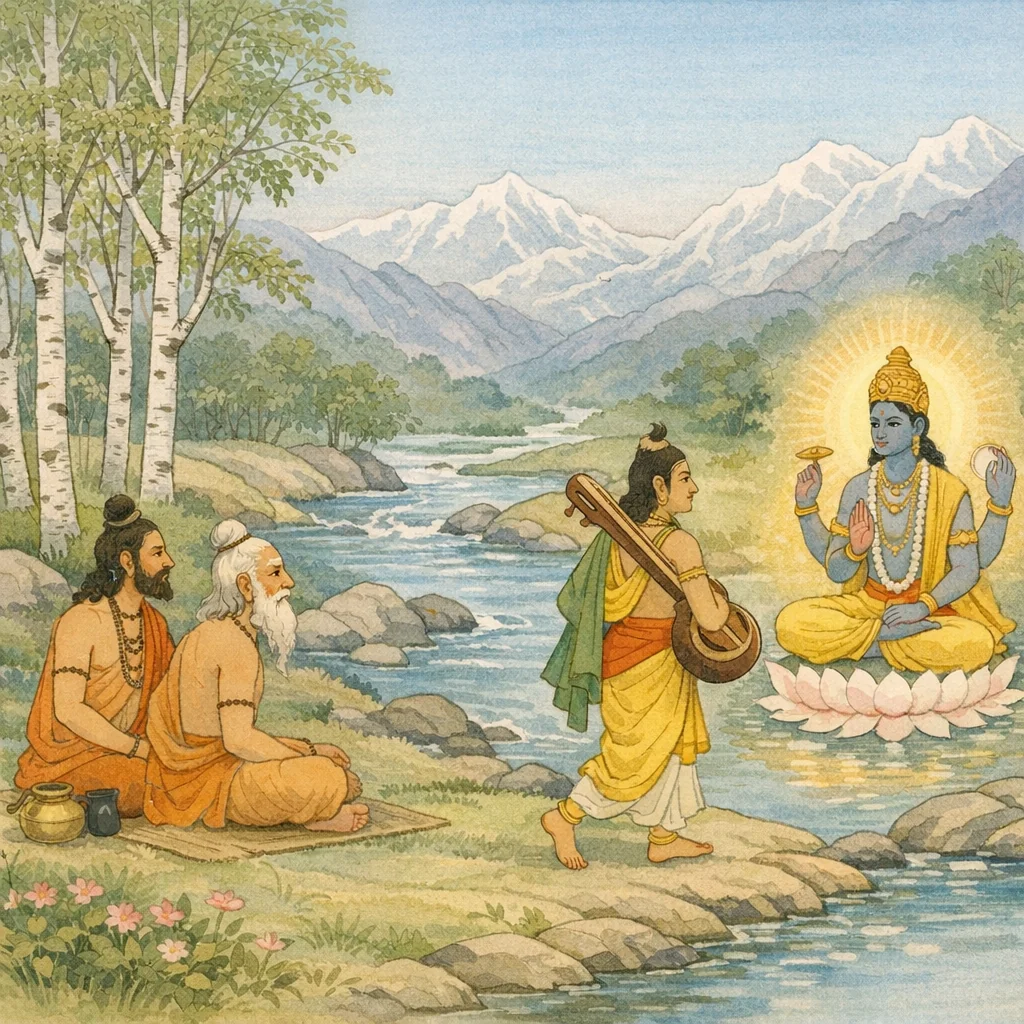
Adhyaya 345
Nāga-āyatana-darśana-pratīkṣā — The Brāhmaṇa’s Request and Waiting on the Gomatī
Upa-parva: Mokṣa-dharma (Liberation-Ethics) — Nāga-āyatana episode (Gomatī riverbank)
Bhīṣma narrates a brāhmaṇa’s sequential travel through varied forests, pilgrimage-fords, and lakes until he approaches a certain muni for guidance. Directed toward a specific nāga, he inquires appropriately and proceeds to the nāga’s sanctuary. Upon arrival he announces himself with respectful address. Hearing him, the nāga’s wife—described as dharma-devoted and pativratā—appears, receives him, and performs formal hospitality. The brāhmaṇa states that he is rested and honored by her gentle speech, and requests the darśana of the exalted nāga-deva as his primary purpose. The nāga-wife explains that her husband has gone on a month-long duty of conveying Sūrya’s chariot and will return within seven or eight days, and asks what further should be done. The brāhmaṇa resolves to stay in the great forest, asks that his arrival be reported without delay, and undertakes regulated living on the auspicious sandbank of the Gomatī. Bhīṣma concludes with the brāhmaṇa returning to the riverbank after reassuring the nāga-wife.
Chapter Arc: शौनक ऋषि सूतनन्दन से कहते हैं कि आपने जो महान आख्यान सुनाया, उसे सुनकर समस्त ऋषि विस्मित हो उठे—और वे नारायण-कथा की अद्वितीय फलश्रुति का उच्चारण करते हैं। → ऋषि-समाज तीर्थ-स्नान और आश्रम-यात्रा जैसे महापुण्यों की तुलना नारायण-कथा से करता है और घोषित करता है कि यह कथा सर्वपापप्रमोचनी है; फिर कथा-परम्परा का सूत्र वैषम्पायन के वचन और व्यास-वन्दना से आगे बढ़ता है, मानो श्रोताओं को एक और गहन दिव्य प्रसंग के लिए तैयार किया जा रहा हो। → वैषम्पायन व्यास के प्रसाद से ‘नारायणकथा’ कहने का संकल्प प्रकट करते हैं; बदर्याश्रम की पवित्र भूमि, तप-तेज के निवास दो ऋषियों का अनुशासित आचरण, और आगे चलकर नारद द्वारा विश्वरूप, अविनाशी परम पुरुष के दर्शन का संकेत—कथा को परम-दैवी शिखर पर ले जाता है। → फलश्रुति-स्वर में यह स्थापित होता है कि नारायण/हरि की कथा सुनना ही सर्वपाप-नाशक और सर्वाश्रम-तीर्थ-सेवन से भी अधिक फलदायी है; कथा-परम्परा सुरक्षित हाथों (व्यास→वैषम्पायन) में सौंप दी जाती है और श्रोता ‘पावित’ घोषित होते हैं। → नारद के विश्वरूप-दर्शन और नारायण द्वारा नारद से आगे कहे जाने वाले वचन का द्वार खुलता है—आगे क्या उपदेश/रहस्य प्रकट होगा?
Shlokas
Verse 1
शौनकने कहा--सूतनन्दन! आपने यह बहुत बड़ा आख्यान सुनाया है। इसे सुनकर समस्त ऋषियोंको बड़ा आश्चर्य हुआ है,इस प्रकार श्रीमहाभारत शान्तिपर्वके अन्तर्गत गोक्षधर्मपर्वमें नाययणकी महिमाविषयक तीन सौ तैतालीसवाँ अध्याय पूरा हुआ ॥/ ३४३ ॥। पम्प बछ। आर: चतुश्नत्वारिशर्दाधिकत्रिशततमो< ध्याय: नर-नारायणका नारदजीकी प्रशंसा करते हुए उन्हें भगवान् वासुदेवका माहात्म्य बतलाना नरनारायणावूचत॒: धन्यो<स्यनुगृहीतो $सि यत् ते दृष्ट: स्वयं प्रभु: । नहितं दृष्टवान् कश्चित् पद्मययोनिरपि स्वयम्
Śaunaka said: “O son of Sūta, you have narrated a truly great legend. Hearing it, all the sages have been filled with wonder.” Thus ends, in the Śānti Parva of the Mahābhārata, within the Mokṣa-dharma section, the three-hundred-and-forty-third chapter concerning the glory of Nārāyaṇa.
Verse 2
सर्वाश्रमाभिगमन सर्वतीर्थावगाहनम् | न तथा फलदं सौते नारायणकथा यथा,सूतकुमार! सम्पूर्ण ऋषि-आश्रमोंकी यात्रा करना और समस्त तीर्थोमें स्नान करना भी वैसा फलदायक नहीं है, जैसी कि भगवान् नारायणकी कथा है
Śaunaka said: “O Sauta, O son of the Sūta, even visiting all the sages’ hermitages and bathing at every sacred ford does not yield fruit equal to that gained from hearing and reflecting upon the sacred narrative of Nārāyaṇa. The Lord’s story surpasses external pilgrimages in spiritual efficacy.”
Verse 3
पाविताड्डा: सम संवृत्ता: श्रुत्वेमामादित: कथाम् । नारायणाश्रयां पुण्यां सर्वपापप्रमोचनीम्,समस्त पापोंसे छुड़ानेवाली नारायणसम्बन्धिनी इस पुण्यमयी कथाको आरम्भसे ही सुनकर हमारे तन-मन पवित्र हो गये
Śaunaka said: “Having heard this sacred narrative from the very beginning—this holy account that rests upon Nārāyaṇa and releases one from all sin—we have become purified in body and mind, and have been made wholly composed and serene.”
Verse 4
दुर्दशों भगवान् देव: सर्वलोकनमस्कृत: । सब्रद्यकै: सुरै: कृत्स्नैरन्यैश्वेव महर्षिभि:,सर्वलोकवन्दित भगवान् नारायणदेवका दर्शन तो ब्रह्मा आदि सम्पूर्ण देवताओं तथा अन्यान्य महर्षियोंके लिये भी दुर्लभ है
Śaunaka said: The Blessed Lord—the God revered by all the worlds—is exceedingly difficult to behold. Even Brahmā and the entire host of gods, together with other great seers, find His vision hard to attain.
Verse 5
दृष्टवान् नारदो यत्तु देवं नारायणं हरिम् । नूनमेतद्धयनुमतं तस्य देवस्य सूतज,सूतनन्दन! नारदजीने जो देवदेव नारायण हरिका दर्शन कर लिया, यह निश्चय ही उन भगवान्की अनुमतिसे ही सम्भव हुआ
Śaunaka said: “That Nārada indeed beheld the divine Nārāyaṇa, Hari—this surely could have happened only by the permission and assent of that very God, O son of a Sūta, O delight of the Sūta-line.”
Verse 6
यद् दृष्टवान् जगन्नाथमनिरुद्धतनौ स्थितम् । यत् प्राद्रवत् पुनर्भूयो नारदो देवसत्तमौ
Śaunaka said: “When he beheld the Lord of the universe abiding in the form of Aniruddha, and when Nārada—foremost among the gods’ sages—again hastened forth, what followed from that vision and that renewed urgency?”
Verse 7
सौतिरुवाच तस्मिन् यज्ञे वर्तमाने राज्ञ: पारिक्षितस्य वै,परिपप्रच्छ राजेन्द्र: पितामहपितामहम् । सूतपुत्रने कहा--शौनक! राजा जनमेजयका वह यज्ञ विधिपूर्वक चल रहा था। उसमें विभिन्न कर्मोके बीचमें अवकाश मिलनेपर राजेन्द्र जनममेजयने अपने पितामहोंके पितामह वेदनिधि भगवान् कृष्णद्वैपायन महर्षि व्याससे इस प्रकार पूछा
Sauti said: While that sacrifice of King Janamejaya, the descendant of Parīkṣit, was being duly conducted, the lordly king found a pause amid the various rites and respectfully questioned his great-grandfather’s great-grandfather—Veda-treasury Bhagavān Kṛṣṇa Dvaipāyana, the sage Vyāsa—asking as follows.
Verse 8
कर्मान्तरेषु विधिवद् वर्तमानेषु शौनक । कृष्णद्वैपायनं व्यासमृषिं वेदनिर्धि प्रभुम्
O Śaunaka, while the prescribed rites were proceeding in due order, there appeared the sage Kṛṣṇa-Dvaipāyana Vyāsa—an authoritative master, a veritable treasury of the Vedas.
Verse 9
जनमेजय उवाच श्वेतद्वीपातन्निवृत्तेन नारदेन सुर्िणा
Janamejaya said: “When the divine sage Nārada returned from Śvetadvīpa, what did he report?”
Verse 10
बदर्याश्रममागम्य समागम्य च तावृषी
Janamejaya said: “Having come to the hermitage of Badarī, and having met those two sages…”—thus he begins to inquire into the circumstances of their meeting at that sacred retreat, long associated with disciplined living, learning, and the pursuit of dharma.
Verse 11
इदं शतसहस्राद्धि भारताख्यानविस्तरात्
Janamejaya said: “This account is indeed drawn from the expanded narration of the Bhārata—the great tale that extends to a hundred thousand verses.”
Verse 12
नवनीतं यथा दध्नो मलयाच्चन्दनं यथा,ब्रह्म! जैसे दहीसे मक्खन, मलयपर्वतसे चन्दन, वेदोंसे आरण्यक और ओषधियोंसे अमृत निकाला गया है, उसी प्रकार आपने यह कथारूपी अमृत निकालकर रखा है
Janamejaya said: “Just as butter is drawn from curd, and sandalwood comes from the Malaya mountain; and as the Āraṇyakas are distilled from the Vedas and nectar is extracted from healing herbs, so too, O Brahman, you have drawn out and set before us this nectar-like essence in the form of sacred narrative.”
Verse 13
आरण्यकं च वेदेभ्य ओषधिभ्योडमृतं यथा । समुद्धृतमिदं ब्रह्मन् कथामृतमिदं तथा,ब्रह्म! जैसे दहीसे मक्खन, मलयपर्वतसे चन्दन, वेदोंसे आरण्यक और ओषधियोंसे अमृत निकाला गया है, उसी प्रकार आपने यह कथारूपी अमृत निकालकर रखा है
Janamejaya said: “O Brahman, just as the Āraṇyakas are drawn out from the Vedas, and nectar is extracted from medicinal herbs, so too have you brought forth and set before us this nectar of sacred narrative. By distilling the essence, you make profound dharma accessible and life-guiding.”
Verse 14
तपोनिधे त्वयोक्त हि नारायणकथाश्रयम् । स ईशो भगवान् देव: सर्वभूतात्मभावन:,तपोनिधे! आपने भगवान् नारयणकी कथासे सम्बन्ध रखनेवाली जो बातें कही हैं, वे सब इस ग्रन्थकी सारभूत हैं। सबके ईश्वर भगवान् नारायणदेव सम्पूर्ण भूतोंको उत्पन्न करनेवाले हैं
Janamejaya said: “O treasure of austerity, what you have spoken—grounded in the sacred narrative of Nārāyaṇa—truly forms the very essence of this teaching. That Lord, the Blessed Divine, is the sovereign of all, the God who brings forth and sustains the inner self of every being.”
Verse 15
अहो नारायणं तेजो दुर्दर्श द्विजसत्तम । यत्राविशन्ति कल्पान्ते सर्वे ब्रह्मादय: सुरा:,द्विजश्रेष्ठ] उन भगवान् नारायणका तेज अद्भुत है। मनुष्यके लिये उसकी ओर देखना भी कठिन है। कल्पके अन्तमें जिनके भीतर ब्रह्मा आदि सम्पूर्ण देवता, ऋषि, गन्धर्व तथा जो कुछ भी चराचर जगत् है, वह सब विलीन हो जाता है, उनसे बढ़कर परम पावन एवं महान् इस भूतल और स्वर्गलोकमें मैं दूसरे किसीको नहीं मानता
Janamejaya said: “O best of Brahmins, wondrous indeed is the radiance of Nārāyaṇa—hard for mortals to behold. At the end of an aeon, into Him all the gods beginning with Brahmā enter and are absorbed. Therefore, on earth and in heaven I recognize none as more supremely pure and great than He.”
Verse 16
ऋषयश्च सगन्धर्वा यच्च किंचिच्चराचरम् | न ततो<स्ति परं मन्ये पावन दिवि चेह च,द्विजश्रेष्ठ] उन भगवान् नारायणका तेज अद्भुत है। मनुष्यके लिये उसकी ओर देखना भी कठिन है। कल्पके अन्तमें जिनके भीतर ब्रह्मा आदि सम्पूर्ण देवता, ऋषि, गन्धर्व तथा जो कुछ भी चराचर जगत् है, वह सब विलीन हो जाता है, उनसे बढ़कर परम पावन एवं महान् इस भूतल और स्वर्गलोकमें मैं दूसरे किसीको नहीं मानता
Janamejaya said: “All the sages, together with the Gandharvas, and whatever exists in the universe—moving and unmoving—are not, in my judgment, superior to Him. I regard none as more supremely purifying than that One, both in heaven and here on earth.”
Verse 17
सर्वाश्रमाभिगमन सर्वतीर्थावगाहनम् । न तथा फलदं चापि नारायणकथा यथा,सम्पूर्ण ऋषि-आश्रमोंकी यात्रा करना और समस्त तीर्थोमें स्नान करना भी वैसा फल देनेवाला नहीं है, जैसा कि भगवान् नारायणकी कथा प्रदान करती है
Janamejaya said: “Even visiting all the hermitages of the sages and bathing at every sacred ford does not yield fruit equal to that bestowed by the sacred narration of Nārāyaṇa. The hearing and telling of the Lord’s story surpasses external pilgrimages in spiritual efficacy.”
Verse 18
सर्वथा पाविता: स्मेह श्रुत्वेमामादित: कथाम् | हरेविंश्वेश्वरस्येह सर्वपापप्रणाशनीम्,सम्पूर्ण विश्वके स्वामी श्रीहरिकी कथा सब पापोंका नाश करनेवाली है। उसे आरम्भसे ही सुनकर हम सब लोग यहाँ सर्वथा पवित्र हो गये हैं
Janamejaya said: “By hearing this account from the very beginning, we have all become completely purified here. For this is the story of Hari, the Lord of the universe, and it destroys every sin.”
Verse 19
न चित्र कृतवांस्तत्र यदार्यों मे धनंजय: । वासुदेवसहायो य: प्राप्तवाउ्जयमुत्तमम्,मेरे पितामह अर्जुनने जो भगवान् वासुदेवकी सहायता पाकर उत्तम विजय प्राप्त कर ली, वह वहाँ उन्होंने कोई अदभुत कार्य नहीं किया है
Janamejaya said: “It is no wonder that my noble ancestor Dhanañjaya (Arjuna) won the highest victory there; for Vāsudeva was his helper. With such divine support, he did nothing astonishing in that place.”
Verse 20
न चास्य किंचिदप्राप्यं मन््ये लोकेष्वपि त्रिषु त्रैलोक्यनाथो विष्णु: स यथा55सीत् साहा[ुकृत् स वै
Janamejaya said: “I do not think there is anything at all that he cannot attain—even across the three worlds. For he is Viṣṇu, the lord of the three worlds; just as he once was, so indeed he remains—ever capable and ever the accomplisher.”
Verse 21
त्रिलोकीनाथ भगवान् कृष्ण ही जब उनके सहायक थे, तब उनके लिये तीनों लोकोंमें किसी वस्तुकी प्राप्ति असम्भव रही हो, यह मैं नहीं मानता ।। धन्याश्व सर्व एवासन ब्रद्मांस्ते मम पूर्वजा: । हिताय श्रेयसे चैव येषामासीज्जनार्दन:
Janamejaya said: “When the Blessed Lord Krishna, the Lord of the three worlds, was their ally, I cannot accept that there could have been anything in the three worlds that was unattainable for them. Indeed, all those Dhanyāśvas—Brahmins who were my ancestors—were fortunate, for Janārdana stood with them for their welfare and highest good.”
Verse 22
ब्रह्मन! मेरे सभी पूर्वज धन्य थे, जिनका हित और कल्याण करनेके लिये साक्षात् जनार्दन तैयार रहते थे ।। तपसाथ सुदृश्यो हि भगवान् लोकपूजित: । य॑ दृष्टवन्तस्ते साक्षाच्छीवत्साडुकविभूषणम्,लोकपूजित भगवान् नारायणका दर्शन तो तपस्यासे ही हो सकता है; किंतु मेरे पितामहोंने श्रीवत्सके चिह्से विभूषित उन भगवानका साक्षात् दर्शन अनायास ही पा लिया था
Janamejaya said: “O Brahmin, blessed indeed were all my forefathers—for their welfare and true good, Janārdana Himself stood ready to act. The Lord, revered by the world, is ordinarily seen only through austerity; yet my grandsires obtained an effortless, direct vision of that world-honored Nārāyaṇa, adorned with the mark of Śrīvatsa.”
Verse 23
तेभ्यो धन्यतरश्नैव नारद: परमेष्ठिज: । न चाल्पतेजसमृषिं वेझि नारदमव्ययम्
Janamejaya said: “Among them, you—Nārada, born of the Creator (Parameṣṭhin)—are the most blessed. For you do not recognize the sage Nārada as one of little splendor; you know him as imperishable.”
Verse 24
श्वेतद्वीपं समासाद्य येन दृष्ट: स्वयं हरि: । देवप्रसादानुगतं व्यक्त तत् तस्य दर्शनम्
Janamejaya said: “Having reached Śvetadvīpa, by whom Hari Himself was seen directly—his vision of the Lord was clearly manifest, arising through the grace of the gods.”
Verse 25
उन सबसे भी अधिक धन्यवादके योग्य ब्रह्मपुत्र नारदजी हैं। मैं अविनाशी नारदजीको कम तेजस्वी ऋषि नहीं समझता, जिन्होंने श्वेतद्वीपमें पहुँचकर साक्षात् श्रीहरिका दर्शन प्राप्त कर लिया। उनका वह भगवद्-दर्शन स्पष्ट ही उन भगवान्की कृपाका फल है ।। तद् दृष्टवांस्तदा देवमनिरुद्धतनौ स्थितम् । बदरीमाश्रमं यत् तु नारद: प्राद्रवत् पुनः
Janamejaya said: “Most worthy of gratitude among them all is Brahmā’s son Nārada. I do not regard the imperishable Nārada as any lesser sage in splendor—he who reached Śvetadvīpa and obtained a direct vision of Śrī Hari. That divine vision is plainly the fruit of the Lord’s grace. Having then beheld the God abiding in the form of Aniruddha, Nārada once again hastened toward the Badarī hermitage.”
Verse 26
श्वेतद्वीपान्निवृत्तश्न नारद: परमेछिज:,ब्रह्मपुत्र नारदजी श्वेतद्वीपसे लौटनेपर जब बदरिकाश्रममें पहुँचकर उन दोनों ऋषियोंसे मिले, तब वहाँ उन्होंने कितने समयतक निवास किया? और वहाँ उनसे किन-किन प्रश्नोंको पूछा?
Janamejaya said: “When Nārada—born of Brahmā—returned from Śvetadvīpa and, on reaching Badarikāśrama, met those two sages, how long did he stay there? And what questions did he put to them?”
Verse 27
बदरीमाश्रमं प्राप्पय समागम्य च तावृषी । कियन्तं कालमवसत् प्रश्नान् कान् पृष्टवांश्व॒ ह,ब्रह्मपुत्र नारदजी श्वेतद्वीपसे लौटनेपर जब बदरिकाश्रममें पहुँचकर उन दोनों ऋषियोंसे मिले, तब वहाँ उन्होंने कितने समयतक निवास किया? और वहाँ उनसे किन-किन प्रश्नोंको पूछा?
Janamejaya said: “After the Brahmā-born sage Nārada returned from Śvetadvīpa and reached the hermitage of Badarī, meeting those two ṛṣis there, how long did he stay in that place? And what questions did he put to them?”
Verse 28
श्वेतद्वीपादुपावृत्ते तस्मिन् वा सुमहात्मनि । किमब्रूतां महात्मानौ नरनारायणावृषी
Janamejaya asked: “When that supremely great-souled one returned from Śvetadvīpa, what did the two great sages, Nara and Nārāyaṇa, say to him?”
Verse 29
वैशम्पायन उवाच नमो भगवते तस्मै व्यासायामिततेजसे
Vaiśampāyana said: “Salutations to that Blessed Lord—Vyāsa—whose splendor is immeasurable.” With this reverent invocation, the narrator hallows the discourse to come as sacred and authoritative, grounding the teaching in devotion and gratitude toward the sage who preserves dharma through scripture.
Verse 30
प्राप्य श्वेतं महाद्वीपं दृष्टवा च हरिमव्ययम्,राजन! श्वेतनामक महाद्वीपमें जाकर वहाँ अविनाशी श्रीहरिका दर्शन करके जब नारदजी लौटे, तब बड़े वेगसे मेरुपर्वतपर आ पहुँचे। परमात्मा श्रीहरिने उनसे जो कुछ कहा था, उस कार्यभारको वे हृदयसे ढो रहे थे
Vaiśampāyana said: “O King, having reached the great continent called Śveta and beholding the imperishable Hari, Nārada returned. Then, with great speed, he arrived at Mount Meru. What the Supreme Lord Śrī Hari had spoken to him, Nārada carried within his heart as a solemn charge—bearing the weight of that divine commission with inward resolve.”
Verse 31
निवृत्तो नारदो राजंस्तरसा मेरुमागमत् | हृदयेनोद्वहन् भारं यदुक्ते परमात्मना,राजन! श्वेतनामक महाद्वीपमें जाकर वहाँ अविनाशी श्रीहरिका दर्शन करके जब नारदजी लौटे, तब बड़े वेगसे मेरुपर्वतपर आ पहुँचे। परमात्मा श्रीहरिने उनसे जो कुछ कहा था, उस कार्यभारको वे हृदयसे ढो रहे थे
Vaiśampāyana said: “O King, Nārada, having turned back, swiftly reached Mount Meru. In his heart he bore the weight of the charge entrusted to him by the Supreme Self (Paramātman).”
Verse 32
पश्चादस्याभवद् राजन्नात्मन: साध्वसं महत् | यद् गत्वा दूरमध्वानं क्षेमी पुनरिहागत:,नरेश्वर! तत्पश्चात् उनके मनमें यह सोचकर बड़ा भारी विस्मय हुआ कि मैं इतनी दूरका मार्ग तै करके पुनः यहाँ सकुशल कैसे लौट आया?
Vaiśampāyana said: “Afterwards, O King, a great astonishment arose in his own mind—how, having gone along so long and distant a road, he had returned here again in safety, O lord of men.”
Verse 33
मेरो: प्रचक्राम तत: पर्वतं गन्धमादनम् | निपपात च खात् तूर्ण विशालां बदरीमनु,तदनन्तर वे मेरुसे गन्धमादन पर्वतकी ओर चले और बदरीविशालतीर्थके समीप तुरंत ही आकाशसे नीचे उतर पड़े
Vaiśampāyana said: Then he set out from Meru toward the Gandhamādana mountain, and swiftly descended from the sky, arriving near the sacred ford called Badarī-Viśālā.
Verse 34
ततः स ददृशे देवी पुराणावृषिसत्तमौ । तपश्चरन्तौ सुमहदात्मनिष्ठौ महाव्रतौ,वहाँ उन्होंने उन दोनों पुरातन देवता ऋषिश्रेष्ठ नर-नारायणका दर्शन किया, जो आत्मनिष्ठ हो महान् व्रत लेकर बड़ी भारी तपस्या कर रहे थे
Then he beheld the divine, ancient foremost of sages—Nara and Nārāyaṇa—steadfast in the Self, observing a great vow and engaged in an immense austerity.
Verse 35
तेजसाभ्यधिकौ सूर्यात् सर्वलोकविरोचनात् । श्रीवत्सलक्षणौ पूज्यौ जटामण्डलधारिणौ
Vaiśampāyana said: “They were possessed of a radiance surpassing the sun, illuminating all the worlds. Marked with the auspicious Śrīvatsa sign, venerable and worthy of worship, they bore a circular mass of matted locks.”
Verse 36
वे दोनों सम्पूर्ण लोकोंको प्रकाशित करनेवाले सूर्यसे भी अधिक तेजस्वी थे। उन पूज्य महात्माओंके वक्षःस्थलमें श्रीवत्सके चिह्न सुशोभित हो रहे थे और वे अपने मस्तकपर जटामण्डल धारण किये हुए थे ।। जालपादभुजौ तौ तु पादयोश्वक्रलक्षणौ | व्यूढोरस्कौ दीर्घभुजी तथा मुष्कचतुष्किणौ,उनके हाथोंमें हंसका और चरणोंमें चक्रका चिह्न था। विशाल वक्ष:स्थल, बड़ी-बड़ी भुजाएँ, अण्डकोशमें चार-चार बीज, मुखमें साठ दाँत और आठ दाढ़ें, मेघके समान गम्भीर स्वर, सुन्दर मुख, चौड़े ललाट, बाँकी भौंहें, सुन्दर ठोढ़ी और मनोहर नासिकासे उन दोनोंकी अपूर्व शोभा हो रही थी
Vaiśaṃpāyana said: Those two revered great-souled beings were more radiant than the sun that illumines all the worlds. The mark of Śrīvatsa shone upon their chests, and they wore a matted crown of hair upon their heads. Their hands and feet bore auspicious signs—on their feet the emblem of the discus. Broad-chested and long-armed, they possessed extraordinary bodily marks (including the rare sign of fourfold generative potency). Their appearance—deep, cloud-like voice, handsome face, wide forehead, arched brows, pleasing chin, and graceful nose—was of uncommon splendor.
Verse 37
षष्टिदन्तावष्टदंष्टी मेघौघसदृशस्वनौ । स्वास्यौ पृथुललाटौ च सुभ्रू सुहनुनासिकौ,उनके हाथोंमें हंसका और चरणोंमें चक्रका चिह्न था। विशाल वक्ष:स्थल, बड़ी-बड़ी भुजाएँ, अण्डकोशमें चार-चार बीज, मुखमें साठ दाँत और आठ दाढ़ें, मेघके समान गम्भीर स्वर, सुन्दर मुख, चौड़े ललाट, बाँकी भौंहें, सुन्दर ठोढ़ी और मनोहर नासिकासे उन दोनोंकी अपूर्व शोभा हो रही थी
Vaiśampāyana said: “They had sixty teeth and eight prominent fangs; their voices rumbled deep like a mass of rain-clouds. Their faces were handsome, their foreheads broad, their eyebrows gracefully arched, and their chins and noses well-formed—so that an extraordinary splendor shone from them.”
Verse 38
आततपत्रेण सदृशे शिरसी देवयोस्तयो: । एवं लक्षणसम्पन्नौ महापुरुषसंज्ञिती,उन दोनों देवताओंके मस्तक छत्रके समान प्रतीत होते थे। ऐसे शुभलक्षणोंसे सम्पन्न उन दोनों महापुरुषोंका दर्शन करके नारदजीको बड़ी प्रसन्नता हुई। भगवान् नर और नारायणने भी नारदजीका स्वागत-सत्कार करके उनका कुशल-समाचार पूछा
Vaiśampāyana said: The heads of those two divine beings appeared like parasols—emblems of sovereign auspiciousness. Seeing those two great persons, complete with such fortunate marks, Nārada was filled with joy; and Nara and Nārāyaṇa, in turn, received him with due honor and inquired after his welfare.
Verse 39
तौ दृष्टवा नारदो हृष्टस्ताभ्यां च प्रतिपूजित: । स्वागतेनाभिभाष्याथ पृष्टश्नानामयं तथा,उन दोनों देवताओंके मस्तक छत्रके समान प्रतीत होते थे। ऐसे शुभलक्षणोंसे सम्पन्न उन दोनों महापुरुषोंका दर्शन करके नारदजीको बड़ी प्रसन्नता हुई। भगवान् नर और नारायणने भी नारदजीका स्वागत-सत्कार करके उनका कुशल-समाचार पूछा
Vaiśampāyana said: Seeing those two, Nārada was filled with joy, and they honored him as was fitting. After greeting him with words of welcome, they inquired in the proper manner about his well-being—whether he was free from fatigue and illness.
Verse 40
बभूवान्तर्गतमतिर्निरी क्ष्य पुरुषोत्तमौ । सदोगतास्तत्र ये वै सर्वभूतनमस्कृता:
Vaiśampāyana said: Having beheld the two supreme persons, his mind turned inward in deep contemplation. Those who were present there—ever devoted to the good—bowed in reverence to all beings, embodying a spirit of universal respect.
Verse 41
श्वेतद्वीपे मया दृष्टास्तादृशावृषिसत्तमौ । तदनन्तर नारदजीने उन दोनों पुरुषोत्तमोंकी ओर देखकर मन-ही-मन विचार किया, अहो! मैंने श्वेतद्वीपमें भगवान्की सभाके भीतर जिन सर्वभूतवन्दित सदस्योंको देखा था, ये दोनों ऋषिश्रेष्ठ भी वैसे ही हैं ।। इति संचिन्त्य मनसा कृत्वा चाभिप्रदक्षिणम्
Vaiśampāyana said: “In Śvetadvīpa I had seen two foremost sages of just such a form.” After that, Nārada, looking toward those two supreme persons, reflected within himself: “Ah! The venerable members I beheld inside the Lord’s assembly in Śvetadvīpa—revered by all beings—these two best of sages are exactly like them.” Having thus pondered in his mind, he then circumambulated them in reverence.
Verse 42
ततस्तौ तपसां वासौ यशसां तेजसामपि,तदनन्तर तपस्या, यश और तेजके भी निवासस्थान वे शम-दमसम्पन्न दोनों ऋषि पूर्वाह्नकालका नित्य कर्म पूर्ण करके फिर शान्त-भावसे पाद्य और अर्घ्य आदि निवेदन करके नारदजीकी पूजा करने लगे
Vaiśaṃpāyana said: Then those two sages—abodes of austerity, and likewise of fame and spiritual radiance—having completed their customary morning rites, calmly offered the respectful gifts of water for washing the feet and the arghya oblation, and began to worship Nārada.
Verse 43
ऋषी शमदमोपेतौ कृत्वा पौर्वाह्निकं विधिम् | पश्चान्नारदमव्यग्रौ पाद्यार्ष्याभ्यामथार्चत:,तदनन्तर तपस्या, यश और तेजके भी निवासस्थान वे शम-दमसम्पन्न दोनों ऋषि पूर्वाह्नकालका नित्य कर्म पूर्ण करके फिर शान्त-भावसे पाद्य और अर्घ्य आदि निवेदन करके नारदजीकी पूजा करने लगे
Vaiśampāyana said: The two sages, endowed with tranquility and self-restraint, completed their regular morning rites. Thereafter, with untroubled minds, they proceeded to honor Nārada—offering him water for washing the feet and the arghya offering—thus worshipping him in a calm and reverent spirit.
Verse 44
पीठयोश्वोपविष्टौ तौ कृतातिथ्याद्विकौ नृप । तेषु तत्रोपविष्टेषु स देशोडभिव्यराजत
Vaiśampāyana said: O king, when the rites of hospitality had been duly performed, the two sat upon their seats. And as they sat there, that place shone with a special splendor—made auspicious by their presence and by the proper honoring of the guest.
Verse 45
अथ नारायणत्तत्र नारदं वाक्यमब्रवीत्
Then, there, Nārāyaṇa addressed Nārada with words—signaling the beginning of a purposeful instruction and counsel within the unfolding discourse.
Verse 46
नरनारायणावूचतु: अपीदानीं स भगवान् परमात्मा सनातन:
Nara and Nārāyaṇa said: “Even now, that Blessed Lord—the eternal Supreme Self—(is present and at work).”
Verse 47
नारद उवाच दृष्टो मे पुरुष: श्रीमान् विश्वरूपधरोडव्यय:
Nārada said: “I have beheld a glorious Person—imperishable—who bears the form of the universe.”
Verse 48
अद्यापि चैनं पश्यामि युवां पश्चन् सनातनौ,मैं इस समय भी आप दोनों सनातन पुरुषोंको देखकर यहीं श्वेतद्वीपनिवासी भगवान्की झाँकी कर रहा हूँ। वहाँ मैंने अव्यक्तरूपधारी श्रीहरिको जिन लक्षणोंसे सम्पन्न देखा था, आप दोनों व्यक्तरूपधारी पुरुष भी उन्हीं लक्षणोंसे सुशोभित हैं
“Even now I behold you both—eternal Puruṣas—before my eyes. As I look upon you, it is as though I am granted a vision, here itself, of the Lord who dwells in Śvetadvīpa. The very marks by which I beheld Śrī Hari there, bearing an unmanifest form—those same marks adorn you both as well, now appearing in manifest form.”
Verse 49
यैर्लक्षणैरुपेत: स हरिरव्यक्तरूपधृक् | तैर्लक्षणैरुपेतौ हि व्यक्तरूपधरौ युवाम्,मैं इस समय भी आप दोनों सनातन पुरुषोंको देखकर यहीं श्वेतद्वीपनिवासी भगवान्की झाँकी कर रहा हूँ। वहाँ मैंने अव्यक्तरूपधारी श्रीहरिको जिन लक्षणोंसे सम्पन्न देखा था, आप दोनों व्यक्तरूपधारी पुरुष भी उन्हीं लक्षणोंसे सुशोभित हैं
Nārada said: “The Lord Hari, who bears an unmanifest form, was endowed with certain distinguishing marks. You two, though bearing manifest forms, are indeed adorned with those very same marks. Even now, as I behold you both—eternal Persons—I seem to be witnessing again the vision of the Lord who dwells in Śvetadvīpa.”
Verse 50
दृष्टौ युवां मया तत्र तस्य देवस्य पार्श्चत: । इहैव चागतो<स्म्यद्य विसृष्ट: परमात्मना,इतना ही नहीं, मैंने आप दोनोंको वहाँ भी परमदेवके पास उपस्थित देखा था और उन्हीं परमात्माके भेजनेसे आज मैं फिर यहाँ आया हूँ
Nārada said: “I saw you both there as well, standing beside that divine Lord. And today I have come here again—sent forth by the Supreme Self.”
Verse 51
को हि नाम भवेत् तस्य तेजसा यशसा श्रिया । सदृशस्टत्रिषु लोकेषु ऋते धर्मात्मजौ युवाम्,तीनों लोकोंमें धर्मके पुत्र आप दोनों महापुरुषोंके सिवा दूसरा कौन है, जो तेज, यश और श्रीमें उन्हीं परमेश्वरके समान हो
Nārada said: “Who, indeed, could be comparable to Him in splendor, fame, and prosperity? In all the three worlds, none is His equal—except you two, the righteous sons of Dharma.”
Verse 52
तेन मे कथित: कृत्स्नो धर्म: क्षेत्रज्ञसंज्ञित: । प्रादुर्भावाश्ष कथिता भविष्या इह ये यथा,उन भगवान् श्रीहरिने मुझसे सम्पूर्ण धर्मका वर्णन किया था। क्षेत्रज्षका भी परिचय दिया था और यहाँ भविष्यमें उनके जो अवतार जैसे होनेवाले हैं, उन्हें भी बताया था
Nārada said: “By him, the entire Dharma—known as the teaching concerning the Knower of the Field (kṣetrajña)—was explained to me in full. He also described the manifestations that are to appear here in the future, and the manner in which they will occur.”
Verse 53
तत्र ये पुरुषा: श्वेता: पज्चेन्द्रियविवर्जिता: । प्रतिबुद्धा श्व ते सर्वे भक्ताश्न पुरुषोत्तमम्,वहाँ जो चन्द्रमाके समान गौरवर्णके पुरुष थे, वे सब-के-सब पाँचों इन्द्रियोंसे रहित अर्थात् पाज्च-भौतिक शरीरसे शून्य, ज्ञानवान् तथा पुरुषोत्तम श्रीविष्णुके भक्त थे
Nārada said: “There, the beings who appeared radiant and white were all free from the five senses—devoid of the gross, sense-based embodiment. Fully awakened in knowledge, they were all devoted to the Supreme Person (Puruṣottama, Viṣṇu).”
Verse 54
तेडर्चयन्ति सदा देवं तै: सार्थ रमते च सः । प्रियभक्तो हि भगवान् परमात्मा द्विजप्रिय:,वे सदा उन नारायणदेवकी पूजा-अर्चा करते रहते हैं और भगवान् भी सदा उनके साथ प्रसन्नतापूर्वक क्रीड़ा करते रहते हैं। भगवानको अपने भक्त बहुत ही प्रिय हैं तथा वे परमात्मा श्रीहरि ब्राह्मणोंके भी प्रेमी हैं
Narada says: “They continually worship the Lord, and the Lord, delighted, sports in their company. For the Blessed One—the Supreme Self—is especially fond of loving devotees, and He is also a lover of the twice-born (brahmins).”
Verse 55
रमते सो<र्च्यमानो हि सदा भागवतप्रिय: । विश्वभुक् सर्वगो देवो माधवो भक्तवत्सल:
Narada said: “He ever delights when he is worshipped, for he is always dear to the devotees of the Lord. That all-pervading divine Mādhava—sustainer of the universe and present everywhere—is tenderly devoted to his devotees.”
Verse 56
वे विश्वका पालन करनेवाले सर्वव्यापी भगवान् बड़े भक्तवत्सल हैं। भगवद्धक्तोंके प्रेमी और प्रियतम श्रीहरि उनसे पूजित हो वहाँ सदा सुप्रसन्न रहते हैं ।। स कर्ता कारणं चैव कार्य चातिबलद्युति: । हेतुश्नाज्ञा विधानं च तत्त्वं चैव महायशा:,वे ही कर्ता, कारण और कार्य हैं। उनका बल और तेज अनन्त है। वे महायशस्वी भगवान् ही हेतु, आज्ञा, विधि और तत्त्वरूप हैं
Narada said: He is indeed the doer, the cause, and the effect; His power and radiance are immeasurable. That supremely glorious Lord is Himself the motive force, the command, the ordinance, and the very principle of reality. Ever affectionate to His devotees, He remains constantly pleased where He is worshipped with love.
Verse 57
तपसा योज्य सो>>त्मान श्वेतद्वीपात् परं हि यत् । तेज इत्यभिविख्यातं स्वयंभासा&$वभासितम्,वे अपने आपको तपस्यामें लगाकर श्वेतद्वीपसे भी परे प्रकाशमान तेजोमय स्वरूपसे विख्यात हैं। उनका वह तेज अपने ही प्रकाशसे प्रकाशित है
Nārada said: “By yoking oneself to austerity, one reaches That which lies beyond Śvetadvīpa—celebrated as pure Radiance. That Radiance shines by its own light, self-luminous and not dependent on anything else.”
Verse 58
शान्ति: सा त्रिषु लोकेषु विहिता भावितात्मना । एतया शुभया बुद्धया नैछिकं व्रतमास्थित:,उन पूतात्मा परमात्माने तीनों लोकोंमें उस शान्तिका विस्तार किया है। अपनी इस कल्याणमयी बुद्धिके द्वारा वे नैप्ठिक व्रतका आश्रय लेकर स्थित हैं
Nārada said: “That peace—established throughout the three worlds—has been set in place by one whose self is fully cultivated and disciplined. Guided by this auspicious, welfare-bearing understanding, he abides in the Naiṣṭhika vow, steadfast in unwavering spiritual commitment.”
Verse 59
न तत्र सूर्यस्तपति न सोमो5भिविराजते । न वायुर्वाति देवेशे तपश्चरति दुश्वरम्,वहाँ सूर्य नहीं तपते, चन्द्रमा नहीं प्रकाशित होते तथा दुष्कर तपस्यामें लगे हुए देवेश्वर श्रीहरिके समीप यह लौकिक वायु भी नहीं चलती है
Narada said: “In that realm the sun does not burn, the moon does not shine, and even the wind does not blow. Near the Lord of gods, engaged in arduous austerity, the ordinary forces of the world lose their sway.”
Verse 60
वेदीमष्टनलोत्सेधां भूमावास्थाय विश्वकृत् एकपादस्थितो देव ऊर्ध्वबाहुरुदड्मुख:
Narada said: “The Creator of the universe prepared a sacred altar on the ground, raised to the height of eight measures, and stood upon it on a single foot. With arms lifted upward and his face turned to the north, the god remained in a posture of austere concentration—an image of disciplined self-restraint and unwavering resolve that underlies righteous conduct.”
Verse 61
वहाँकी भूमिपर एक ऊँची वेदी बनी है, जिसकी ऊँचाई आठ अंगुलियोंकी लंबाईके बराबर है। उसपर आखरूढ़ हो वे विश्वकर्ता परमात्मा दोनों भुजाएँ ऊपर उठाये और उत्तरकी ओर मुँह किये एक पैरसे खड़े हैं ।। साज्नावर्तयन् वेदांस्तपस्तेपे सुदुश्चरम् । यद् ब्रह्मा ऋषयश्चैव स्वयं पशुपतिश्न यत्,वे अंगोंसहित सम्पूर्ण वेदोंकी आवृत्ति करते हुए अत्यन्त कठोर तपस्यामें संलग्न हैं। ब्रह्मा, स्वयं महादेव, सम्पूर्ण ऋषि और शेष, श्रेष्ठ देवता तथा दैत्य, दानव, राक्षस, नाग, गरुड, गन्धर्व, सिद्ध एवं राजर्षिगण सदा विधिपूर्वक जो हव्य और कव्य अर्पण करते हैं, वह सब कुछ उन्हीं भगवानके चरणोंमें उपस्थित होता है
Nārada said: “On that ground there stands a lofty altar, its height measured as eight finger-breadths. Mounting it, the Supreme Lord—the Maker of the universe—stands upon a single foot, facing north, with both arms raised upward. Reciting the Vedas in due order, He performs an austerity exceedingly hard to accomplish—an austerity such as even Brahmā, the sages, and Paśupati (Śiva) themselves undertake. While He repeats the complete Vedas together with their ancillary limbs, He remains absorbed in severe tapas. Whatever offerings—havya for the gods and kavya for the ancestors—are presented according to rule by Brahmā, by Mahādeva, by all the ṛṣis, by Śeṣa, and by the foremost among gods, asuras, dānavas, rākṣasas, nāgas, Garuḍa, gandharvas, siddhas, and royal seers—everything comes to rest at the feet of that Lord.”
Verse 62
शेषाश्व विबुधश्रेष्ठा दैत्यदानवराक्षसा: । नागा: सुपर्णा गन्धर्वा: सिद्धा राजर्षयश्न ये,वे अंगोंसहित सम्पूर्ण वेदोंकी आवृत्ति करते हुए अत्यन्त कठोर तपस्यामें संलग्न हैं। ब्रह्मा, स्वयं महादेव, सम्पूर्ण ऋषि और शेष, श्रेष्ठ देवता तथा दैत्य, दानव, राक्षस, नाग, गरुड, गन्धर्व, सिद्ध एवं राजर्षिगण सदा विधिपूर्वक जो हव्य और कव्य अर्पण करते हैं, वह सब कुछ उन्हीं भगवानके चरणोंमें उपस्थित होता है
Narada said: “Even the foremost beings—Śeṣa and the celestial horses, the best of the gods, as well as Daityas, Dānavas, and Rākṣasas; Nāgas, Suparṇas (Garuḍa-kind), Gandharvas, Siddhas, and royal seers—engage in exceedingly austere tapas while continually reciting the Vedas in full, with all their limbs and auxiliaries. Whatever offerings of havya (for the gods) and kavya (for the ancestors) are duly presented—by Brahmā, by Mahādeva himself, by all the Ṛṣis, by Śeṣa, and by these various orders of beings—everything ultimately comes to rest at the feet of that Supreme Lord. The ethical thrust is that disciplined practice, Vedic learning, and ritual merit find their true completion only when oriented toward the highest divine refuge.”
Verse 63
नरनारायणो द्रष्ठूं कारणं तद् ब्रवीहि मे । नारदजीने जो अनिरुद्ध-विग्रहमें स्थित हुए जगन्नाथ श्रीहरिका दर्शन किया और पुनः जो वे वहाँसे देवश्रेष्ठ नर-नारायणका दर्शन करनेके लिये उनके पास दौड़े गये, इसका क्या कारण है? यह मुझे बताइये,हव्यं कव्यं च सततं विधियुक्तं प्रयुड्जते । कृत्स्नं तु तस्य देवस्थ चरणावुपतिष्ठति वे अंगोंसहित सम्पूर्ण वेदोंकी आवृत्ति करते हुए अत्यन्त कठोर तपस्यामें संलग्न हैं। ब्रह्मा, स्वयं महादेव, सम्पूर्ण ऋषि और शेष, श्रेष्ठ देवता तथा दैत्य, दानव, राक्षस, नाग, गरुड, गन्धर्व, सिद्ध एवं राजर्षिगण सदा विधिपूर्वक जो हव्य और कव्य अर्पण करते हैं, वह सब कुछ उन्हीं भगवानके चरणोंमें उपस्थित होता है
Shaunaka said: “Tell me the reason for this: why did Nārada, after beholding the Lord of the universe Hari manifest in the form of Aniruddha, then hasten again to see the foremost divine sages Nara and Nārāyaṇa? For to them, continually and in due rite, offerings meant for the gods (havya) and for the ancestors (kavya) are presented; and indeed the entirety of those offerings comes to rest at their divine feet.”
Verse 64
या: क्रिया: सम्प्रयुक्ताश्न एकान्तगतबुद्धिभि: । ता: सर्वा: शिरसा देव: प्रतिगृह्नाति वै स््वयम्,जिनकी बुद्धि अनन्य भावसे एकमात्र भगवानमें ही लगी हुई है, उन भक्तोंद्वारा जो क्रियाएँ समर्पित की जाती हैं, उन सबको वे भगवान् स्वयं शिरोधार्य करते हैं
Narada said: “Whatever acts and observances are performed and offered by those whose understanding has become one-pointed—withdrawn from all else and fixed solely on the Lord—those offerings the Divine Himself accepts, as it were, placing them upon His head.”
Verse 65
न तस्यान्य: प्रियतर: प्रतिबुद्धैर्महात्मभि: । विद्यते त्रिषु लोकेषु ततो5स्यैकान्तिकं गत:,वहाँके ज्ञानी-महात्मा भक्तोंसे बढ़कर भगवान्को तीनों लोकोंमें दूसरा कोई प्रिय नहीं है; अतः मैं अनन्य भावसे उन्हींकी शरणमें गया हूँ
Nārada said: “For Him, among the awakened great-souled ones, there is no one dearer to Him anywhere in the three worlds. Therefore I have taken exclusive refuge in Him alone.”
Verse 66
इह चैवागतस्तेन विसृष्ट: परमात्मना । एवं मे भगवान् देव: स्वयमाख्यातवान् हरि: । आसिष्ये तत्परो भूत्वा युवाभ्यां सह नित्यश:,यहाँ भी मैं उन्हीं परमात्माके भेजनेसे आया हूँ। स्वयं भगवान् श्रीहरिने मुझसे ऐसा कहा था। अब मैं उन्हींकी आराधनामें तत्पर हो आप दोनोंके साथ यहाँ नित्य निवास करूँगा
“I have come here as well, dispatched by that Supreme Self. Thus did the Blessed Lord, the divine Hari, personally declare to me. Therefore, devoted wholly to His worship, I shall dwell here continually in your company.”
Verse 86
परिपप्रच्छ राजेन्द्र: पितामहपितामहम् । सूतपुत्रने कहा--शौनक! राजा जनमेजयका वह यज्ञ विधिपूर्वक चल रहा था। उसमें विभिन्न कर्मोके बीचमें अवकाश मिलनेपर राजेन्द्र जनममेजयने अपने पितामहोंके पितामह वेदनिधि भगवान् कृष्णद्वैपायन महर्षि व्याससे इस प्रकार पूछा
The Sūta’s son said: “O Śaunaka, King Janamejaya’s sacrifice was proceeding in due form. And in an interval amid the many ritual acts, the royal Janamejaya questioned the great Ṛṣi Vyāsa—Kṛṣṇa Dvaipāyana, treasury of the Vedas, grandsire of grandsires—in these words.”
Verse 93
ध्यायता भगवद्धाक्यं चेष्टितं किमत: परम् । जनमेजय बोले--भगवन्! भगवान् नारायणके कथनपर विचार करते हुए देवर्षि नारद जब श्वेतद्वीपसे लौट आये, तब उसके बाद उन्होंने क्या किया?
Janamejaya said: “Revered sir, after the divine sage Nārada returned from Śvetadvīpa—reflecting upon the words spoken by Lord Nārāyaṇa—what did he do next? What further course of action followed from that contemplation?”
Verse 103
कियन्तं कालमवसत् कां कथां पृष्टवांश्व सः । बदरिकाश्रममें आकर उन दोनों ऋषियोंसे मिलनेके पश्चात् नारदजीने वहाँ कितने समयतक निवास किया और उन दोनोंसे कौन-सी कथा पूछी?
Janamejaya asked: “After arriving at Badarikāśrama and meeting those two sages, how long did Nārada stay there, and what story did he inquire about from them?”
Verse 113
आमन्थ्य मतिमन्थेन ज्ञानोदधिमनुत्तमम् । एक लाख श्लोकोंसे युक्त विस्तृत महाभारत इतिहाससे निकालकर जो आपने यह सारभूत कथा सुनायी है, यह बुद्धिरूपी मथानीके द्वारा ज्ञानके उत्तम समुद्रको मथकर निकाले गये अमृतके समान है
Janamejaya said: “By churning the unsurpassed ocean of knowledge with the churning-rod of discernment, you have drawn out and recited this essential narrative from the vast Mahābhārata history, a work comprising a hundred thousand verses. This distilled account is like nectar obtained by churning the supreme sea of wisdom with the ladle of intellect.”
Verse 253
नरनारायणो द्रष्टूं कि तु तत् कारणं मुने । मुने! नारदजीने उस समय प्रैतद्वीपमें जाकर जो अनिरुद्ध-विग्रहमें स्थित नारायणदेवका साक्षात्कार किया तथा पुनः नर-नारायणका दर्शन करनेके लिये जो बदरिकाश्रमको प्रस्थान किया, इसका क्या कारण है?
Janamejaya said: “O sage, what was the reason for seeking the vision of Nara-Nārāyaṇa? At that time Nārada went to Praitadvīpa and directly beheld Lord Nārāyaṇa abiding in the form of Aniruddha; and then he set out again for Badarikāśrama to obtain the darśana of Nara and Nārāyaṇa. What prompted this sequence of actions?”
Verse 286
तदेतन्मे यथातत्त्वं सर्वमाख्यातुमहसि । श्वेतद्वीपसे लौटे हुए उन नारदजीसे महात्मा नर-नारायण ऋषियोंने क्या बात की थी? ये सब बातें आप यथार्थरूपसे बतानेकी कृपा करें
Janamejaya said: “Please relate to me, exactly as it truly happened, the whole account. When Nārada returned from Śvetadvīpa, what conversation did the great sages Nara and Nārāyaṇa have with him? Kindly tell me all of this in a faithful and accurate manner.”
Verse 343
इति श्रीमहाभारते शान्तिपर्वणि मोक्षधर्मपर्वणि नारायणीये त्रिचत्वारिंशदधिकत्रिशततमो< ध्याय:
Thus, in the Śrī Mahābhārata, within the Śānti Parva—specifically in the Mokṣa-dharma section, in the Nārāyaṇīya—ends the three-hundred-and-forty-third chapter (343).
Verse 416
स चोपविविशे तत्र पीठे कुशमये शुभे । मन-ही-मन ऐसा सोचकर वे उन दोनोंकी प्रदक्षिणा करके एक सुन्दर कुशासनपर बैठ गये
Then, having respectfully circumambulated those two and reflecting inwardly, he sat down there upon an auspicious seat made of kuśa grass.
Verse 443
आज्याहुतिमहाज्वालैर्यज्ञवाटो यथाग्निभि: । नरेश्वर! अपने नित्यकर्म तथा नारदजीका आतिथ्य-सत्कार करके वे दोनों ऋषि भी कुशासनपर बैठ गये। वहाँ उन तीनोंके बैठ जानेपर वह प्रदेश घीकी आहुतिसे प्रज्वलित विशाल लपटोंवाले तीन अग्नियोंसे प्रकाशित यज्ञमण्डपकी भाँति सुशोभित होने लगा
Vaiśampāyana said: “O king, just as a sacrificial enclosure shines when fires blaze high with oblations of ghee, so too did that place become radiant. After completing their daily rites and duly honoring Nārada with the hospitality owed to a guest, the two sages also took their seats upon kuśa-grass mats. When all three were seated, the region appeared splendid—like a yajña-hall illuminated by three fires whose great flames are fed by ghee-offerings.”
Verse 466
श्वेतद्वीपे त्वया दृष्ट आवयो: प्रकृति: परा । नर-नारायण बोले--देवर्षे! क्या तुमने इस समय श्वेतद्वीपमें जाकर हम दोनोंका परम कारणरूप सनातन परमात्मा भगवान्का दर्शन कर लिया?
Vaiśampāyana said: In Śvetadvīpa you beheld our supreme, transcendent source. Nara and Nārāyaṇa asked, “O divine seer, have you, at this time, gone to Śvetadvīpa and obtained the vision of that eternal Lord—the Supreme Self—who is the highest causal principle behind us both?”
Verse 2936
यस्य प्रसादाद् वक्ष्यामि नारायणकथामिमाम् | वैशम्पायनजीने कहा--अमिततेजस्वी भगवान् व्यासको नमस्कार है, जिनके कृपाप्रसादसे मैं भगवान् नारायणकी यह कथा कह रहा हूँ
Vaiśampāyana said: By whose gracious favor I am able to speak, I shall now relate this sacred account of Nārāyaṇa—offered with reverence to the immeasurably radiant Bhagavān Vyāsa, through whose blessing this narration becomes possible.
Verse 4536
सुखोपविष्टं विश्रान्तं कृतातिथ्यं सुखस्थितम् । इसके बाद वहाँ आतिथ्य ग्रहण करके सुखपूर्वक बैठकर विश्राम करते हुए नारदजीसे नारायणने इस प्रकार कहा
Vaiśaṃpāyana said: When Nārada had been comfortably seated, rested, duly honored as a guest, and was at ease, Nārāyaṇa—after receiving him with proper hospitality—addressed him in this manner.
Verse 4736
सर्वे लोका हि तत्रस्थास्तथा देवा: सहर्षिभि: । नारदजीने कहा--भगवन! मैंने विश्वरूपधारी उन अविनाशी एवं कान्तिमान् परम पुरुषका दर्शन कर लिया। ऋषियोंसहित देवता तथा सम्पूर्ण लोक उन्हींके भीतर विराजमान हैं
Nārada said: “Indeed, all the worlds abide there, and so too the gods together with the ṛṣis.” In context, he is describing the vision of the imperishable, radiant Supreme Person in whose being the entire cosmos—deities, sages, and all realms—are contained, underscoring that true sovereignty and refuge lie in the all-encompassing Divine rather than in limited worldly power.
Frequently Asked Questions
The brāhmaṇa faces a choice between immediate gratification (departing or demanding) and disciplined patience: he elects respectful waiting and proper notification protocols to preserve dharma in an uncertain timetable.
The chapter models non-transactional spiritual pursuit: seeking darśana through etiquette, restraint, and endurance, while honoring household dharma expressed through the nāga-wife’s careful hospitality and truthful guidance.
No explicit phalaśruti occurs in these verses; the implied meta-lesson is that adherence to dharmic procedure (pūjā, truthful speech, regulated living) is itself a qualifying condition for meaningful encounter within mokṣa-oriented narratives.