Adhyaya 17
Śalya-hatānantarāṇi: Madrarāja-padānugānāṃ praskandana and the Pandava counter-encirclement (शल्यहतानन्तराणि—मद्रराजपदानुगानां प्रस्कन्दनम्)
Upa-parva: Madrarāja-padānugānāṃ praskandana (After Śalya’s fall: the Madra contingent’s assault and Duryodhana’s attempted restraint)
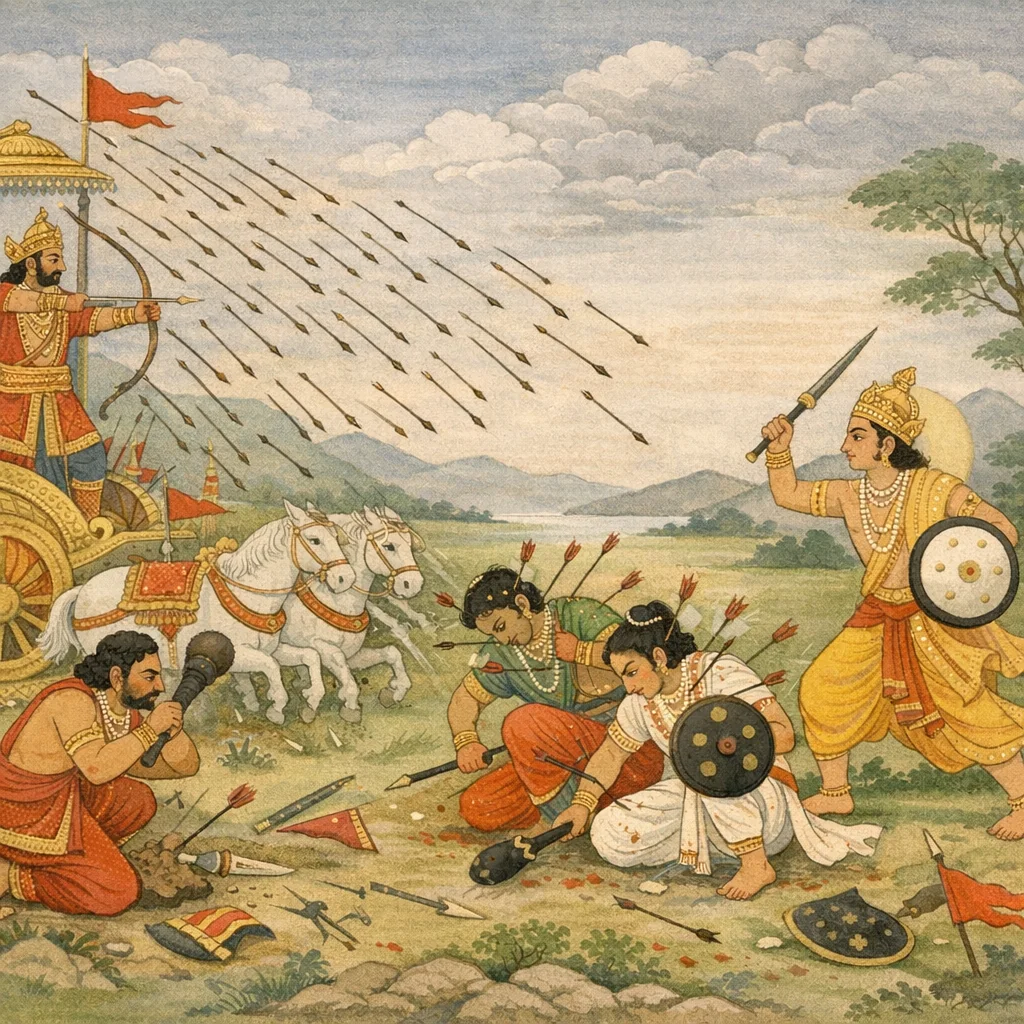
Saṃjaya reports that, after Śalya’s death, seven hundred Madra-following charioteers surge forward in great force. Duryodhana, elevated on an elephant and marked by royal insignia, repeatedly forbids their advance, yet the warriors—intent on killing Yudhiṣṭhira—enter the Pandava host and engage with loud bowstrings and close combat. Hearing of Śalya’s fall and Yudhiṣṭhira’s distress, Arjuna arrives with the Gāṇḍīva; Bhīma, the Mādrī sons, Sātyaki, the Draupadeyas, Dhṛṣṭadyumna, Śikhaṇḍin, and allied Pañcālas form a protective ring around Yudhiṣṭhira and churn the enemy ranks. Duryodhana’s inability to enforce restraint prompts Śakuni’s counsel: assemble with cavalry, chariots, and elephants to protect the endangered Madra force and fight in coordinated solidarity. The Kaurava side advances with a tumult of commands; the Pandavas meet them in a central formation, and the Madra contingent is quickly cut down. The battlefield is described through dismemberment imagery, broken chariots, fallen horses, and ominous signs (a great meteor crossing the sun). Seeing the Madra force destroyed and Śalya fallen, Duryodhana’s army becomes disoriented and turns away, fleeing under pressure from resolute Pandava archers.
Chapter Arc: शल्य, क्षत्रियर्षभ, मेघ-गर्जन-सा शरवर्षा बरसाते हुए पाण्डव-पक्ष की अग्रपंक्ति पर टूट पड़ता है—युद्धभूमि पर एक क्षण को लगता है मानो इन्द्र का वज्रवर्ष उतर आया हो। → शल्य सात्यकि को दस बाणों से, भीमसेन और सहदेव को तीन-तीन से और युधिष्ठिर को भी पीड़ित कर पाण्डव-सेना की धुरी हिला देता है; उसके तीक्ष्ण प्रहार आयुधों सहित भुजाएँ और ध्वज काटते हैं, और रणभूमि कुश-बिछी वेदी-सी योद्धाओं से पट जाती है। मुहूर्त भर में वह संज्ञा पाकर क्रोध-रक्त नेत्रों से और भी उग्र हो उठता है, मानो सहस्रनेत्र की प्रतिमा। → युधिष्ठिर शल्य के सामने धर्म-बल और राज-धैर्य को शस्त्र बनाकर निर्णायक प्रहार करते हैं; भीमसेन शल्य के घोड़ों और सारथि को लक्ष्य कर रथ-बल तोड़ते हैं। शल्य का तेज क्षण भर सांवर्तक-अग्नि-सा दीखता है, पर उसी ज्वाला के बीच उसका विनाश-काल उपस्थित होता है—मद्रराज का पतन युद्ध की दिशा पलट देता है। → शल्य तथा उसके भाई का वध हो जाता है; कृतवर्मा (हार्दिक्य) भीषण दबाव में रथ बदलकर पीछे हटता है। पाण्डव-पक्ष, जो अभी-अभी शरवर्षा में डगमगा रहा था, शल्य-पतन के साथ पुनः संगठित होकर बढ़त ले लेता है। → कौरव-पक्ष का एक और स्तम्भ गिर चुका है—अब अगला सेनापति कौन, और दुर्योधन की अंतिम आशा किस पर टिकेगी?
Shlokas
Verse 1
/ ऑपन--माजल छा ्-जस:अ सप्तदशो< ध्याय: भीमसेनद्वारा राजा शल्यके घोड़े और सारथिका तथा युधिष्ठिरद्वारा राजा शल्य और उनके भाईका वध एवं कृतवर्माकी पराजय संजय उवाच अथान्यद् धनुरादाय बलवान वेगवत्तरम् | युधिष्ठिरं मद्रपतिर्भित््वा सिंह इवानदत्,संजय कहते हैं--राजन्! तदनन्तर बलवान मद्रराज शल्य दूसरा अत्यन्त वेगशाली धनुष हाथमें लेकर युधिष्ठिरको घायल करके सिंहके समान गर्जने लगे
Sañjaya said: Then the mighty king of Madra, Śalya, taking up another bow of even greater speed, struck Yudhiṣṭhira and, like a lion, roared aloud.
Verse 2
ततः स शरवर्षेण पर्जन्य इव वृष्टिमान् । अभ्यवर्षदमेयात्मा क्षत्रियान् क्षत्रियर्षभ:,तत्पश्चात् अमेय आत्मबलसे सम्पन्न क्षत्रियशिरोमणि शल्य वर्षा करनेवाले मेघके समान क्षत्रियवीरोंपर बाणोंकी वृष्टि करने लगे
Sañjaya said: Then that bull among kṣatriyas, of immeasurable spirit, rained down a shower of arrows upon the warriors—like a rain-bearing cloud pouring its downpour. The scene underscores the fierce momentum of battle, where martial excellence and resolve surge forward even as the ethical weight of violence remains implicit in the kṣatriya duty of war.
Verse 3
सात्यकिं दशभिर्विद्ध्वा भीमसेन त्रिभि: शरै: । सहदेवं त्रिभिरविंद्ध्वा युधिष्ठिरमपीडयत्,उन्होंने सात्यकिको दस, भीमसेनको तीन तथा सहदेवको भी तीन बाणोंसे घायल करके युधिष्ठिरको भी पीड़ित कर दिया
Sañjaya said: Having struck Sātyaki with ten arrows, Bhīmasena with three, and Sahadeva with three as well, he further pressed and pained Yudhiṣṭhira—intensifying the battle’s pressure upon the Pāṇḍavas.
Verse 4
तांस्तानन्यान् महेष्वासान् साश्वान् सरथकूबरान् | अर्दयामास विशिखैरुल्काभिरिव कुञ्जरान्,जैसे शिकारी जलते हुए काष्ठोंसे हाथियोंको पीड़ा देते हैं, उसी प्रकार वे दूसरे-दूसरे महाधनुर्धर वीरोंको भी घोड़े, रथ और कूबरोंसहित अपने बाणोंद्वारा पीड़ित करने लगे
Then he harried those other mighty bowmen as well—together with their horses, chariots, and yokes—tormenting them with his arrows as a hunter torments elephants with burning brands.
Verse 5
कुण्जरान् कुण्जरारोहानश्चानश्वप्रयायिन: । रथांश्ष रथिन: सार्थ जघान रथिनां वर:,रथियोंमें श्रेष्ठ शल्यने हाथियों और हाथीसवारोंको, घोड़ों और घुड़सवारोंको तथा रथों और रथियोंको एक साथ ही नष्ट कर दिया
Sañjaya said: The foremost of chariot-warriors, Śalya, struck down in one sweep elephants and their riders, horses and their mounted fighters, and chariots along with their charioteers—cutting through the battle-array with overwhelming force.
Verse 6
बाहुंश्विच्छेद तरसा सायुधान् केतनानि च । चकार च महीं योधैस्तीर्णा वेदीं कुशैरिव,उन्होंने आयुधोंसहित भुजाओं और ध्वजोंको वेगपूर्वक काट डाला और पृथ्वीपर उसी प्रकार योद्धाओंकी लाशें बिछा दीं, जैसे वेदीपर कुश बिछाये जाते हैं
Sañjaya said: With swift force he severed warriors’ arms even as they still held their weapons, and he cut down their banners as well. Then he made the earth strewn with fallen fighters—like a sacrificial altar spread over with kuśa grass.
Verse 7
तथा तमरिसैन्यानि घ्नन्तं मृत्युमिवान्तकम् । परिवद्र॒र्भुशं क्रुद्धा: पाण्डुपाउ्चालसोमका:
Sañjaya said: Even so, as he struck down the enemy battalions like Death itself—like Yama, the Ender—the Pāṇḍavas, the Pāñcālas, and the Somakas, fiercely enraged, closed in around him from all sides.
Verse 8
इस प्रकार मृत्यु और यमराजके समान शत्रुसेनाका संहार करनेवाले राजा शल्यको अत्यन्त क्रोधमें भरे हुए पाण्डव, पांचाल तथा सोमकयोद्धाओंने चारों ओरसे घेर लिया ।। त॑ भीमसेनश्न शिनेश्न नप्ता माद्रयाश्न पुत्रौ पुरुषप्रवीरी । समागतं भीमबलेन राज्ञा पर्याप्तमन्योन्यमथाह्दयन्त,भीमसेन, शिनिपौत्र सात्यकि और माद्रीके पुत्र नरश्रेष्ठ नकुल-सहदेव--ये भयंकर बलशाली राजा युधिष्ठिरके साथ भिड़े हुए सामर्थ्यशाली वीर शल्यको परस्पर युद्धके लिये ललकारने लगे
Sañjaya said: Thus the Pandavas—together with the Panchalas and the Somakas—ablaze with fierce wrath, surrounded King Shalya on every side, he who destroyed the enemy host like Death and Yama. Then Bhimasena, Satyaki the grandson of Shini, and Madri’s two sons, the foremost of men, Nakula and Sahadeva—advancing with the mighty King Yudhishthira—began to challenge the fully capable Shalya, calling him out for single combat amid the crush of battle.
Verse 9
ततस्तु शूरा: समरे नरेन्द्र नरेश्वरं प्राप्य युधां वरिष्ठम् आवार्य चैनं समरे नृवीरा जघ्नु: शरै: पत्रिभिरुग्रवेगै:,नरेन्द्र! तत्पश्चात् वे शौर्यशाली नरवीर योद्धाओंमें श्रेष्ठ नरेश्वर शल्यको रोककर समरभूमिमें भयंकर वेगशाली बाणोंद्वारा घायल करने लगे
Then, O King, the valiant warriors in that battle closed in upon Shalya, lord of men and foremost in war; checking him on the field, they wounded him with feathered arrows of dreadful speed.
Verse 10
संरक्षितो भीमसेनेन राजा माद्रीसुता भ्यामथ माधवेन । मद्राधिपं पत्रिभिरुग्रवेगै: स्तनान्तरे धर्मसुतो निजघ्ने,धर्मपुत्र राजा युधिष्ठिरने भीमसेन, नकुल-सहदेव तथा सात्यकिसे सुरक्षित हो मद्रराज शल्यकी छातीमें उग्रवेगशाली बाणोंद्वारा प्रहार किया
Sañjaya said: Guarded by Bhimasena, by Madri’s two sons (Nakula and Sahadeva), and by Satyaki, ally of Madhava, King Yudhishthira—the son of Dharma—struck Shalya, lord of Madra, in the chest with arrows of fierce speed.
Verse 11
ततो रणे तावकानां रथौघा: समीक्ष्य मद्राधिपतिं शरार्तम् | पर्यावद्रु: प्रवरास्ते सुसज्जा दुर्योधनस्यानुमते पुरस्तात्,तब रणभूमिमें मद्रराजको बाणोंसे पीड़ित देख आपके श्रेष्ठ रथी योद्धा दुर्योधनकी आज्ञासे सुसज्जित हो उन्हें घेरकर युधिष्ठिरके आगे खड़े हो गये
Then on the battlefield, seeing the lord of Madra afflicted by arrows, the foremost chariot-warriors on your side, well arrayed at Duryodhana’s command, rushed up, surrounded him, and stood before Yudhishthira.
Verse 12
ततो द्रुतं मद्रजनाधिपो रणे युधिष्ठिरं सप्तभिरभ्यविद्धयत् । त॑ चापि पार्थो नवभि: पृषत्कै- विंव्याध राजंस्तुमुले महात्मा,इसके बाद मद्रराजने संग्राममें तुरंत ही सात बाणोंसे युधिष्ठिरको बींध डाला। राजन! उस तुमुल युद्धमें महात्मा युधिष्ठिरने भी नौ बाणोंसे शल्यको घायल कर दिया
Then, swiftly in battle, the lord of Madra pierced Yudhishthira with seven arrows. And, O King, in that tumultuous fight, the great-souled Yudhishthira in turn wounded Shalya with nine shafts.
Verse 13
आकर्णपूर्णायतसम्प्रयुक्तै: शरैस्तदा संयति तैलधौतै: । अन्योन्यमाच्छादयतां महारथौ मद्राधिपश्चापि युधिष्ठिरश्ष,मद्रराज शल्य और युधिष्ठिर दोनों महारथी कानतक खींचकर छोड़े गये और तेलमें धोये हुए बाणोंद्वारा उस समय युद्धमें एक-दूसरेको आच्छादित करने लगे
Sañjaya said: Then, in the thick of battle, the two great chariot-warriors—Śalya, lord of Madra, and Yudhiṣṭhira—shot arrows drawn back to the ear and released at full stretch, their shafts gleaming as if washed in oil. With those keen missiles they began to veil one another, each striving to overwhelm the other beneath an unrelenting cover of arrows.
Verse 14
ततस्तु तूर्ण समरे महारथौ परस्परस्यान्तरमीक्षमाणौ । शरैर्भुशं विव्यधतुर्नुपोत्तमौ महाबलौ शत्रुभिरप्रधृष्यौ,वे दोनों महारथी समरभूमिमें एक-दूसरेपर प्रहार करनेका अवसर देख रहे थे। दोनों ही शत्रुओंके लिये अजेय, महाबलवान् तथा राजाओंमें श्रेष्ठ थे। अतः: बड़ी उतावलीके साथ बाणोंद्वारा एक-दूसरेको गहरी चोट पहुँचाने लगे
Sañjaya said: Then, in the thick of battle, the two great chariot-warriors, watching for an opening against one another, swiftly pierced each other again and again with arrows. Both were kings of the highest rank—mighty in strength and unassailable by their foes—and so, with urgent resolve, they dealt deep wounds in their contest for victory.
Verse 15
तयोर्धनुज्यातलनि:स्वनो महान् महेन्द्रवजञाशनितुल्यनि:स्वन: । परस्परं बाणगणैर्महात्मनो: प्रवर्षतोर्मद्रपपाण्डुवीरयो:
Sañjaya said: Between those two great-souled warriors—the king of Madra and the Pāṇḍava hero—as they showered each other with volleys of arrows, there arose a mighty sound: the twang and clash of their bowstrings, like the thunderous crash of Indra’s thunderbolt.
Verse 16
परस्पर बाणोंकी वर्षा करते हुए महामना मद्रराज तथा पाण्डववीर युधिष्ठिरके धनुषकी प्रत्यंचाका महान् शब्द इन्द्रके वजकी गड़गड़ाहटके समान जान पड़ता था ।। तौ चेरतुर्व्याप्रशिशुप्रकाशौ महावनेष्वामिषगृद्धिनाविव । विषाणिनौ नागवराविवोभौ ततक्षतु: संयति जातदर्पो,उन दोनोंका घमण्ड बढ़ा हुआ था। वे दोनों मांसके लोभसे महान् वनमें जूझते हुए व्याप्रके दो बच्चोंके समान तथा दाँतोवाले दो बड़े-बड़े गजराजोंकी भाँति युद्धस्थलमें परस्पर आघात करने लगे
Sañjaya said: As the high-souled king of Madra and the Pāṇḍava hero Yudhiṣṭhira showered arrows upon one another, the mighty twang of their bowstrings seemed like the thunderous roar of Indra’s thunderbolt. Inflamed with pride in the clash of battle, the two moved about like tiger-cubs grappling in a great forest out of hunger for flesh; and like two tusked, lordly elephants, they struck each other again and again on the battlefield.
Verse 17
ततस्तु मद्राधिपतिर्महात्मा युधिष्ठिरं भीमबलं प्रसहा । विव्याध वीरं हृदये5तिवेगं शरेण सूर्याग्निसमप्र भेण,इति श्रीमहा भारते शल्यपर्वणि शल्यवधे सप्तदशोडथध्याय:
Sañjaya said: Then the great-souled lord of Madra, overpowering him by force, struck the heroic Yudhiṣṭhira—mighty as Bhīma—in the region of the heart with a swift-flying arrow blazing like the sun and fire.
Verse 18
तत्पश्चात् महामना मद्रराज शल्यने सूर्य और अग्निके समान तेजस्वी बाणसे अत्यन्त वेगवान् और भयंकर बलशाली वीर युधिष्ठिरकी छातीमें चोट पहुँचायी ।। ततो5तिविद्धो5थ युधिष्ठिरोडपि सुसम्प्रयुक्तेन शरेण राजन । जघान मद्राधिपतिं महात्मा मुर्दें च लेभे ऋषभ: कुरूणाम्,राजन! उससे अत्यन्त घायल होनेपर भी कुरुकुल-शिरोमणि महात्मा युधिष्ठिरने अच्छी तरह चलाये हुए बाणके द्वारा मद्रराज शल्यको आहत (एवं मूर्च्छित) कर दिया। इससे उन्हें बड़ी प्रसन्नता हुई
Thereafter the high-souled king of Madra, Śalya—radiant like the sun and fire—struck the heroic Yudhiṣṭhira on the chest with a swift, dreadful, and power-laden arrow. Though grievously pierced, Yudhiṣṭhira, the bull among the Kurus, answered with a well-aimed shaft and smote the lord of Madra, bringing him to a stunned collapse.
Verse 19
ततो मुहूर्तादिव पार्थिवेन्द्रो लब्ध्वा संज्ञां क्रोधसंरक्तनेत्र: । शतेन पार्थ त्वरितो जघान सहसनेत्रप्रतिमप्रभाव:,तब इन्द्रके समान प्रभावशाली राजा शल्यने दो ही घड़ीमें होशमें आकर क्रोधसे लाल आँखें करके बड़ी उतावलीके साथ युधिष्ठिरको सौ बाण मारे
Then, as if after only a brief moment, the lord of kings regained consciousness. With eyes reddened by anger and with the splendor of Indra of a thousand eyes, he swiftly struck Pārtha (Yudhiṣṭhira) with a hundred arrows.
Verse 20
त्वरंस्ततो धर्मसुतो महात्मा शल्यस्य कोपान्नवभि: पृषत्कै: । भित्त्वा हुरस्तपनीयं च वर्म जघान षड्भिस्त्वपरै: पृषत्कैः,इसके बाद धर्मपुत्र महात्मा युधिष्ठिरने कुपित हो शीघ्रतापूर्वक नौ बाण मारकर राजा शल्यकी छाती और उनके सुवर्णमय कवचको विदीर्ण कर दिया। फिर छः: बाण और मारे
Then Dharmasuta Yudhiṣṭhira, the great-souled king, swiftly—stirred to wrath—shot nine arrows, rending Śalya’s chest and splitting his golden cuirass; and he followed with six more shafts.
Verse 21
ततस्तु मद्राधिपति: प्रकृष्टें भधनुर्विकृष्य व्यसृजत् पृषत्कान् | द्वाभ्यां शराभ्यां च तथैव राज्ञ- श्रिच्छेद चापं कुरुपुड्वस्य,तदनन्तर मद्रराजने अपने उत्तम धनुषको खींचकर बहुत-से बाण छोड़े। उन्होंने दो बाणोंसे कुरुकुलशिरोमणि राजा युधिष्ठिरके धनुषको काट दिया
Then the lord of Madra drew his excellent bow and loosed many arrows; and with two shafts he cut down the bow of King Yudhiṣṭhira, the crest-jewel of the Kurus.
Verse 22
नवं ततो<न्यत् समरे प्रगृहा राजा धनुर्घोरतरं महात्मा । शल्यं तु विव्याध शरै: समन्ताद् यथा महेन्द्रो नमुचिं शिताग्रै:,तब महात्मा राजा युधिष्छिरने समरांगणमें दूसरे नये और अत्यन्त भयंकर धनुषको हाथमें लेकर तीखी धारवाले बाणोंसे शल्यको उसी प्रकार सब ओरसे घायल कर दिया, जैसे देवराज इन्द्रने नमुचिको
Sañjaya said: Then, in the thick of battle, the noble king took up another, new bow—still more dreadful than before—and struck Śalya on every side with sharp-pointed arrows, just as great Indra once pierced Namuci with keen-edged shafts.
Verse 23
ततस्तु शल्यो नवश्रि: पृषत्कै- भीमस्य राज्ञश्वच युधिष्ठिरस्य । निकृत्य रौक्मे पटुवर्मणी तयो- विंदारयामास भुजौ महात्मा,तब महामनस्वी शल्यने नौ बाणोंसे भीमसेन तथा राजा युधिष्ठिरके सोनेके सुदृढ़ कवचोंको काटकर उन दोनोंकी भुजाओंको विदीर्ण कर डाला
Sañjaya said: Then Śalya—freshly resplendent—struck with his arrows; cutting through the strong golden armours of Bhīma and King Yudhiṣṭhira, that great-souled warrior tore open the arms of them both. In the grim ethic of battle, prowess and resolve are displayed through such decisive blows, even as the suffering they cause underscores the terrible cost of war.
Verse 24
ततो<5परेण ज्वलनार्कतेजसा क्षुरेण राज्ञो धनुरुन्ममाथ । कृपश्च तस्यैव जघान सूतं षड्भि: शरै: सोडभिमुख: पपात,इसके बाद अग्नि और सूर्यके समान तेजस्वी क्षुरके द्वारा उन्होंने राजा युधिष्ठिरके धनुषको मथित कर दिया। फिर कृपाचार्यने भी छ: बाणोंसे उन्हींके सारथिको मार डाला। सारथि उनके सामने ही पृथ्वीपर गिर पड़ा
Then, with a razor-edged arrow blazing like fire and the sun, he shattered King Yudhiṣṭhira’s bow. And Kṛpa too struck down that very king’s charioteer with six shafts; the driver fell to the earth right before him. The scene underscores the ruthless mechanics of battle: disabling a warrior by breaking his weapon and removing his support, even when the target is not the principal combatant.
Verse 25
मद्राधिपश्चापि युधिष्ठिरस्य शरैश्नतुर्भि्निजघान वाहान् | वाहांश्व हत्वा व्यकरोन्महात्मा योधक्षयं धर्मसुतस्य राज्ञ:,तत्पश्चात् मद्रराजने चार बाणोंसे युधिष्ठिरके चारों घोड़ोंका भी संहार कर डाला। घोड़ोंको मारकर महामनस्वी शल्यने धर्मपुत्र राजा युधिष्ठिरके योद्धाओंका विनाश आरम्भ कर दिया
Sañjaya said: The lord of Madra too struck down Yudhiṣṭhira’s four steeds with four arrows. Having slain the horses, the high-souled Śalya then set about the destruction of King Yudhiṣṭhira’s warriors—an act that intensifies the moral pressure of war by targeting the king’s mobility and protection, not merely his person.
Verse 26
(यददभुतं कर्म न शक््यमन्यै: सुदुःसहं तत् कृतवन्तमेकम् । शल्यं नरेन्द्रस्य विषण्णभावाद् विचिन्तयामास मृदड़केतु: ।। किमेतदिन्द्रावरजस्य वाक्यं मोघं भवत्यद्य विधेबलेन । जहीति शल्यं हावदत् तदाजौ न लोकनाथस्य वचो<न््यथा स्यात् ।।) जो अद्भुत एवं दुःसह कार्य दूसरे किसीसे नहीं हो सकता, वही एकमात्र शल्यने राजा युधिष्ठिरके प्रति कर दिखाया। इससे मृदंगचिह्लित ध्वजवाले युधिष्ठिर विषादग्रस्त हो इस प्रकार चिन्ता करने लगे--'“क्या आज दैवबलसे इन्द्रके छोटे भाई भगवान् श्रीकृष्णकी बात झूठी हो जायगी। उन्होंने स्पष्ट कहा था कि “आप युद्धमें शल्यको मार डालिये” उन जगदीश्वरका कथन व्यर्थ तो नहीं होना चाहिये। तथा कृते राजनि भीमसेनो मद्राधिपस्थाथ ततो महात्मा । छित्त्वा धनुर्वेगवता शरेण द्वाभ्यामविध्यत् सुभुशं नरेन्द्रम,जब मद्रराज शल्यने राजा युधिष्ठिरकी ऐसी दशा कर दी, तब महामनस्वी भीमसेनने एक वेगवान् बाणद्वारा उनके धनुषको काट दिया और दो बाणोंसे उन नरेशको भी अत्यन्त घायल कर दिया
Sañjaya said: Seeing that Śalya alone had accomplished a wondrous and almost unbearable feat—something no other could have done—Yudhiṣṭhira, whose banner bore the emblem of a drum, sank into dejection and began to reflect: “Can it be that today, by the force of destiny, the words of Kṛṣṇa, the younger brother of Indra, will prove futile? In the battle he clearly urged, ‘Slay Śalya.’ The Lord of the world’s counsel should not turn out otherwise.”
Verse 27
तथापरेणास्य जहार यन्तुः कायाच्छिर: संहननीयमध्यात् । जघान चाश्चां श्वतुरः सुशीघ्र॑ तथा भृशं कुपितो भीमसेन:
Sañjaya said: Then, with another blow, the charioteer severed his head from the body at the neck. And Bhīmasena, fiercely enraged, swiftly struck down the four horses as well. The scene underscores the war’s ruthless momentum: anger drives rapid, decisive violence, where even the supporting elements of battle—driver and steeds—are cut down to disable the foe completely.
Verse 28
तत्पश्चात् अधिक क्रोधमें भरे हुए भीमसेनने दूसरे बाणसे शल्यके सारथिका मस्तक उसके धड़से अलग कर दिया और उनके चारों घोड़ोंको भी शीघ्र ही मार डाला ।। तमग्रणी: सर्वधनुर्धराणा- मेकं॑ चरन्तं समरे5तिवेगम् । भीम: शतेन व्यकिरच्छराणां माद्रीपुत्र: सहदेवस्तथैव,इसके बाद सम्पूर्ण धनुर्धरोंमें अग्रगण्य भीमसेन तथा माद्रीकुमार सहदेवने समरांगणमें बड़े वेगसे एकाकी विचरनेवाले शल्यपर सैकड़ों बाणोंकी वर्षा की
Thereafter Bhīmasena, his wrath fiercely kindled, with a second arrow severed the head of Śalya’s charioteer from his body, and swiftly slew the four horses as well. Then Bhīma, foremost among archers, and Sahadeva, son of Mādrī, rained hundreds of shafts upon Śalya as he sped alone across the battlefield with tremendous swiftness.
Verse 29
तै: सायकैर्मोहितं वीक्ष्य शल्यं भीम: शरैरस्य चकर्त वर्म | स भीमसेनेन निकृत्तवर्मा मद्राधिपश्चर्म सहस्रतारम्,उन बाणोंसे शल्यको मोहित हुआ देख भीमसेनने उनके कवचको भी काट डाला। भीमसेनके द्वारा अपना कवच कट जानेपर भयंकर बलशाली महामनस्वी मद्रराज शल्य सहस््र तारोंके चिहसे सुशोभित ढाल और तलवार लेकर उस रथसे कूद पड़े और कुन्तीपुत्रकी ओर दौड़े। उन्होंने नकुलके रथका हरसा काटकर युधिष्ठिरपर धावा किया
Sañjaya said: Seeing Śalya bewildered by those arrows, Bhīma with his shafts cut through Śalya’s armour. When his armour had been hewn away by Bhīmasena, Śalya—the lord of Madra, formidable in strength and high-minded—seized a shield marked with a thousand studs and a sword, leapt down from his chariot, and rushed toward the son of Kuntī.
Verse 30
प्रगृह्दा खड॒गं च रथान्महात्मा प्रस्कन्द्य कुन्तीसुतमभ्यधावत् । छित्त्वा रथेषां नकुलस्य सो5थ युधिष्ठिरें भीमबलो<5भ्यधावत्,उन बाणोंसे शल्यको मोहित हुआ देख भीमसेनने उनके कवचको भी काट डाला। भीमसेनके द्वारा अपना कवच कट जानेपर भयंकर बलशाली महामनस्वी मद्रराज शल्य सहस््र तारोंके चिहसे सुशोभित ढाल और तलवार लेकर उस रथसे कूद पड़े और कुन्तीपुत्रकी ओर दौड़े। उन्होंने नकुलके रथका हरसा काटकर युधिष्ठिरपर धावा किया
Sañjaya said: Taking up his sword, the high-souled Śalya leapt down from his chariot and rushed toward the son of Kuntī. Having then cut down Nakula’s chariot-gear, the mighty-armed warrior charged straight at Yudhiṣṭhira.
Verse 31
त॑ चापि राजानमथोत्पतन्तं क्रुद्धं यथैवान्तकमापतन्तम् । धृष्टझ्ुम्नो द्रौपदेया: शिखण्डी शिनेश्व नप्ता सहसा परीयु:,क्रोधमें भरे हुए यमराजके समान उछलकर आनेवाले राजा शल्यको धूृष्टद्युम्न, द्रौपदीके पुत्र शिखण्डी तथा सात्यकिने सहसा चारों ओरसे घेर लिया
Sañjaya said: And they also rushed upon King Śalya as he sprang forward in fury, charging like Death itself. Dhṛṣṭadyumna, the sons of Draupadī, Śikhaṇḍin, and Sātyaki’s grandson swiftly surrounded him from all sides.
Verse 32
अथास्य चर्माप्रतिमं न््यकृन्तद् भीमो महात्मा नवश्रि: पृषत्कै: । खडगं च भल्लैर्निचकर्त मुष्टौ नदन प्रहृष्टस्तव सैन्यमध्ये,महामना भीमने नौ बाणोंसे उनकी अनुपम ढालके टुकड़े-टुकड़े कर डाले। फिर आपकी सेनाके बीचमें बड़े हर्षके साथ गर्जना करते हुए उहोंने अनेक भल्लोंद्वारा उनकी तलवारकी मुट्ठी भी काट डाली
Sañjaya said: Then Bhīma, the great-souled hero of ever-renewed splendor, cut to pieces his incomparable shield with sharp arrows. And with keen bhalla-shafts he also severed the hilt of his sword, roaring in delight amid your army.
Verse 33
तत् कर्म भीमस्य समीक्ष्य हृष्टा- स््ते पाण्डवानां प्रवरा रथौघा: । नादं च चक्रुर्भुशमुत्स्मयन्तः शड्खांश्व दध्मु: शशिसंनिकाशान्,भीमसेनका यह बना देखकर पाण्डवदलके श्रेष्ठ रथी बड़े प्रसन्न हुए और वे हँसते हुए जोर-जोरसे सिं करने तथा चन्द्रमाके समान उज्ज्वल शंख बजाने लगे
Sañjaya said: Seeing that deed of Bhīma, the foremost chariot-warriors of the Pāṇḍavas were filled with joy. Smiling broadly, they raised a great roar and blew their conches, bright as the moon—an exultant signal of renewed courage and solidarity amid the battle’s strain.
Verse 34
तेनाथ शब्देन विभीषणेन तथाभितप्तं बलमप्रधृष्यम् कांदिग्भूतं रुधिरेणो क्षिताडूं विसंज्ञकल्पं च तदा विषण्णम्,उस भयानक शब्दसे संतप्त हो अजेय कौरवसेना विषादग्रस्त एवं अचेत-सी हो गयी। वह खूनसे लथपथ हो अज्ञात दिशाओंकी ओर भागने लगी
Sañjaya said: Struck and seared by that dreadful roar, the otherwise unassailable host was thrown into confusion. Smeared with blood, it became as if senseless and sank into dejection, fleeing in panic without knowing which direction to take.
Verse 35
स मद्रराज: सहसा विकीर्णो भीमाग्रगै: पाण्डवयो धमुख्यै: । युधिष्ठटिरस्याभिमुखं जवेन सिंहो यथा मृगहेतो: प्रयात:,भीम जिनके अगुआ थे, उन पाण्डवपक्षके प्रमुख वीरोंद्वारा बाणोंसे आच्छादित किये गये मद्रराज शल्य सहसा बड़े वेगसे युधिष्ठिरकी ओर दौड़े, मानो कोई सिंह किसी मृगको पकड़नेके लिये झपटा हो
Sañjaya said: The king of Madra, Śalya—suddenly covered over by the arrows of the foremost Pāṇḍava warriors led by Bhīma—rushed with great speed straight toward Yudhiṣṭhira, like a lion springing forward to seize its prey.
Verse 36
स धर्मराजो निहताश्वसूत: क्रोधेन दीप्तो ज्वलनप्रकाश: । दृष्टवा च मद्राधिपतिं सम तूर्ण समभ्यधावत् तमरिं बलेन,धर्मराज युधिष्ठिरके घोड़े और सारथि मारे गये थे, इसलिये वे क्रोधसे उद्दीप्त हो प्रज्वलित अग्निके समान जान पढ़ते थे। उन्होंने अपने शत्रु मद्रराज शल्यको देखकर उनपर बलपूर्वक आक्रमण किया
Sañjaya said: King Yudhiṣṭhira, whose horses and charioteer had been slain, blazed with anger like a fire. Seeing Śalya, the lord of Madra, he rushed swiftly and forcefully against that enemy.
Verse 37
गोविन्दवाक्यं त्वरितं विचिन्त्य दश्ने मतिं शल्यविनाशनाय । स धर्मराजो निहताश्वसूतो रथे तिष्ठन् शक्तिमेवा भ्यकाड्क्षत्,उस समय श्रीकृष्णके वचनको स्मरण करके उन्होंने शीघ्र ही शल्यको मार डालनेका निश्चय किया। धर्मराजके घोड़े और सारथि तो मारे ही जा चुके थे केवल रथ शेष था; अतः उसीपर खड़े होकर उन्होंने शल्यपर शक्तिके ही प्रयोगका विचार किया
Recalling Govinda’s words and reflecting on them swiftly, Dharmarāja steeled his resolve to bring about Śalya’s destruction. His horses and charioteer had already been slain, leaving only the chariot; standing upon it, he fixed his intent on using the spear-weapon against Śalya.
Verse 38
तच्चापि शल्यस्य निशम्य कर्म महात्मनो भागमथावशिष्टम् । कृत्वा मन: शल्यवधे महात्मा यथोक्तमिन्द्रावरजस्य चक्रे,महात्मा युधिष्ठिरने महामना शल्यके पूर्वोक्त कर्मको देख-सुनकर और उन्हें अपना ही भाग अवशिष्ट जानकर, जैसा श्रीकृष्णने कहा था उसके अनुसार शल्यके वधका संकल्प किया
Sañjaya said: Hearing also of that deed of the great Śalya, and understanding that what remained was now his own appointed share, the noble king set his mind upon Śalya’s slaying. He acted exactly as Indra’s younger brother, Kṛṣṇa, had instructed—resolute, accepting the burden of duty that the war had placed upon him.
Verse 39
स धर्मराजो मणिहेमदण्डां जग्राह शक्ति कनकप्रकाशाम् | नेत्रे च दीप्ते सहसा विवृत्य मद्राधिपं क्रुद्धमना निरैक्षत्,धर्मराजने मणि और सुवर्णमय दण्डसे युक्त तथा सोनेके समान प्रकाशित होनेवाली शक्ति हाथमें ली और मन-ही-मन कुपित हो सहसा रोषसे जलती हुई आँखें फाड़कर मद्रराज शल्यकी ओर देखा
Sañjaya said: King Yudhiṣṭhira seized the spear whose shaft was set with gems and gold, shining like molten gold. Then, his eyes suddenly widening and blazing with anger, he fixed his gaze upon Śalya, the lord of Madra.
Verse 40
निरीक्षितो5सौ नरदेव राज्ञा पूतात्मना निर्हटकल्मषेण । आसीजन्न यद् भस्मसान्मद्रराज- स्तदद्भुतं मे प्रतिभाति राजन्
Sañjaya said: O King, that Madra ruler was closely observed by the king—pure in spirit and with all taint driven away—yet he did not sit down upon the ashes. This strikes me, O King, as something truly wondrous.
Verse 41
नरदेव! पापरहित, पवित्र अन्तःकरणवाले, राजा युधिष्ठिरके रोषपूर्वक देखनेपर भी मद्रराज शल्य जलकर भस्म नहीं हो गये, यह मुझे अद्भुत बात जान पड़ती है ।। ततस्तु शक्ति रुचिरोग्रदण्डां मणिप्रवेकोज्ज्वलितां प्रदीप्ताम् । चिक्षेप वेगात् सुभृशं महात्मा मद्राधिपाय प्रवर: कुरूणाम्,तदनन्तर कौरवशिरोमणि महात्मा युधिष्ठिरने सुन्दर एवं भयंकर दण्डवाली तथा उत्तम मणियोंसे जटित होनेके कारण प्रज्वलित दिखायी देनेवाली उस देदीप्यमान शक्तिको मद्रराज शल्यके ऊपर बड़े वेगसे चलाया
Sañjaya said: “O king, it seems wondrous to me that even when King Yudhiṣṭhira—pure in heart and free from sin—looked upon the ruler of Madra, Śalya, with anger, Śalya was not consumed or reduced to ashes. Then that great-souled Yudhiṣṭhira, foremost among the Kurus, hurled with tremendous force at the lord of Madra a blazing spear—its shaft fierce and beautiful, and its brilliance intensified by inlaid precious gems.”
Verse 42
दीप्तामथैनां प्रहितां बलेन सविस्फुलिज्रां सहसा पतन्तीम् । प्रैक्षन्त सर्वे कुरव: समेता दिवो युगान्ते महतीमिवोल्काम्,बलपूर्वक फेंकी जानेसे प्रज्वलित हुई तथा आगकी चिनगारियाँ छोड़ती हुई उस शक्तिको, वहाँ आये हुए समस्त कौरवोंने प्रलयकालमें आकाशसे गिरनेवाली बड़ी भारी उल्काके समान सहसा शल्यपर गिरती देखा
Sañjaya said: Then all the assembled Kurus watched that blazing śakti, hurled with force, showering sparks as it fell swiftly—like a great meteor dropping from the sky at the end of an age—plunging upon Śalya.
Verse 43
तां कालरात्रीमिव पाशहस्तां यमस्य धात्रीमिव चोग्ररूपाम् | स ब्रह्मुदण्डप्रतिमाममोधां ससर्ज यत्तो युधि धर्मराज:,वह शक्ति पाश हाथमें लिये हुए कालरात्रिके समान उग्र, यमराजकी धायके समान भयंकर तथा ब्रह्मदण्डके समान अमोघ थी। धर्मराजने बड़े यत्न और सावधानीके साथ युद्धमें उसका प्रयोग किया था
Sañjaya said: That weapon—like Kālarātri herself with a noose in hand, and like Yama’s fierce nurse—was terrifying in form and unfailing like the rod of Brahmā. Dharmarāja hurled it in battle with utmost effort and careful resolve.
Verse 44
गन्धसत्रगग्रयासनपान भो ज नै- रभ्यर्चितां पाण्डुसुतै: प्रयत्नात् । सांवर्तकाग्निप्रतिमां ज्वलन्तीं कृत्यामथर्वाज्धिरसीमिवोग्राम्,पाण्डवोंने गन्ध (चन्दन), माला, उत्तम आसन, पेयपदार्थ और भोजन आदि अर्पण करके सदा प्रयत्नपूर्वक उसकी पूजा की थी। वह प्रलयकालिक संवर्तक नामक अग्निके समान प्रज्वलित होती और अथर्वांगिरस मन्त्रोंसे प्रकट की गयी कृत्याके समान अत्यन्त भयंकर जान पड़ती थी
Sañjaya said: The sons of Pāṇḍu, with sustained effort, continually worshipped her by offering perfumes (such as sandal), garlands, the finest seats, drinks, and food. She blazed like the Saṃvartaka fire of cosmic dissolution, and appeared exceedingly dreadful—like a kṛtyā brought forth through Atharvāṅgirasa mantras.
Verse 45
ईशानहेतो: प्रतिनिर्मितां तां त्वष्टा रिपूणामसुदेहभक्ष्याम् । भूम्यन्तरिक्षादिजलाशयानि प्रसहा भूतानि निहन्तुमीशाम्,त्वष्टा प्रजापति (विश्वकर्मा)-ने भगवान् शंकरके लिये उस शक्तिका निर्माण किया था। वह शत्रुओंके प्राण और शरीरको अपना ग्रास बना लेनेवाली थी तथा जल, थल एवं आकाश आदियमें रहनेवाले प्राणियोंको भी बलपूर्वक मार डालनेमें समर्थ थी
Sañjaya said: For the sake of Īśāna (Śiva), Tvaṣṭṛ (Prajāpati, Viśvakarman) fashioned that power anew. It would devour the enemies’ very life-breath and bodies, and it was capable of violently destroying beings dwelling on land, in the sky, and in waters.
Verse 46
घण्टापताकामणिवज्जभाजं वैदूर्यचित्रां तपनीयदण्डाम् । त्वष्टा प्रयत्नान्नियमेन क्लृप्तां ब्रह्मद्विषामन्तकरीममोघाम्,उसमें छोटी-छोटी घंटियाँ और पताकाएँ लगी थीं, मणि और हीरे जड़े गये थे, वैदूर्यमणिके द्वारा उसे चित्रित किया गया था। उस शक्तिका दण्ड तपाये हुए सुवर्णका बना था। विश्वकर्माने नियमपूर्वक रहकर बड़े प्रयत्नसे उसको बनाया था। वह ब्रह्मद्रोहियोंका विनाश करनेवाली तथा लक्ष्य वेधनेमें अचूक थी
Sañjaya said: “It was adorned with little bells and fluttering pennons, set with gems and diamonds, and inlaid with vaidūrya. Its shaft was made of refined gold. Fashioned by Tvaṣṭṛ with disciplined care and great effort, it was unfailing—an instrument of destruction for those hostile to Brahman, and unerring in striking its mark.”
Verse 47
बलप्रयत्नादधिरूढवेगां मन्त्रैश्न घोरैरभिमन्त्रय यत्नात् । ससर्ज मार्गेण च तां परेण वधाय मद्राधिपतेस्तदानीम्,बल और प्रयत्नके द्वारा उसका वेग बहुत बढ़ गया था, युधिष्ठिरने उस समय मद्रराजका वध करनेके लिये उसे घोर मन्त्रोंसे अभिमन्त्रित करके उत्तम मार्गके द्वारा प्रयत्नपूर्वक छोड़ा था
Sañjaya said: Empowered by strength and strenuous effort, its speed had risen to a fierce pitch. Then Yudhiṣṭhira, intent on the death of the lord of Madra, carefully consecrated it with dreadful mantras and released it with deliberate aim along the best course.
Verse 48
हतो$सि पापेत्यभिगर्जमानो रुद्रोडन्धकायान्तकरं यथेषुम् प्रसार्य बाहुं सुदृढं सुपार्णि क्रोधेन नृत्यन्निव धर्मराज:,जैसे रुद्रने अन्धकासुरपर प्राणान्तकारी बाण छोड़ा था, उसी प्रकार क्रोधसे नृत्य-सा करते हुए धर्मराज युधिष्ठिरने सुन्दर हाथवाली अपनी सुदृढ़ बाँह फैलाकर वह शक्ति शल्यपर चला दी और गरजते हुए कहा--'ओ पापी! तू मारा गया”
Sañjaya said: Roaring, “You are slain, O sinner!”, Dharmarāja Yudhiṣṭhira—his arm outstretched, firm and well-aimed—hurled his spear at Śalya, just as Rudra once loosed a life-ending arrow at Andhaka. In his wrath he seemed to dance, embodying the grim moral tension of war where righteous duty is carried out through terrible violence.
Verse 49
(स्फुरत्प्रभामण्डलमंशुजालै- धर्मात्मनो मद्रविनाशकाले । पुरत्रयप्रोत्सरणे पुरस्ता- न्याहेश्वरं रूपमभूत् तदानीम् ।।) पूर्वकालमें त्रिपुरोंका विनाश करते समय भगवान् महेश्वरका जैसा स्वरूप प्रकट हुआ था, वैसा ही शल्यके संहारकालमें उस समय धर्मात्मा युधिष्ठिरका रूप जान पड़ता था। वे अपने किरणसमूहोंसे प्रभाका पुंज बिखेर रहे थे। तां सर्वशक्त्या प्रहितां सुशक्ति युधिष्ठिरेणाप्रतिवार्यवीर्याम् । प्रतिग्रहायाभिननर्द शल्य: सम्यग्घुतामग्निरिवाज्यधाराम्,युधिष्ठिरने उस उत्तम शक्तिको अपना सारा बल लगाकर चलाया था। इसके सिवा, उसके बल और प्रभावको रोकना किसीके लिये भी असम्भव था तो भी उसकी चोट सहनेके लिये मद्रराज शल्य गरज उठे, मानो हवन की हुई घृतधाराको ग्रहण करनेके लिये अग्निदेव प्रज्वलित हो उठे हों
Sañjaya said: At the time of destroying Śalya, the righteous Yudhiṣṭhira appeared with a blazing halo and a net of rays—like the very form of Lord Maheśvara that once manifested in the ancient destruction of the three cities (Tripura). Then Yudhiṣṭhira hurled that excellent spear with all his strength; its force and efficacy were irresistible. Yet King Śalya roared to receive the blow, like fire flaring up to accept a well-offered stream of ghee in sacrifice.
Verse 50
सा तस्य मर्माणि विदार्य शुभ्र- मुरो विशालं च तथैव भित्त्वा विवेश गां तोयमिवाप्रसक्ता यशो विशाल नृपतेर्दहन्ती,परंतु वह शक्ति राजा शल्यके मर्मस्थानोंको विदीर्ण करके उनके उज्ज्वल एवं विशाल वक्ष:स्थलको चीरती तथा विस्तृत यशको दग्ध करती हुई जलकी भाँति धरतीमें समा गयी। उसकी गति कहीं भी कुण्ठित नहीं होती थी
Sañjaya said: That bright spear, having torn through his vital points and likewise cleaving his broad, shining chest, sank into the earth like water that meets no obstruction—burning away the king’s vast fame. Its course was nowhere checked.
Verse 51
नासाक्षिकर्णास्यविनि:सृतेन प्रस्यन्दता च व्रणसम्भवेन । संसिक्तगात्रो रुधिरेण सो5भूत् क्रौज्चो यथा स्कन्दहतो महाद्रि:,जैसे कार्तिकेयकी शक्तिसे आहत हुआ महापर्वत क्रौंच गेरूमिश्रित झरनोंके जलसे भीग गया था, उसी प्रकार नाक, आँख, कान और मुखसे निकले तथा घावोंसे बहते हुए खूनसे शल्यका सारा शरीर नहा गया
Sañjaya said: His whole body became drenched in blood—blood issuing from his nose, eyes, ears, and mouth, and blood streaming from the wounds. He looked like the great mountain Krauñca, soaked by reddish torrents, when it was struck down by Skanda. The image underscores the brutal cost of war: even the mighty are reduced to helpless suffering, and violence leaves no room for dignity or restraint.
Verse 52
प्रसार्य बाहू च रथाद् गतो गां संछिजन्नवर्मा कुरुनन्दनेन | महेन्द्रवाहप्रतिमो महात्मा वज्राहतं शुद्रमिवाचलस्य,कुरुनन्दन! भीमसेनने जिनके कवचको छिज्न-भिन्न कर डाला था, वे इन्द्रके ऐरावत हाथीके समान विशालकाय राजा शल्य दोनों बाहें फैलाकर वज्जके मारे हुए पर्वत-शिखरकी भाँति रथसे पृथ्वीपर गिर पड़े
Sañjaya said: Spreading out his arms, King Śalya fell from his chariot onto the earth, his armor torn and shattered by Bhīmasena, O scion of the Kurus. That great-souled warrior, huge like Indra’s mount Airāvata, collapsed like a mountain-peak struck by the thunderbolt—an image of how, in war, even the mighty are brought down when their protection and pride are broken.
Verse 53
बाहू प्रसार्याभिमुखो धर्मराजस्य मद्रराट् । ततो निपतितो भूमाविन्द्रध्वज इवोच्छित:,मद्रराज शल्य धर्मराज युधिष्ठिरके सामने ही अपनी दोनों भुजाओंको फैलाकर ऊँचे इन्द्रध्वजके समान धराशायी हो गये
Sañjaya said: Facing Dharmarāja Yudhiṣṭhira, the king of Madra stretched out both his arms; then he fell to the earth, like a lofty Indra-banner collapsing.
Verse 54
स तथा भिन्नसर्वाज्रो रुधिरेण समुक्षित: । प्रत्युदूगत इव प्रेम्णा भूम्या स नरपुज्भव:
Sañjaya said: Thus that bull among men, his whole body shattered and drenched in blood, seemed—as though the very earth, out of love, had risen up to receive him—when he fell upon the ground.
Verse 55
प्रियया कान्तया कान्त: पतमान इवोरसि । उनके सारे अंग विदीर्ण हो गये थे तथा वे खूनसे नहा उठे थे। जैसे प्रियतमा कामिनी अपने वक्ष:स्थलपर गिरनेकी इच्छावाले प्रियतमका प्रेमपूर्वक स्वागत करती है, उसी प्रकार पृथ्वीने अपने ऊपर गिरते हुए नरश्रेष्ठ शल्यको मानो प्रेमपूर्वक आगे बढ़कर अपनाया था ।। चिरं भुक्त्वा वसुमतीं प्रियां कान्तामिव प्रभु:
Sañjaya said: As though a beloved woman were welcoming her lover to her breast, the earth seemed to receive Śalya as he fell upon her. Having long enjoyed the earth like a dear wife, the mighty lord now returned to her embrace.
Verse 56
धर्म्ये धर्मात्मना युद्धे निहतो धर्मसूनुना
Sañjaya said: In a righteous battle, he was slain by the son of Dharma.
Verse 57
शकक््त्या विभिन्नह्नदयं विप्रविद्धायुधध्वजम्
Sañjaya said: With a spear, his heart was split open; his weapon and banner were struck down and shattered.
Verse 58
ततो युधिष्ठिरश्नापमादायेन्द्रधनुष्प्रभम्
Sañjaya said: Then Yudhiṣṭhira took up a bow that shone like Indra’s rainbow—signaling his resolve to act with kingly responsibility amid the pressures of war.
Verse 59
व्यधमद् द्विषत: संख्ये खगराडिव पन्नगान् | देहान् सुनिशितैर्भल्लै रिपूर्णां नाशयन् क्षणात्
Sañjaya said: In the press of battle he struck down the hostile warriors, as the king of birds (Garuḍa) strikes serpents. With razor-sharp arrows he destroyed the bodies of his foes in an instant—an image of war’s ruthless momentum, where prowess is measured by swift, decisive harm rather than by compassion.
Verse 60
तदनन्तर युधिष्छिरने इन्द्रधनुषके समान कान्तिमान् दूसरा धनुष लेकर सर्पोका संहार करनेवाले गरुड़की भाँति युद्धस्थलमें तीखे भल्लोंद्वारा शत्रुओंके शरीरोंका नाश करते हुए क्षणभरमें उन सबका विध्वंस कर दिया ।। ततः पार्थस्य बाणौघैरावृता: सैनिकास्तव । निमीलिताक्षा: क्षिण्वन्तो भृशमन्योन्यमर्दिता:
Sañjaya said: Thereafter Yudhiṣṭhira, taking up another bow radiant like a rainbow, moved on the battlefield like Garuḍa who destroys serpents. With sharp broad-headed arrows he struck down the bodies of his foes and, in but a moment, brought about the ruin of them all. Then your soldiers, covered over by torrents of Pārtha’s arrows, their eyes half-closed, were grievously afflicted and weakened, pressing and crushing one another in panic.
Verse 61
ततः: शल्ये निपतिते मद्रराजानुजो युवा
Sañjaya said: Then, when Śalya had fallen, the young brother of the king of Madra (Śalya) came forward—signaling the next turn in the battle’s grim succession, where kinship and duty drive warriors to step into the place of the slain.
Verse 62
विव्याध च नरश्रेष्ठो नाराचैर्बहुभिस्त्वरन्
Sañjaya said: Then that foremost of men, acting with swift resolve, pierced his foe with many nārāca arrows—an image of the war’s relentless momentum, where prowess and urgency drive the combat onward.
Verse 63
त॑ विव्याधाशुगै: षड्भिर्धर्मराजस्त्वरन्निव
Sanjaya said: Then Dharmarāja (Yudhiṣṭhira), as if in urgent haste, pierced them with six swift arrows—an act of disciplined force amid the moral strain of war.
Verse 64
कार्मुकं चास्य चिच्छेद क्षुराभ्यां ध्वजमेव च । तब धर्मराजने उसे शीघ्रतापूर्वक छः: बाणोंसे बींध डाला तथा दो क्षुरोंसे उसके धनुष और ध्वजको काट दिया ।। ततो<स्य दीप्यमानेन सुदृढेन शितेन च
Sanjaya said: With two razor-edged arrows Yudhiṣṭhira swiftly severed his opponent’s bow, and he also cut down the very banner. Then, with a blazing, firmly driven, keen shaft, he pressed the attack further—showing the disciplined resolve of a king who fights without malice yet without hesitation in the demands of war.
Verse 65
प्रमुखे वर्तमानस्य भल्लेनापाहरच्छिर: । तत्पश्चात् एक चमकीले, सुदृढ़ और तीखे भल्लसे सामने खड़े हुए उस राजकुमारके मस्तकको काट गिराया ।। ६४ $ ।। सकुण्डलं तद् ददृशे पतमानं शिरो रथात्
Sanjaya said: He then saw that head—still adorned with its earrings—falling down from the chariot. The line underscores the stark finality of battlefield violence: even royal insignia and personal ornaments cannot shield one from the consequences of war.
Verse 66
तस्यापकृत्तशीर्ष तु शरीरं पतितं रथात्
Sanjaya said: His body—its head already severed—fell down from the chariot. The line starkly underscores the irreversible consequence of violence in war.
Verse 67
विचित्रकवचे तस्मिन् हते मद्रनूपानुजे
Sanjaya said: When that warrior of wondrous armor—the younger brother of the king of Madra—was slain, the course of the battle turned upon the fall of a prominent Kaurava ally, underscoring how, in war, even great protection and renown cannot avert the consequences of fate and prior deeds.
Verse 68
शल्यानुजं हतं दृष्टवा तावकास्त्यक्तजीविता:
Sañjaya said: Seeing Śalya’s younger brother slain, the Kaurava warriors lost the will to live—struck by grief and the collapse of hope amid the carnage of war.
Verse 69
तांस्तथा भज्यमानांस्तु कौरवान् भरतर्षभ
Sañjaya said: “O bull among the Bharatas, the Kauravas—thus being shattered and broken in battle…”
Verse 70
तमायान्तं महेष्वासं दुष्प्रसहूं दुरासदम्
Sañjaya said: “Seeing him advancing—an archer of mighty bow, hard to overpower and impossible to assail—(they beheld a warrior whose approach itself inspired dread).”
Verse 71
तौ समेतौ महात्मानौ वा्ष्णेयौ वरवाजिनौ
Sañjaya said: Those two great-souled Vārṣṇeya heroes, mounted on excellent steeds, came together—an image of noble prowess converging amid the moral gravity of the war.
Verse 72
इषुभिर्विमलाभासैश्छादयन्तौ परस्परम्
Sañjaya said: The two warriors, showering each other with arrows that gleamed with a spotless radiance, seemed to veil one another—so dense was their exchange. The verse underscores the relentless reciprocity of battle, where prowess and resolve manifest as an unbroken contest rather than a one-sided assault.
Verse 73
चापमार्गबलोदधूतान् मार्गणान् वृष्णिसिंहयो:
Sañjaya said: The arrows, driven forth by the force of the bow and released upon their flight-path, sped toward the lion-like heroes of the Vṛṣṇis—an image of war’s relentless momentum, where skill and power propel weapons against the foremost protectors of their side.
Verse 74
सात्यकिं दशभिर्विद्ध्वा हयांश्षास्य त्रिभि: शरै:
Sañjaya said: Having pierced Sātyaki with ten arrows, he also struck his horses with three shafts—an act meant to cripple the warrior’s mobility and press the advantage in the brutal calculus of battle.
Verse 75
चापमेकेन चिच्छेद हार्दिक्यो नतपर्वणा । कृतवर्माने दस बाणोंसे सात्यकिको तथा तीनसे उनके घोड़ोंको घायल करके झुकी हुई गाँठवाले एक बाणसे उनके धनुषको भी काट दिया || ७४ ई || तन्निकृत्तं धनुः श्रेष्ठमपास्य शिनिपुज्गभव:
Sañjaya said: With a single arrow whose joints were bent, Hārdikya (Kṛtavarmā) cut down Sātyaki’s bow. Then, striking Sātyaki with ten arrows and wounding his horses with three, he again severed Sātyaki’s bow with one well-aimed shaft. Casting aside that excellent bow now cut, the foremost of the Śinis (Sātyaki) prepared to continue the fight—showing the relentless momentum of battle where skill and resolve, rather than anger alone, drive each exchange.
Verse 76
तदादाय धनु: श्रेष्ठ वरिष्ठ: सर्वधन्विनाम्
Sañjaya said: Taking up that finest bow—supreme among all archers’ weapons—the foremost of all bowmen prepared to act, signaling the decisive resolve and martial responsibility demanded by the war’s grim dharma.
Verse 77
ततो रथं युगेषां च च्छित्त्वा भल्लै: सुसंयतै:
Then, with well-aimed bhalla arrows, he cut down the chariot and also the yokes (and their fittings), disabling the opponent’s mobility in the midst of battle—an act that shifts the contest from mere display of prowess to the harsh ethics of war, where crippling an enemy’s means of fighting becomes decisive.
Verse 78
ततस्तं विरथं दृष्टवा कृप: शारद्वत: प्रभो
Sañjaya said: Then, seeing him bereft of his chariot, Kṛpa—Śāradvata’s son—(addressing the king) spoke, as the battle’s harsh turns laid bare both the warriors’ vulnerability and the relentless demands of duty in war.
Verse 79
अपोवाह तत): क्षिप्रं रथमारोप्य वीर्यवान् | प्रभो! कृतवर्माको रथहीन हुआ देख शरद्वानके पराक्रमी पुत्र कृपाचार्य उसे शीघ्र ही अपने रथपर बिठाकर वहाँसे दूर हटा ले गये || ७८ $ ।। मद्रराजे हते राजन् विरथे कृतवर्मणि
Sañjaya said: “O King, when the lord of Madra had been slain and Kṛtavarman was left without a chariot, the valiant Kṛpa quickly lifted him onto his own car and withdrew him from that place.”
Verse 80
तत् परे नान्वबुध्यन्त सैन्येन रजसा वृते
Sañjaya said: But those on the other side could not clearly perceive what was happening, for the army was enveloped in a cloud of dust. In the moral haze of battle—where confusion and obscured vision prevail—right judgment becomes difficult, and actions are driven more by circumstance than discernment.
Verse 81
ततो मुहूर्तात् तेडपश्यन् रजो भीम॑ समुत्थितम्
Then, after a brief interval, they saw a dreadful cloud of dust rising up—an ominous sign on the battlefield, suggesting the approach or movement of great forces and intensifying the moral weight of the unfolding slaughter.
Verse 82
ततो दुर्योधनो दृष्टवा भग्नं स्वबलमन्तिकात्
Sañjaya said: Then Duryodhana, seeing from nearby that his own army had been shattered, was struck by the stark reality of defeat. The moment underscores how pride and reliance on sheer force collapse when adharma-driven ambition meets the consequences of war.
Verse 83
पाण्डवान् सरथान् दृष्टवा धृष्टद्ुम्नं च पार्षतम्
Sañjaya said: Seeing the Pāṇḍavas with their chariots, and also Dhṛṣṭadyumna, the son of Pārṣata (Drupada), the scene turns to the immediate moral pressure of war—recognition of the opposing leaders and their readiness for battle, where duty and strategy collide amid inevitable violence.
Verse 84
त॑ परे नाभ्यवर्तन्त मर्त्या मृत्युमिवागतम्
Sañjaya said: The opposing warriors did not dare to close in on him, as though he were Death itself come before them. The moment underscores how, in the fury of battle, a single formidable fighter can embody inevitable consequence, shaking the will of even seasoned men.
Verse 85
ततो युधिष्िरो राजा त्वरमाणो महारथ:,तब महारथी राजा युधिष्ठिरने बड़ी उतावलीके साथ चार बाण मारकर कृतवमकि चारों घोड़ोंका संहार कर डाला तथा छ: तेज धारवाले भल्लोंसे कृपाचार्यको भी घायल कर दिया
Sañjaya said: Then King Yudhiṣṭhira, the great chariot-warrior, acting with urgent resolve, struck down Kṛtavarmā’s four horses with four arrows. And with six razor-edged bhalla shafts he also wounded the venerable teacher Kṛpa. In the press of battle, even the righteous king is driven to swift, decisive violence—yet the narrative keeps the ethical tension visible when elders and teachers become targets amid the necessities of war.
Verse 86
चतुर्भिनिजघानाश्चान् पत्रिभि: कृतवर्मण: । विव्याध गौतमं चापि षड्भिर्भल्लै: सुतेजनै:,तब महारथी राजा युधिष्ठिरने बड़ी उतावलीके साथ चार बाण मारकर कृतवमकि चारों घोड़ोंका संहार कर डाला तथा छ: तेज धारवाले भल्लोंसे कृपाचार्यको भी घायल कर दिया
Sañjaya said: Then King Yudhiṣṭhira, a great chariot-warrior, swiftly struck down the four horses of Kṛtavarman with four arrows; and with six keen, razor-edged bhalla shafts he also pierced Gautama (Kṛpa), wounding him. The scene underscores the grim ethics of battlefield necessity, where even measured kings are driven to decisive violence to check formidable opponents.
Verse 87
अश्वत्थामा ततो राज्ञा हताश्वं विरथीकृतम् तमपोवाह हार्दिक्यं स्वरथेन युधिष्ठिरात्,इसके बाद अभश्व॒त्थामा अपने रथके द्वारा घोड़ोंके मारे जानेसे रथहीन हुए कृतवर्माको राजा युधिष्ठिरके पाससे दूर हटा ले गया
Sañjaya said: Thereafter Aśvatthāmā, using his own chariot, drew Hārdikya (Kṛtavarmā) away from King Yudhiṣṭhira—Hārdikya having been deprived of his horses and thus rendered chariotless. In the press of war, this act shows the immediate duty of a comrade: to preserve an ally’s life and restore him to safety when he is exposed and vulnerable.
Verse 88
ततः शारद्वत: षडडश्नि: प्रत्यविद्धयद् युधिष्ठिरम् । विव्याध चाश्वान्निशितैस्तस्याष्टाभि: शिलीमुखै:,तब कृपाचार्यने छः बाणोंसे राजा युधिष्ठिरको बींध डाला और आठ पैने बाणोंसे उनके घोड़ोंको भी घायल कर दिया
Then Śāradvata (Kṛpa) struck King Yudhiṣṭhira with six arrows. With eight sharp, reed-like shafts he also pierced Yudhiṣṭhira’s horses—an act that, in the harsh ethics of battle, aims not only at the warrior but at disabling his mobility and command in the midst of war.
Verse 89
एवमेतन्महाराज युद्धशेषमवर्तत । तव दुर्मन्त्रिते राजन् सह पुत्रस्य भारत,महाराज! भरतवंशी नरेश! इस प्रकार पुत्रसहित आपकी कुमन्त्रणासे इस युद्धका अन्त हुआ
Sañjaya said: “So it was, O great king: thus the remnant and final outcome of the war came to pass. O king, descendant of Bharata, it ended through your ill counsel—together with your son.”
Verse 90
तस्मिन् महेष्वासवरे विशस्ते संग्राममध्ये कुरुपुड्रवेन । पार्था: समेता: परमप्रहृष्टा: शड्खान् प्रदध्मुर्ठतमीक्ष्य शल्यम्,कुरुकुलशिरोमणि युधिष्ठिरके द्वारा युद्धमें श्रेष्ठ महाधनुर्धर शल्यके मारे जानेपर कुन्तीके सभी पुत्र एकत्र हो अत्यन्त हर्षमें भर गये और शल्यको मारा गया देख शंख बजाने लगे
Sañjaya said: When that foremost of great bowmen, Śalya, had been slain in the midst of the battle by the bull among the Kurus, the Pārthas—gathered together and filled with supreme joy—blew their conches on seeing Śalya fallen.
Verse 91
युधिष्ठिरं च प्रशशंसुराजौ पुरा कृते वृत्रवधे यथेन्द्रम् । चक्रुश्न नानाविधवाद्यशब्दान् निनादयन्तो वसुधां समेता:,जैसे पूर्वकालमें वृत्रासुरका वध करनेपर देवताओंने इन्द्रकी स्तुति की थी, उसी प्रकार सब पाण्डवोंने रणभूमिमें युधिष्ठिरकी भूरि-भूरि प्रशंसा की और पृथ्वीको प्रतिध्वनित करते हुए वे सब लोग नाना प्रकारके वाद्योंकी ध्वनि फैलाने लगे
Sañjaya said: Just as, in former times, the gods praised Indra after the slaying of Vṛtra, so too on the battlefield all the Pāṇḍavas lavishly praised Yudhiṣṭhira; gathered together, they made the earth resound as they set forth the sounds of many kinds of war-instruments.
Verse 563
सम्यग्घुत इव स्विष्ट: प्रशान्तो 5ग्निरिवा ध्वरे । उस धर्मानुकूल युद्धमें धर्मात्मा धर्मपुत्र युधिष्ठिरके द्वारा मारे गये राजा शल्य यज्ञमें विधिपूर्वक घीकी आहुति पाकर शान्त होनेवाली “स्विष्टकृत्” अग्निके समान सर्वथा शान्त हो गये
Sañjaya said: In that war conducted in accordance with dharma, King Śalya—slain by the righteous Yudhiṣṭhira, the son of Dharma—became utterly calm, like the sacrificial fire called Sviṣṭakṛt that is pacified when ghee is properly offered in a rite.
Verse 573
संशान्तमपि मद्रेशं लक्ष्मीनैंव विमुड्चति । शक्तिने राजा शल्यके वक्षःस्थलको विदीर्ण कर डाला था, उनके आयुध तथा ध्वज छिन्न-भिन्न हो बिखरे पड़े थे और वे सदाके लिये शान्त हो गये थे तो भी मद्रराजको लक्ष्मी (शोभा या कान्ति) छोड़ नहीं रही थी
Sañjaya said: Though the lord of Madra had been stilled forever—his life brought to its end—Lakṣmī, the radiance of royal splendor, did not abandon him. Thus a warrior-king’s dignity may remain visible even in death.
Verse 603
क्षरन्तो रुधिरं देहैविपन्नायुधजीविता: । युधिष्ठिरके बाणसमूहोंसे आच्छादित हुए आपके सैनिकोंने आँखें मीच लीं और आपसमें ही एक-दूसरेको घायल करके वे अत्यन्त पीड़ित हो गये। उस समय शरीरोंसे रक्तकी धारा बहाते हुए वे अपने अस्त्र-शस्त्र और जीवनसे भी हाथ धो बैठे
Sañjaya said: Covered by volleys of arrows loosed by Yudhiṣṭhira, your soldiers shut their eyes in terror and confusion. In the crush of battle they struck one another and were grievously afflicted. Blood streamed from their bodies; bereft of weapons and of the will to live, they seemed stripped of both strength and life.
Verse 616
भ्रातुस्तुल्यो गुणै: सर्वे रथी पाण्डवम भ्ययात् । तदनन्तर, मद्रराज शल्यके मारे जानेपर उनका छोटा भाई, जो अभी नवयुवक था और सभी गुणोंमें अपने भाईकी ही समानता करता था, रथपर आरूढ़ हो पाण्डुपुत्र युधिष्ठिरपर चढ़ आया
Sañjaya said: After Śalya, the king of Madra, was slain, his younger brother—still a youth, yet equal to him in every virtue—mounted his chariot and charged against the Pāṇḍava Yudhiṣṭhira, the son of Pāṇḍu.
Verse 623
हतस्यापचितिं भ्रातुश्निकीर्षय्युद्धदुर्मद: । मारे गये भाईका प्रतिशोध लेनेकी इच्छासे वह रणदुर्मद नरश्रेष्ठ वीर बड़ी उतावलीके साथ उन्हें बहुत-से नाराचोंद्वारा घायल करने लगा
Sañjaya said: Driven to avenge his slain brother and inflamed by the pride of battle, that foremost of men, fierce in war, hastened to wound them with many nārāca arrows.
Verse 656
पुण्यक्षयमनुप्राप्य पतन् स्वर्गादिव च्युतः । पुण्य समाप्त होनेपर स्वर्गसे भ्रष्ट हो नीचे गिरनेवाले जीवकी भाँति उसका वह कुण्डलसहित मस्तक रथसे भूतलपर गिरता देखा गया
Sañjaya said: As though a being, its merit exhausted, falls after being cast from heaven, so was his head—still adorned with earrings—seen to drop from the chariot onto the earth.
Verse 663
रुधिरेणावसिक्ताडुं दृष्टवा सैन्यमभज्यत । फिर खूनसे लथपथ हुआ उसका शरीर भी, जिसका सिर काट लिया गया था, रथसे नीचे गिर पड़ा। उसे देखकर आपकी सेनामें भगदड़ मच गयी
Sañjaya said: Seeing that body, its limbs drenched in blood, the army broke ranks and fell into panic—an ominous sign of collapsing morale amid the brutal ethics of war, where even the sight of a fallen warrior can shatter collective resolve.
Verse 673
हाहाकार प्रकुर्वाणा: कुरवो<भिप्रदुद्रुवु: । मद्रनरेशका वह छोटा भाई विचित्र कवचसे सुशोभित था, उसके मारे जानेपर समस्त कौरव हाहाकार करते हुए भाग चले
Sañjaya said: The Kauravas, raising a loud cry of lamentation, fled in panic. With the fall of the Madra king’s younger brother—resplendent in wondrous armor—their morale broke, revealing how the death of a prominent warrior can unravel an army’s resolve amid the ethical chaos of war.
Verse 683
वित्रेसु: पाण्डवभयादू रजोध्यस्तास्तदा भूृशम् । शल्यके भाईको मारा गया देख धूलिधूसरित हुए आपके सारे सैनिक पाण्डुपुत्रके भयसे जीवनकी आशा छोड़कर अत्यन्त त्रस्त हो गये
Sañjaya said: Stricken with fear of the Pāṇḍavas, the troops were then utterly shaken; covered in dust, they lost hope of life and fell into extreme panic as the battle’s tide turned against them.
Verse 696
शिनेर्नप्ता किरन् बाणैरभ्यवर्तत सात्यकि: । भरतश्रेष्ठ! इस प्रकार भागते हुए उन कौरव-योद्धाओंपर बाणोंकी वर्षा करते हुए शिनिपौत्र सात्यकि उनका पीछा करने लगे
Sanjaya said: O best of the Bharatas, Sātyaki—the grandson of Śini—advanced, scattering a shower of arrows. As the Kaurava warriors fled, he pursued them relentlessly, raining shafts upon them, pressing the rout without letting fear or disorder turn him from his martial duty.
Verse 703
हार्दिक्यस्त्वरितो राजन प्रत्यगृह्नादभीतवत् | राजन! दुःसह एवं दुर्जय महाधनुर्धर सात्यकिको आक्रमण करते देख कृतवर्माने शीघ्रतापूर्वक एक निर्भय वीरकी भाँति उन्हें रोका
Sañjaya said: O King, Hārdikya (Kṛtavarmā), acting swiftly, checked the oncoming assault without fear. Seeing Sātyaki—formidable, hard to withstand, and difficult to conquer, a great wielder of the bow—advance to attack, Kṛtavarmā restrained him like a brave warrior, steady in the face of danger.
Verse 713
हार्दिक्य: सात्यकिश्रैव सिंहाविव बलोत्कटौ । श्रेष्ठ घोड़ोंवाले वे महामनस्वी वृष्णिवंशी वीर सात्यकि और कृतवर्मा दो बलोन्मत्त सिंहोंके समान एक-दूसरेसे भिड़ गये
Sañjaya said: Hārdikya (Kṛtavarmā) and Sātyaki—both mighty as lions in their ferocity—those two high-souled heroes of the Vṛṣṇi line, mounted on excellent horses, charged at one another and clashed in direct combat.
Verse 723
अर्चिर्भिरिव सूर्यस्य दिवाकरसमप्रभौ । सूर्यके समान तेजस्वी वे दोनों वीर दिनकरकी किरणोंके सदृश निर्मल कान्तिवाले बाणोंद्वारा एक-दूसरेको आच्छादित करने लगे
Sañjaya said: Like the blazing rays of the sun, those two heroes—equal in splendor to the Day-maker—began to veil one another with arrows, their shafts shining with a pure radiance like the sun’s own beams.
Verse 736
आकाशगानपश्याम पतड्जनिव शीघ्रगान् । वृष्णिवंशके उन दोनों सिंहोंके धनुषद्वारा बलपूर्वक चलाये हुए शीघ्रगामी बाणोंको हमने टिड्डीदलोंके समान आकाशमें व्याप्त हुआ देखा था
Sañjaya said: We saw in the sky those swift-flying arrows—forcefully loosed from the bows of the two lion-like heroes of the Vṛṣṇi line—spreading everywhere like swarms of locusts.
Verse 753
अन्यदादत्त वेगेन वेगवत्तरमायुधम् | उस कटे हुए श्रेष्ठ धनुषको फेंककर शिनिप्रवर सात्यकिने उससे भी अत्यन्त वेगशाली दूसरा धनुष शीघ्रतापूर्वक हाथमें ले लिया
Sañjaya said: Casting aside the severed, excellent bow, the foremost of the Śinis—Sātyaki—swiftly took up another weapon, even more rapid in its force.
Verse 766
हार्दिक्यं दशभिर्बाणै: प्रत्यविध्यत् स्तनान्तरे । उस श्रेष्ठ धनुषको लेकर सम्पूर्ण धनुर्धरोंमें अग्रगण्य सात्यकिने कृतवर्माकी छातीमें दस बाणोंद्वारा गहरी चोट पहुँचायी
Sañjaya said: Sātyaki, foremost among all archers, took up his excellent bow and struck Hārdikya (Kṛtavarmā) in the region of the chest with ten arrows, inflicting a deep wound.
Verse 776
अश्वांस्तस्थावधीत् तूर्णमुभौ च पार्ष्णिसारथी । तत्पश्चात् सुसंयत भल्लोंके प्रहारसे उसके रथ, जूए और ईषादण्ड (हरसे)-को काटकर शीघ्र ही घोड़ों तथा दोनों पारशश्वरक्षकोंको भी मार डाला
Sanjaya said: Standing firm, he swiftly struck down the horses and also the two attendants stationed at the rear of the chariot. Thereafter, with well-aimed, razor-edged arrows delivered in rapid succession, he cut apart his opponent’s chariot, its yoke, and the pole; then, without delay, he killed the horses and the two rear charioteers as well.
Verse 796
दुर्योधनबलं सर्व पुनरासीत् पराड्मुखम् । राजन्! जब मद्रराज मारे गये और कृतवर्मा भी रथहीन हो गया, तब दुर्योधनकी सारी सेना पुनः युद्धसे मुँह मोड़कर भागने लगी
Sanjaya said: O King, Duryodhana’s entire host once again turned away from the fight. When the king of Madra had been slain and Kṛtavarmā too was left without his chariot, Duryodhana’s forces lost heart and, turning their faces from battle, began to flee.
Verse 806
बल॑ तु हतभूयिष्ठं तत् तदा55सीत् पराड्म्मुखम् । परंतु वहाँ सब ओर धूल छा रही थी, इसलिये शत्रुओंको इस बातका पता न चला। अधिकांश योद्धाओंके मारे जानेसे उस समय वह सारी सेना युद्धसे विमुख हो गयी थी
Sanjaya said: That army, with most of its strength already destroyed, turned away from the battle at that time. Yet, because dust was rising everywhere, the enemies could not clearly perceive what had happened. With the majority of the warriors slain, the whole host became disheartened and withdrew from the fight.
Verse 813
विविधै: शोणितस्रावै: प्रशान्तं पुरुषर्षभ । पुरुषप्रवर! तदनन्तर दो ही घड़ीमें उन सबने देखा कि धरतीकी जो धूल ऊपर उड़ रही थी, वह नाना प्रकारके रक्तका स्रोत बहनेसे शान्त हो गयी है
Sanjaya said: “O bull among men, foremost of persons! Soon after that—within the space of two ghaṭīs—they all saw that the dust rising above the earth had been stilled, as many streams of blood flowed in diverse ways.
Verse 826
जवेनापतत: पार्थनिक: सर्वानवारयत् | उस समय दुर्योधनने यह देखकर कि मेरी सेना मेरे पाससे भाग गयी है, वेगसे आक्रमण करनेवाले समस्त पाण्डवयोद्धाओंको अकेले ही रोका
Sanjaya said: With swift force, the warrior of the Pārthas checked them all. At that moment, Duryodhana, seeing that my army had fled from his side, single-handedly held back all the Pāṇḍava fighters who were charging in with speed.
Verse 833
आनर्त च दुराधर्ष शितैर्बाणैरवारयत् । रथसहित पाण्डवोंको, ट्रुपदकुमार धृष्टद्युम्नको तथा दुर्जय वीर आनर्तनरेशको सामने देखकर उसने तीखे बाणोंद्वारा उन सबको आगे बढ़नेसे रोक दिया
Sañjaya said: Seeing the formidable king of Ānarta—together with the Pāṇḍavas upon their chariots and Dhṛṣṭadyumna, Drupada’s son—he checked their advance with sharp arrows. By the force of his keen shafts he held them all back from pressing forward, revealing the harsh discipline of war, where valor strives to restrain valor.
Verse 843
अथान्यं रथमास्थाय हार्दिक्यो5पि न्यवर्तत । जैसे मरणधर्मा मनुष्य पास आयी हुई अपनी मौतको नहीं टाल सकते, उसी प्रकार वे शत्रुपक्षके सैनिक दुर्योधनको लाँधघकर आगे न बढ़ सके। इसी समय कृतवर्मा भी दूसरे रथपर आरूढ़ हो पुनः वहीं लौट आया
Sañjaya said: Then Hārdikya (Kṛtavarmā), mounting another chariot, turned back again. Just as mortal men cannot avert the death that has come close to them, so the warriors of the opposing host could not overleap Duryodhana and press forward beyond him. At that very moment, Kṛtavarmā too, having ascended a second chariot, returned once more to the same place.
Verse 5536
सर्वैरज्जै: समाश्शलिष्य प्रसुप्त इव चाभवत् | प्रियतमा कान्ताकी भाँति इस वसुधाका चिरकालतक उपभोग करनेके पश्चात् राजा शल्य मानो अपने सम्पूर्ण अंगोंस उसका आलिंगन करके सो गये थे
Sañjaya said: Having embraced the earth with all his limbs, King Śalya became as though asleep. Like a beloved wife after long enjoyment, so—after prolonged possession and experience of sovereignty—he lay still, as if the world itself had been fully clasped and then relinquished into rest.
Frequently Asked Questions
The dilemma concerns rājadharma versus warrior impulse: whether obedience to a ruler’s restraint should override factional rage and retaliatory intent, especially when acting may endanger allies and accelerate collapse.
Strategic action without discipline is self-defeating: authority must be matched by internal restraint and coordinated purpose, or collective energy becomes a force of disintegration rather than protection.
No explicit phalaśruti appears in this adhyāya; its meta-function is descriptive and diagnostic—showing how the breakdown of command and cohesion operates as a narrative indicator of impending defeat.