Adhyaya 46
Karma-vipāka: Truth, Yama’s Judgment, and the Marks of Sin in Rebirth
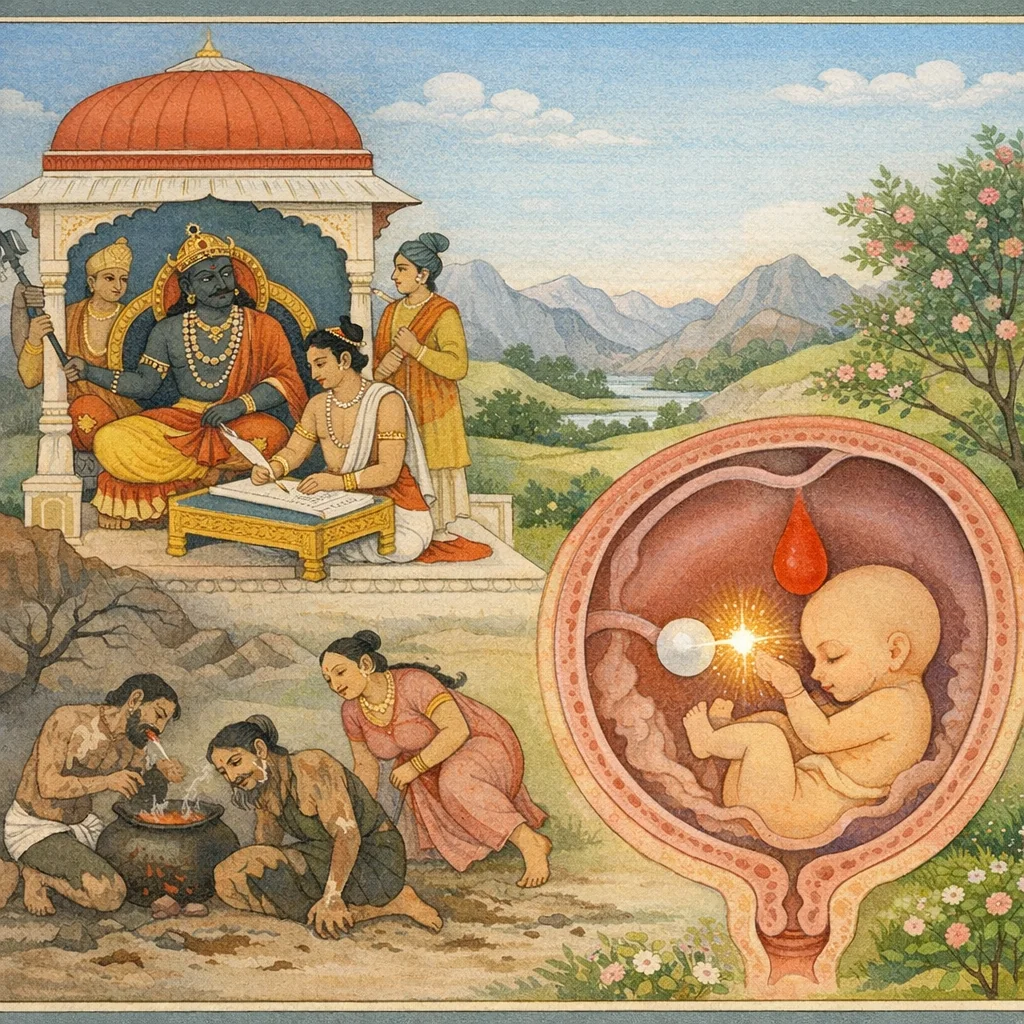
Continuing the Preta Kalpa’s teaching on afterlife ethics, Garuḍa affirms that merit yields heavenly enjoyments and excellence, and asks Śrī Kṛṣṇa how sinners are reborn and how karma ripens into the bonds of destiny. Kṛṣṇa explains that humans return to the world bearing marks formed by previously experienced auspicious and inauspicious deeds. The self-controlled are corrected by the guru, the wicked by the king, but hidden sins meet their final judge and chastiser in Yama. Without prāyaścitta (expiation), beings pass through diverse Yama-lokas and then re-enter embodied life stamped with karmic residues. A detailed catalogue links wrongs—disrespectful speech, lying, brahmahatyā, intoxication, theft, sexual transgression, ritual impropriety, cheating, and breaches of mourning rules—to disabilities, diseases, poverty, childlessness, and animal births. The chapter then turns to metaphysics: the jīva enters embryogenesis through semen and blood, endowed with mahābhūtas, senses, mind, prāṇa, and the play of attraction and aversion. The wheel of saṃsāra rises through svadharma and falls through adharma; neglect of duty driven by lust and anger leads again to hell, preparing for later chapters on karmic mechanics and remedial disciplines.
Shlokas
Verse 1
प्रत्याब्दिकादिश्राद्धनिरूपणं नाम पञ्चचत्वारिंशो ऽध्यायः तार्क्ष्य उवाच / सुकृतस्य प्रभावेण स्वर्गो नानाविधो नणाम् / भोगाः सौख्याति रूपञ्च बलं बुद्धैः पराक्रमः
Garuda said: By the power of meritorious deeds, humans attain diverse kinds of heaven; there arise enjoyments, happiness, beauty of form, strength, intelligence, and heroic prowess.
Verse 2
सत्यं पुण्यवतां देव जायते ऽत्र परत्र च / सत्यंसत्यं पुनः सत्यं वेदवाक्यं न चान्यथा
O Deva, for the meritorious, truth (satya) bears fruit both here in this world and in the world beyond. Truth—truth again, and truth once more: it is the utterance of the Veda, and it cannot be otherwise.
Verse 3
धर्मो जयति नाधर्मः सत्यं जयाते नानृतम् / क्षमा जयति न क्रोधो विष्णुर्जयति नासुरः
Dharma triumphs, not adharma. Truth triumphs, not falsehood. Forgiveness triumphs, not anger. Viṣṇu triumphs, not the forces of asuric nature.
Verse 4
तद्वत्सत्यं मया ज्ञातं सुकृताच्छोभनं भवेत् / यतोत्कृष्टतमं पुण्यं तथोत्कृष्टतरोनरः
Thus have I understood this as true: from meritorious deeds arises what is auspicious. As the merit is most excellent, so too does the person become more excellent.
Verse 5
एवन्तु श्रोतुमिच्छामि जायन्ते पापिनो यथा / येन कर्मविपाकेन यथा नियमभाग्भवेत्
Thus I wish to hear: how sinners are born, and by what ripening of karma one comes to receive the allotted rule and restraint of destiny.
Verse 6
यांयां योनिमवाप्नोति यथारूपश्च जायते / तन्मे वद सुरश्रेष्ठ समासेनापि काङ्क्षितम्
Into whatever womb a being attains, and in whatever form it is born—tell me that, O best of the gods, even in brief; for I long to know.
Verse 7
श्रीकृष्ण उवाच / शुभाशुभफलैस्तार्क्ष्य भुक्तभोगा नरास्त्विह / जायन्ते लक्षणैर्यैस्तुतानि मे शृणु काश्यप
Śrī Kṛṣṇa said: O Tārkṣya, here in this world human beings are born bearing the marks that arise from the fruits of their auspicious and inauspicious deeds already experienced. O Kāśyapa, listen to those signs from Me.
Verse 8
गुरुरात्मवतां शास्ता राजा शास्ता दुरात्मनाम् / इह प्रच्छन्नपापानां शास्ता वैवस्वतो यमः
For the self-restrained, the guru is the disciplinarian; for the wicked-minded, the king is the disciplinarian. But here, for those whose sins are concealed, the true chastiser is Yama Vaivasvata, son of Vivasvat.
Verse 9
प्रायश्चित्तेष्वचीर्णेषु यमलोका ह्यनेकधा / यातनाभिर्विमुक्ता ये यान्ति ते जीवसन्ततीम्
When expiatory rites (prāyaścitta) are not performed, the realms of Yama (Yama-loka) become many and varied. Those released after enduring torments enter the stream of embodied life again—into a further succession of births.
Verse 10
गत्वा मानुषभावे तु पापचिह्ना भवन्ति ते / तान्यहं तव चिह्नानि कथयिष्ये खगोत्तम
When they enter human existence again, they bear the marks of sin. I shall now tell you those signs, O best of birds, Garuda.
Verse 11
सोढ्वा वै यातनाः सर्वा गत्वा वैवस्वतक्षयम् / निस्तीर्णयातनास्ते तु लोकमायान्ति चिह्निताः
Having endured all the torments and gone to the abode of Vaivasvata (Yama), those who have crossed beyond the punishments return to the world—marked by signs.
Verse 12
गद्गदो ऽनतवादी स्यान्मूकश्चैव गवानृते / ब्रह्महा जायते कुष्ठी श्यावदन्तश्च मद्यपः
One who speaks with disrespect becomes stammering, and one who lies about a cow becomes mute. A slayer of a brāhmaṇa is born afflicted with leprosy, and a drinker of intoxicants is born with darkened teeth.
Verse 13
कुनखी स्वर्णहरणाद्दुश्चर्मा गुरुतल्पगः / संयोगी हीनयोनिः स्याद्दरिद्रो ऽदत्तदानतः
By stealing gold one incurs disease of the nails; by violating the Guru’s bed (the sin of gurutaḷpa) one is afflicted with a foul skin disease. One who enters forbidden sexual union is born in a low womb; and one who gives no dāna (charity) becomes poor.
Verse 14
अयाज्ययाजको याति ग्राहमसूकरतां द्विजः / खरो वै बहुयाजी स्यात्काको निर्मन्त्रभोजनात्
A twice-born man (dvija) who performs yajña for one unfit to receive it is said to be reborn as a crocodile or a hog. One who conducts many sacrifices in a blameworthy, showy manner becomes a donkey; and one who eats without being duly invited becomes a crow.
Verse 15
अपरीक्षितभोक्तारो व्याघ्राः स्युर्निर्जने वने / बहुतर्जको मार्जरः खद्योतः कक्षदाहकः
In a lonely forest, those who eat without discernment become like tigers. One who habitually threatens becomes a cat; and one who, like a firefly (khadyota), burns the thickets becomes a burner of brush—bringing harm far beyond his small stature.
Verse 16
पात्रे विद्याप्रदाता यो बलीवर्दो भवेत्तसः / अन्नं पर्युषितं विप्रे प्रददत्कुक्करो भवेत्
One who bestows vidyā (sacred learning) upon a worthy recipient is reborn as a strong bull. But one who gives stale, kept-over food to a brāhmaṇa is reborn as a dog.
Verse 17
मात्सर्यादपि जात्यन्धो जन्मान्धः पुस्तकं हरन् / फलान्याहरतो ऽपत्यं म्रियते नात्र संशयः
Out of envy one becomes blind by nature—indeed blind from birth—and steals a book. And the child of one who takes away another’s fruits dies; of this there is no doubt.
Verse 18
मृतो वानरतां याति तन्मुखो गण्डवान् भवेत् / अदत्त्वा भक्ष्यमश्राति अनपत्यो भवेत्तु सः
After death, he goes to the state of a monkey; his face becomes swollen with boils. If one eats food that was not given (to him), he becomes childless.
Verse 19
हरन्वस्त्रं भवेद्गोधा गरदः पवनाशनः / प्रवज्यागमनाद्राजन् भवेन्मरुपिशाचकः
O King, one who steals clothing is reborn as an iguana; one who administers poison becomes a consumer of wind. And one who returns after having taken renunciation becomes a desert-dwelling piśāca.
Verse 20
चातको जलहर्ता स्याद्धान्यहर्ता च मूषिकः / अप्राप्तयौवनां सेवन् भवेत्सर्प इति श्रुतिः
One who steals water becomes a cātaka bird; one who steals grain becomes a mouse. And one who has intercourse with a girl who has not yet reached maturity becomes a serpent—so declares the sacred tradition.
Verse 21
गुरुदाराभिलाषी च कृकलासो भवेद्ध्रुवम् / जलप्रस्त्रवणं यस्तु भिन्द्यान्मत्स्यो भवेन्नरः
One who lusts after the wife of his guru certainly becomes a lizard. And the man who breaks (or damages) a water-outlet or water-channel becomes a fish.
Verse 22
अविक्रेयक्रयाच्चैव बको गृध्रो भवेन्नरः / अयोनिगो वृको हि स्यादुलूकः क्रयवञ्चनात्
By buying what ought not to be sold, a man is reborn as a heron or a vulture. By engaging in improper sexual conduct he becomes a wolf; and by cheating in buying and selling he becomes an owl.
Verse 23
मृतस्यैकादशाहे तु भुञ्जानश्चाभिजायते / प्रतिश्रुत्य द्विजेभ्योर्ऽथमददज्जम्बुको भवेत्
One who eats during the eleven-day period after a death is reborn as a devourer of carrion; and one who, having promised wealth to the Brahmins (the twice-born), does not give it, becomes a jackal.
Verse 24
राज्ञरिं गत्वा भवेद्दंष्ट्री तस्करो विङ्वराहकः / शारिवा फलविक्रेता वृषश्च वृषलीपतिः
One who approaches or serves the king’s enemies is reborn as a tusked beast; a thief becomes a boar-like creature; one who trades in the herb śārivā becomes a fruit-seller; and one who violates proper conduct is born as a bull, or else as the husband of a low-caste woman.
Verse 25
मार्जरो ऽग्निं पदा स्पृष्ट्वा रोगवान्परमांसभुक् / उदक्यागमनात्षण्डो दुर्गन्धश्च सुगन्धहृत्
If a cat touches the fire with its paw, it is taken as a sign of illness and excessive meat-eating. If a menstruating woman arrives at an inauspicious time, it indicates impotence; and foul odor, when it arises, is said to destroy fragrance and auspiciousness.
Verse 26
यद्वा तद्वापि पारक्यं स्वल्पं वा हरते बहु / हृत्वा वै योनिमाप्नोति तिरश्चां नात्र संशयः
Whether it be this or that—whoever steals what belongs to another, be it little or much—having stolen, he surely attains an animal birth; of this there is no doubt.
Verse 27
एवमादीनि चिह्नानि अन्यान्यपि खगेश्वर / स्वकर्मविततान्येव? दृश्यन्ते यैस्तु मानवैः
O Lord of birds, Garuda, such signs—and many others besides—are seen by those humans who can perceive them; they are nothing but manifestations spread forth by one’s own karma.
Verse 28
एवं दुष्कृतकर्मा हि भुक्त्वा च नरकान्क्रमात् / जायते कर्मशेषेण उक्तास्वेतासु योनिषु
Thus, the doer of sinful deeds—having undergone the hells one after another—takes birth again, driven by the remaining residue of karma, in these very wombs (forms of birth) that have been described.
Verse 29
ततो जन्मशतं मर्त्ये सर्वजन्तुषु काश्यप / जायते नात्र सन्देहः समीभूते शुभाशुभे
Then, O Kāśyapa, one is born a hundred times in the mortal world among all kinds of living beings—of this there is no doubt—when the balances of merit and demerit become equalized.
Verse 30
स्त्रीपुंसयो प्रसङ्गेन निरुद्धे शुक्रसोणिते / समुपेतः पञ्चभूतैर्जायते पाञ्चभौतिकः
When, through the union of woman and man, the semen and blood are brought together and contained, then—endowed with the five great elements—the embodied being composed of the five elements comes into existence.
Verse 31
इन्द्रियाणि मनः प्राणा ज्ञानमायुः सुखं धृतिः / धारणा प्रेरणं दुः खं मिथ्याहङ्कार एव च
The senses, the mind, the vital breaths (prāṇa), knowledge, lifespan, happiness, steadfastness; concentration, impulse, sorrow, and indeed false ego—these too belong to the make-up of embodied experience.
Verse 32
प्रयताकृतिवर्णस्तु रागद्वेषौ भवाभवौ / तस्येदमात्मनः सर्वमनादेरादिमिच्छतः
Its manifest modes and qualities arise as attraction (rāga) and aversion (dveṣa), becoming the causes of coming into being and not coming into being. All this belongs to that Self, which is beginningless, yet wills, as it were, to assume an origin.
Verse 33
स्वकर्म बद्धस्य तदा गर्भवृद्धिर्भवेदिति / पुरा यथा मया प्रोक्तं तव जन्तोर्हि लक्षणम्
Bound by one’s own karma, the embryo grows accordingly—just as I told you before, O Garuḍa; these indeed are the marks of the embodied jīva.
Verse 34
एवं प्रवर्तितं चक्रं भूतग्रामे चतुर्विधे / समुत्पत्तिर्विनाशश्च जायते तार्क्ष्य देहिनाम्
Thus the wheel of saṃsāra turns within the fourfold host of beings; and, O Tārkṣya (Garuḍa), for embodied creatures both birth and destruction arise.
Verse 35
स्वधर्मेणैवोर्ध्वगतिरधर्मेणाप्यधोगतिः / जायते सर्ववर्णानां स्वधर्मचलनात् खग
By svadharma—one’s own ordained duty—there is indeed an upward course; by adharma there is also a downward fall. For all varṇas, O Bird (Garuḍa), such fruits arise from straying from one’s own duty.
Verse 36
देवत्वे मानुषत्वे च दानभोगादिकाः क्रियाः / या दृश्यन्ते वैनतेय तत्सर्वं कर्मजं फलम्
Whether as a deva or as a human, the deeds that are seen—such as dāna (giving), enjoyment of pleasures, and the like—O Vainateya, all of that is fruit born of karma.
Verse 37
अकर्मविहिते घोरे कामक्रोधार्जिते ऽशुभे / पतेद्वै नरके भूयो तस्योत्तारो न विद्यते
In that dreadful, unrighteous state—born of neglected duty and of inauspicious deeds amassed through lust and anger—one falls again into hell; for such a person, no deliverance is found.
Frequently Asked Questions
It states that while guru and king discipline in visible domains, hidden sins fall under Yama’s jurisdiction. If prāyaścitta is not performed, the being experiences Yama-loka torments; after release, the remaining karmic residue manifests as bodily/mental marks and appropriate wombs in rebirth.
The text treats speech as a moral instrument governed by satya and respect. Misuse of speech (disrespect, falsehood) is said to ripen into impairment of the same faculty in a future birth, illustrating karma’s ‘correspondence’ (yathā-karma-phala).
Ethical restraint aligned with svadharma, cultivation of satya and kṣamā, and performance of prāyaścitta for wrongdoing. The chapter’s logic is preventative: reduce karmic residue before Yama’s adjudication and before re-embodiment.