Adhyaya 5
Vidura’s Questions on Devotion and Sarga; Maitreya Begins the Account of Creation
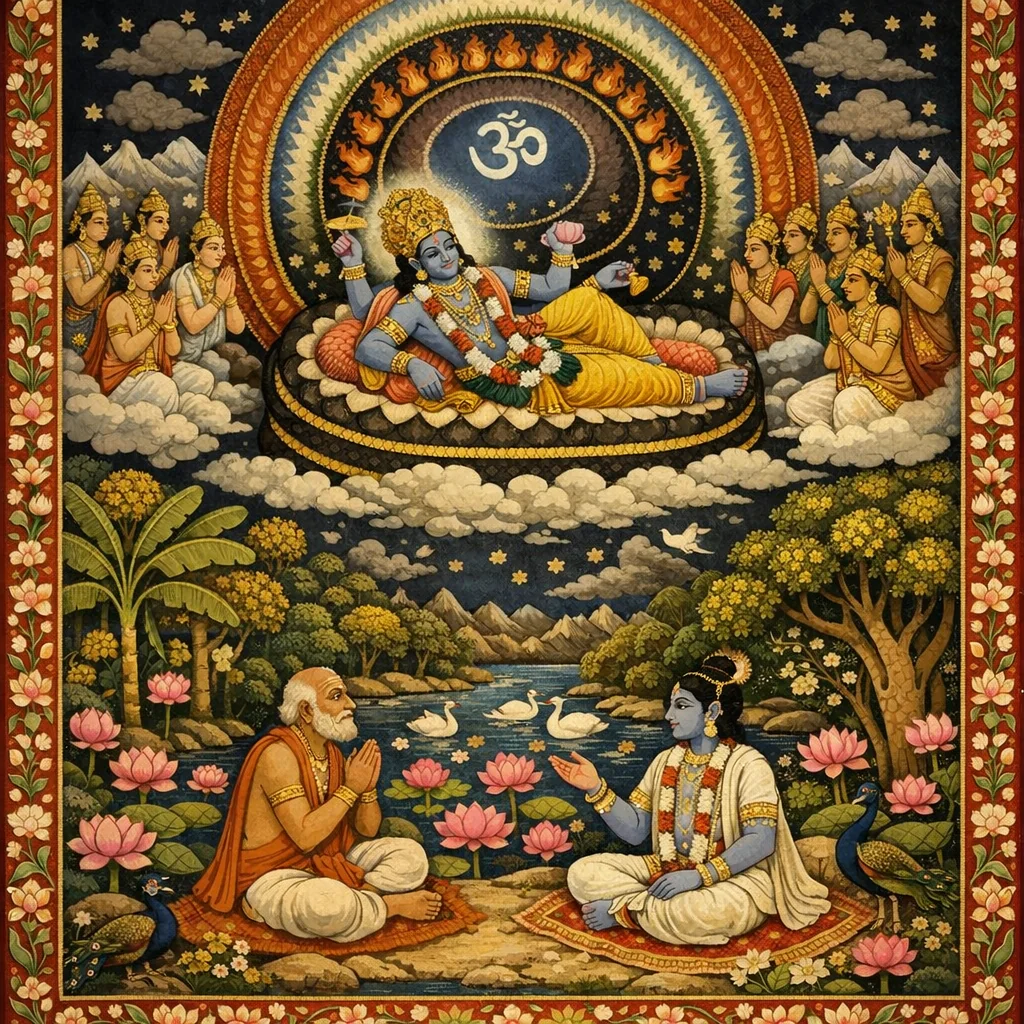
Continuing his pilgrimage for transcendental meaning, Vidura reaches the source region of the Gaṅgā and approaches the sage Maitreya. Rejecting the promise of happiness through fruitive work, Vidura argues that karma only increases distress and asks to be taught bhakti—devotional service that pleases the Lord within the heart and reveals Vedic truth. He requests a coherent account of the Lord’s incarnations and of the ordered creation and governance of the cosmos, including the diversification of species, names, forms, and social gradations. Maitreya honors Vidura, discloses his extraordinary identity and divine connection, and begins the cosmological sequence: before creation the Lord alone exists; māyā is the manifest energy; under kāla the puruṣa impregnates prakṛti; the mahat-tattva appears and develops into ahaṅkāra in three guṇic phases, producing mind, senses, and the elements from sound to earth. Empowered deities, unable to perform their functions, offer prayers, take shelter of the Lord’s lotus feet, and seek directives for service. Thus the chapter bridges Vidura’s existential inquiry to the forthcoming detailed exposition of creation and divine administration.
Shlokas
Verse 1
श्री शुक उवाच द्वारि द्युनद्या ऋषभ: कुरूणां मैत्रेयमासीनमगाधबोधम् । क्षत्तोपसृत्याच्युतभावसिद्ध: पप्रच्छ सौशील्यगुणाभितृप्त: ॥ १ ॥
Śukadeva said: Vidura, the foremost of the Kurus, perfected in devotion to Acyuta, came to the gateway of the celestial Gaṅgā (Hardwar), where the great sage Maitreya, of unfathomable wisdom, was seated. Gentle and inwardly satisfied, Vidura approached and inquired.
Verse 2
विदुर उवाच सुखाय कर्माणि करोति लोको न तै: सुखं वान्यदुपारमं वा । विन्देत भूयस्तत एव दु:खं यदत्र युक्तं भगवान् वदेन्न: ॥ २ ॥
Vidura said: O great sage, people perform works seeking happiness, yet by such acts they find neither true joy nor satisfaction nor relief from distress; rather, their suffering increases. Therefore, please instruct us how one should live to attain real happiness.
Verse 3
जनस्य कृष्णाद्विमुखस्य दैवा- दधर्मशीलस्य सुदु:खितस्य । अनुग्रहायेह चरन्ति नूनं भूतानि भव्यानि जनार्दनस्य ॥ ३ ॥
O my Lord, to bestow mercy upon those who have turned away from Krishna, who by fate fall into adharma and suffer greatly, the noble souls—the devotees of Janardana—surely wander upon this earth.
Verse 4
तत्साधुवर्यादिश वर्त्म शं न: संराधितो भगवान् येन पुंसाम् । हृदि स्थितो यच्छति भक्तिपूते ज्ञानं सतत्त्वाधिगमं पुराणम् ॥ ४ ॥
Therefore, O best of saints, instruct us in the auspicious path by which Bhagavan is perfectly worshiped. Dwelling in the heart, He grants from within—unto those purified by bhakti—the ancient knowledge by which the Absolute Truth is realized, according to Vedic principles.
Verse 5
करोति कर्माणि कृतावतारो यान्यात्मतन्त्रो भगवांस्त्र्यधीश: । यथा ससर्जाग्र इदं निरीह: संस्थाप्य वृत्तिं जगतो विधत्ते ॥ ५ ॥
O great sage, kindly narrate how Bhagavan—the independent, desireless Lord of the three worlds and controller of all energies—accepts incarnations and performs His divine works; and how, in the beginning, He created this universe and established perfectly ordered principles for its maintenance.
Verse 6
यथा पुन: स्वे ख इदं निवेश्य शेते गुहायां स निवृत्तवृत्ति: । योगेश्वराधीश्वर एक एत- दनुप्रविष्टो बहुधा यथासीत् ॥ ६ ॥
He lies within His own ‘kha’—the sky-like inner expanse—placing the entire creation in that space, and rests in the cave, free from any need to strive for maintenance. As the one Lord over all masters of yoga and the proprietor of everything, He enters this creation and appears as many living beings in diverse species, yet remains wholly distinct from the jivas.
Verse 7
क्रीडन् विधत्ते द्विजगोसुराणां क्षेमाय कर्माण्यवतारभेदै: । मनो न तृप्यत्यपि शृण्वतां न: सुश्लोकमौलेश्चरितामृतानि ॥ ७ ॥
The Lord, sporting through His many incarnations, arranges His deeds for the welfare of the brāhmaṇas, the sacred cows, and the devas. Though we hear again and again, our minds are never fully satisfied by the nectar of His divine pastimes.
Verse 8
यैस्तत्त्वभेदैरधिलोकनाथो लोकानलोकान् सह लोकपालान् । अचीक्लृपद्यत्र हि सर्वसत्त्व- निकायभेदोऽधिकृत: प्रतीत: ॥ ८ ॥
According to the distinctions of reality, the Lord of all worlds created the various planets and abodes, along with their kings and rulers. Living beings are placed in diverse orders in accord with the modes of nature and their karma.
Verse 9
येन प्रजानामुत आत्मकर्म- रूपाभिधानां य भिदां व्यधत्त । नारायणो विश्वसृगात्मयोनि- रेतच्च नो वर्णय विप्रवर्य ॥ ९ ॥
O foremost of brāhmaṇas, please describe as well how Nārāyaṇa—the creator of the universe, the self-sufficient Lord—has variously fashioned the natures, activities, forms, features, and names of all living beings.
Verse 10
परावरेषां भगवन् व्रतानि श्रुतानि मे व्यासमुखादभीक्ष्णम् । अतृप्नुम क्षुल्लसुखावहानां तेषामृते कृष्णकथामृतौघात् ॥ १० ॥
O my Lord, I have heard again and again from the mouth of Vyāsadeva about the higher and lower stations and their observances. I am satiated with those lesser topics that yield petty happiness; without the flowing nectar of Kṛṣṇa-kathā, nothing satisfies me.
Verse 11
कस्तृप्नुयात्तीर्थपदोऽभिधानात् सत्रेषु व: सूरिभिरीड्यमानात् । य: कर्णनाडीं पुरुषस्य यातो भवप्रदां गेहरतिं छिनत्ति ॥ ११ ॥
Who among men can be satisfied without ample hearing of the Lord, whose lotus feet are the sum of all holy places and whom great sages and devotees praise in sacred assemblies? Such discourse, entering through the ears, severs the bondage of homebound affection that breeds worldly entanglement.
Verse 12
मुनिर्विवक्षुर्भगवद्गुणानां सखापि ते भारतमाह कृष्ण: । यस्मिन्नृणां ग्राम्यसुखानुवादै- र्मतिर्गृहीता नु हरे: कथायाम् ॥ १२ ॥
O Bharata, your friend the sage Kṛṣṇa-dvaipāyana Vyāsa has already sung the Lord’s transcendental qualities in the Mahābhārata; his aim was to draw the minds of people—attached to worldly tales—toward kṛṣṇa-kathā.
Verse 13
सा श्रद्दधानस्य विवर्धमाना विरक्तिमन्यत्र करोति पुंस: । हरे: पदानुस्मृतिनिर्वृतस्य समस्तदु:खाप्ययमाशु धत्ते ॥ १३ ॥
For one who faithfully longs to hear kṛṣṇa-kathā always, detachment from all else steadily grows; and the devotee, blissful in remembrance of Śrī Kṛṣṇa’s lotus feet, swiftly dispels every misery.
Verse 14
ताञ्छोच्यशोच्यानविदोऽनुशोचे हरे: कथायां विमुखानघेन । क्षिणोति देवोऽनिमिषस्तु येषा- मायुर्वृथावादगतिस्मृतीनाम् ॥ १४ ॥
O sage, those who, by sinful deeds, turn away from hari-kathā and thus miss the purpose of the Mahābhārata are truly pitiable; I too lament for them, seeing how unblinking Time wastes their lifespan while they drown in disputation, imagined goals, and manifold rituals.
Verse 15
तदस्य कौषारव शर्मदातु- र्हरे: कथामेव कथासु सारम् । उद्धृत्य पुष्पेभ्य इवार्तबन्धो शिवाय न: कीर्तय तीर्थकीर्ते: ॥ १५ ॥
O Maitreya, friend of the distressed, the very essence of all discourse is hari-kathā alone, for it brings auspiciousness to the world; therefore, as bees gather honey from flowers, draw out the nectar and sing to us the glory of the Lord famed in holy places.
Verse 16
स विश्वजन्मस्थितिसंयमार्थे कृतावतार: प्रगृहीतशक्ति: । चकार कर्माण्यतिपूरुषाणि यानीश्वर: कीर्तय तानि मह्यम् ॥ १६ ॥
Please chant for me all those superhuman, transcendental deeds of the Supreme Controller, Bhagavān, who descends in avatāras endowed with full potency to manifest, sustain, and govern the cosmic creation.
Verse 17
श्री शुक उवाच स एवं भगवान् पृष्ट: क्षत्त्रा कौषारवो मुनि: । पुंसां नि:श्रेयसार्थेन तमाह बहुमानयन् ॥ १७ ॥
Śrī Śukadeva Gosvāmī said: At Vidura’s request, the great sage Maitreya, honoring him greatly, began to speak for the highest welfare of all people.
Verse 18
मैत्रेय उवाच साधु पृष्टं त्वया साधो लोकान् साध्वनुगृह्णता । कीर्तिं वितन्वता लोके आत्मनोऽधोक्षजात्मन: ॥ १८ ॥
Śrī Maitreya said: O saintly Vidura, your inquiry is most auspicious. Showing mercy to the world and spreading the glory of a mind absorbed in Adhokṣaja, you have benefited both the world and me.
Verse 19
नैतच्चित्रं त्वयि क्षत्तर्बादरायणवीर्यजे । गृहीतोऽनन्यभावेन यत्त्वया हरिरीश्वर: ॥ १९ ॥
O Kṣattā (Vidura), it is not at all wondrous that you have accepted Hari, the Supreme Lord, with undeviating, single-minded devotion, for you were born from the seed of Vyāsadeva (Bādarāyaṇa).
Verse 20
माण्डव्यशापाद्भगवान् प्रजासंयमनो यम: । भ्रातु: क्षेत्रे भुजिष्यायां जात: सत्यवतीसुतात् ॥ २० ॥
By the curse of Māṇḍavya Muni, you—formerly Bhagavān Yamarāja, the great controller of beings after death—have now appeared as Vidura. You were begotten by Vyāsadeva, the son of Satyavatī, in the kept wife (bhujisyā) of his brother.
Verse 21
भवान् भगवतो नित्यं सम्मत: सानुगस्य ह । यस्य ज्ञानोपदेशाय मादिशद्भगवान् व्रजन् ॥ २१ ॥
You are one of the Supreme Lord’s eternal associates, and thus you are always dear to Him. For the sake of instructing you in divine knowledge, the Lord, while returning to His own abode, entrusted me with this charge.
Verse 22
अथ ते भगवल्लीला योगमायोरुबृंहिता: । विश्वस्थित्युद्भवान्तार्था वर्णयाम्यनुपूर्वश: ॥ २२ ॥
Therefore I shall describe to you, in due order, the pastimes of the Bhagavān, wherein His Yogamāyā greatly expands His transcendental potency for the creation, maintenance, and dissolution of the cosmos.
Verse 23
भगवानेक आसेदमग्र आत्मात्मनां विभु: । आत्मेच्छानुगतावात्मा नानामत्युपलक्षण: ॥ २३ ॥
Before creation, the Bhagavān alone existed, without a second, the Lord of all living beings. By His will creation becomes possible, and in the end everything merges back into Him; that Supreme Self is known by many names.
Verse 24
स वा एष तदा द्रष्टा नापश्यद् दृश्यमेकराट् । मेनेऽसन्तमिवात्मानं सुप्तशक्तिरसुप्तदृक् ॥ २४ ॥
At that time the Lord, the undisputed proprietor of all, was the sole seer; the cosmic manifestation was not yet present. With material energy dormant, He seemed to feel incomplete, though His internal potency was already manifest.
Verse 25
सा वा एतस्य संद्रष्टु: शक्ति: सदसदात्मिका । माया नाम महाभाग ययेदं निर्ममे विभु: ॥ २५ ॥
The Lord is the seer, and the external energy—the seen—acts as both cause and effect within the cosmic manifestation. O greatly fortunate Vidura, this external energy is called māyā, and only through her agency does the entire material manifestation become possible.
Verse 26
कालवृत्त्या तु मायायां गुणमय्यामधोक्षज: । पुरुषेणात्मभूतेन वीर्यमाधत्त वीर्यवान् ॥ २६ ॥
By the turning of eternal time, within māyā composed of the three guṇas, Adhokṣaja, as the puruṣa incarnation—His plenary expansion—places the seed potency; thus the living beings come to manifest.
Verse 27
ततोऽभवन् महत्तत्त्वमव्यक्तात्कालचोदितात् । विज्ञानात्मात्मदेहस्थं विश्वं व्यञ्जंस्तमोनुद: ॥ २७ ॥
Thereafter, impelled by eternal Time, the mahat-tattva—the great totality of matter—became manifest from the unmanifest. Within that mahat-tattva, Bhagavān, pure goodness itself, placed from His own divine body the seeds of the universe’s manifestation, dispelling darkness.
Verse 28
सोऽप्यंशगुणकालात्मा भगवद्दृष्टिगोचर: । आत्मानं व्यकरोदात्मा विश्वस्यास्य सिसृक्षया ॥ २८ ॥
That mahat-tattva, too, is a principle comprising portions, the guṇas, and time, and it lies within the vision of Bhagavān. Desiring to create, it differentiated itself into many forms, becoming the basis for the generation of this universe.
Verse 29
महत्तत्त्वाद्विकुर्वाणादहंतत्त्वं व्यजायत । कार्यकारणकर्त्रात्मा भूतेन्द्रियमनोमय: । वैकारिकस्तैजसश्च तामसश्चेत्यहं त्रिधा ॥ २९ ॥
From the transformation of the mahat-tattva arose aham-tattva, the false ego. It appears in three aspects—cause, effect, and doer—operating on the plane of the elements, the senses, and the mind. This ego is threefold according to the guṇas: goodness, passion, and ignorance.
Verse 30
अहंतत्त्वाद्विकुर्वाणान्मनो वैकारिकादभूत् । वैकारिकाश्च ये देवा अर्थाभिव्यञ्जनं यत: ॥ ३० ॥
When false ego transforms through contact with the mode of goodness, the vaikārika mind (manas) arises. The devas who govern the phenomenal world and bring its objects to manifestation are also born of that same vaikārika principle.
Verse 31
तैजसानीन्द्रियाण्येव ज्ञानकर्ममयानि च ॥ ३१ ॥
The senses arise from the taijasa (rajas) aspect of false ego, and thus they serve as instruments of both knowledge and action. Therefore, speculative philosophical knowing and fruit-seeking activity are predominantly governed by the mode of passion, rajas.
Verse 32
तामसो भूतसूक्ष्मादिर्यत: खं लिङ्गमात्मन: ॥ ३२ ॥
From the tamasic transformation of false ego arises the subtle principle of sound; from sound the sky (ether) manifests, standing as a symbolic sign (linga) of the Supreme Soul, Paramatma.
Verse 33
कालमायांशयोगेन भगवद्वीक्षितं नभ: । नभसोऽनुसृतं स्पर्शं विकुर्वन्निर्ममेऽनिलम् ॥ ३३ ॥
Thereafter Bhagavan glanced upon the sky, partly mingled with eternal time and external energy; from the sky arose the subtle principle of touch, and from its transformation the air (vayu) was produced.
Verse 34
अनिलोऽपि विकुर्वाणो नभसोरुबलान्वित: । ससर्ज रूपतन्मात्रं ज्योतिर्लोकस्य लोचनम् ॥ ३४ ॥
Thereafter the exceedingly powerful air, interacting with the sky, generated the subtle principle of form; that perception of form transformed into jyoti—electric light—by which the world is seen.
Verse 35
अनिलेनान्वितं ज्योतिर्विकुर्वत्परवीक्षितम् । आधत्ताम्भो रसमयं कालमायांशयोगत: ॥ ३५ ॥
When jyoti, surcharged within the air, underwent transformation and was glanced upon by the Supreme, then—by the conjunction of eternal time and external energy—water arose, along with the quality of taste.
Verse 36
ज्योतिषाम्भोऽनुसंसृष्टं विकुर्वद्ब्रह्मवीक्षितम् । महीं गन्धगुणामाधात्कालमायांशयोगत: ॥ ३६ ॥
Thereafter the water born of jyoti, as it transformed and was glanced upon by Brahman—the Supreme Personality of Godhead—by the conjunction of eternal time and external energy became earth, whose foremost quality is fragrance (smell).
Verse 37
भूतानां नभ आदीनां यद्यद्भव्यावरावरम् । तेषां परानुसंसर्गाद्यथासंख्यं गुणान् विदु: ॥ ३७ ॥
O gentle one, from the sky (ether) down to the earth, whatever higher or lower qualities appear in the elements arise only from the final touch of the merciful glance of the Supreme Personality of Godhead, in due order.
Verse 38
एते देवा: कला विष्णो: कालमायांशलिङ्गिन: । नानात्वात्स्वक्रियानीशा: प्रोचु: प्राञ्जलयो विभुम् ॥ ३८ ॥
The presiding deities of these elements are empowered expansions of Lord Viṣṇu; under the external energy they appear as eternal Time and are His own parts. Entrusted with diverse cosmic functions yet unable to fulfill them, they folded their hands and offered the Almighty Lord these prayers.
Verse 39
देवा ऊचु: नमाम ते देव पदारविन्दं प्रपन्नतापोपशमातपत्रम् । यन्मूलकेता यतयोऽञ्जसोरु- संसारदु:खं बहिरुत्क्षिपन्ति ॥ ३९ ॥
The demigods said: O Lord, we bow to Your lotus feet, an umbrella for surrendered souls that soothes the burning miseries of material life. Under that shelter the sages easily cast away the great sorrow of saṁsāra; therefore we offer our reverent obeisances to Your feet.
Verse 40
धातर्यदस्मिन् भव ईश जीवा- स्तापत्रयेणाभिहता न शर्म । आत्मन्लभन्ते भगवंस्तवाङ्घ्रि- च्छायां सविद्यामत आश्रयेम ॥ ४० ॥
O Father, O Lord, the living beings in this world, struck by the threefold miseries, can never find true happiness. Therefore, O Bhagavān, we take shelter of the shade of Your lotus feet, filled with knowledge; we too seek refuge there.
Verse 41
मार्गन्ति यत्ते मुखपद्मनीडै- श्छन्द:सुपर्णैऋर्षयो विविक्ते । यस्याघमर्षोदसरिद्वराया: पदं पदं तीर्थपद: प्रपन्ना: ॥ ४१ ॥
The clear-minded sages, borne on the wings of the Vedas, ever seek in solitude the nest of Your lotuslike face. And since Your lotus feet are themselves the refuge of all holy places, they surrender at every step—taking shelter of the best of rivers, the sin-destroying Gaṅgā—and thus come to Your feet, the Lord of all tīrthas.
Verse 42
यच्छ्रद्धया श्रुतवत्या य भक्त्या संमृज्यमाने हृदयेऽवधाय । ज्ञानेन वैराग्यबलेन धीरा व्रजेम तत्तेऽङ्घ्रिसरोजपीठम् ॥ ४२ ॥
One who, with faith and bhakti, eagerly hears of Your lotus feet and places them within the heart in meditation is at once illumined with true knowledge and, by the strength of detachment, becomes peaceful. Therefore we must take shelter of the sanctuary of Your lotus feet.
Verse 43
विश्वस्य जन्मस्थितिसंयमार्थे कृतावतारस्य पदाम्बुजं ते । व्रजेम सर्वे शरणं यदीश स्मृतं प्रयच्छत्यभयं स्वपुंसाम् ॥ ४३ ॥
O Lord, for the creation, maintenance, and dissolution of the universe You descend in incarnations; therefore we all take shelter of Your lotus feet, for remembrance of You grants Your devotees sacred memory, courage, and fearlessness.
Verse 44
यत्सानुबन्धेऽसति देहगेहे ममाहमित्यूढदुराग्रहाणाम् । पुंसां सुदूरं वसतोऽपि पुर्यां भजेम तत्ते भगवन् पदाब्जम् ॥ ४४ ॥
O Lord, those entangled in the temporary body and in home and kin, bound by the stubborn notions of “mine” and “I,” cannot behold Your lotus feet though they are present within their very being. Yet let us take shelter of Your lotus feet.
Verse 45
तान् वै ह्यसद्वृत्तिभिरक्षिभिर्ये पराहृतान्तर्मनस: परेश । अथो न पश्यन्त्युरुगाय नूनं ये ते पदन्यासविलासलक्ष्या: ॥ ४५ ॥
O Supreme Lord, Urugāya, offenders whose inner vision has been stolen by outward material pursuits cannot see Your lotus feet; yet Your pure devotees behold them, for their sole aim is to relish Your transcendental pastimes.
Verse 46
पानेन ते देव कथासुधाया: प्रवृद्धभक्त्या विशदाशया ये । वैराग्यसारं प्रतिलभ्य बोधं यथाञ्जसान्वीयुरकुण्ठधिष्ण्यम् ॥ ४६ ॥
O Lord, those who drink the nectar of narrations about You, their hearts made clear by deepening bhakti, attain the very essence of renunciation and awakened knowledge; and thus they easily reach Vaikuṇṭha-loka, Your unimpeded abode in the spiritual sky.
Verse 47
तथापरे चात्मसमाधियोग- बलेन जित्वा प्रकृतिं बलिष्ठाम् । त्वामेव धीरा: पुरुषं विशन्ति तेषां श्रम: स्यान्न तु सेवया ते ॥ ४७ ॥
Others too, steady in wisdom, by the power of self-samādhi conquer the mighty modes of nature and enter into You; yet for them there is great toil, whereas Your devotee simply serves You in bhakti and feels no such pain.
Verse 48
तत्ते वयं लोकसिसृक्षयाद्य त्वयानुसृष्टास्त्रिभिरात्मभि: स्म । सर्वे वियुक्ता: स्वविहारतन्त्रं न शक्नुमस्तत्प्रतिहर्तवे ते ॥ ४८ ॥
O Original Person, we are Yours alone. For the sake of creating the worlds You brought us forth one after another under the three modes; thus our actions became divided, and after creation we could not act in unison for Your transcendental pleasure.
Verse 49
यावद्बलिं तेऽज हराम काले यथा वयं चान्नमदाम यत्र । यथोभयेषां त इमे हि लोका बलिं हरन्तोऽन्नमदन्त्यनूहा: ॥ ४९ ॥
O Unborn Lord, enlighten us about the means and proper time to offer You all pleasing grains and goods as bali (sacred offerings), and how we may partake ourselves, so that we and all beings in these worlds may live undisturbed and easily gather life’s necessities for You and for us.
Verse 50
त्वं न: सुराणामसि सान्वयानां कूटस्थ आद्य: पुरुष: पुराण: । त्वं देव शक्त्यां गुणकर्मयोनौ रेतस्त्वजायां कविमादधेऽज: ॥ ५० ॥
You are the original personal founder of all the devas and their various orders, yet You are the oldest and ever unchanged. O Lord, You have no source and no superior; You placed the seed of all living beings within the external energy, the womb of guna and karma, and yet You Yourself are unborn.
Verse 51
ततो वयं मत्प्रमुखा यदर्थे बभूविमात्मन् करवाम किं ते । त्वं न: स्वचक्षु: परिदेहि शक्त्या देव क्रियार्थे यदनुग्रहाणाम् ॥ ५१ ॥
O Supreme Self, we (Brahmā and the rest), created at the beginning from the mahat-tattva, for what purpose do we exist, and what shall we do for You? O Deva, grant us Your directions as our very eyes; bestow perfect knowledge and potency so we may serve You in the many departments of the subsequent creation.
Frequently Asked Questions
Vidura observes that karma pursued for enjoyment does not yield lasting satisfaction and instead aggravates distress because it binds one to repeated desire, reaction, and the threefold miseries. Therefore he seeks a higher path—bhakti—by which the Lord in the heart becomes pleased and grants knowledge of the Absolute beyond temporary gains.
Maitreya outlines that by the Lord’s will, under kāla, mahat-tattva manifests and differentiates, producing ahaṅkāra in three guṇic phases. From goodness arise mind and devatās; from passion arise the senses and karma/jñāna tendencies; from ignorance arise the tanmātras leading to the gross elements—beginning with sound and sky, then touch and air, form and fire/light, taste and water, and finally smell and earth—each activated by the Lord’s glance.