Adhyaya 4
Varāhādy-avatāra-varṇana (Description of Varāha and Other Incarnations)
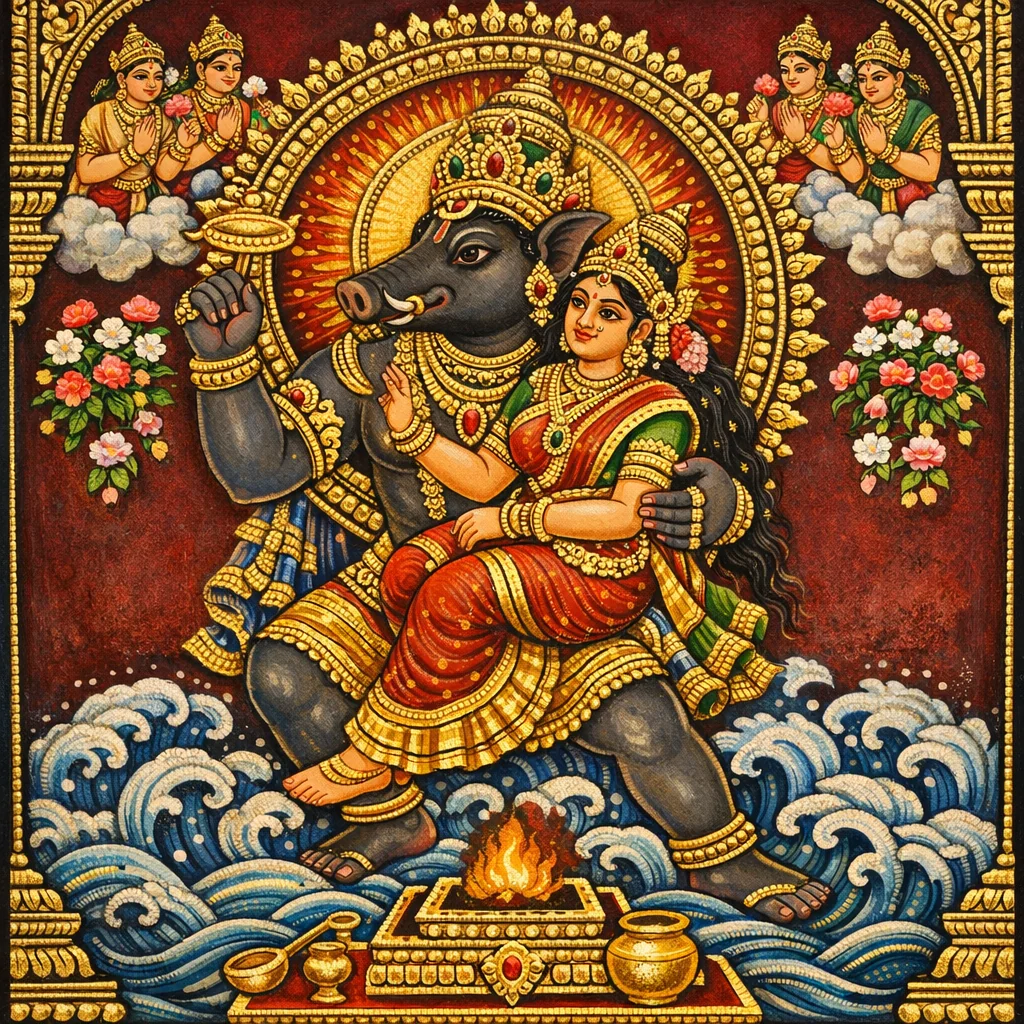
Agni begins a compact cycle of avatāras, portraying divine descent as the restoration of yajña (sacrificial order), the devas’ rightful shares, and earthly balance. Hiraṇyākṣa defeats the devas, and Viṣṇu appears as Varāha—explicitly Yajñarūpa, the very form of sacrifice—slays the asuric threat, and secures Dharma’s protection. Hiraṇyakaśipu then seizes sacrificial portions and divine authority, prompting Viṣṇu’s Narasiṃha to re-establish the devas in their proper stations. When the devas seek refuge, Viṣṇu comes as Vāmana into Bali’s sacrifice; through the legally binding gift of water and the request for three strides, he expands to cover the three worlds, sends Bali to Sutala, and restores Indra’s sovereignty. Agni finally outlines Paraśurāma’s descent to remove the earth’s burden of arrogant Kṣatriyas: born to Jamadagni and Reṇukā, he slays Kārttavīrya, avenges Jamadagni’s death, pacifies the earth twenty-one times, and donates the earth to Kaśyapa. The chapter ends with a phalaśruti, declaring that hearing these avatāras leads heavenward and exalting śravaṇa (devotional listening) as a Purāṇic discipline.
Shlokas
Verse 1
रसा तां जगाम ह मोहिनीं प्राप्य मतिमान् स्त्रियः केशामधारयदिति ग, चिह्नितपुस्तकपाठः तत्र तत्र महातीर्थं क्षेत्राणामुत्तमोत्तममिति ग, चिह्नितपुस्तकपाठः अथ चतुर्थो ऽध्यायः वराहाद्यवतारवर्णनं अग्निर् उवाच अवतारं वराहस्य वक्ष्ये ऽहं पापनाशनम् हिरण्याक्षो ऽसुरेशो ऽभूत् देवान् जित्वा दिवि स्थितः
“(Variant readings noted in some marked manuscripts:) ‘Rasā went there’; and ‘Having obtained Mohinī, the intelligent one held women by the hair’; and ‘Here and there are great sacred fords—each holy place the very best among sacred fields.’ Now begins the fourth chapter: the description of Varāha and other incarnations. Agni said: ‘I shall describe the incarnation of Varāha, the destroyer of sin. Hiraṇyākṣa became the lord of the Asuras; having conquered the gods, he stood established in heaven.’”
Verse 2
देवैर् गत्वा स्तुतो विष्णुर् यज्ञरूपो वराहकः अभूत्, तं दानवं हत्वा दैत्यैः साकञ्च कण्टकम्
Approached by the gods and praised, Viṣṇu became the Boar (Varāha), whose very form was the sacrifice (Yajña). Having slain that Dānava, he also destroyed the “thorn”—the obstructive menace—together with the Daityas.
Verse 3
धर्मदेवादिरक्षाकृत् ततः सो ऽन्तर्दधे हरिः हिरण्याक्षस्य वै भ्राता हिरण्यकशिपुस् तथा
Having secured the protection of Dharma and the gods, Hari then disappeared. And indeed, Hiraṇyakaśipu was the brother of Hiraṇyākṣa.
Verse 4
जितदेवयज्ञभागः सर्वदेवाधिकारकृत् नारसिंहवपुः कृत्वा तं जघान सुरैः सह
After he had seized the gods’ shares of the sacrificial offerings and usurped the authority belonging to all the deities, (Viṣṇu), assuming the bodily form of Narasiṃha, slew him together with the gods.
Verse 5
स्वपदस्थान् सुरांश् चक्रे नारसिंहः सुरैः स्तुतः देवासुरे पुरा युद्धे बलिप्रभृतिभिः सुराः
Praised by the gods, Narasiṃha restored the Devas to their own stations. Formerly, in the war between Devas and Asuras, the gods had been overpowered by Bali and the others.
Verse 6
जिताः स्वर्गात्परिभ्रष्टा हरिं वै शरणं गताः सुराणामभयं दत्वा अदित्या कश्यपेन च
Defeated and cast down from heaven, they indeed went to Hari for refuge; and Aditi, together with Kaśyapa, granted fearlessness to the gods.
Verse 7
स्तुतो ऽसौ वामनो भूत्वा ह्य् अदित्यां स क्रतुं ययौ बलेः श्रीयजमानस्य, राजद्वारे ऽगृणात् श्रुतिं
Thus praised, he became Vāmana; and indeed, together with Aditi, he went to Bali’s sacrificial rite—Bali, the illustrious patron of the yajña—and at the royal gate he recited a sacred Vedic formula.
Verse 8
देवान् पठन्तं तं श्रुत्वा वामनं वरदो ऽब्रवीत् निवारितो ऽपि शुक्रेण बलिर् ब्रूहि यद् इच्छसि
Hearing Vāmana reciting invocations to the gods, the boon-giver (Bali) spoke: “Though restrained by Śukra, O Bali—say what you desire.”
Verse 9
तत्ते ऽहं सम्प्रदास्यामि, वामनो बलिमब्रवीत् रोभूदिति घ, चिह्नितपुस्तकपाठः सुरान् जित्वेति ख, चिह्नितपुस्तकपाठः सार्धन्तु कण्टकमिति ख, घ, चिह्नितपुस्तकद्वयपाठः हिरण्यकशिपुस्तदेति घ, चिह्नितपुस्तकपाठः हरिन्ते इति ख, ग, घ, चिह्नितपुस्तकत्रयपाठः पदत्रयं हि गुर्वर्थं देहि दास्ये तमब्रवीत्
Bali said, “Truly, I shall grant you that.” Then Vāmana spoke to Bali: “Give me three paces, for it is for a weighty and lofty purpose.” He replied, “I shall give it.”
Verse 10
तोये तु पतिते हस्ते वामनो ऽभूदवामनः भूर्लोकं स भुवर्लोकं स्वर्लोकञ्च पदत्रयं
But when water was poured into his hand to confirm the gift, the Dwarf (Vāmana) was no longer a dwarf; and with three strides he encompassed Bhūrloka (earth), Bhuvarloka (mid-region), and Svargaloka (heaven).
Verse 11
चक्रे बलिञ्च सूतलं तच्छक्राय ददौ हरिः शक्रो देवैर् हरिं स्तुत्वा भुवनेशः सुखी त्वभूत्
Hari (Viṣṇu) placed Bali in Sutala and bestowed that realm upon Śakra (Indra). Then Śakra, together with the gods, praised Hari and became joyful as lord of the worlds.
Verse 12
वक्ष्ये परशुरामस्य चावतारं शृणु द्विज उद्धतान् क्षत्रियान् मत्वा भूभारहरणाय सः
I shall now relate the descent (avatāra) of Paraśurāma—listen, O twice-born. Deeming the Kṣatriyas to have grown arrogant, he incarnated to remove the burden of the earth.
Verse 13
अवतीर्णो हरिः शान्त्यै देवविप्रादिपालकः जमदग्ने रेणुकायां भार्गवः शस्त्रपारगः
For the establishment of peace, Hari descended as Bhārgava (Paraśurāma), a protector of the gods, Brahmins, and others. Born to Jamadagni and Reṇukā, he was fully accomplished in the science of weapons.
Verse 14
दत्तात्रेयप्रसादेन कार्त्तवीर्यो नृपस्त्वभृत् सहस्रबाहुः सर्वोर्वी- पतिः स मृगयां गतः
By the grace of Dattātreya, King Kārttavīrya arose—known as Sahasrabāhu, the sovereign lord of the whole earth—and he set out on a hunting expedition.
Verse 15
श्रान्तो निमन्त्रितो ऽरण्ये मुनिना जमदग्निना कामधेनुप्रभावेण भोजितः सबलो नृपः
Wearied, the king—together with his forces—was invited in the forest by the sage Jamadagni and was fed by the power of Kāmadhenu.
Verse 16
अप्रार्थयत् कामधेनुं यदा स न ददौ तदा हृतवानथ रामेण शिरश्छित्वा निपातितः
When he requested Kāmadhenu and the other did not give her, he then seized her; thereafter, Rāma cut off his head and struck him down.
Verse 17
युद्धे परशुना राजा धेनुः स्वाश्रममाययौ कार्त्तवीर्यस्य पुत्रैस्तु जमदग्निर्निपातितः
In battle the king was slain by Paraśu (Paraśurāma); and the cow returned to its own hermitage. But the sons of Kārttavīrya struck down Jamadagni.
Verse 18
रामे वनं गते वैराद् अथ रामः समागतः पितरं निहतं दृष्ट्वा पितृनाशाभिमर्षितः
When Rāma had gone to the forest, then—out of enmity—he returned; and seeing his father slain, he was struck with anguish at the destruction of his father.
Verse 19
त्रिःसप्तकृत्वः पृथिवीं निःक्षत्रामकरोद्विभुः कुरुक्षेत्रे पञ्च कुण्डान् कृत्वा सन्तर्प्य वै पितॄन्
Twenty-one times the mighty one made the earth bereft of Kṣatriyas. Then, at Kurukṣetra, having constructed five ritual fire-pits, he indeed satisfied the Pitṛs, the ancestral fathers, through offerings.
Verse 20
मे गुर्वर्थमिति ख, चिह्नितपुस्तकपाठः भ्रान्त इति ख, चिह्नितपुस्तकपाठः अप्रार्थयद्धोमधेनुमिति ख, ग, चिहिनितपुस्तकद्वयपाठः सधेनुश्चाश्रमं ययौ इति ख, घ, ङ, चिह्नितपुस्तकत्रयपाठः काश्यपाय महीं दत्वा महेन्द्रे पर्वते स्थितः कूर्मस्य च वराहस्य नृसिंहस्य च वामनं अवतारं च रामस्य श्रुत्वा याति दिवं नरः
“For my teacher’s purpose”—so reads one marked manuscript; “mistaken”—so reads one marked manuscript; “he requested the sacrificial cow for the homa”—so read two marked manuscripts; “and, along with the cow, he went to the hermitage”—so read three marked manuscripts. Having given the earth to Kaśyapa and remaining on Mount Mahendra, a man who hears of the avatāras—Kūrma, Varāha, Narasiṃha, Vāmana, and Rāma—goes to heaven.
Frequently Asked Questions
Varāha is described as Yajñarūpa—Viṣṇu embodying sacrifice itself—so the slaying of Hiraṇyākṣa is framed as restoring yajña, deva-protection, and Dharma rather than merely winning a battle.
The gift is confirmed by the pouring of water into the hand (dāna-saṅkalpa), after which Vāmana’s three strides establish cosmic jurisdiction; the episode links sovereignty, ritual contract, and the reallocation of power (Bali to Sutala; Indra restored).
The narrative explicitly cites Kṣatriya arrogance as destabilizing the world; Paraśurāma’s campaign and subsequent donation of the earth to Kaśyapa function as corrective re-ordering aligned with Dharma and brahminical guardianship.
It concludes that one who hears these avatāra accounts (including Kūrma, Varāha, Narasiṃha, Vāmana, and Rāma) attains heaven, presenting śravaṇa as a meritorious devotional practice.