Adhyaya 15
पाण्डवचरितवर्णनम् (The Account of the Pāṇḍavas)
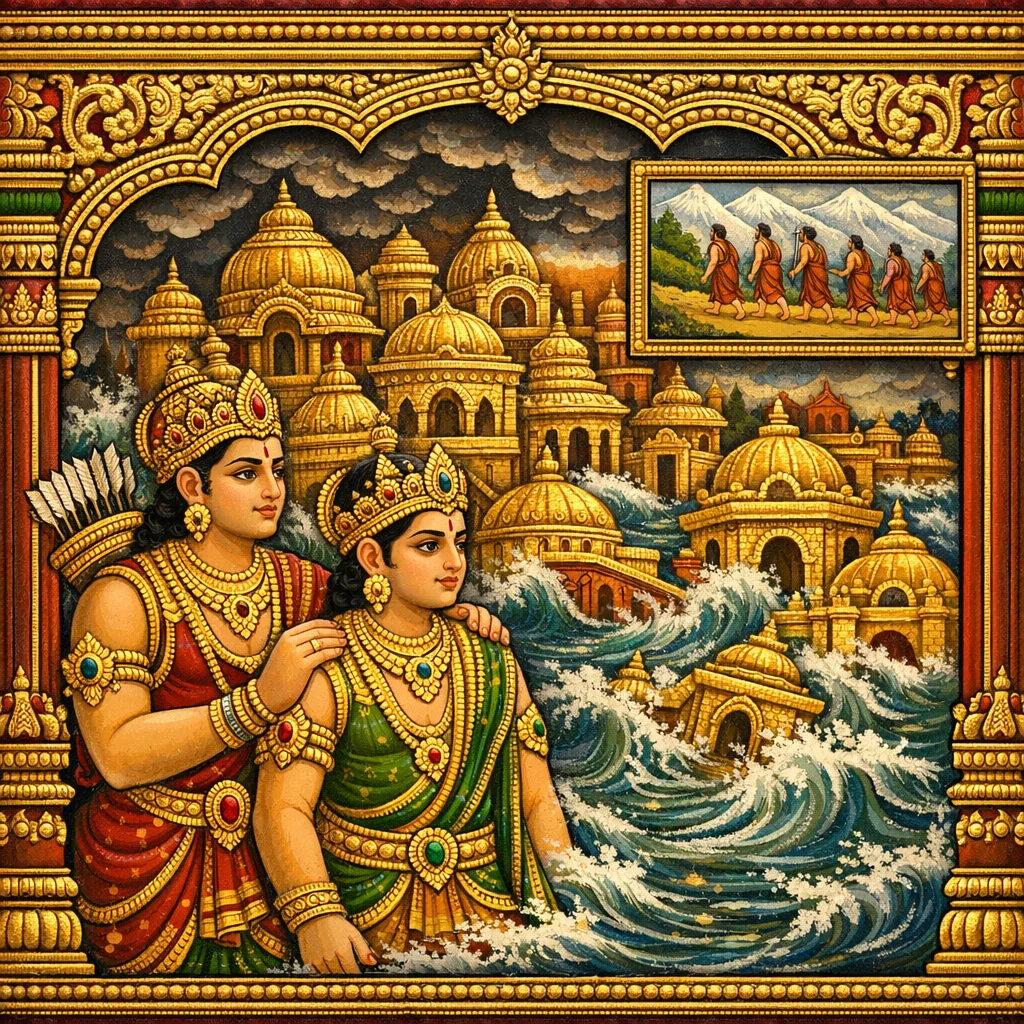
Lord Agni continues the avatāra-līlā by compressing the Mahābhārata’s post-war close into a dharma-centered epitome. Yudhiṣṭhira is established as king; Dhṛtarāṣṭra, Gāndhārī, and Pṛthā retire to the forest, marking the shift from royal duty to renunciation. Vidura attains heaven through a fire-linked end. Viṣṇu’s cosmic aim is declared: to lighten Earth’s burden through the Pāṇḍavas as instruments, and to dissolve the Yādavas under the pretext of a curse (mauṣala). Hari relinquishes the body at Prabhāsa; later Dvārakā is overwhelmed by the ocean, teaching impermanence. Arjuna performs funerary rites, loses efficacy without Kṛṣṇa’s presence, and is consoled by Vyāsa before reporting to Hastināpura. Yudhiṣṭhira installs Parīkṣit and undertakes the Great Departure with his brothers and Draupadī, reciting Hari’s names; the companions fall on the path, and Yudhiṣṭhira ascends to heaven in Indra’s chariot, ending with a phalaśruti promising heavenly attainment through recitation.
Shlokas
Verse 1
इत्य् आदिमहापुराणे आग्नेये महाभारतवर्णनं नाम चतुर्दशो ऽध्यायः अथ पञ्चदशो ऽध्यायः पाण्डवचरितवर्णनम् अग्निर् उवाच युधिष्ठिरे तु राज्यस्थे आश्रमादाश्रमान्तरम् धृतराष्ट्रो वनमगाद् गान्धारी च पृथा द्विज
Thus, in the Agni Purāṇa, the primeval Mahāpurāṇa, ends the fourteenth chapter entitled “The Description of the Mahābhārata.” Now begins the fifteenth chapter, “The Account of the Pāṇḍavas.” Agni said: When Yudhiṣṭhira was established in kingship, Dhṛtarāṣṭra went to the forest, moving from one hermitage to another, together with Gāndhārī and Pṛthā, O brāhmaṇa.
Verse 2
विदुरस्त्वग्निना दग्धो वनजेन दिवङ्गतः एवं विष्णुर्भुवो भारमहरद्दानवादिकम्
Vidura, burned by fire, attained heaven through the merit of forest-born fuel. Thus did Viṣṇu remove the burden of the earth—namely, the dānavas and the like.
Verse 3
धर्मायाधर्मनाशाय निमित्तीकृत्य पाण्डवान् स विप्रशापव्याजेन मुषलेनाहरत् कुलम्
For the sake of dharma and for the destruction of adharma, he made the Pāṇḍavas the instrumental cause; and, under the pretext of a brāhmaṇa’s curse, he destroyed the clan by means of an iron club (muṣala).
Verse 4
यादवानां भारकरं वज्रं राज्येभ्यषेचयत् देवदेशात् प्रभासे स देहं त्यक्त्वा स्वयं हरिः
Hari himself brought forth the burden-bearing “Vajra” (the fatal club/bolt) among the kingdoms; then, at Prabhāsa—the divine sacred region—he cast off his body of his own accord.
Verse 5
इन्द्रलोके ब्रह्मलोके पूज्यते स्वर्गवासिभिः बलभद्रोनन्तमूर्तिः पातालस्वर्गमीयिवान्
In Indra’s world and in Brahmā’s world, Balabhadra—whose form is Ananta—is worshipped by the dwellers of heaven; having passed through the nether realms (Pātāla), he has also reached the heavenly spheres.
Verse 6
अविनाशी हरिर्देवो ध्यानिभिर्ध्येय एव सः विना तं द्वारकास्थानं प्लावयामास सागरः
Hari, the divine Lord, is imperishable; he alone is the object of contemplation for meditators. The ocean flooded all things, yet it did not touch that sacred site of Dvārakā.
Verse 7
संस्कृत्य यादवान् पार्थो दत्तोदकधनादिकः स्त्रियोष्टावक्रशापेन भार्या विष्णोश् च याः स्थिताः
Having duly performed the funerary rites (saṃskāra) for the Yādavas, Pārtha (Arjuna) also offered the water-oblation (dattodaka) and gifts of wealth and the like. The women who remained—Viṣṇu’s consorts—were so fated because of Aṣṭāvakra’s curse.
Verse 8
पुनस्तच्छापतो नीता गोपालैर् लगुडायुधैः अर्जुनं हि तिरस्कृत्य पार्थः शोकञ्चकार ह
Then again, because of that very curse, he was brought to humiliation by cowherds (gopālas) armed with clubs (laguḍas); for, having been insulted, Arjuna—the son of Pṛthā—fell into grief.
Verse 9
व्यासेनाश्वासितो मेने बलं मे कृष्णसन्निधौ मौषलेनेति ख, चिह्नितपुस्तकपाठः स्वर्गमाप्नुयादिति ख, ग, चिह्नितपुस्तकद्वयपाठः हस्तिनापुरमागत्य पार्थः सर्वं न्यवेदयत्
Comforted by Vyāsa, (Arjuna) deemed his strength to rest in Kṛṣṇa’s very presence. Having come to Hastināpura, Pārtha (Arjuna) reported everything in full. (Variant readings: “by the club-fight (mauṣala-) …” and “may attain heaven …”.)
Verse 10
युधिष्ठिराय स भ्रात्रे पालकाय नृणान्तदा तद्धनुस्तानि चास्त्राणि स रथस्ते च वाजिनः
Then, for his brother Yudhiṣṭhira—the protector of men—there were assigned that bow, those weapons, that chariot, and those horses.
Verse 11
विना कृष्णेन तन्नष्टं दानञ्चाश्रोत्रिये यथा तच् छ्रुत्वा धर्मराजस्तु राज्ये स्थाप्य परीक्षितम्
“Without Kṛṣṇa, that would be ruined—just as a gift given to one who is not a śrotriya (a worthy recipient trained in the Veda) is wasted.” Hearing this, King Yudhiṣṭhira (Dharmarāja) installed Parīkṣit upon the throne.
Verse 12
प्रस्थानं प्रस्थितो धीमान् द्रौपद्या भ्रातृभिः सह संसारानित्यतां ज्ञात्वा जपन्नष्टशतं हरेः
Setting out on the Great Departure, the wise one—together with Draupadī and his brothers—having understood the impermanence of worldly existence, kept reciting in japa the eight-hundred-fold (names/formula) of Hari.
Verse 13
महापथे तु पतिता द्रौपदी सहदेवकः नकुलः फाल्गुनो भीमो राजा शोकपरायणः
On the great path, Draupadī fell; then Sahadeva, Nakula, Phālguna (Arjuna), and Bhīma fell as well. The king (Yudhiṣṭhira) became wholly absorbed in grief.
Verse 14
इन्द्रानीतरथारूढः सानुजः स्वर्गमाप्तवान् दृष्ट्वा दुर्योधनादींश् च वासुदेवं च हर्षितः एतत्ते भारतं प्रोक्तं यः पठेत्स दिवं व्रजेत्
Mounted upon a chariot brought by Indra, he—together with his younger brother—attained heaven. Seeing Duryodhana and the others, and also Vāsudeva, he rejoiced. Thus has this Bhārata been declared to you; whoever recites it goes to the heavenly world.
Frequently Asked Questions
It frames the Mahābhārata’s aftermath as bhāra-haraṇa: Viṣṇu removes Earth’s burden by making the Pāṇḍavas instrumental and by concluding the Yādava line through a curse-pretext and the mauṣala event.
It moves from stable kingship (Yudhiṣṭhira’s rule and Parīkṣit’s installation) to the Great Departure, using the falls on the path and Dvārakā’s submergence to teach impermanence and the turn toward Hari-nāma.
It illustrates the doctrine of diminished worldly efficacy without divine sannidhi (presence), reinforcing reliance on dharma, remembrance, and rightful succession rather than personal prowess alone.