Adhyaya 1
Granthaprasthāvanā (Preface): Sāra of Knowledge, Twofold Brahman, and the Purpose of Avatāras
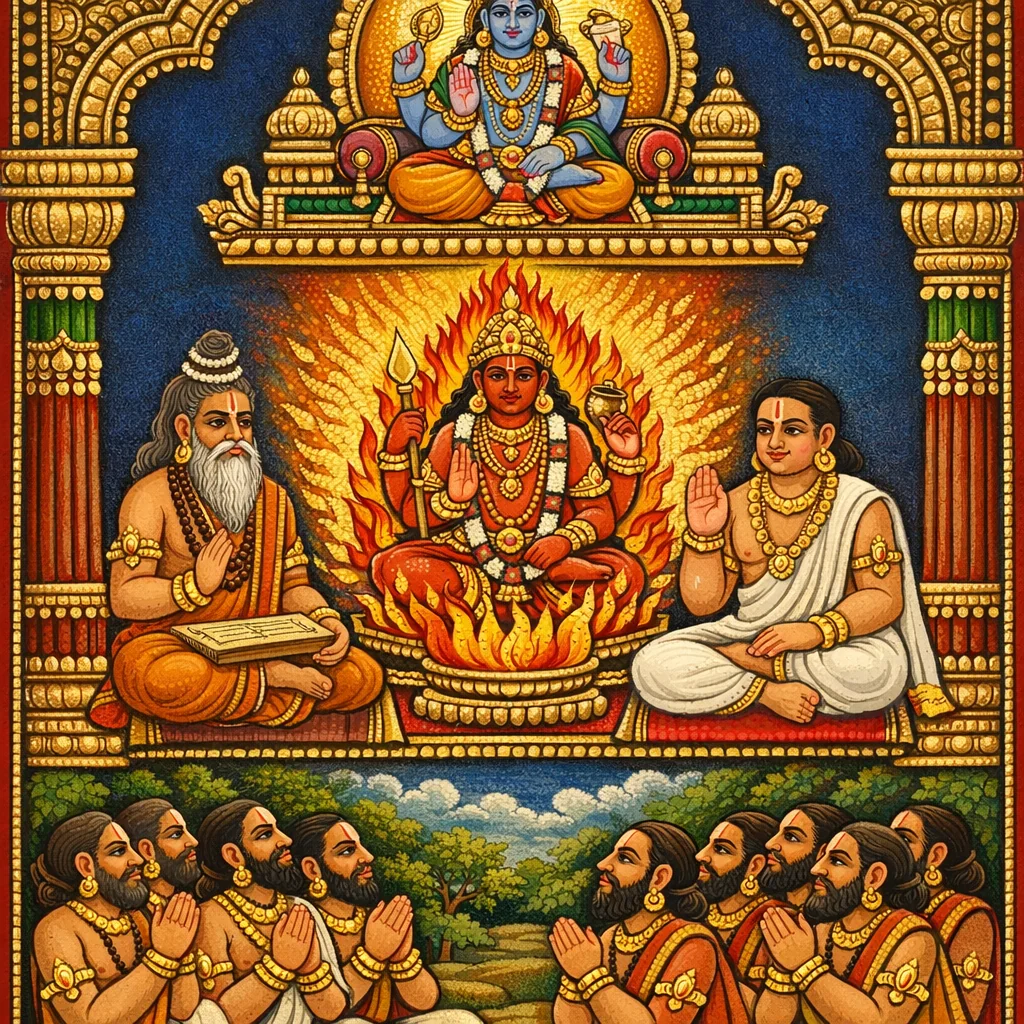
Chapter 1 begins with a maṅgala invocation and presents the Agni Purāṇa as an authoritative, salvific compendium. At Naimiṣa, Śaunaka and other Hari-devotee sages welcome Sūta and ask for the “essence of essences,” the knowledge that yields omniscience. Sūta replies that Viṣṇu—creator and cosmic regulator—is that essence; knowing Him culminates in the realization, “I am Brahman.” The chapter then sets an epistemic map: two Brahmans (śabda-brahman and para-brahman) and two knowledges (aparā and parā). A transmission lineage is established: Sūta learned the sāra from Vyāsa, Vyāsa from Vasiṣṭha, and Vasiṣṭha repeats what Agni taught in an assembly of sages and gods. Agni identifies himself with Viṣṇu and Kālāgni-Rudra and defines the Purāṇa as vidyā-sāra, granting both enjoyment and liberation to reciters and listeners. It enumerates aparā vidyā—Vedas, Vedāṅgas, and allied śāstras such as grammar, mīmāṃsā, dharmaśāstra, logic, medicine, music, dhanurveda, and arthaśāstra—while reserving parā vidyā as that by which Brahman is realized. It closes by introducing avatāra-līlā (Matsya, Kūrma, etc.) as the vehicle for explaining creation cycles, genealogies, manvantaras, and dynastic histories—forms assumed by the formless to teach causes, purposes, and dharma.
Shlokas
Verse 1
ञानं समाधिः ब्रह्मज्ञानं अद्वैतब्रह्मज्ञानं गीतासारः यमगीता आग्नेयपुराणमाहात्म्यं ॐ नमो भगवते वासुदेवाय अग्निपुराणम् अथ प्रथमो ऽध्यायः ग्रन्थप्रस्तावना श्रियं सरस्वतीं गौरीं गणेशं स्कन्दमीश्वरम् ब्रह्माणं वह्निमिन्द्रादीन् वासुदेवं नमाम्यहम्
Knowledge; samādhi (meditative absorption); knowledge of Brahman; non-dual knowledge of Brahman; the essence of the Gītā; Yama’s Gītā; the greatness of the Agneya Purāṇa—“Om, homage to the Blessed Lord Vāsudeva.” The Agni Purāṇa. Now begins the first chapter, the Preface to the treatise. I bow to Śrī (Lakṣmī), Sarasvatī, Gaurī, Gaṇeśa, Skanda, Īśvara, Brahmā, Vahni (Agni), Indra and the other gods, and to Vāsudeva.
Verse 2
नैमिषे हरिमीजाना ऋषयः शौनकादयः तीर्थयात्राप्रसङ्गेन स्वागतं सूतमब्रुवन्
In Naimiṣa, the sages—Śaunaka and others—devotees of Hari, on the occasion of discussing pilgrimage to the tīrthas (sacred fords), welcomed Sūta and spoke to him.
Verse 3
ऋषय ऊचुः सूत त्वं पूजितो ऽस्माभिः सारात्सारं वदस्व नः येन विज्ञानमात्रेण सर्वज्ञत्वं प्रजायते
The sages said: “O Sūta, you have been honored by us; tell us the very essence of all essences—by the mere possession of which knowledge, omniscience arises.”
Verse 4
सूत उवाच सारात्सारो हि भगवान् विष्णुः सर्गादिकृद्विभुः ब्रह्माहमस्मि तं ज्ञात्वा सर्वज्ञत्वं प्रजायते
Sūta said: “Indeed, the Blessed Lord Viṣṇu is the very essence of all essences, the all-pervading one who brings about creation and the rest of the cosmic functions. Knowing Him, one realizes ‘I am Brahman,’ and omniscience arises.”
Verse 5
द्वे ब्रह्मणी वेदितव्ये शब्दब्रह्म परं च यत् द्वे विद्ये वेदितव्ये हि इति चाथर्वणी श्रुतिः
Two forms of Brahman are to be known: Brahman as sacred sound (śabda-brahman) and the supreme Brahman (para-brahman). Indeed, two kinds of knowledge are to be known—so declares the Atharvanic Vedic revelation (Atharva-śruti).
Verse 6
अहं शुकश् च पैलाद्या गत्वा वदरिकाश्रमम् व्यासं नत्वा पृष्टवन्तः सो ऽस्मान् सारमथाब्रवीत्
I, together with Śuka and others such as Paila, went to the hermitage at Badarī; having bowed to Vyāsa and questioned him, he then expounded to us the essential summary of the teaching.
Verse 7
व्यास उवाच शुकाद्यैः शृणु सूत त्वं वशिष्ठो मां यथाब्रवीत् ब्रह्मसारं हि पृच्छन्तं मुनिभिश् च परात्परम्
Vyāsa said: “O Sūta, listen—(as I relate) exactly how Vasiṣṭha spoke to me, when I, together with Śuka and the other sages, inquired about the supreme, transcendent essence of Brahman.”
Verse 8
लक्ष्मीमिति घ, चिह्नितपुस्तकपाठः विज्ञातमात्रेण इति घ, चिह्नितपुस्तकपाठः अपरञ्च परञ्च यदिति ख, चिह्नितपुस्तकपाठः यदब्रवीदिति ख, घ, चिह्नितपुस्तकद्वयपाठः वसिष्ठ उवाच द्वैविध्यं ब्रह्म वक्ष्यामि शृणु व्यासाखिलानुगम् यथाग्निर्मां पुरा प्राह मुनिभिर्दैवतैः सह
Vasiṣṭha said: “I shall explain the twofold nature of Brahman; listen, O Vyāsa, you who follow and preserve the whole tradition. I shall relate it exactly as Agni formerly told me, in the presence of sages and divine beings.”
Verse 9
पुराणं परमाग्नेयं ब्रह्मविद्याक्षरं परम् ऋग्वेदाद्यपरं ब्रह्म सर्वदेवसुखावहम्
This supreme Agneya Purāṇa is the highest imperishable Brahma-knowledge; it is the transcendent Brahman beyond even the Ṛgveda and the other Vedas, and it bestows well-being and delight upon all the gods.
Verse 10
अग्निनोक्तं पुराणम् यद् आग्नेयं ब्रह्मसम्मितम् भुक्तिमुक्तिप्रदं दिव्यं पठतां शृण्वतां नृणाम्
That Purāṇa proclaimed by Agni—called the Āgneya—equal in authority to Brahman (the Veda), is divine and bestows both worldly enjoyment and liberation upon people who recite it and who listen to it.
Verse 11
कालाग्निरूपिणम् विष्णुं ज्योतिर्ब्रह्म परात्परम् मुनिभिः पृष्टवान् देवं पूजितं ज्ञानकर्मभिः
The sages questioned that God—Viṣṇu—who bears the form of the Fire of Time (kālāgni), who is the supreme Light-Brahman, transcending even the transcendent, and who is worshipped through both spiritual knowledge and sacred action (karma).
Verse 12
वसिष्ठ उवाच संसारसागरोत्तार- नावं ब्रह्मेश्वरं वद विद्यासारं यद्विदित्वा सर्वज्ञो जायते नरः
Vasiṣṭha said: “Tell me of Brahman, the Supreme Lord—the boat for crossing the ocean of saṃsāra—and teach that essence of knowledge, knowing which a man becomes all-knowing.”
Verse 13
अग्निर् उवाच विष्णुः कालाग्निरुद्रो ऽहं विद्यासारं वदामि ते विद्यासारं पुराणं यत् सर्वं सर्वस्य कारणं
Agni said: “I am Viṣṇu; I am Rudra as the Fire of Time (Kālāgni). I shall declare to you the Essence of Knowledge—namely that Purāṇa which is the essence of all learning, which is everything, and the cause of everything.”
Verse 14
सर्गस्य प्रतिसर्गस्य वंशमन्वन्तरस्य च वंशानुचरितादेश् च, मत्स्यकूर्मादिरूपधृक्
Assuming the forms of Matsya, Kūrma, and the other incarnations, (the Lord) proclaims the topics of creation, re-creation, genealogies, the Manvantaras, and the accounts of dynasties and their deeds.
Verse 15
द्वे विद्ये भगवान् विष्णुः परा चैवापरा च ह ऋग्यजुःसामाथर्वाख्या वेदाङ्गानि च षड् द्विज
The Blessed Lord Viṣṇu is known through two kinds of knowledge—higher (parā) and lower (aparā). The lower comprises the Vedas called Ṛg, Yajus, Sāman, and Atharvan, and also the six Vedāṅgas, O twice-born one (dvija).
Verse 16
अयपाठः पुण्यमिति ख, चिह्नितपुस्तकपाठः यद् गदित्वा इति ग, चिह्नितपुस्तकपाठः ज्ञानसन्दीपनादेव इति ग, चिह्नितपुस्तकपाठः ब्रह्माग्नेयं पुराणमिति ग, घ, चिह्नितपुस्तकद्वयपाठः यद् द्विज इति ख, चिह्नितपुस्तकपाठः शिक्षा कल्पो व्याकरणं निरुक्तं ज्योतिषाङ्गतिः छन्दो ऽभिधानं मीमांसा धर्मशास्त्रं पुराणकम्
Phonetics (Śikṣā), ritual procedure (Kalpa), grammar (Vyākaraṇa), etymological exposition (Nirukta), Jyotiṣa—astronomy/astrology as a Vedic auxiliary, metrics (Chandas), lexicography (Abhidhāna), Mīmāṃsā (Vedic hermeneutics), Dharmaśāstra (law and duty), and the Purāṇa itself—these are the branches of learning set forth.
Verse 17
न्यायवैद्यकगान्धर्वं धनुर्वेदो ऽर्थशास्त्रकम् अपरेयं परा विद्या यया ब्रह्माभिगम्यते
Logic (Nyāya), medicine (Vaidyaka), gāndharva (music), Dhanurveda (the science of archery), and Arthaśāstra (statecraft) constitute the lower knowledge (apara); but the higher knowledge (parā) is that by which Brahman is realized.
Verse 18
यत्तददृश्यमग्राह्यम् अगोत्रचरणम् ध्रुवम् विष्णुनोक्तं यथा मह्यं देवेभ्यो ब्रह्मणा पुरा तथा ते कथयिष्यामि हेतुं मत्स्यादिरूपिणम्
That Reality is invisible and beyond grasp, without lineage and without feet (i.e., not confined to bodily attributes), and immutable. Just as Viṣṇu declared it to me, and as Brahmā formerly spoke it to the gods, so shall I explain to you the reason and purpose of the One who assumes forms beginning with the Fish (Matsya).
Frequently Asked Questions
A formal taxonomy of knowledge: aparā vidyā is itemized (Vedas, Vedāṅgas, plus śāstras such as vyākaraṇa, nirukta, chandas, mīmāṃsā, dharmaśāstra, nyāya, vaidya, gāndharva, dhanurveda, and arthaśāstra), while parā vidyā is defined as the means of realizing Brahman.
It positions all disciplined learning under a graded soteriology: worldly arts become dharma-supporting auxiliaries (bhukti), while the culmination is non-dual Brahman-realization (mukti), approached through devotion to Viṣṇu and discernment between śabda-brahman and para-brahman.
Avatāras are presented as the Lord’s pedagogical strategy—assuming forms like Matsya and Kūrma to disclose the Purāṇic framework (creation cycles, genealogies, manvantaras, royal lineages) and the causal rationale (hetu) behind divine embodiment.