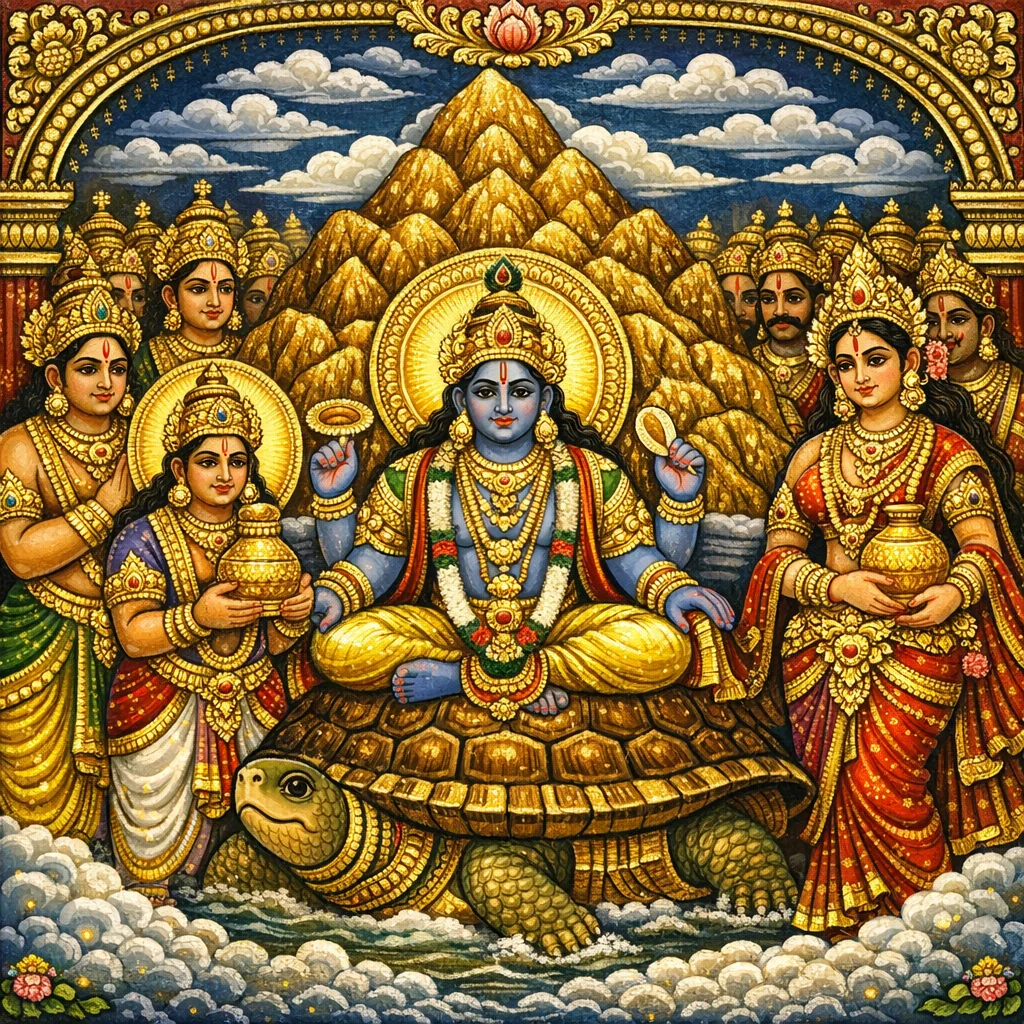
Adhyaya 3
Kūrma-avatāra-varṇana (The Description of the Tortoise Incarnation) — Samudra Manthana and the Reordering of Cosmic Prosperity
Agni continues the avatāra-līlā sequence, turning from Matsya directly to the Kūrma incarnation. The Devas, weakened by Durvāsas’ curse and bereft of Śrī (splendor/prosperity), take refuge in Viṣṇu dwelling in the Kṣīrābdhi (Ocean of Milk). Viṣṇu advises a strategic alliance (sandhi) with the Asuras to churn the ocean for amṛta and the return of Śrī, while declaring that immortality will ultimately belong to the Devas, not the Dānavas. Mandara serves as the churning rod and Vāsuki as the rope; when the mountain sinks, Viṣṇu becomes Kūrma to bear it and sustain the cosmic work. From the churning arise Hālāhala poison, Vāruṇī, Pārijāta, the Kaustubha jewel, divine beings, and Lakṣmī—signs of restored auspicious order. Dhanvantari emerges with amṛta; Viṣṇu then becomes Mohinī to distribute it to the gods, linking the eclipse myth to Rāhu’s severed head and the merit of dāna during grahaṇa. The chapter ends with a Vaiṣṇava–Śaiva pivot: Viṣṇu’s māyā deludes Rudra, yet Viṣṇu proclaims that only Śiva can conquer that māyā—culminating in the Devas’ victory and a phalaśruti promising heavenly reward for recitation.
Shlokas
Verse 1
इत्य् आदिमहापुराणे आग्नेये मत्स्यावतारो नाम द्वितीयो ऽध्यायः अथ तृतीयो ऽध्यायः कूर्मावतारवर्णनं अग्निर् उवाच वक्ष्ये कूर्मावतारञ्च श्रुत्वा पापप्रणाशनम् पुरा देवासुरे युद्धे दैत्यैर् देवाः पराजिताः
Thus, in the Agni Purāṇa, the primordial Mahāpurāṇa, ends the second chapter called “The Matsya (Fish) Incarnation.” Now begins the third chapter: “The Description of the Kūrma (Tortoise) Incarnation.” Agni said: “I shall recount the Kūrma incarnation—hearing which destroys sins. Formerly, in the war between the gods and the asuras, the gods were defeated by the daityas.”
Verse 2
दुर्वाससश् च शापेन निश्रीकाश्चाभवंस्तदा स्तुत्वा क्षीराब्धिगं विष्णुम् ऊचुः पालय चासुरात्
Then, due to the curse of Durvāsas, they became bereft of Śrī (prosperity and splendor). Having praised Viṣṇu who abides in the Ocean of Milk, they said, “Protect us also from the Asuras.”
Verse 3
ब्रह्मादिकान् हरिः प्राह सन्धिं कुर्वन्तु चासुरैः क्षीराब्धिमथनार्थं हि अमृतार्थं श्रिये ऽसुराः
Hari addressed Brahmā and the other gods: “Let a truce be made with the Asuras for the purpose of churning the Ocean of Milk—for amṛta—so that the Asuras, seeking the nectar of immortality, may also obtain Śrī (Lakṣmī).”
Verse 4
अरयो ऽपि हि सन्धेयाः सति कार्यार्थगौरवे युष्मानमृतभाजो हि कारयामि न दानवान्
Even enemies are to be reconciled (through alliance) when the gravity of the objective and the necessity of the task so require. For I make you partakers of immortality; I do not elevate the Dānavas.
Verse 5
तकपाठः संश्रुतं पापनाशनमिति ख, ग, घ चिह्नितपुस्तकत्रयपाठः सुरा क्षीराब्धिगमिति ग, घ, चिह्नितपुस्त्कद्वयपाठः सन्धिं कुरुत चासुररिति ग, चिह्नितपुस्तकपाठः भाजो हि करिष्यामि इति ख, चिह्नितपुस्तकपाठः मन्थानं मन्दरं कृत्वा नेत्रं कृत्वा तु वासुकिम् क्षीराब्धिं मत्सहायेन निर्मथध्वमतन्द्रिताः
(Textual variants are noted in some manuscripts.) Then the instruction is given: “Make Mount Mandara the churning-rod, and use Vāsuki as the churning-cord; with my assistance, churn the Ocean of Milk unceasingly and without negligence.”
Verse 6
विष्णूक्तां संविदं कृत्वा दैत्यैः क्षीराब्धिमागताः ततो मथितुमारब्धाः यतः पुच्छन्ततः सुराः
Having concluded the compact spoken by Viṣṇu with the Daityas, they came to the Ocean of Milk. Then they began to churn it, the gods taking hold at the tail end of the serpent-rope.
Verse 7
फणिनिःश्वाससन्तप्ता हरिणाप्यायिताः सुराः मथ्यमाने ऽर्णवे सो ऽद्रिर् अनाधारो ह्य् अपो ऽविशत्
Scorched by the serpent Vāsuki’s hissing breath, the gods were revived and strengthened by Hari (Viṣṇu). As the ocean was being churned, that mountain—having no support—indeed sank into the waters.
Verse 8
कूर्मरूपं समास्थाय दध्रे विष्णुश् च मन्दरम् क्षीराब्धेर्मथ्यमानाच्च विषं हालाहलं ह्य् अभूत्
Assuming the form of a tortoise, Viṣṇu supported Mount Mandara; and as the Ocean of Milk was being churned, the poison called Hālāhala indeed arose.
Verse 9
हरेण धारितं कण्ठे नीलकण्ठस्ततो ऽभवत् ततो ऽभूद्वारुणी देवी पारिजातस्तु कौस्तुभः
When Hari held that poison at his throat, he then became known as Nīlakaṇṭha (“the blue-throated one”). Thereupon the goddess Vāruṇī appeared; and also emerged the Pārijāta tree and the Kaustubha jewel.
Verse 10
गावश्चाप्सरसो दिव्या लक्ष्मीर्देवी हरिङ्गता पश्यन्तः सर्वदेवास्तां स्तुवन्तः सश्रियो ऽभवन्
Divine cows and celestial apsarases appeared, and the goddess Lakṣmī—golden-limbed—came forth. Seeing her, all the gods praised her and became endowed with splendor and prosperity.
Verse 11
ततो धन्वन्तरिर्विष्णुर् आयुर्वेदप्रवर्तकः बिभ्रत् कमण्डलुम्पूर्णम् अमृतेन समुत्थितः
Then Viṣṇu, as Dhanvantari—the promulgator of Āyurveda—arose, bearing a kamaṇḍalu (water-pot) filled to the brim with amṛta, the nectar of immortality.
Verse 12
अमृतं तत्कराद्दैत्या सुरेभ्यो ऽर्धं प्रदाय च गृहीत्वा जग्मुर्जन्माद्या विष्णुः स्त्रीरूपधृक् ततः
Taking the nectar from her hand, the Daityas—after giving half of it to the Devas—seized the remainder and went away. Thereupon Viṣṇu, assuming a woman’s form, set events in motion.
Verse 13
तां दृष्ट्वा रूपसम्पन्नां दैत्याः प्रोचुर्विमोहिताः भव भार्यामृतं गृह्य पाययास्मान् वरानने
Seeing her, endowed with perfect beauty, the Daityas, utterly deluded, said: “Become our wife; take the amṛta and make us drink it, O fair-faced one.”
Verse 14
तथेत्युक्त्वा हरिस्तेभ्यो गृहीत्वापाययत्सुरान् चन्द्ररूपधरो राहुः पिबंश्चार्केन्दुनार्पितः
Saying “So be it,” Hari took it and made the gods drink. Rāhu, assuming the form of the Moon, also drank, having been placed between the Sun and the Moon.
Verse 15
तु इति ख, चिह्नितपुस्तकपाठः निःश्वाससंग्लाना इति ख, घ, चिह्नितपुस्तकद्वयपाठः ततो हर इति ग, घ, चिह्नितपुस्तकद्वयपाठः प्रदर्शक इति ख, ग, चिह्नितपुस्तकद्वयपाठः अकन्दुसूचित इति ख, चिह्नितपुस्तकपाठः हरिणाप्यरिणा च्छिन्नं स राहुस्तच्छिरः पृथक् कृपयामरतान्नीतं वरदं हरिमब्रवीत्
Though cut down by Hari—even by his foe—Rāhu’s head was severed and remained apart. Then, out of compassion, he was led to the immortals, and he addressed boon-giving Hari (Viṣṇu).
Verse 16
राहुर्मत्तस्तु चन्द्रार्कौ प्राप्स्येते ग्रहणं ग्रहः तस्मिन् कले च यद्दानं दास्यन्ते स्यात् तदक्षयं
But when Rāhu becomes frenzied, he seizes the Moon and the Sun—this is the eclipse caused by the graha (the planetary seizer). And whatever gift is given at that time becomes imperishable, yielding inexhaustible merit.
Verse 17
तथेत्याहाथ तं विष्णुस् ततः सर्वैः सहामरैः स्त्रीरूपं सम्परित्यज्य हरेणोक्तः प्रदर्शय
Saying, “So be it,” Vishnu then addressed him; and thereafter, in the presence of all the gods, having abandoned the female form, he displayed his true form as instructed by Hari.
Verse 18
दर्शयामास रुद्राय स्त्रीरूपं भगवान् हरिः मायया मोहितः शम्भुः गौरीं त्यक्त्वा स्त्रियं गतः
The Blessed Lord Hari displayed to Rudra a female form. Deluded by Hari’s māyā, Śambhu, abandoning Gaurī, went after that woman.
Verse 19
नग्न उन्मत्तरूपो ऽभूत् स्त्रियः केशानधारयत् अगाद्विमुच्य केशान् स्त्री अन्वधावच्च ताङ्गताम्
He became naked and assumed the appearance of a madman. He seized the women by their hair; and, letting go of their hair, he ran off—while the woman too chased after him and went to that place.
Verse 20
स्खलितं तस्य वीर्यं कौ यत्र यत्र हरस्य हि तत्र तत्राभवत् क्षेत्रं लिङ्गानां कनकस्य च
Wherever indeed the vīrya (virile energy) of Hara (Śiva) fell, at each such place there arose a sacred field (kṣetra) of liṅgas—and also of gold.
Verse 21
मायेयमिति तां ज्ञात्वा स्वरूपस्थो ऽभवद्धरः शिवमाह हरी रुद्र जिता माया त्वया हि मे
Recognizing her as “This is Māyā,” the Bearer (Viṣṇu) became established in his own true nature. Then Hari said to Śiva: “O Rudra, by you indeed my Māyā has been conquered.”
Verse 22
न जेतुमेनां शक्तो मे त्वदृते ऽन्यः पुमान् भुवि अप्राप्याथामृतं दैत्या देवैर् युद्धे निपातिताः त्रिदिवस्थाः सुराश्चासन् यः पठेत् त्रिदिवं व्रजेत्
“Other than you, no man on earth is able to conquer her for me. Then, failing to obtain the nectar, the Daityas were struck down by the gods in battle; the Suras remained established in heaven. Whoever recites (this account) shall go to heaven.”
Frequently Asked Questions
Viṣṇu assumes the tortoise form to provide a stable support (ādhāra) for Mount Mandara when it sinks, making the churning of the Milk Ocean possible and ensuring the emergence of amṛta and Śrī (Lakṣmī).
Viṣṇu advocates sandhi (truce) even with enemies when the objective is weighty and collective action is required—an explicitly pragmatic principle that mirrors rājadharma’s emphasis on policy, alliance, and outcomes aligned to dharma.
It states that whoever recites this account attains heaven (tridiva), framing narrative remembrance as a purifier and merit-producing discipline.