Adhyaya 8
Śrīrāmāvatāra-kathana (Account of the Rāma Incarnation) — Kiṣkindhā Alliance and the Search for Sītā
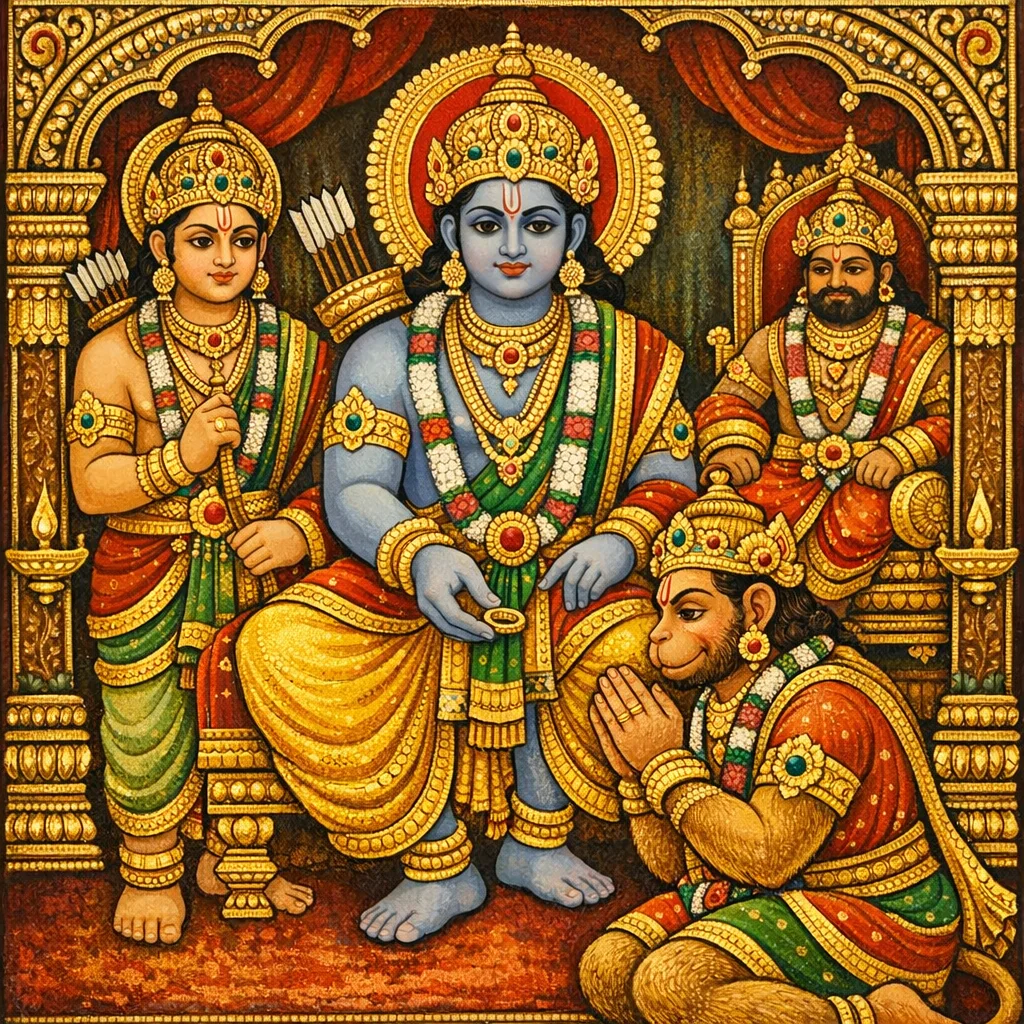
This chapter continues Śrī Rāma’s Avatāra-līlā in the Kiṣkindhā episode, stressing dharmic alliance and disciplined action. Grieving at Pampā, Rāma is guided by Hanūmān to befriend Sugrīva. To establish trust, Rāma displays superhuman might—piercing seven tāla palms with one arrow and hurling Dundubhi’s body far away—then slays Vālin, ends the brothers’ enmity, and restores Sugrīva’s kingship. When Sugrīva delays, Rāma observes Cāturmāsya on Mālyavat; Lakṣmaṇa admonishes him and Sugrīva repents. Search parties of vānaras are dispatched under strict time limits; Hanūmān receives Rāma’s signet-ring for the southern route. As the southern party falters, Sampāti reveals that Sītā is in Laṅkā, in the Aśoka grove, enabling the vānaras to report the decisive geographic and strategic lead for the next stage of the rescue.
Shlokas
Verse 1
ग, चिह्नितपुस्तकद्वयपाठः प्रेषित इति ख, चिह्नितपुस्तकपाठः विरथ इति ख, ग, ङ, चिह्नितपुस्तकत्रयपाठः आह्वयामास इति ङ, चिह्नितपुस्तकपाठः अथ अष्टमो ऽध्यायः श्रीरामावतारकथनं नारद उवाच रामः पम्पासरो गत्वा शोचन् स शर्वरीं ततः हनूमता स सुग्रीवं नीतो मित्रञ्चकार ह
Nārada said: Rāma went to Lake Pampā and spent the night in sorrow. Thereafter, led by Hanūmān to Sugrīva, he formed a bond of friendship (with him).
Verse 2
सप्त तालान् विनिर्भिद्य शरेणैकेन पश्यतः पादेन दुन्दुभेः कायञ् चिक्षेप दशयोजनं
Before the onlookers, he pierced seven tāla-palms with a single arrow; and with his foot he hurled Dundubhi’s body a distance of ten yojanas.
Verse 3
तद्रिपुं बालिनं हत्वा भ्रातरं वैरकारिणम् किष्किन्धां कपिराज्यञ्च रुमान्तारां समर्पयत्
Having slain that enemy Vālin—his brother who had become the cause of enmity—he handed over Kiṣkindhā and the sovereignty of the Vānara host (monkey kingdom) to Rumāntārā.
Verse 4
ऋष्यमूके हरीशाय किष्किन्धेशो ऽब्रवीत्स च सीतां त्वं प्राश्यसे यद्वत् तथा राम करोमि ते
On Mount Ṛṣyamūka, the lord of Kiṣkindhā spoke to Harīśa (Rāma): “Just as you will regain Sītā, so, O Rāma, will I act for you—helping you accordingly.”
Verse 5
तच् छ्रुत्वा माल्यवत्पृष्ठे चातुर्मास्यं चकार सः किष्किन्धायाञ्च सुग्रीवो यदा नायाति दर्शनं
Hearing this, he stayed on the slopes of Mālyavat and observed the Cāturmāsya vow (the four-month observance), since Sugrīva in Kiṣkindhā did not come to meet him for an audience.
Verse 6
तदाब्रवीत्तं रामोक्तं लक्ष्मणो व्रज राघवम् न स सङ्कुचितः पन्था येन बाली हतो गतः
Then Lakṣmaṇa, speaking as Rāma had instructed, said to him: “Go to Rāghava (Rāma). That path is not constricted—it is the very route by which Vālī went and was slain.”
Verse 7
समये तिष्ठ सुग्रीव मा बालिपथमन्वगाः सुग्रीव आह संसक्तो गतं कालं न बुद्धवान्
“Keep to the proper time, Sugrīva; do not follow the path of Vālī.” Sugrīva replied, “I was entangled in distractions; I did not realize that the time had passed.”
Verse 8
इत्युक्त्वा स गतो रामं नत्वोवाच हरीश्वरः आनीता वानराः सर्वे सीतायाश् च गवेषणे
Having said this, he went to Rāma; bowing down, Harīśvara spoke: “All the vānara hosts have been gathered for the search for Sītā.”
Verse 9
आनरेन्द्रमिति ङ, चिह्नितपुस्तकपाठः अब्रवीत्तत् इति ग, चिह्नितपुस्तकपाठः प्राप्स्यसि यथा इति ख, चिह्नितपुस्तकपाठः सुग्रीवमाह सङ्क्रुद्ध इति ख, ग, चिह्नितपुस्तकद्वयपाठः सुग्रीव ऋद्धिसंसक्त इति ङ, चिह्नितपुस्तकपाठः त्वन्मतात् प्रेषयिष्यामि विचिन्वन्तु च जानकीम् पूर्वादौ मासमायान्तु मासादूर्ध्वं निहन्मि तान्
“Following your counsel, I shall dispatch the search-parties; let them seek Jānakī. Beginning with the eastern quarter and then the others, let them return within a month; if they remain beyond a month, I will slay them.”
Verse 10
इत्युक्ता वानराः पूर्व- पश्चिमोत्तरमार्गगाः जग्मू रामं ससुग्रीवम् अपश्यन्तस् तु जानकीम्
Thus instructed, the vānaras set out along the routes to the east, west, and north; they went with Rāma together with Sugrīva, but they did not find Jānakī (Sītā).
Verse 11
रामाङ्गुलीयं सङ्गृह्य हनूमान् वानरैः सह दक्षिणे मार्गयामास सुप्रभाया गुहान्तिके
Having taken Rāma’s signet-ring, Hanumān—together with the monkeys—set out to search along the southern route, near the cave of Suprabhā.
Verse 12
मासादूर्ध्वञ्च विन्यस्ता अपश्यन्तस्तु जानकीम् ऊचुर्वृथा मरिष्यामो जटायुर्धन्य एवसः
Having resolved to wait beyond a month and yet not seeing Jānakī, they said: “We shall die in vain. Jatāyu alone was truly blessed.”
Verse 13
सीतार्थे यो ऽत्यजत् प्राणान् रावणेन हतो रणे तच् छ्रुत्वा प्राह सम्पातिर् विहाय कपिभक्षणं
“Hearing that one had given up his life for Sītā and was slain in battle by Rāvaṇa, Sampāti spoke—having abandoned the eating of monkeys.”
Verse 14
भ्रातासौ मे जटायुर्वै मयोड्डीनो ऽर्कमण्डलम् अर्कतापाद्रक्षितो ऽगात् दग्धपक्षो ऽहमब्भ्रगः
“That Jatāyu is indeed my brother. I—the peacock—flew up to the sun’s orb; protected from the sun’s burning heat, I returned—though my wings were scorched, I became a cloud-goer.”
Verse 15
रामवार्ताश्रवात् पक्षौ जातौ भूयो ऽथ जानकीम् पश्याम्यशोकवनिका- गतां लङ्कागतां किल
On hearing tidings of Rāma, my wings have, as it were, grown anew; now I shall indeed see Jānakī—so they say—gone to the Aśoka grove, come to Laṅkā.
Verse 16
शतयोजनविस्तीर्णे लवणाब्धौ त्रिकूटके ज्ञात्वा रामं ससुग्रीवं वानराः कथयन्तु वै
In the salt ocean, a hundred yojanas wide, at Trikūṭa (mountain), having recognized Rāma together with Sugrīva, let the vānaras indeed report the matter.
Frequently Asked Questions
It serves as a public pramāṇa (proof) of Rāma’s capability, legitimizing the alliance with Sugrīva and grounding subsequent political-military action in demonstrable competence.
It highlights disciplined restraint and seasonal observance even amid crisis, framing Rāma’s campaign as dharmically regulated rather than impulsive.
It functions as an authenticating token (credential) enabling recognition and trust, while also symbolically extending Rāma’s authority into reconnaissance and diplomacy.
It converts despair into actionable intelligence by identifying Laṅkā and the Aśoka grove as Sītā’s location, transforming the search from broad exploration to targeted mission.