Adhyaya 5
Śrīrāmāvatāra-varṇanam (Description of the Incarnation of Śrī Rāma)
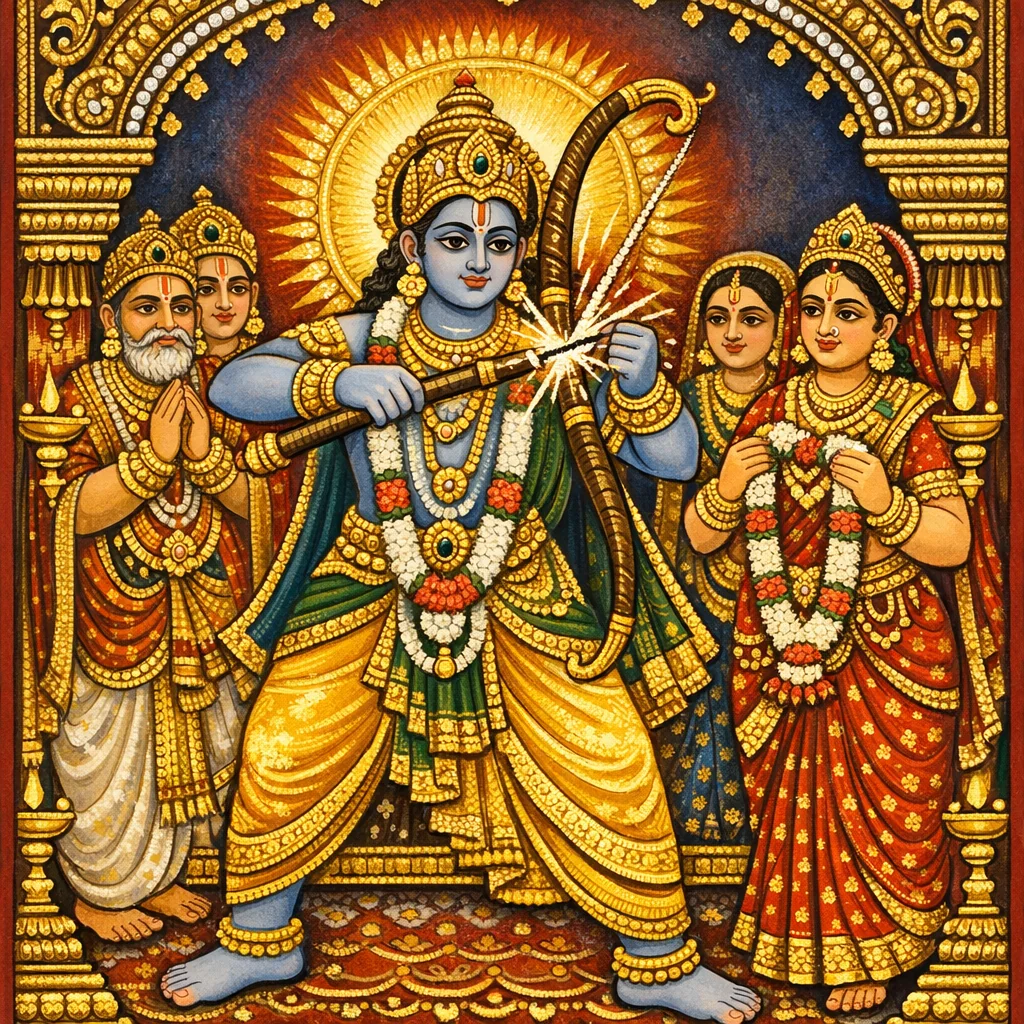
Agni proclaims a faithful retelling of the Rāmāyaṇa as Nārada once taught Vālmīki, declaring it a śāstric means that bestows both bhukti (worldly prosperity) and mukti (liberation). Nārada opens with a compressed solar genealogy—from Brahmā through Marīci, Kaśyapa, Sūrya, and Vaivasvata Manu to Ikṣvāku, then Kakutstha, Raghu, Aja, and Daśaratha—placing Rāma’s avatāra within the hereditary frame of rājadharma. Hari manifests fourfold to destroy Rāvaṇa and allied threats, and through the consecrated pāyasa distributed by Ṛśyaśṛṅga are born Rāma, Bharata, Lakṣmaṇa, and Śatrughna. Trained to protect dharma, the princes answer Viśvāmitra’s request by removing yajña-obstacles: slaying Tāḍakā, driving off Mārīca, and killing Subāhu. The narrative turns to Mithilā, where Rāma witnesses Janaka’s rite, strings and breaks Śiva’s bow, wins Sītā, and the brothers marry into Janaka’s line. Returning, Rāma subdues Jāmadagnya (Paraśurāma), completing a rite-to-royalty arc that models disciplined power under dharma.
Shlokas
Verse 1
इत्य् आदिमहापुराणे आग्नेये वराहनृसिंहाद्यवतारो नाम चतुर्थो ऽध्यायः अथ पञ्चमो ऽध्यायः श्रीरामावतारवर्णनम् अग्निर् उवाच रामायणमहं वक्ष्ये नारदेनोदितं पुरा वाल्मीकये यथा तद्वत् पठितं भुक्तिमुक्तिदम्
Thus, in the Agni Purāṇa, the Ādi-Mahāpurāṇa, the fourth chapter entitled “The incarnations beginning with Varāha and Narasiṃha” is concluded. Now begins the fifth chapter, “Description of the incarnation of Śrī Rāma.” Agni said: “I shall expound the Rāmāyaṇa—formerly taught by Nārada to Vālmīki—exactly as it was recited; when studied, it bestows both worldly enjoyment and liberation.”
Verse 2
नारद उवाच विष्णुनाभ्यब्जजो ब्रह्मा मरीचिर्ब्रह्मणः सुतः मरीचेः कश्यपस्तस्मात् सूर्यो वैवस्वतो मनुः
Nārada said: From the lotus sprung from Viṣṇu’s navel arose Brahmā. Marīci was Brahmā’s son; from Marīci came Kaśyapa; from him came Sūrya; and from him came Vaivasvata Manu.
Verse 3
ततस्तस्मात्तथेक्ष्वाकुस् तस्य वंशे ककुत्स्थकः ककुत्स्थस्य रघुस्तस्माद् अजो दशरथस्ततः
Thereafter, from him was Ikṣvāku; in his lineage arose Kakutstha. From Kakutstha came Raghu; from him came Aja; and thereafter came Daśaratha.
Verse 4
रावणादेर्बधार्थाय चतुर्धाभूत् स्वयं हरिः राज्ञो दशरथाद्रामः कौशल्यायां बभूव ह
For the slaying of Rāvaṇa and the others, Hari Himself manifested in fourfold form; and from King Daśaratha, Rāma was born of Kauśalyā.
Verse 5
कैकेय्यां भरतः पुत्रः सुमित्रायाञ्च लक्ष्मणः शत्रुघ्न ऋष्यशृङ्गेण तासु सन्दत्तपायसात्
In Kaikeyī, Bharata was born as a son; and in Sumitrā, Lakṣmaṇa and Śatrughna were born—through the consecrated pāyasa (rice-milk) that Ṛśyaśṛṅga duly apportioned to them.
Verse 6
प्राशिताद्यज्ञसंसिद्धाद् रामाद्याश् च समाः पितुः यज्ञविघ्नविनाशाय विश्वामित्रार्थितो नृपः
After the consecrated sacrificial food had been partaken of and the yajña duly brought to completion, Rāma and his brothers became the equals of their father. Then the king, at Viśvāmitra’s request, (sent them) to destroy the obstructions that were disrupting the sacrifice.
Verse 7
रामं सम्प्रेषयामास लक्ष्मणं मुनिना सह रामो गतो ऽस्त्रशस्त्राणि शिक्षितस्ताडकान्तकृत्
He dispatched Rāma together with Lakṣmaṇa and the sage. Rāma went forth, trained in astras and weapons, and became the slayer of Tāḍakā.
Verse 8
मारीचं मानवास्त्रेण मोहितं दूरतो ऽनयत् सुबाहुं यज्ञहन्तारं सबलञ्चावधीत् बली
With the Mānava-weapon he bewildered Mārīca and drove him far away; and the mighty one slew Subāhu—the destroyer of the sacrifice—together with his forces.
Verse 9
सिद्धाश्रमनिवासी च विश्वामित्रादिभिः सह गतः क्रतुं मैथिलस्य द्रष्टुञ्चापं सहानुजः
Residing at Siddhāśrama, Rāma, together with Viśvāmitra and others, went—along with his younger brother—to witness the sacrificial rite of the king of Mithilā and to see the bow.
Verse 10
शतानन्दनिमित्तेन विश्वामित्रप्रभावितः रामाय कथितो राज्ञा समुनिः पूजितः क्रतौ
On account of Śatānanda, the king—moved by Viśvāmitra’s influence—spoke these matters to Rāma; and that sage was honored in the sacrificial rite.
Verse 11
धनुरापूरयामास लीलया स बभञ्ज तत् वीर्यशुक्लाञ्च जनकः सीतां कन्यान्त्वयोनिजाम्
He strung the bow with ease, and then he broke it. King Janaka then presented Sītā—the maiden, not born from a womb—as a prize for prowess.
Verse 12
ददौ रामाय रामो ऽपि पित्रादौ हि समागते उपयेमे जानकीन्ताम् उर्मिलां लक्ष्मणस् तथा
When the fathers and other elders had assembled, (Janaka) gave (Sītā) to Rāma; and Rāma too, in due form, accepted Jānakī as his wife. Likewise, Lakṣmaṇa married Urmilā.
Verse 13
श्रुतकीर्तिं माण्डवीञ्च कुशध्वजसुते तथा जनकस्यानुजस्यैते शत्रुघ्नभरतावुभौ
And (they married) Śrutakīrti and Māṇḍavī—both daughters of Kuśadhvaja. These two, Bharata and Śatrughna, were sons of Janaka’s younger brother.
Verse 14
कन्ये द्वे उपयेमाते जनकेन सुपूजितः रामो ऽगात्सवशिष्ठाद्यैर् जामदग्न्यं विजित्य च अयोध्यां भरतोभ्यागात् सशत्रुघ्नो युधाजितः
The two maidens were married into the royal house. Rāma, greatly honored by King Janaka, departed with Vasiṣṭha and others; and, having subdued Jāmadagnya (Paraśurāma), he went to Ayodhyā. Bharata too returned to Ayodhyā, together with Śatrughna and Yudhājit, his maternal uncle.
Frequently Asked Questions
It is explicitly framed as ‘bhukti-mukti-dam’—a study that yields worldly success and liberation—thereby positioning avatāra narrative as both ethical instruction (rājadharma) and spiritual sādhanā.
Rāma’s weapons-training under Viśvāmitra’s guidance culminates in the removal of sacrificial disruptions: the slaying of Tāḍakā, the driving away of Mārīca with the Mānava-weapon, and the killing of Subāhu with his forces.
By tracing the solar line from cosmic origins to Daśaratha, the chapter anchors Rāma’s avatāra in a legitimate rājadharma setting, presenting divine descent as the restoration of order through an ideal royal lineage.