Adhyaya 2
मत्स्यावतारवर्णनम् (The Description of the Matsya Incarnation)
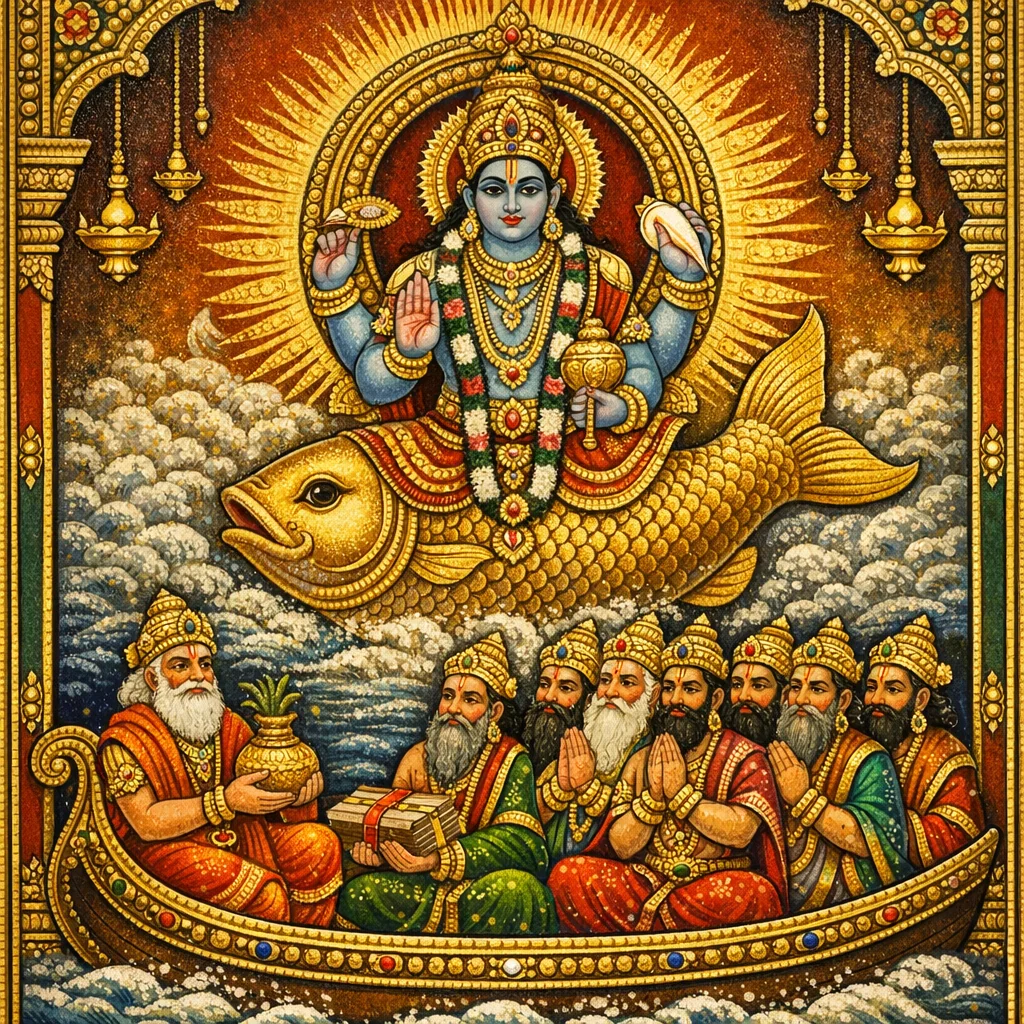
Chapter 2 begins the avatāra-līlā by presenting Vasiṣṭha’s request for a coherent account of Viṣṇu’s descents as the causal basis of creation and preservation. Agni replies that the avatāra’s ethical purpose is to destroy the wicked and protect the virtuous. Set at the close of a former aeon during a naimittika pralaya, when the worlds are flooded as ocean, Manu Vaivasvata performs austerity and water-libations on the Kṛtamālā riverbank and meets a tiny fish begging for refuge. As Manu shelters it in a jar, then a lake, and finally the sea, the fish expands miraculously to cosmic size and reveals itself as Nārāyaṇa. Matsya instructs Manu to prepare a boat, gather seeds and necessities, endure the night of Brahmā with the Seven Sages, and bind the boat to Matsya’s horn with the great serpent. The episode culminates in the safeguarding of the Vedas and leads into the later avatāras (Kūrma, Varāha), framing preservation of revelation as the central avatāra-function.
Shlokas
Verse 1
इत्य् आदिमहापुराणे आग्नेये प्रश्नो नाम प्रथमोध्यायः अथ द्वितीयो ऽध्यायः मत्स्यावतारवर्णनं वशिष्ठ उवाच मत्स्यादिरूपिणं विष्णुं ब्रूहि सर्गादिकारणम् पुराणं ब्रह्म चाग्नेयं यथा विष्णोः पुरा श्रुतम्
Thus, in the Āgneya (Agni) Purāṇa—within the Primordial Great Purāṇa—the first chapter is called “The Question.” Now begins the second chapter, “The Description of the Matsya Incarnation.” Vasiṣṭha said: “Tell of Viṣṇu who assumes the form of the Fish and other (incarnations), the cause of creation and so forth; and expound the Āgneya Purāṇa, the sacred brahman-teaching, just as it was formerly heard from Viṣṇu.”
Verse 2
अग्निर् उवाच मत्स्यावतारं वक्ष्ये ऽहं वसिष्ठ शृणु वै हरेः अवतारक्रिया दुष्ट- नष्ट्यै सत्पालनाय हि
Agni said: “O Vasiṣṭha, listen indeed. I shall describe Hari’s incarnation as the Fish (Matsya). Truly, the activity of divine descent (avatāra) is for the destruction of the wicked and for the protection of the virtuous.”
Verse 3
आसीदतीतकल्पान्ते ब्राह्मो नैमित्तिको लयः समुद्रोपप्लुतास्तत्र लोका भूरादिका मुने
At the end of the previous aeon, O sage, there occurred the Brahmā-type occasional dissolution (naimittika pralaya); there, the worlds beginning with Bhū (the earthly realm) were flooded by the ocean.
Verse 4
मनुर्वैवस्वतस्तेपे तपो वै भुक्तिमुक्तये एकदा कृतमालायां कुर्वतो जलतर्पणं
Manu Vaivasvata performed austerity indeed for the attainment of worldly enjoyment and liberation. Once, on the bank of the Kṛtamālā river, while he was performing water-libations (tarpaṇa),
Verse 5
तस्याञ्जल्युदके मत्स्यः स्वल्प एको ऽभ्यपद्यत क्षेप्तुकामं जले प्राह न मां क्षिप नरोत्तम
In the water held in his cupped palms, a single tiny fish came to him. As he was about to throw it back into the water, it spoke: “O best of men, do not cast me away.”
Verse 6
ब्रह्मावगम्यते इति ख, ग, घ, चिह्नितपुस्तकत्रयपाठः अगोत्रचरणं परमिति ग, चिह्नितपुस्तकपाठः न मां क्षिप नृपोत्तम इति ख, ग, घ, चिह्नितपुस्तकत्रयपाठः प्>ग्राहादिभ्यो भयं मे ऽद्य तच् छ्रुत्वा कलशे ऽक्षिपत् स तु वृद्धः पुनर्मत्स्यः प्राह तं देहि मे वृहत्
“(Reading variants:) ‘It is understood as Brahman’—so read the three marked manuscripts (kha, ga, gha). ‘The supreme is beyond lineage and Vedic recension’—so reads the marked manuscript (ga). ‘Do not throw me away, O best of kings’—so read the three marked manuscripts (kha, ga, gha). ‘Today I fear crocodiles and the like.’ Hearing that, he placed it in a water-jar. Then, when the fish had grown again, it said: ‘Give me a larger (container).’”
Verse 7
स्थानमेतद्वचः श्रुत्वा राजाथोदञ्चने ऽक्षिपत् तत्र वृद्धो ऽब्रवीद्भूपं पृथु देहि पदं मनो
Having heard these words, the king then turned his attention toward the northern quarter. Thereupon an elder said to the king: “O Pṛthu, set your mind upon your rightful position and footing.”
Verse 8
सरोवरे पुनः क्षिप्तो ववृधे तत्प्रमाणवान् ऊचे देहि वृहत् स्थानं प्राक्षिपच्चाम्बुधौ ततः
When he was cast again into a lake, he grew to that very measure. Then he said, “Grant me a vast space,” and thereafter he was thrown into the ocean.
Verse 9
लक्षयोजनविस्तीर्णः क्षणमात्रेण सो ऽभवत् मत्स्यं तमद्भुतं दृष्ट्वा विस्मितः प्राब्रवीन् मनुः
In a mere instant it spread out to the vast extent of a hundred thousand yojanas. Seeing that wondrous fish, Manu—astonished—spoke.
Verse 10
को भवान् ननु वै विष्णुर् नारायण नमोस्तुते मायया मोहयसि मां किमर्थं त्वं जनार्दन
Who are you indeed? Surely you are Viṣṇu—Nārāyaṇa; obeisance be to you. Why do you bewilder me by your māyā, O Janārdana?
Verse 11
मनुनोक्तो ऽब्रवीन्मत्स्यो मनुं वै पालने रतम् अवतीर्णो भवायास्य जगतो दुष्टनष्टये
Thus addressed by Manu, the Fish (Matsya) spoke to Manu, who was devoted to protection: “I have descended for the welfare of this world, for the destruction of the wicked.”
Verse 12
सप्तमे दिवसे त्वब्धिः प्लावयिष्यति वै जगत् उपस्थितायां नावि त्वं वीजादीनि विधाय च
On the seventh day, the ocean will indeed inundate the world. When the boat has arrived, you should also place the seeds and other essentials within it.
Verse 13
सप्तर्षिभिः परिवृतो निशां ब्राह्मीं चरिष्यसि उपस्थितस्य मे शृङ्गे निबध्नीहि महाहिना
Surrounded by the Seven Sages, you shall pass through the Brahmā-night. And when I am present, bind (the boat) upon my horn with the great serpent.
Verse 14
इत्युक्त्वान्तर्दधे मत्स्यो मनुः कालप्रतीक्षकः स्थितः समुद्र उद्वेले नावमारुरुहे तदा
Having spoken thus, the Fish (Matsya) disappeared. Manu, waiting for the appointed time, remained there; then, when the ocean surged in flood, he boarded the boat.
Verse 15
एकशृङ्गधरो मत्स्यो हैमो नियुतयोजनः हौ मनुरिति ख, घ, चिह्नितपुस्तकद्वयपाठः ननु विष्णुस्त्वमिति ख, ग, घ, चिह्नितपुस्तकत्रयपाठः इत्य् उक्तान्तर्हितो मत्स्य इति घ, चिह्नितपुस्तकपाठः इत्य् उक्त्वा देवमत्स्यात्मा बृहत्कारणसङ्गत इति ग, चिह्नितपुस्तकपाठः नावम्बबन्ध तच्छृङ्गे मत्स्याख्यं च पुराणकम्
The Fish (Matsya)—golden in hue, bearing a single horn, and extending for ten thousand yojanas—appeared. Having thus spoken to Manu, the divine Fish, whose form was that of the deity (Viṣṇu) and who was connected with the great causal principle, caused the boat to be fastened to that horn; thus is conveyed the account known as the Purāṇic “Matsya” episode.
Verse 16
शुश्राव मत्स्यात्पापघ्नं संस्तुवन् स्तुतिभिश् च तं ब्रह्मवेदप्रहर्तारं हयग्रीवञ्च दानवं
He heard from Matsya—the destroyer of sin—while praising Him with hymns, the account of Hayagrīva, the Dānava who had carried off the Brahmā-Vedas.
Verse 17
अवधीत्, वेदमत्स्याद्यान् पालयामास केशवः प्राप्ते कल्पे ऽथ वाराहे कूर्मरूपो ऽभवद्धरिः
Keśava protected the Vedas, beginning with the Fish (incarnation). Then, when the Varāha-kalpa arrived, Hari assumed the form of the Tortoise (Kūrma).
Frequently Asked Questions
Agni defines avatāra-kriyā as twofold: dūṣṭa-nāśa (destruction of the wicked) and sat-pālana (protection of the virtuous), framing incarnation as ethical preservation of cosmic and social order.
Matsya’s guidance ensures continuity through pralaya by saving Manu, the Saptarṣis, and the seeds of life, while the narrative explicitly links Matsya to the safeguarding and recovery of the Vedas (including the Hayagrīva motif), making revelation-protection the avatāra’s core function.