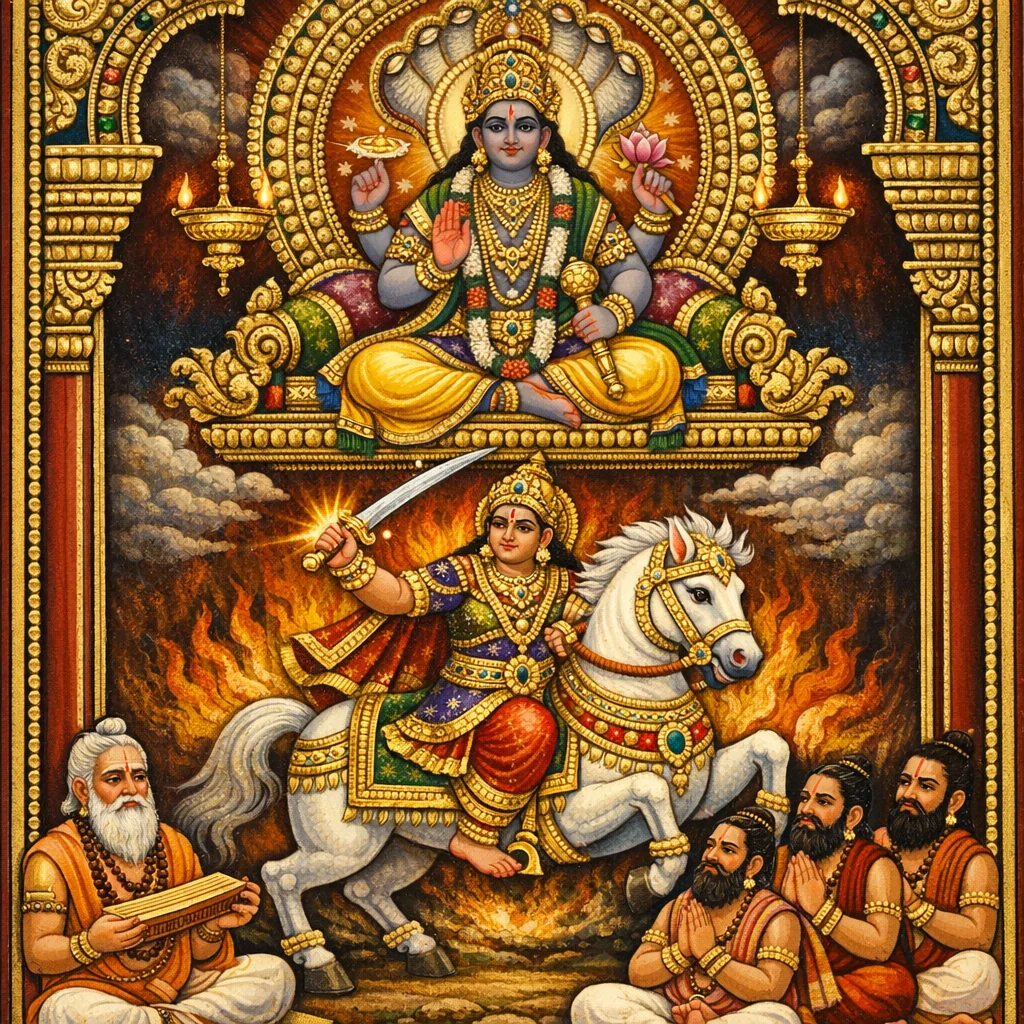
Adhyaya 16
Chapter 16 — बुद्धाद्यवतारकथनम् (Narration of Buddha and Other Incarnations)
Agni opens Chapter 16 by declaring that hearing and reciting the account of the Buddha-avatāra yields significant spiritual fruit. Set amid a devas–asuras struggle, the devas—defeated—seek refuge in the Lord; Viṣṇu answers by assuming the form of Māyā-moha and being born as Śuddhodana’s son, deluding the daityas into abandoning Vedic dharma. From this turn arise Veda-vihīna communities, including the Ārhata stream, portrayed as producing pāṣaṇḍa identities and deeds that lead toward naraka. The chapter then diagnoses Kali-yuga: moral collapse, predatory rulers in mleccha guise, and altered traditions about the number of Vedic branches. It culminates in Kalki’s restorative eschatology: armed, with Yājñavalkya as purohita, he destroys the mlecchas, re-establishes varṇāśrama boundaries, and inaugurates the return of Kṛta-yuga. The conclusion universalizes this pattern across kalpas and manvantaras, affirms the innumerability of avatāras, promises heaven to those who hear or recite the Daśāvatāra, and proclaims Hari as the regulator of dharma/adharma and the cause of cosmic emanation and dissolution.
Shlokas
Verse 1
इत्य् आदिमहापुराणे आग्नेये महाभारतवर्णनं नाम पञ्चदशो ऽध्यायः अथ षोडशो ऽध्यायः बुद्धाद्यवतारकथनम् अग्निर् उवाच वक्ष्ये बुद्धावतारञ्च पठतः शृण्वतोर्थदम् पुरा देवासुरे युद्धे दैत्यैर् देवाः पराजिताः
Thus, in the Āgneyā (Agni) portion of the Primeval Mahāpurāṇa, the fifteenth chapter entitled “Description of the Mahābhārata” concludes. Now begins the sixteenth chapter, “The narration of the Buddha and other incarnations.” Agni said: “I shall also declare the Buddha-incarnation, fruitful in meaning for one who reads or hears it. Formerly, in the war between the Devas and the Asuras, the Devas were defeated by the Daityas.”
Verse 2
रक्ष रक्षेति शरणं वदन्तो जग्मुरीश्वरम् मायमोहस्वरुपोसौ शुद्धोदनसुतो ऽभवत्
Crying, “Protect! Protect!” and declaring him their refuge, they approached the Lord; and he indeed, assuming the form of Māyā-moha (Delusion and Bewilderment), became the son of Śuddhodana.
Verse 3
मोहयामास दैत्यांस्तांस्त्याजिता वेदधर्मकम् ते च बौद्धा बभूवुर्हि तेभ्योन्ये वेदवर्जिताः
He deluded those Daityas; having abandoned the dharma grounded in the Vedas, they indeed became Buddhists, and from them arose others too who were devoid of the Vedas.
Verse 4
आर्हतः सो ऽभवत् पश्चादार्हतानकरोत् परान् एवं पाषण्डिनो जाता वेदधर्मादिवर्जिताः
Afterwards he became an Ārhata (Jaina), and he made others also into Ārhatas. Thus the pāṣaṇḍins (heretics) arose—devoid of the Vedic dharma and the like (that is, Vedic rites and observances).
Verse 5
नरकार्हं कर्म चक्रुर्ग्रहीष्यन्त्यधमादपि सर्वे कलियुगान्ते तु भविष्यन्ति च सङ्कराः
They will commit deeds deserving of hell, and all will resort even to the lowest means. At the end of the Kali age they will become “saṅkara”—a mixed and confused populace, born of social and moral disorder.
Verse 6
दस्यवः शीलहीनाश् च वेदो वाजसनेयकः दश पञ्च च शाखा वै प्रमाणेन भविष्यति
And when dāsas/brigands prevail and people are devoid of proper conduct, the Vājasaneyaka (White Yajurveda) will, by the authoritative reckoning, have fifteen branches (śākhās).
Verse 7
धर्मकञ्चुकसंवीता अधर्मरुचयस् तथा मानुषान् भक्षयिष्यन्ति म्लेच्छाः पार्थिवरूपिणः
Clad in the cloak of righteousness yet delighting in unrighteousness, the Mlecchas—assuming the guise of kings—will devour human beings, that is, oppress and consume the people.
Verse 8
कल्की विष्णुयशःपुत्रो याज्ञवल्क्यपुरोहितः उत्सादयिष्यति म्लेच्छान् गृहीतास्त्रः कृतायुधः
Kalki, the son of Viṣṇuyaśas, with Yājñavalkya as his family priest (purohita), will exterminate the mlecchas—having taken up his weapons and fully armed for battle.
Verse 9
स्थापयिष्यति मर्यादां चातुर्वर्ण्ये यथोचिताम् आश्रमेषु च सर्वेषु प्रजाः सद्धर्मवर्त्मनि
He will establish maryādā—proper boundaries and discipline—for the cāturvarṇya (the four social orders) as is fitting, and likewise in all the āśramas (stages of life), guiding the people onto the path of true dharma (saddharma).
Verse 10
कल्किरूपं परित्यज्य हरिः स्वर्गं गमिष्यति ततः कृतयुगान्नाम पुरावत् सम्भविष्यति
Having abandoned the form of Kalki, Hari (Viṣṇu) will depart to heaven; thereafter, the age called Kṛta‑Yuga will arise again, as it was in former times.
Verse 11
वर्नाश्रमाश् च धर्मेषु स्वेषु स्थास्यन्ति सत्तम एवं सर्वेषु कल्पेषु सर्वमन्वन्तरेषु च
O best of the virtuous, the orders of society and the stages of life (varṇa and āśrama) will remain established in their respective duties—thus it is in all kalpas and in every manvantara.
Verse 12
अवतारा असङ्ख्याता अतीतानागतादयः विष्णोर्दशावताराख्यान् यः पठेत् शृणुयान्नरः
The incarnations are innumerable—past, future, and the rest. Any person who recites or listens to the account of Viṣṇu’s ten incarnations (Daśāvatāra) …
Verse 13
सोवाप्तकामो विमलः सकुलः स्वर्गमाप्नुयात् धर्माधर्मव्यवस्थानमेवं वै कुरुते हरिः अवतीर्णञ्च स गतः सर्गादेः कारणं हरिः
Thus, with his desires fulfilled, purified, and together with his lineage, he would attain heaven. In this very way Hari establishes the proper ordering of dharma and adharma. Having descended (as an avatāra) and then departed, that Hari is indeed the cause of creation and the rest—the cosmic process beginning with emanation.
Frequently Asked Questions
The chapter states that reciting or hearing the Daśāvatāra narrative brings purification, fulfillment of aims, and attainment of heaven together with one’s lineage.
It presents avatāras as mechanisms by which Hari regulates dharma and adharma: delusion is used to redirect hostile forces, and Kalki later restores maryādā, varṇāśrama duties, and the conditions for a renewed Kṛta-yuga.