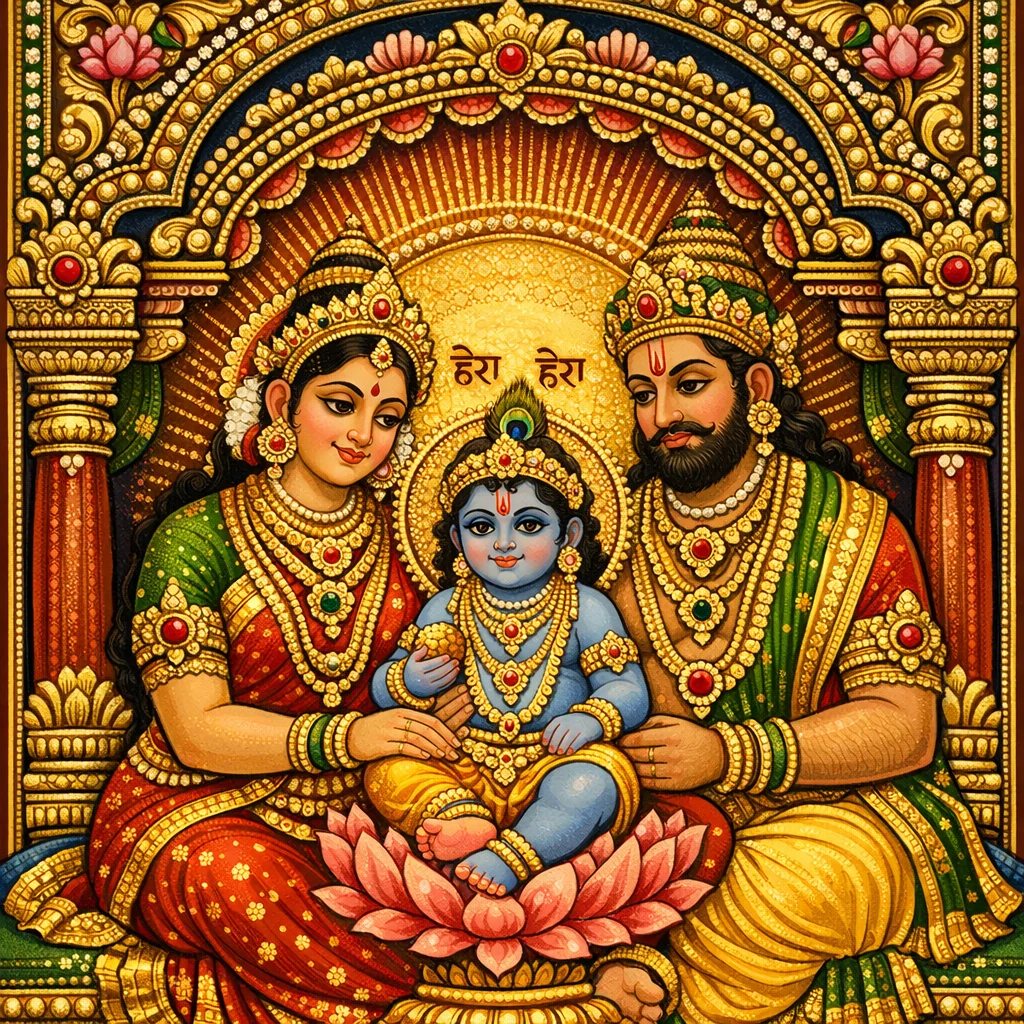
Adhyaya 12
Chapter 12 — श्रीहरिवंशवर्णनं (Śrī-Harivaṃśa-varṇana) | The Description of the Sacred Harivaṃśa
Agni recounts the Harivaṃśa genealogy from Viṣṇu’s navel-lotus (Brahmā → Atri → Soma → Purūravas → Āyu → Nahuṣa → Yayāti), tracing branching lines that culminate in the Yādavas, with Vasudeva foremost. He then compresses Kṛṣṇa’s avatāra-līlā into an ordered sequence: embryo transfers (including Balarāma), Kṛṣṇa’s midnight manifestation, the exchange with Yaśodā, and Kaṁsa’s brutality. A sky-born Devī foretells Kaṁsa’s doom, is praised with Durgā epithets, and a tri-sandhyā recitation merit is stated. Kṛṣṇa’s Vraja deeds follow—Pūtanā, Yamala-Arjuna, Śakaṭa, Kāliya, Dhenuka, Keśin, Ariṣṭa, and Govardhana—then the Mathurā arc: Kuvalayāpīḍa, Cāṇūra–Muṣṭika, and Kaṁsa’s death. The narrative expands to Jarāsandha’s siege, Dvārakā’s founding, Narakāsura’s defeat, the Pārijāta retrieval, and the Pradyumna–Aniruddha–Uṣā episode, culminating in the Hari–Śaṅkara conflict and the doctrine of non-difference (abheda). It closes with Yādava proliferation and the promise that reading the Harivaṃśa fulfills desired aims and leads to Hari.
Shlokas
Verse 1
इत्य् आदिमहापुराणे आग्नेये रामायणे उत्तरकाण्डवर्णनं नाम एकादशो ऽध्यायः अथ द्वादशो ऽध्यायः श्रीहरिवंशवर्णनं अग्निर् उवाच हरिवंशम्प्रवक्ष्यामि विष्णुनाभ्यम्बुजादजः ब्रह्मणोत्रिस्ततः सोमः सोमाज्जातः पुरूरवाः
Thus, in the Agni Purāṇa—within the Āgneya Rāmāyaṇa—the eleventh chapter is called “The Description of the Uttara-kāṇḍa.” Now begins the twelfth chapter, “The Description of the Sacred Harivaṃśa.” Agni said: “I shall expound the lineage of Hari. From the lotus arising from Viṣṇu’s navel was born the Unborn (Brahmā). From Brahmā came Atri; from him, Soma; and from Soma was born Purūravas.”
Verse 2
तस्मादायुरभूत्तस्मान् नहुषो ऽतो ययातिकः यदुञ्च तुर्वसुन्तस्माद् देवयानी व्यजायत
From him was born Āyu; from him, Nahuṣa; from him, Yayāti. From Yayāti were born Yadu and Turvasu; and from Yayāti also was born Devayānī.
Verse 3
द्रुह्यं चानुं च पूरुं च शर्मिष्ठा वार्षपर्वणी यदोः कुले यादवाश् च वसुदेवस्तदुत्तमः
From (her) were born Druhyu, Anu, and Puru. Śarmiṣṭhā, the daughter of Vṛṣaparvan, also bore offspring; and in the lineage of Yadu arose the Yādavas—among them Vasudeva was the foremost.
Verse 4
भुवो भारावतारार्थं देवक्यां वसुदेवतः हिरण्यकशिपोः पुत्राः षड्गर्भा योगनिद्रया
For the purpose of descending to relieve the burden of the Earth, the six embryos—sons of Hiraṇyakaśipu—were placed in Devakī through Vasudeva, by Yog-nidrā (the divine power of mystical sleep).
Verse 5
विष्णुप्रयुक्तया नीता देवकीजठरं पुरा अभूच्च सप्तमो गर्भो देवक्या जठराद् बलः
Formerly, by the prompting of Viṣṇu, the embryo was conveyed into Devakī’s womb; and that seventh embryo, transferred from Devakī’s womb, became Bala (Balarāma).
Verse 6
सङ्क्रामितो ऽभूद्रोहिण्यां रौहिणेयस्ततो हरिः कृष्णाष्टम्याञ्च नभसि अर्धरात्रे चतुर्भुजः
Then Hari was transferred into Rohiṇī, and thus was born as Rauhiṇeya. And on Kṛṣṇāṣṭamī—the eighth lunar day of the dark fortnight in the month of Nabhas (Bhādrapada)—at midnight, He appeared four-armed.
Verse 7
देवक्या वसुदेवेन स्तुतो बालो द्विबाहुकः वसुदेवः कंसभयाद् यशोदाशयने ऽनयत्
The two-armed infant—praised by Devakī and Vasudeva—was, out of fear of Kaṁsa, carried by Vasudeva and placed upon Yaśodā’s bedchamber.
Verse 8
यशोदाबालिकां गृह्य देवकीशयने ऽनयत् कंसो बालध्वनिं श्रुत्वा ताञ्चिक्षेप शिलातले
Taking Yaśodā’s infant girl, he brought her to Devakī’s bed. Kaṃsa, hearing the sound of a child, seized her and hurled her down upon a stone-slab.
Verse 9
वारितोपि स देवक्या मृत्युर्गर्भोष्टमो मम श्रुत्वाशरीरिणीं वाचं मत्तो गर्भास्तु मारिताः
Though Devakī tried to restrain him, he (Kaṃsa), thinking, “My death is Devakī’s eighth embryo,” and having heard the bodiless voice, killed the embryos that came from her.
Verse 10
समर्पितास्तु देवक्या विवाहसमयेरिताः सा क्षिप्ता बालिका कंसम् आकाशस्थाब्रवीदिदम्
But the children, handed over by Devakī at the time of her marriage as had been demanded, were cast down by Kaṁsa; then a young girl, remaining in the sky, spoke these words.
Verse 11
किं मया क्षिप्तया कंस जातो यस्त्वां बधिष्यति विष्णुनाभ्यब्जादज इति ख, चिह्नितपुस्तकपाठः सर्वस्वभूतो देवानां भूभारहरणाय सः
“What has been achieved by my being cast away, O Kaṁsa—for from me will be born the one who will slay you?” (A marked manuscript-variant reads: “aja, born from the lotus in Viṣṇu’s navel.”) He—who is the very essence of the gods—has come to remove the burden of the earth.
Verse 12
इत्युक्त्वा सा च शुम्भादीन् हत्वेन्द्रेण च संस्तुता आर्या दुर्गा वेदगर्भा अम्बिका भद्रकाल्यपि
Having thus spoken, she slew Śumbha and the others; and she was praised by Indra—she who is the Noble Lady, Durgā, the Womb/Essence of the Vedas, Ambikā, and also Bhadrakālī.
Verse 13
भद्रा क्षेम्या क्षेमकरी नैकबाहुर् नमामि ताम् त्रिसन्ध्यं यः पठेन्नाम सर्वान् कामानवाप्नुयात्
I bow to her—Bhadrā (the Auspicious One), Kṣemyā (the Bestower of safety), Kṣemakarī (the Maker of welfare), and Naikabāhuḥ (the Many-armed One). Whoever recites these names at the three junctions of the day obtains all desired aims.
Verse 14
कंसो ऽपि पूतनादींश् च प्रेषयद्बालनाशने यशोदापतिनन्दाय वसुदेवेन चार्पितौ
Kamsa too dispatched Pūtanā and others to destroy the child; and the two (children) had been entrusted by Vasudeva to Nanda, the husband of Yaśodā.
Verse 15
रक्षणाय च कंसादेर् भीतेनैव हि गोकुले रामकृष्णौ चेरतुस्तौ गोभिर्गोपालकैः सह
Indeed, for protection—being afraid of Kaṁsa and the like—those two, Rāma and Kṛṣṇa, dwelt in Gokula together with the cows and the cowherd boys.
Verse 16
सर्वस्य जगतः पालौ गोपालौ तौ बभूवतुः कृष्णश्चोलूखले बद्धो दाम्ना व्यग्रयशोदया
Though they were the protectors of the entire universe, the two became mere cowherds; and Kṛṣṇa—bound with a rope to a mortar by the anxious, bustling Yaśodā—remained tied there.
Verse 17
यमलार्जुनमध्ये ऽगाद् भग्नौ च यमलार्जुनौ परिवृत्तश् च शकटः पादक्षेपात् स्तनार्थिना
Crawling into the space between the twin arjuna trees, the milk-seeking child kicked with his feet—whereupon the twin arjunas were broken, and the cart was overturned.
Verse 18
पूतना स्तनपानेन सा हता हन्तुमुद्यता वृन्दावनगतः कृष्णः कालियं यमुनाह्रदात्
Pūtanā—who had come intent on killing him—was slain by (Kṛṣṇa’s) suckling at her breast; and Kṛṣṇa, having gone to Vṛndāvana, drew out and subdued Kāliya from the pool of the Yamunā.
Verse 19
जित्वा निःसार्य चाब्धिस्थञ् चकार बलसंस्तुतः क्षेमं तालवनं चक्रे हत्वा धेनुकगर्दभं
Having conquered and driven out those who dwelt in the waters, and being praised by Balarāma, he made Tālavana safe and secure by slaying the ass-demon Dhenuka.
Verse 20
अरिष्टवृषभं हत्वा केशिनं हयरूपिणम् शक्रोत्सवं परित्यज्य कारितो गोत्रयज्ञकः
Having slain Ariṣṭa, the bull-demon, and Keśin who had taken the form of a horse, and setting aside the festival of Śakra (Indra), he caused the “gotra-sacrifice” (gotra-yajña)—the Govardhana and ancestral-clan worship offering—to be performed.
Verse 21
पर्वतं धारयित्वा च शक्राद्वृष्टिर् निवारिता नमस्कृतो महेन्द्रेण गोविन्दो ऽथार्जुनोर्पितः
By holding the mountain aloft, he checked the rain sent by Śakra (Indra); then Mahendra bowed in reverence to Govinda, and thereafter Arjuna was presented to him as an offering.
Verse 22
इन्द्रोत्सवस्तु तुष्टेन भूयः कृष्णेन कारितः रथस्थो मथुराञ्चागात् कंसोक्ताक्रूरसंस्तुतः
But Kṛṣṇa, being pleased, once again had the Indra-utsava performed; then, mounted upon a chariot, he went to Mathurā at Kaṁsa’s command, accompanied by Akrūra who sang his praises.
Verse 23
गोपीभिरनुरक्ताभिः क्रीडिताभिर् निरीक्षितः रजकं चाप्रयच्छन्तं हत्वा वस्त्राणि चाग्रहीत्
Watched by the affectionate gopīs, who were sporting with him, he slew the washerman who refused to hand over the garments, and then took the clothes.
Verse 24
सह रामेण मालाभृन् मालाकारे वरन्ददौ दत्तानुलेपनां कुब्जाम् ऋजुं चक्रे ऽहनद् गजं
Together with Rāma, the garland-bearer bestowed boons upon the garland-maker. He also made Kubjā—who had offered unguent—straight and well-formed, and he slew an elephant.
Verse 25
मत्तं कुवलयापीडं द्वारि रङ्गं प्रविश्य च कंसादीनां पश्यतां च मञ्चस्थानां नियुद्धकं
At the very entrance of the arena, he entered the stadium and fought the rut-maddened elephant Kuvalayāpīḍa, while Kaṃsa and the others, seated upon the raised platform, looked on.
Verse 26
चक्रे चाणूरमल्लेन मुष्टिकेन बलो ऽकरोत् चाणूरमुष्टिकौ ताभ्यां हतौ मल्लौ तथापरे
Bala (Balarāma) engaged the wrestler Cāṇūra, and (Kṛṣṇa) took on Muṣṭika; by those two, Cāṇūra and Muṣṭika were slain, and the other wrestlers as well.
Verse 27
मथुराधिपतिं कंसं हत्वा तत्पितरं हरिः चक्रे यादवराजानम् अस्तिप्राप्ती च कंसगे
Having slain Kaṃsa, the ruler of Mathurā, Hari (Kṛṣṇa) installed Kaṃsa’s father as king over the Yādavas; and in the affair connected with Kaṃsa there was also the recovery and gathering of the bones (of the slain).
Verse 28
जरासन्धस्य ते पुत्र्यौ जरासन्धस्तदीरितः चक्रे स मथुरारोधं यादवैर् युयुधे शरैः
Those two daughters of Jarāsandha—at their urging—Jarāsandha laid siege to Mathurā and fought the Yādavas with volleys of arrows.
Verse 29
रामकृष्णौ च मथुरां त्यक्त्वा गोमन्तमागतौ जरासन्धं विजित्याजौ पौण्ड्रकं वासुदेवकं
Rāma (Balarāma) and Kṛṣṇa, having left Mathurā, came to Mount Gomanta; and, having defeated Jarāsandha in battle, they also overcame Pauṇḍraka Vāsudeva.
Verse 30
पुरीं च द्वारकां कृत्वा न्यवसद् यादवैर् वृतः भौमं तु नरकं हत्वा तेनानीताश् च कन्यकाः
Having founded the city of Dvārakā, he dwelt there, surrounded by the Yādavas. After slaying Naraka, Bhūma’s son, he also brought back the maiden-princesses whom he had carried off.
Verse 31
देवगन्धर्वयक्षाणां ता उवाच जनार्दनः षोदशस्त्रीसहस्राणि रुक्मिण्याद्यास् तथाष्ट च
To those women of the gods, Gandharvas, and Yakṣas, Janārdana declared: “Sixteen thousand women—beginning with Rukmiṇī—and also eight principal queens.”
Verse 32
सत्यभामासमायुक्तो गरुडे नरकार्दनः मणिशैलं सरत्रञ्च इन्द्रं जित्वा हरिर्दिवि
Accompanied by Satyabhāmā, Hari—the slayer of Naraka—mounted upon Garuḍa and went to heaven; having conquered Indra, he brought away the Maṇi-mountain and also the Pārijāta tree.
Verse 33
पारिजातं समानीय सत्यभामागृहे ऽकरोत् सान्दीपनेश् च शस्त्रास्त्रं ज्ञात्वा तद्बालकं ददौ
Having brought the Pārijāta tree, he placed it in Satyabhāmā’s house; and, having learned from Sandīpani the lore of weapons and astras (sacred missiles), he restored that guru’s child.
Verse 34
जित्वा पञ्चजनं दैत्यं यमेन च सुपूजितः रजकञ्च प्रजल्पन्तमिति ख, चिह्नितपुस्तकपाठः अबधीत् कालयवनं मुचुकुन्देन पूजितः
Having conquered the daitya Pañcajana, he was greatly honored even by Yama. He also slew Kālayavana—(a marked manuscript reading adds: “and the washerman who spoke insolently”)—and he was revered by Mucukunda.
Verse 35
वसुदेवं देवकीञ्च भक्तविप्रांश् च सोर्च्यत् रेवत्यां बलभद्राच्च यज्ञाते निशठोन्मुकौ
One should worship Vasudeva and Devakī, and also the devoted brāhmaṇas; and worship Balabhadra together with Revatī—thus the two, Niśaṭha and Unmuka, are to be known as born of a sacrifice (yajña-born).
Verse 36
कृष्णात् शाम्बो जाम्बवत्यामन्यास्वन्ये ऽभवन् सुताः
From Kṛṣṇa, Śāmba was born of Jāmbavatī; and from his other wives, other sons were born.
Verse 37
तं मत्स्यं शम्बरायादान्मायावत्यै च शम्बरः
He gave that fish to Śambara; and Śambara, in turn, gave it to Māyāvatī.
Verse 38
मायावती मत्स्यमध्ये दृष्ट्वा स्वं पतिमादरात् पपोष सा तं चोवाच रतिस्ते ऽहं पतिर्मम
Māyāvatī, seeing her own husband within the fish, lovingly nourished him; and she said to him, “I am your beloved, and you are my husband.”
Verse 39
कामस्त्वं शम्भुनानङ्गः कृतोहं शम्बरेण च हृता न तस्य पत्नी त्वं मायाज्ञः शम्बरं जहि
You are Kāma—made by Śambhu to be Ananga (the bodiless one). I too have been abducted by Śambara. You are not his husband; you, who know the arts of illusion (māyā), slay Śambara.
Verse 40
तच् छ्रुत्वा शम्बरं हत्वा प्रद्युम्नः सह भार्यया मायावत्या ययौ कृष्णं कृष्णो हृष्टो ऽथ रुक्मिणी
Hearing this, Pradyumna—having slain Śambara—went to Kṛṣṇa together with his wife Māyāvatī. Kṛṣṇa was delighted, and so too was Rukmiṇī.
Verse 41
प्रद्युम्नादनिरुद्धोभूदुषापतिरुदारधीः बाणो बलिसुतस्तस्य सुतोषा शोणितं पुरं
From Pradyumna was born Aniruddha, noble-minded, the husband of Uṣā. There was Bāṇa, the son of Bali; his daughter was Uṣā; and Śoṇita was Bāṇa’s city.
Verse 42
तपसा शिवपुत्रो ऽभूत् मायूरध्वजपातितः युद्धं प्राप्स्यसि वाण त्वं वाणं तुष्टः शिवोभ्यधात्
Through austerities (tapas) he became as it were a son of Śiva; yet he was struck down by the one whose banner bears the peacock. Pleased, Śiva declared to Bāṇa: “O Bāṇa, you shall come to battle.”
Verse 43
शिवेन क्रीडतीं गौरीं दृष्ट्वोषा सस्पृहा पतौ तामाह गौरी भर्ता ते निशि सुप्तेति दर्शनात्
Seeing Gaurī sporting with Śiva, Uṣā—filled with longing for her own husband—said to her: “Gaurī, your husband appears to be asleep at night,” thus she inferred from what she had seen.
Verse 44
वैशाखमासद्वादश्यां पुंसो भर्ता भविष्यति गौर्युक्ता हर्षिता चोषा गृहे सुप्ता ददर्श तं
On the Dvādaśī (twelfth lunar day) in the month of Vaiśākha, he will become a woman’s husband. And Uṣā—fair in beauty and filled with joy—while sleeping in the house, beheld him (in a dream/vision).
Verse 45
आत्मना सङ्गतं ज्ञात्वा तत्सख्या चित्रलेखया लिखिताद्वै चित्रपटादनिरुद्धं समानयत्
Recognizing him as the one united with her in her own heart, she—through her friend Citralekhā—brought Aniruddha, identified from the painted portrait upon the picture-cloth.
Verse 46
तच् छ्रुत्वा इति ग, चिह्नितपुस्तकपाठः कृष्णपौत्रं द्वारकातो दुहिता वाणमन्त्रिणः कुम्भाण्डस्यानिरुद्धोगाद्रराम ह्य् उषया सह
Hearing that (as the marked manuscript reading indicates), Aniruddha—the grandson of Kṛṣṇa—came from Dvārakā and enjoyed himself together with Uṣā, the daughter of Bāṇa’s minister (Bāṇāsura), namely Kumbhāṇḍa.
Verse 47
वाणध्वजस्य सम्पातै रक्षिभिः स निवेदितः अनिरुद्धस्य वाणेन युद्धमासीत्सदारुणम्
As the guards rushed in, he (Aniruddha) was reported to Bāṇadhvaja; and then a most dreadful battle arose with Bāṇa, Aniruddha’s opponent.
Verse 48
श्रुत्वा तु नारदात् कृष्णः प्रद्युम्नबलभद्रवान् गरुडस्थोथ जित्वाग्नीन् ज्वरं माहेश्वरन्तथा
Having heard this from Nārada, Kṛṣṇa—accompanied by Pradyumna and Balabhadra—mounted Garuḍa; and then, having overcome the fires, he likewise subdued the Mahādeva-born fever, the Māheśvara Jvara.
Verse 49
हरिशङ्करयोर्युद्धं बभूवाथ शराशरि नन्दिविनायकस्कन्दमुखास्तार्क्षादिभिर्जिताः
Then a battle arose between Hari (Viṣṇu) and Śaṅkara (Śiva), with volleys of arrows and counter-arrows. Nandin, Vināyaka (Gaṇeśa), Skanda, and the others were overcome by Tārkṣya (Garuḍa) and his allies.
Verse 50
जृम्भते शङ्करे नष्टे जृम्भणास्त्रेण विष्णुना छिन्नं सहस्रं बाहूनां रुद्रेणाभयमर्थितम्
When Śaṅkara was made to yawn and rendered powerless by Viṣṇu through the Jṛmbhaṇa-weapon, a thousand of Viṣṇu’s arms were cut off; then Rudra sought from him an assurance of safety.
Verse 51
विष्णुना जीवितो वाणो द्विबाहुः प्राब्रवीच्छिवम् त्वया यदभयं दत्तं वाणस्यास्य मया च तत्
Bāṇa, whose life had been spared by Viṣṇu, was addressed by the two-armed Śiva: “The fearlessness you granted to this Bāṇa—by me too, that very boon is confirmed.”
Verse 52
आवयोर् नास्ति भेदो वै भेदी नरकमाप्नुयात् शिवाद्यैः पूजितो विष्णुः सोनिरुद्ध उषादियुक्
“Truly, there is no difference between us; one who makes a distinction (between us) would attain hell. Viṣṇu is worshipped by Śiva and the other gods; He is that Aniruddha, accompanied by Uṣā and the rest.”
Verse 53
द्वारकान्तु गतो रेमे उग्रसेनादियादवैः अनिरुद्धात्मजो वज्रो मार्कण्डेयात्तु सर्ववित्
But having gone to Dvārakā, he lived in delight among the Yādavas headed by Ugrasena. And Vajra, the son of Aniruddha, became all-knowing—well-versed in everything—through the instruction of Mārkaṇḍeya.
Verse 54
बलभद्रः प्रलम्बघ्नो यमुनाकर्षणो ऽभवत् द्विविदस्य कपेर्भेत्ता कौरवोन्मादनाशनः
He became known as Balabhadra, the slayer of Pralamba; the one who drew aside the Yamunā; the destroyer of the monkey Dvivida; and the remover of the Kauravas’ madness— their arrogant frenzy.
Verse 55
हरी रेमेनेकमूर्तो रुक्मिण्यादिभिरीश्वरः पुत्रानुत्पादयामास त्वसंख्यातान् स यादवान् हरिवंशं पठेत् यः स प्राप्तकामो हरिं व्रजेत्
Hari, the one Lord manifest in a single form, sported with Rukmiṇī and the other queens, and begot innumerable sons—the Yādavas. Whoever recites the Harivaṃśa, having gained the fulfillment of desires, attains Hari.
Frequently Asked Questions
It legitimizes Kṛṣṇa’s avatāra through lineage mapping and then demonstrates dharma-restoration through a compressed sequence of Vraja, Mathurā, and Dvārakā episodes, ending with a recitation phala that frames the narrative as sādhanā.
The chapter articulates Hari–Śaṅkara abheda: Viṣṇu and Śiva are declared non-different, and sectarian distinction-making is condemned as spiritually harmful.
It links bhakti (Kṛṣṇa-līlā remembrance), dharma (tyrant-slaying and protection of society), and mantra-like practice (tri-sandhyā recitation of Devī names) with a phalaśruti promising both desired aims (bhukti) and attainment of Hari (mokṣa-oriented culmination).