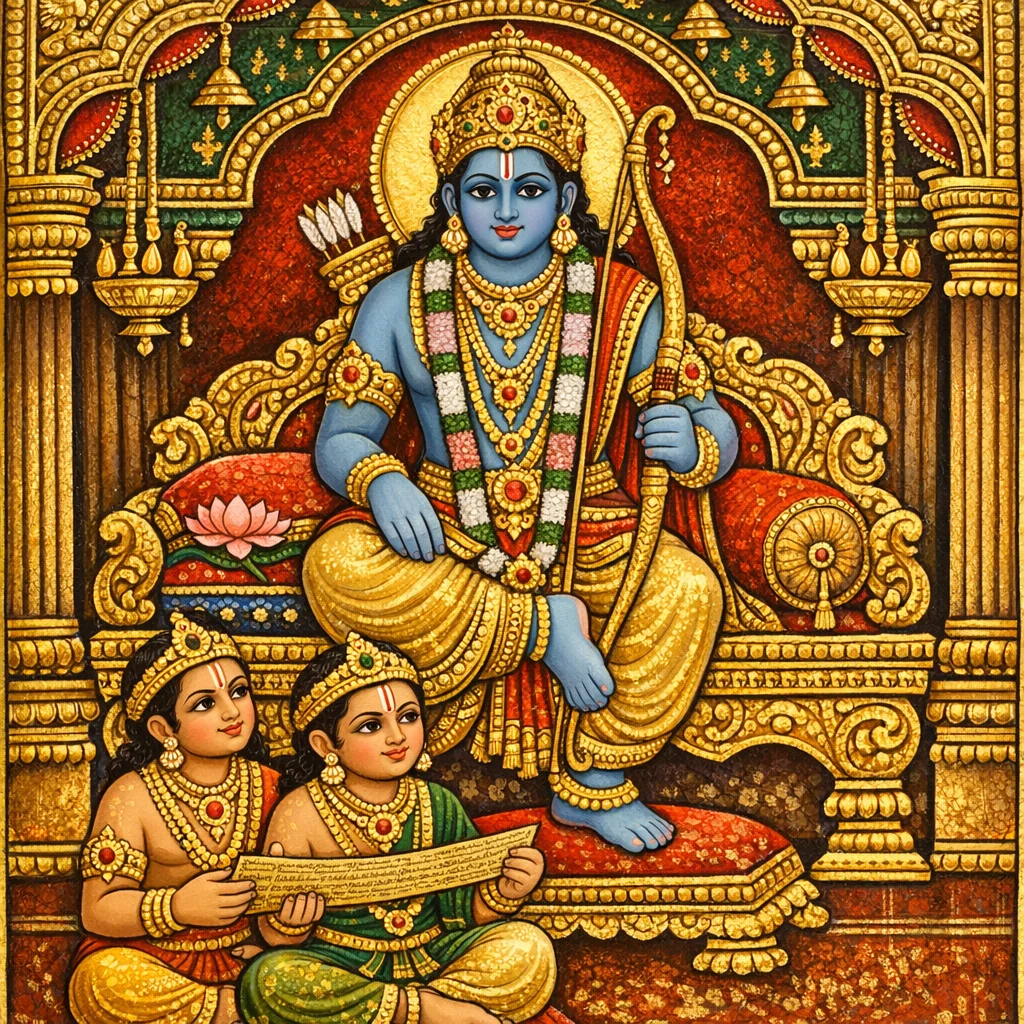
Adhyaya 11
Śrīrāmāvatāra-varṇana (Description of the Incarnation of Sri Rama)
This chapter shifts from the Yuddha-kāṇḍa narrative to a concise avatāra-līlā recap focused on Śrī Rāma’s post-war reign and its dharmic fruits. Nārada visits Rāma in his established kingdom with Agastya and other sages, praising the divine victory marked by Indrajit’s fall. The text then compresses the Rākṣasa lineage—Pulastya to Viśravas, Kubera’s birth, and Rāvaṇa’s rise through Brahmā’s boon—culminating in Indrajit’s identity and his defeat by Lakṣmaṇa for the gods’ security. After the sages depart, it turns to royal governance and frontier pacification: Śatrughna is sent (at the gods’ request) to slay Lavaṇa; Bharata destroys vast hostile forces linked with Śailūṣa and installs Takṣa and Puṣkara as regional rulers, exemplifying rājadharma as protecting the disciplined after removing the wicked. The birth and later recognition of Kuśa and Lava at Vālmīki’s āśrama is noted, followed by a soteriological turn: consecrated kingship is paired with prolonged contemplation of “I am Brahman.” The chapter ends with Rāma’s sacrificial rule and collective ascent, and Agni’s affirmation that Vālmīki composed the Rāmāyaṇa from Nārada’s account; hearing it leads to heavenly attainment.
Shlokas
Verse 1
इत्य् आदिमहापुराणे आग्नेये रामायणे युद्धकाण्डवर्णनं नाम दशमो ऽध्यायः अथ एकादशो ऽध्यायः श्रीरामावतारवर्णनं नारद उवाच राज्यस्थं राघवं जग्मुर् अगस्त्याद्याः सुपूजिताः धन्यस्त्वं विजयी यस्माद् इन्द्रजिद्विनिपातितः
Thus ends the tenth chapter in the Agni Purāṇa’s Rāmāyaṇa section, entitled “Description of the Yuddha-kāṇḍa.” Now begins the eleventh chapter, “Description of the incarnation of Śrī Rāma.” Nārada said: “While Rāghava (Rāma) was established in his kingdom, Agastya and other sages—duly honoured—came to him. Blessed are you, the victorious one, since Indrajit has been struck down.”
Verse 2
ब्रह्मात्मजः पुलस्त्योभूत् विश्रवास्तस्य नैकषी पुष्पोत्कटाभूत् प्रथमा तत्पुत्रोभूद्धनेश्वरः
Pulastya, a mind-born son of Brahmā, had a son named Viśravas. Viśravas had (as his wife) Naikāṣī; his first consort was Puṣpotkaṭā. From her was born Dhaneśvara (Kubera), the Lord of Wealth.
Verse 3
नैकष्यां रावणो जज्ञे विंशद्बाहुर्दशाननः स्वर्गमार्गेण वै गत इति ख, चिह्नितपुस्तकपाठः तपसा ब्रह्मदत्तेन वरेण जितदैवतः
In Naikaṣā was born Rāvaṇa—twenty-armed and ten-faced. (A marked manuscript reading adds: “indeed he went by the path to heaven.”) By austerity, through a boon granted by Brahmā, he became one who had conquered the gods.
Verse 4
कुम्भकर्णः सनिद्रो ऽभूद् धर्मिष्ठो ऽभूद्विभीषणः स्वसा शूर्पणखा तेषां रावणान्मेघनादकः
Kumbhakarṇa was ever bound by drowsiness; Vibhīṣaṇa was righteous, devoted to dharma. Their sister was Śūrpaṇakhā; and from Rāvaṇa was born Meghanāda.
Verse 5
इन्द्रं जित्वेन्द्रजिच्चाभूद् रावणादधिको बली हतस्त्वया लक्ष्मणेन देवादेः क्षेममिच्छता
Having conquered Indra, he became known as Indrajit, a mighty one even more powerful than Rāvaṇa; yet he was slain by you, Lakṣmaṇa, who sought the welfare and security of the foremost of the gods.
Verse 6
इत्युक्त्वा ते गता विप्रा अगस्त्याद्या नमस्कृताः देवप्रार्थितरामोक्तः शत्रुघ्नो लवणार्दनः
Having spoken thus, those brahmin-sages—Agastya and the others—departed, having been duly saluted. Then Śatrughna, the slayer of Lavaṇa, set forth as instructed by Rāma at the request of the gods.
Verse 7
अभूत् पूर्मथुरा काचित् रामोक्तो भरतो ऽवधीत् कोटित्रयञ्च शैलूष- पुत्राणां निशितैः शरैः
There was once an earlier settlement called Mathurā. At Rāma’s command, Bharata slew—using sharp arrows—three koṭi (thirty million) of the sons of Śailūṣa.
Verse 8
शैलूषं दुष्टगन्धर्वं सिन्धुतीरनिवासिनम् तक्षञ्च पुष्करं पुत्रं स्थापयित्वाथ देशयोः
Having installed Śailūṣa—the wicked Gandharva dwelling on the banks of the Sindhu—and also Takṣa and Puṣkara as (his) sons in their respective regions, he then proceeded onward.
Verse 9
भरतोगात्सशत्रुघ्नो राघवं पूजयन् स्थितः रामो दुष्टान्निहत्याजौ शिष्टान् सम्पाल्य मानवः
Bharata went forth with Śatrughna at his side, standing firm while honoring Rāghava (Rāma). Rāma, the noble man, having slain the wicked in battle, protected the virtuous and well-disciplined.
Verse 10
पुत्रौ कुशलवौ जातौ वाल्मीकेराश्रमे वरौ लोकापवादात्त्यक्तायां ज्ञातौ सुचरितश्रवात्
Two excellent sons, Kuśa and Lava, were born in Vālmīki’s hermitage; and when she was abandoned because of public reproach, they were later recognized through hearing of her noble conduct.
Verse 11
राज्येभिषिच्य ब्रह्माहम् अस्मीति ध्यानतत्परः दशवर्षसहस्राणि दशवर्षशतानि च
Having been consecrated to kingship, one should be intent on meditation on the thought, “I am Brahman,” for ten thousand years and (again) for one thousand years.
Verse 12
राज्यं कृत्वा क्रतून् कृत्वा स्वर्गं देवार्चितो ययौ सपौरः सानुजः सीता- पुत्रो जनपदान्वितः
Having ruled the kingdom and performed the sacrificial rites (kratu), he—honored by the gods—departed to heaven, together with the citizens, together with his younger brothers, accompanied by Sītā’s sons, and along with the people of his realm.
Verse 13
अग्निर् उवाच वाल्मीकिर् नारदाच्छ्रुत्वा रामायणमकारयत् सविस्तरं यदेतच्च शृणुयात्स दिवं व्रजेत्
Agni said: Having heard it from Nārada, Vālmīki composed the Rāmāyaṇa in full detail; and whoever listens to this (Rāmāyaṇa) attains the heavenly realm.
Frequently Asked Questions
It summarizes Rāma’s incarnation through post-war kingship, the defeat of Indrajit, the dharmic stabilization of the realm via Śatrughna and Bharata, and concludes with the Ramāyaṇa’s origin and its hearing-fruit (phalāśruti).
It presents the king’s duty as eliminating disruptive forces, installing orderly governance in regions, and protecting the śiṣṭa (disciplined/virtuous), while integrating royal action with inner discipline and contemplation.
It provides etiological context for the conflict—linking boons, austerity, and power—so the victory over Indrajit is framed as restoration of cosmic and divine security rather than mere battlefield success.
After consecration, it emphasizes sustained contemplation on the realization ‘I am Brahman,’ indicating that righteous rule can be paired with inner liberation-oriented discipline.