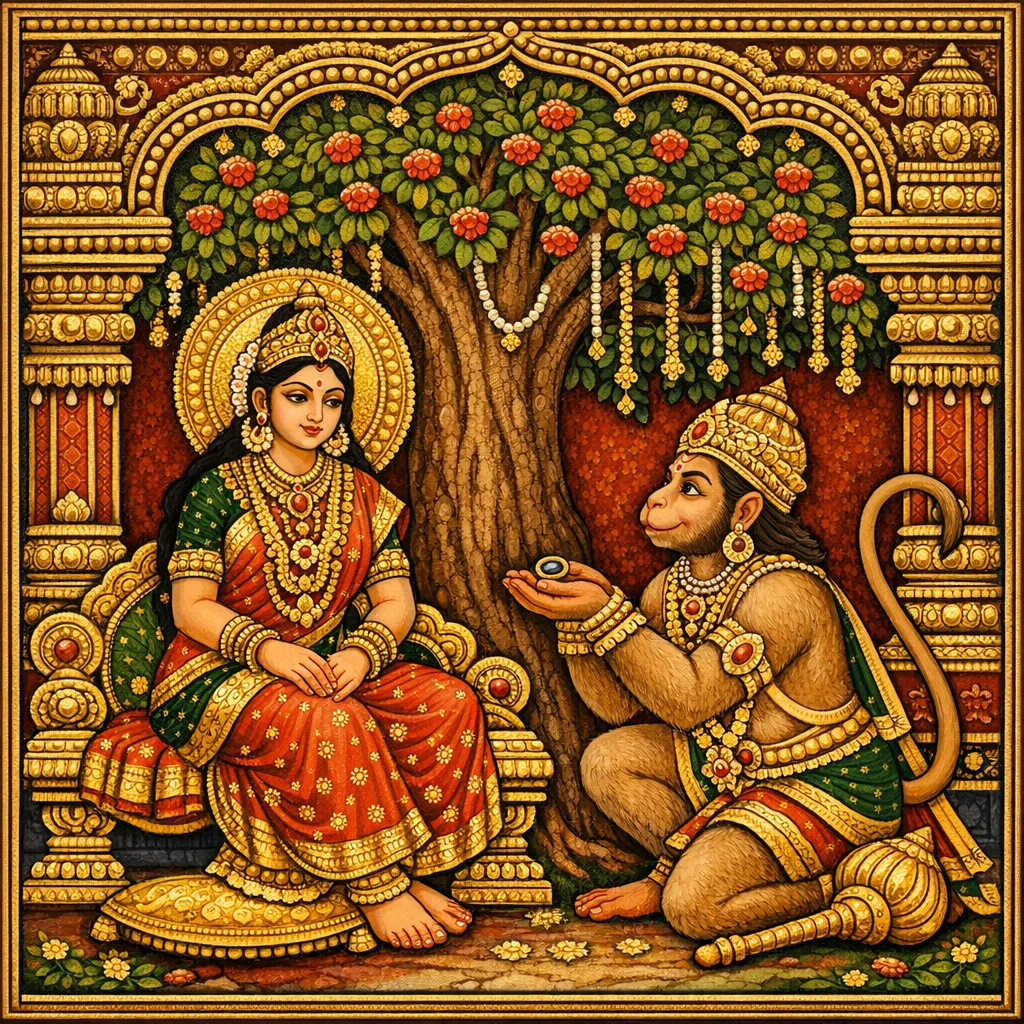
Adhyaya 9
Chapter 9 — श्रीरामावतारकथनम् (Śrī Rāmāvatāra-kathanam) | Hanumān’s Ocean-Crossing, Sītā-Darśana, and the Setu Plan
This chapter continues the Rāmāyaṇa avatāra-līlā, presenting Hanumān as the chosen instrument of Śrī Rāma’s dharma-mission. Guided by Sampāti’s counsel, the vānaras face the strategic crisis of crossing the ocean, and Hanumān alone undertakes the mighty leap for the troop’s survival and Rāma’s success. He overcomes sea-borne trials (Maināka’s offer and Siṃhikā’s attack), surveys Laṅkā’s power through its palaces, and finds Sītā in the Aśoka grove. Their exchange confirms identity, fidelity, and proof: Rāma’s ring is given as recognition, and Sītā returns a jewel and message, insisting that Rāma himself must be her rescuer. Hanumān then employs measured force—devastating the grove to gain audience, declaring himself Rāma’s envoy, and warning Rāvaṇa of inevitable defeat. After Laṅkā is burned and Sītā reassured, he returns with “nectar-like” tidings that cool Rāma’s grief. The chapter culminates in alliance and righteous engineering: Vibhīṣaṇa’s refuge and consecration, and the Ocean’s counsel to build Nala’s bridge (setu), enabling the just campaign to advance.
Shlokas
Verse 1
इत्य् आदिमहापुराणे आग्नेये रामायाणे किष्किन्धाकाण्डवर्णनं नाम अष्टमो ऽध्यायः अथ नवमो ऽध्यायः श्रीरामावतारकथनं नारद उवाच सम्पातिवचनं श्रुत्वा हनुमानङ्गदादयः अब्धिं दृष्ट्वाब्रुवंस्ते ऽब्धिं लङ्घयेत् को नु जीवयेत्
Thus, in the Agni Purāṇa—within the Rāmāyaṇa section—the eighth chapter, called “Description of the Kiṣkindhā Kāṇḍa,” is concluded. Now begins the ninth chapter, “The Account of Śrī Rāma’s Descent (Avatāra).” Nārada said: Having heard Sampāti’s words, Hanumān, Aṅgada, and the others, on seeing the ocean, said, “Who indeed is capable of leaping across this sea and remaining alive?”
Verse 2
कपीनां जीवनार्थाय रामकार्यप्रसिद्धये शतयोजनविस्तीर्णं पुप्लुवे ऽब्धिं स मारुतिः
For the very survival of the monkeys and for the successful accomplishment of Rāma’s mission, Maruti—the son of the Wind—leapt across the ocean, a hundred yojanas wide.
Verse 3
दृष्ट्वोत्थितञ्च मैनाकं सिंहिकां विनिपात्य च लङ्कां दृष्ट्वा राक्षसानां गृहाणि वनितागृहे
Seeing Maināka rise up (from the ocean), and having struck down Siṃhikā, he beheld Laṅkā; and then the dwellings of the rākṣasas—(including) the women’s quarters within the palace-residence.
Verse 4
दशग्रीवस्य कुम्भस्य कुम्भकर्णस्य रक्षसः विभीषणस्येन्द्रजितो गृहे ऽन्येषां च रक्षसो
In the houses (palaces) of Daśagrīva (Rāvaṇa), Kumbha, the rākṣasa Kumbhakarṇa, Vibhīṣaṇa, and Indrajit, and also in the houses of the other rākṣasas as well.
Verse 5
नापश्यत् पानभूम्यादौ सीतां चिन्तापरायणः अशोकवनिकां गत्वा दृष्टवाञ्छिंशपातले
Anxiously absorbed in thought, he did not see Sītā at first on the drinking-ground and other places; then, going to the Aśoka grove, he saw her beneath a śiṃśapā tree.
Verse 6
राक्षसीरक्षितां सीतां भव भार्येति वादिनं रावणं शिंशपास्थो ऽथ नेति सीतान्तु वादिनीं
Sītā—guarded by rākṣasī women—saw Rāvaṇa speaking the words, “Be my wife”; but Sītā, seated beneath the śiṃśapā tree, answered, “No.”
Verse 7
भव भार्या रावणस्य राक्षसीर्वादिनीः कपिः गते तु रावणे प्राह राजा दशरथो ऽभवत्
“Become the wife of Rāvaṇa,” thus spoke the rākṣasī; but the monkey replied: “When Rāvaṇa is gone, King Daśaratha will come to be your rightful lord.”
Verse 8
रामो ऽस्य लक्ष्मणः पुत्रौ वनवासङ्गतौ वरौ रामपत्नी जानकी त्वं रावणेन हृता बलात्
Rama and his brother Lakshmana—those two excellent princes—have gone to dwell in the forest; you, Janaki, the wife of Rama, have been forcibly carried off by Ravana.
Verse 9
रामः सुग्रीवमित्रस् त्वां मार्गयन् प्रेषयच्च माम् साभिज्ञानञ्चागुलीयं रामदत्तं गृहाण वै
Rama—Sugriva’s ally—has been searching for you and has sent me. As a token of recognition, accept this ring given by Rama.
Verse 10
सीताङ्गुलीयं जग्राह सापश्यन्मारूतिन्तरौ भूयो ऽग्रे चोपविष्टं तम् उवाच यदि जीवति
Sītā took that ring. Seeing Māruti (Hanumān) on the tree, she again sat down before him and spoke: “If he is alive…”
Verse 11
रामः कथं न नयति शृङ्कितामब्रवीत् कपिः रामः सीते न जानीते ज्ञात्वा त्वां स नयिष्यति
The monkey (Hanumān) said to the doubting Sītā: “How could Rāma not take you back? O Sītā, Rāma does not know your whereabouts; once he knows you, he will surely lead you back.”
Verse 12
रावणं राक्षसं हत्वा सबलं देवि मा शुच साभिज्ञानं देहि मे त्वं मणिं सीताददत्कपौ
“Having slain the rākṣasa Rāvaṇa together with his forces, O Lady, do not grieve. Give me a token of recognition—your jewel.” Thus Sītā gave the gem to the monkey (Hanumān).
Verse 13
उवाच मां यथा रामो नयेच्छीघ्रं तथा कुरु रामश् च इति ख, चिह्नितपुस्तकपाठः त्वां मार्गयेत् प्रेषयेच्च मामिति घ, चिह्नितपुस्तकपाठः काकाक्षिपातनकथाम् प्रतियाहि हि शोकह
He said: “Act in such a way that Rāma may quickly lead me away (or bring me along).” (Some marked manuscripts read: “and (tell) Rāma…”. Another marked reading: “May he search for you and send me.”) “Indeed, go and relate the account of the crow’s striking of the eye”—thus spoke Śoka.
Verse 14
मणिं कथां गृहीत्वाह हनूमान्नेष्यते पतिः अथवा ते त्वरा काचित् पृष्ठमारुह मे शुभे
Taking the jewel and the message, Hanumān said: “Your husband will be brought (back to you). Or, if you have any urgency, O auspicious lady, mount upon my back.”
Verse 15
अद्य त्वां दर्शयिष्यामि ससुग्रीवञ्च राघवम् सीताब्रवीद्धनूमन्तं नयतां मां हि राघवः
Hanūmān said: “Today I shall show you Rāghava together with Sugrīva.” Then Sītā spoke to Hanūmān: “Indeed, let Rāghava take me from here.”
Verse 16
हनूमान् स दशग्रीव दर्शनोपायमाकरोत् वनं बभञ्ज तत्पालान् हत्वा दन्तनखादिभिः
Then Hanūmān devised a means to secure an audience with Daśagrīva (Rāvaṇa): he ravaged the grove, killing its guards with his teeth, nails, and the like.
Verse 17
हत्वातु किङ्करान् सर्वान् सप्त मन्त्रिसुतानपि पुत्रमक्षं कुमारञ्च शक्रजिच्च बबन्ध तम्
Having slain all the attendants (servitors) and also the seven sons of the ministers, he bound Akṣa, the prince—along with Śakrajit (Indrajit).
Verse 18
नागपाशेन पिङ्गाक्षं दर्शयामास रावणम् उवाच रावणः कस्त्वं मारुतिः प्राह रावणम्
With the serpent-noose (Nāgapāśa), they seized the tawny-eyed one and brought him to be shown before Rāvaṇa. Rāvaṇa asked, “Who are you?” Māruti replied to Rāvaṇa.
Verse 19
रामदूतो राघवाय सीतां देहि मरिष्यसि रामबाणैर् हतः सार्धं लङ्कास्थै राक्षसैर् ध्रुवम्
I am Rāma’s envoy. Return Sītā to Rāghava; otherwise you will die—surely slain by Rāma’s arrows, together with the Rākṣasas dwelling in Laṅkā.
Verse 20
रावणो हन्तुमुद्युक्तो विभीषणनिवारितः दीपयामास लाङ्गलं दीप्तपुच्छः स मारुतिः
Rāvaṇa, intent on killing him, was restrained by Vibhīṣaṇa. Then Māruti, son of the Wind-god—his tail blazing—set his tail aflame.
Verse 21
दग्ध्वा लङ्कां राक्षसांश् च दृष्ट्वा सीतां प्रणम्य ताम् समुद्रपारमागम्य दृष्टा सीतेति चाब्रवीत्
Having burned Laṅkā and the Rākṣasas, and having seen Sītā and bowed to her, he crossed back over the ocean and declared, “Sītā has been seen.”
Verse 22
अङ्गदादीनङ्गदाद्यैः पीत्वा मधुवने मधु जित्वा दधिमुखादींश् च दृष्ट्वा रामञ्च ते ऽब्रुवन्
Together with Aṅgada and the others, they drank the honey in Madhuvana and overcame Dadhimukha and his companions. Then they went, saw Rāma as well, and spoke to him with their report.
Verse 23
दृष्टा सीतेति रामो ऽपि हृष्टः पप्रच्छ मारुतिम् कथं दृष्ट्वा त्वया सीता किमुवाच च माम्प्रति
On hearing, “Sītā has been seen,” Rāma too became delighted and questioned Māruti (Hanumān): “How did you behold Sītā, and what did she say concerning me?”
Verse 24
सीताकथामृतेनैव सिञ्च मां कामवह्निगम् हनूमानब्रवीद्रामं लङ्घयित्वाब्धिमागतः
“With the nectar of Sītā’s tidings alone, sprinkle and cool me—who am inflamed by the fire of desire.” Thus Hanumān, having leapt across the ocean and returned, spoke to Rāma.
Verse 25
सीतां दृष्ट्वा पुरीं दग्ध्वा सीतामणिं गृहाण वै हत्वा त्वं रावणं सीतां प्राप्स्यसे राम मा शुच
Having seen Sītā and burned the city, indeed take Sītā’s jewel. After you slay Rāvaṇa, you will regain Sītā, O Rāma—do not grieve.
Verse 26
गृहीत्वा तं मणिं रामो रुरोद विरहातुरः मणिं दृष्ट्वा जानकी मे दृष्टा सीता नयस्व माम्
Taking that jewel, Rāma—tormented by separation—began to weep: “Seeing this jewel is as though seeing Janakī; I have seen Sītā. Lead me to her.”
Verse 27
तया विना न जीवामि सुग्रीवाद्यैः प्रबोधितः समुद्रतीरं गतवान् तत्र रामं विभीषणः
“Without her I cannot live.” Thus admonished and roused by Sugrīva and the others, Vibhīṣaṇa went to the seashore and there approached Rāma.
Verse 28
गतस्तिरस्कृतो भ्रात्रा रावणेन दुरात्मना रामाय देहि सीतां त्व मित्युक्तेनासहायवान्
Spurned by his brother—Rāvaṇa, wicked in soul—he departed, having been told, “You—give Sītā to Rāma,” and finding himself without support.
Verse 29
रामो विभीषणं मित्रं लङ्कैश्वर्ये ऽभ्यषेचयत् समुद्रं प्रार्थयन्मार्गं यदा नायात्तदा शरैः
Rāma consecrated his friend Vibhīṣaṇa to the sovereignty of Laṅkā. Then, requesting the Ocean to grant a passage, when it did not comply, he resolved to compel it with arrows.
Verse 30
भेदयामास रामञ्च उवाचाब्धिः समागतः नलेन सेतुं बध्वाब्धौ लङ्कां व्रज गभीरकः
Then the Ocean came forth and addressed Rāma: “O mighty hero, have Nala build a bridge upon the sea, and proceed to Laṅkā.”
Verse 31
अहं त्वया कृतः पूर्वं रामो ऽपि नलसेतुना कृतेन तरुशैलाद्यैर् गतः पारं महोदधेः वानरैः स सुवेलस्थः सह लङ्कां ददर्श वै
Formerly, I (the Ocean) was made by you; and Rāma too, by means of the bridge built by Nala—constructed with trees, mountains, and the like—crossed the great ocean to the far shore along with the Vānaras. Stationed on Suvela, he indeed beheld Laṅkā.
Frequently Asked Questions
The immediate problem is the ocean-crossing to reach Laṅkā; it is resolved first by Hanumān’s leap (mission success), and later at campaign-scale by the Ocean’s instruction to build Nala’s bridge (setu) for the vānaras and Rāma.
Hanumān offers Rāma’s ring as proof; Sītā then gives her jewel as a return-token and message, enabling Rāma to trust the report and proceed decisively.
Vibhīṣaṇa, rejected for advising righteousness, approaches Rāma; Rāma accepts him as a friend and consecrates him to Laṅkā’s sovereignty, modeling dharmic statecraft through protection, legitimacy, and strategic coalition.